

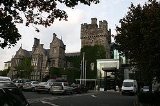
Clontarf Castle

Encyclopedia
Clontarf Castle is a much-modernised castle
, dating to 1837, in Clontarf
, Dublin, Ireland
, an area famous as a key location of the Battle of Clontarf
in 1014. There has been a castle on the site since 1172. In modern times, it has functioned as a bar, cabaret venue, and hotel.
and, after their suppression in 1308, passed to the Knights Hospitaller
, until they were in turn deprived of it at the Dissolution of the Monasteries
. The last prior, Sir John Rawson, was created Viscount Clontarf in 1541 in return for surrendering the castle and its lands to the crown.
granted the estate to Sir Geoffrey Fenton
, her secretary of state for Ireland, and it passed by marriage from his descendants to the King family. George King of Clontarf took part in the Irish Rebellion of 1641
and as a result his lands were confiscated.
, the Clontarf estate was given to Captain John Blackwell, on August 14, 1649. Blackwell afterwards sold his interest to John Vernon
, Quartermaster General of Cromwell’s army. The Vernon family was to remain in possession for some 300 years.
In 1660, John Vernon, passed Clontarf Castle to his son, Edward Vernon. Edward died in 1684 and one of his sisters took possession. In 1695 a first cousin of Edward's, also named John Vernon, claimed rights and the estate was granted to him by an Act of Parliament in 1698.
The last of the direct male line of Vernons at Clontarf was Edward Kingston Vernon (1869–1967), who succeeded to the estate on the death of his father Edward in 1913. He lived at the castle for only six months, after which time it was let to John George Oulton and his wife Mona, the only daughter of Walter Blades Calverley by Vernon's sister Edyth. The castle was finally sold to the Oultons in 1933.
JG Oulton, who took over the Vernon estate, died in the castle on April 17, 1952, and the Castle was left to his son, Desmond, who sold the property to pay death duties and other expenses.
As the Clontarf Castle Hotel, it has been significantly enlarged by the addition of modern wings.
Most of the former estate lands are long since sold for housing, but there remains a modest curtilage, with an ornamental gatehouse; most of this is laid out for car parking.
was a frequent visitor to the then castle during his stay in Dublin for the premiere of Messiah
in 1742. The lady of the house at that time, Dorothy Vernon, was from Hanover
and "particularly intimate" with the composer, who wrote a piece called Forest Music for her, said to combine German and Irish melodies. The neighbouring area of Dollymount
is traditionally said to be named after this lady.
Clontarf Castle was painted by J. M. W. Turner
, although he never visited (it is said to be his only Irish subject); his patron Walter Fawkes
was married to Maria Sophia Vernon of Clontarf and one of her sketches is believed to have been the basis of the finished watercolour. The work was mislabelled 'Caltarf Castle' and the subject was only positively identified in 1998 - it depicts the castle building previous to the present structure.
Some childhood memories of the castle in the early years of the 20th century appear in Enemies of Promise
by the writer Cyril Connolly
, whose mother was one of the Vernon family.
The castle is referred to by Irish rock group Thin Lizzy
in the song "The Friendly Ranger at Clontarf Castle", the opening track on their 1971 debut album Thin Lizzy
.
Before reopening as a hotel in 1997 the castle was for many years a popular cabaret venue; comedians Tom O'Connor and Maureen Potter
and accordionist Dermot O'Brien have each released live recordings made there. Dana
was crowned Queen of Cabaret there in 1968, prior to winning the 1970 Eurovision Song Contest. The 1997 building works included the construction of a new conference and banqueting centre which hosts conferences and product launches, a regular antiques fair, and is a popular wedding venue.
Castle
A castle is a type of fortified structure built in Europe and the Middle East during the Middle Ages by European nobility. Scholars debate the scope of the word castle, but usually consider it to be the private fortified residence of a lord or noble...
, dating to 1837, in Clontarf
Clontarf, Dublin
Clontarf is a coastal suburb on the northside of Dublin, in Ireland. It is most famous for giving the name to the Battle of Clontarf in 1014, in which Brian Boru, High King of Ireland, defeated the Vikings of Dublin and their allies, the Irish of Leinster. This battle, which extended to districts...
, Dublin, Ireland
Republic of Ireland
Ireland , described as the Republic of Ireland , is a sovereign state in Europe occupying approximately five-sixths of the island of the same name. Its capital is Dublin. Ireland, which had a population of 4.58 million in 2011, is a constitutional republic governed as a parliamentary democracy,...
, an area famous as a key location of the Battle of Clontarf
Battle of Clontarf
The Battle of Clontarf took place on 23 April 1014 between the forces of Brian Boru and the forces led by the King of Leinster, Máel Mórda mac Murchada: composed mainly of his own men, Viking mercenaries from Dublin and the Orkney Islands led by his cousin Sigtrygg, as well as the one rebellious...
in 1014. There has been a castle on the site since 1172. In modern times, it has functioned as a bar, cabaret venue, and hotel.
The deLacy family and the Templars
The first castle on the grounds, of which no trace remains, was built in 1172 by either Hugh de Lacy, lord of Meath, or his tenant Adam de Phepoe. Clontarf was subsequently held by the Knights TemplarKnights Templar
The Poor Fellow-Soldiers of Christ and of the Temple of Solomon , commonly known as the Knights Templar, the Order of the Temple or simply as Templars, were among the most famous of the Western Christian military orders...
and, after their suppression in 1308, passed to the Knights Hospitaller
Knights Hospitaller
The Sovereign Military Hospitaller Order of Saint John of Jerusalem of Rhodes and of Malta , also known as the Sovereign Military Order of Malta , Order of Malta or Knights of Malta, is a Roman Catholic lay religious order, traditionally of military, chivalrous, noble nature. It is the world's...
, until they were in turn deprived of it at the Dissolution of the Monasteries
Dissolution of the Monasteries
The Dissolution of the Monasteries, sometimes referred to as the Suppression of the Monasteries, was the set of administrative and legal processes between 1536 and 1541 by which Henry VIII disbanded monasteries, priories, convents and friaries in England, Wales and Ireland; appropriated their...
. The last prior, Sir John Rawson, was created Viscount Clontarf in 1541 in return for surrendering the castle and its lands to the crown.
1500s to 1600s
In 1600 Queen Elizabeth IElizabeth I of England
Elizabeth I was queen regnant of England and Ireland from 17 November 1558 until her death. Sometimes called The Virgin Queen, Gloriana, or Good Queen Bess, Elizabeth was the fifth and last monarch of the Tudor dynasty...
granted the estate to Sir Geoffrey Fenton
Geoffrey Fenton
Sir Geoffrey Fenton was an English writer, Privy Councillor, and Principal Secretary of State in Ireland.-Early literary years:...
, her secretary of state for Ireland, and it passed by marriage from his descendants to the King family. George King of Clontarf took part in the Irish Rebellion of 1641
Irish Rebellion of 1641
The Irish Rebellion of 1641 began as an attempted coup d'état by Irish Catholic gentry, who tried to seize control of the English administration in Ireland to force concessions for the Catholics living under English rule...
and as a result his lands were confiscated.
The Vernon family
At the Cromwellian conquest of IrelandCromwellian conquest of Ireland
The Cromwellian conquest of Ireland refers to the conquest of Ireland by the forces of the English Parliament, led by Oliver Cromwell during the Wars of the Three Kingdoms. Cromwell landed in Ireland with his New Model Army on behalf of England's Rump Parliament in 1649...
, the Clontarf estate was given to Captain John Blackwell, on August 14, 1649. Blackwell afterwards sold his interest to John Vernon
John Vernon (of Clontarf)
John Vernon was Quartermaster-General of Oliver Cromwell’s army and third son of Sir Edward Vernon, of Houndshill, Staffordshire, England. John obtained title to Clontarf Castle near Dublin in 1649 through a financial arrangement with John Blackwall who had been granted the estate by Oliver Cromwell...
, Quartermaster General of Cromwell’s army. The Vernon family was to remain in possession for some 300 years.
In 1660, John Vernon, passed Clontarf Castle to his son, Edward Vernon. Edward died in 1684 and one of his sisters took possession. In 1695 a first cousin of Edward's, also named John Vernon, claimed rights and the estate was granted to him by an Act of Parliament in 1698.
The last of the direct male line of Vernons at Clontarf was Edward Kingston Vernon (1869–1967), who succeeded to the estate on the death of his father Edward in 1913. He lived at the castle for only six months, after which time it was let to John George Oulton and his wife Mona, the only daughter of Walter Blades Calverley by Vernon's sister Edyth. The castle was finally sold to the Oultons in 1933.
JG Oulton, who took over the Vernon estate, died in the castle on April 17, 1952, and the Castle was left to his son, Desmond, who sold the property to pay death duties and other expenses.
1957 to 1997
The Castle remained vacant until 1957 when it was purchased by Mrs. Egan, who in turn sold it not long after to Eddie Regan in the 1960s. Gerry and Carmel Houlihan purchased the building in 1972 and ran it as a popular cabaret venue until 1998.Conversion to hotel
The Castle re-opened to the public as a four star 111 guest room hotel in June 1997.Current structure
The current building dates to 1837 and was designed by the Irish architect William Vitruvius Morrison for John Edward Venables Vernon, the then owner, when the previous building was found to be unsafe.As the Clontarf Castle Hotel, it has been significantly enlarged by the addition of modern wings.
Most of the former estate lands are long since sold for housing, but there remains a modest curtilage, with an ornamental gatehouse; most of this is laid out for car parking.
Art, music and literature
HandelGeorge Frideric Handel
George Frideric Handel was a German-British Baroque composer, famous for his operas, oratorios, anthems and organ concertos. Handel was born in 1685, in a family indifferent to music...
was a frequent visitor to the then castle during his stay in Dublin for the premiere of Messiah
Messiah (Handel)
Messiah is an English-language oratorio composed in 1741 by George Frideric Handel, with a scriptural text compiled by Charles Jennens from the King James Bible and the Book of Common Prayer. It was first performed in Dublin on 13 April 1742, and received its London premiere nearly a year later...
in 1742. The lady of the house at that time, Dorothy Vernon, was from Hanover
Hanover
Hanover or Hannover, on the river Leine, is the capital of the federal state of Lower Saxony , Germany and was once by personal union the family seat of the Hanoverian Kings of Great Britain, under their title as the dukes of Brunswick-Lüneburg...
and "particularly intimate" with the composer, who wrote a piece called Forest Music for her, said to combine German and Irish melodies. The neighbouring area of Dollymount
Dollymount
Dollymount is a coastal suburban area on the north coast of Dublin Bay, within Clontarf, on the northside of Dublin, Ireland, just East of St Anne's Park.-Dollymount Strand:...
is traditionally said to be named after this lady.
Clontarf Castle was painted by J. M. W. Turner
J. M. W. Turner
Joseph Mallord William Turner RA was an English Romantic landscape painter, watercolourist and printmaker. Turner was considered a controversial figure in his day, but is now regarded as the artist who elevated landscape painting to an eminence rivalling history painting...
, although he never visited (it is said to be his only Irish subject); his patron Walter Fawkes
Walter Fawkes
Walter Ramsden Hawkesworth Fawkes was a Yorkshire landowner, writer and Member of Parliament for Yorkshire from 1806 to 1807.-Biography:...
was married to Maria Sophia Vernon of Clontarf and one of her sketches is believed to have been the basis of the finished watercolour. The work was mislabelled 'Caltarf Castle' and the subject was only positively identified in 1998 - it depicts the castle building previous to the present structure.
Some childhood memories of the castle in the early years of the 20th century appear in Enemies of Promise
Enemies of Promise
Enemies of Promise is a critical and autobiographical work written by Cyril Connolly and first published in 1938.It comprises three parts, the first dedicated to Connolly's observations about literature and the literary world of his time, the second a listing of adverse elements that affect the...
by the writer Cyril Connolly
Cyril Connolly
Cyril Vernon Connolly was an English intellectual, literary critic and writer. He was the editor of the influential literary magazine Horizon and wrote Enemies of Promise , which combined literary criticism with an autobiographical exploration of why he failed to become the successful author of...
, whose mother was one of the Vernon family.
The castle is referred to by Irish rock group Thin Lizzy
Thin Lizzy
Thin Lizzy are an Irish hard rock band formed in Dublin in 1969. Two of the founding members, drummer Brian Downey and bass guitarist/vocalist Phil Lynott met while still in school. Lynott assumed the role of frontman and led them throughout their recording career of thirteen studio albums...
in the song "The Friendly Ranger at Clontarf Castle", the opening track on their 1971 debut album Thin Lizzy
Thin Lizzy (album)
Thin Lizzy is the first studio album by Irish hard rock band Thin Lizzy, released in 1971.-Track listing:Side one# "The Friendly Ranger at Clontarf Castle" – 3:01# "Honesty Is No Excuse" – 3:40...
.
Before reopening as a hotel in 1997 the castle was for many years a popular cabaret venue; comedians Tom O'Connor and Maureen Potter
Maureen Potter
Maria Philomena Potter , known as Maureen Potter, was an acclaimed Irish singer, actor, comedian and performer.-Life:...
and accordionist Dermot O'Brien have each released live recordings made there. Dana
Dana Rosemary Scallon
Dana Rosemary Scallon , known in her singing career simply as Dana, is an Irish singer and former Member of the European Parliament ....
was crowned Queen of Cabaret there in 1968, prior to winning the 1970 Eurovision Song Contest. The 1997 building works included the construction of a new conference and banqueting centre which hosts conferences and product launches, a regular antiques fair, and is a popular wedding venue.
See also
- List of abbeys and priories in Ireland (County Dublin)
- Forbes George VernonForbes George VernonForbes George Vernon , Lieutenant British Army, was a Member of the Legislative Assembly of the Canadian province of British Columbia from 1875 to 1882, and from 1886 to 1894, representing the riding of Yale...
- John Vernon (of Clontarf)John Vernon (of Clontarf)John Vernon was Quartermaster-General of Oliver Cromwell’s army and third son of Sir Edward Vernon, of Houndshill, Staffordshire, England. John obtained title to Clontarf Castle near Dublin in 1649 through a financial arrangement with John Blackwall who had been granted the estate by Oliver Cromwell...
- Clontarf, DublinClontarf, DublinClontarf is a coastal suburb on the northside of Dublin, in Ireland. It is most famous for giving the name to the Battle of Clontarf in 1014, in which Brian Boru, High King of Ireland, defeated the Vikings of Dublin and their allies, the Irish of Leinster. This battle, which extended to districts...
- Parish of Clontarf (Roman Catholic)Parish of Clontarf (Roman Catholic)Founded in the early days of Irish Christian parish structures, the Parish of Clontarf assumed in 1829 the mantle of Union Parish for a large area of north Dublin, a role previously filled by the Parish of Coolock, into which Clontarf had been subsumed in 1614 - refer to that article for history...
- Church of Ireland Parish of ClontarfChurch of Ireland Parish of ClontarfThe Parish of St. John the Baptist, the Church of Ireland Parish of Clontarf, Dublin is a religious community located on the north shore of Dublin Bay, bounded by the Parishes of North Strand to the west, Coolock to the north and Raheny to the east .The Parish Church is situated on , approximately...
Sources
- D'Alton, John. History of the County of Dublin. Dublin, 1838
- McIntyre, Dennis. The Meadow of the Bull: a History of Clontarf. Future Print, Dublin, 1987.
- 'Vernon of Clontarf Castle' in Burke's Landed Gentry of Ireland (1912) pp. 722–3
- A Study of Vernon and Venables Families and Their Connections