
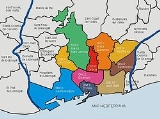
Ciutat Vella is a
district of BarcelonaBarcelona, Catalonia, Spain proper is presently divided into 10 districts. These are administrated by a councillor designated by the main city council, and each of them have some powers relating to issues such as urbanism or infrastructure in their area. The current division of the city into...
, numbered
District 1. The name means "old city" in
CatalanCatalan is a Romance language, the national and only official language of Andorra and a co-official language in the Spanish autonomous communities of Catalonia, the Balearic Islands and Valencian Community, where it is known as Valencian , as well as in the city of Alghero, on the Italian island...
and refers to the oldest neighborhoods in the city of
BarcelonaBarcelona is the second largest city in Spain after Madrid, and the capital of Catalonia, with a population of 1,621,537 within its administrative limits on a land area of...
,
SpainSpain , officially the Kingdom of Spain languages]] under the European Charter for Regional or Minority Languages. In each of these, Spain's official name is as follows:;;;;;;), is a country and member state of the European Union located in southwestern Europe on the Iberian Peninsula...
.
Ciutat Vella is nestled between the
Mediterranean SeaThe Mediterranean Sea is a sea connected to the Atlantic Ocean surrounded by the Mediterranean region and almost completely enclosed by land: on the north by Anatolia and Europe, on the south by North Africa, and on the east by the Levant...
and the neighborhood called
l'EixampleThe Eixample is a district of Barcelona between the old city and what were once surrounding small towns , constructed in the 19th and early 20th centuries....
(the Extension.). It is considered as the centre of the city; the
Plaça Catalunya is one of the most popular
meeting pointA meeting point is a geographically defined place where people meet - both for tourists and citizens. They are often landmarks which gain the reputation and become a popular as a safe and convenient place for people to meet....
s in all of
CataloniaCatalonia is an autonomous community in northeastern Spain, with the official status of a "nationality" of Spain. Catalonia comprises four provinces: Barcelona, Girona, Lleida, and Tarragona. Its capital and largest city is Barcelona. Catalonia covers an area of 32,114 km² and has an...
.
There are four administrative neighborhoods (some of them include former or traditional neighborhoods):
- La Barceloneta
- El Gòtic
- El Raval
El Raval is a neighbourhood in the Ciutat Vella district of Barcelona, Spain. The neighborhood, especially the part closest to the port, was also informally known as Barri xinès, meaning "Chinatown" El Raval is one of the two historical neighborhoods that border the la Rambla...
- Sant Pere, Santa Caterina i la Ribera
Sant Pere, Santa Caterina i la Ribera is a neighborhood in the Ciutat Vella district of Barcelona, Catalonia . It is formed by the former neighborhoods of Sant Pere, Santa Caterina and la Ribera....
:
- Sant Pere
- Santa Caterina
- La Ribera
Les Rambles
Running down the center of the
Ciutat Vella (dividing the
Raval and
Barri Gòtic) are the boulevards
Les Rambles, popularly known as
La RamblaLa Rambla is a street in central Barcelona, popular with both tourists and locals alike. A 1.2 kilometer-long tree-lined pedestrian mall between Barri Gòtic and El Raval, it connects Plaça de Catalunya in the centre with the Christopher Columbus monument at Port Vell.- Overview :La Rambla can be...
(in singular) since they are continuous, like a single street.
Les Rambles stretches from
Plaça Catalunya to the
Mediterranean SeaThe Mediterranean Sea is a sea connected to the Atlantic Ocean surrounded by the Mediterranean region and almost completely enclosed by land: on the north by Anatolia and Europe, on the south by North Africa, and on the east by the Levant...
and, since the 1990s, now extends out over the sea into one of Barcelona's newest centers of entertainment,
Maremagnum. Each of
Les Rambles has its own specialty.
La Rambla de les Flors (The Flowers
Rambla) is devoted to flower stands, another
Rambla to animal vendors (selling mainly birds), and the lowest
Rambla hosts temporary art fairs.
El Mercat de Sant Josep (more commonly known as
La Boqueria) and
Gran Teatre del Liceu (the Opera House) are both located here.
Les Rambles are among the most frequently travelled streets by pedestrians in Barcelona.
At the bottom, there is the
Museu Marítim (naval museum), which chronicles the history of life on the Mediterranean, including a full-scale model of a galley. The museum is housed in the medieval
Drassanes (shipyards), where the ships that made Catalonia a great sea power in the Mediterranean were built.
Raval
This portion of the city is often referred to as
el Barri Xinès, or
China town. It acquired this name not due to there being residents of Chinese origin, but because it was how a Chinese city was imagined to be. Due to its previous reputation as a dangerous area, the local government has invested in the neighborhood, including the creation of a walkway to the sea, the
Rambla del Raval and building development, including the new
Filmoteca de Catalunya. It has become one of the most dynamic areas of the city. Many smaller ethnic restaurants may be found in
Raval and fashionable restaurants and cafés have been opening up. The
Museu d'Art Contemporani de Barcelona (Contemporary Art Museum of Barcelona) are in this neighborhood.
Barri Gòtic
On the other side of
Les Rambles, is
. This neighborhood houses the Cathedral of Barcelona,
la GeneralitatGeneralitat is the name of the autonomous systems of government of two of the present Spanish autonomous communities: Catalonia and the Valencian Community. The term is also used for the government of the semi-autonomous comarca of Val d'Aran, the Generalitat a l'Aran.Generalitat refers to all...
(the Catalan government hall), and
(
BarcelonaBarcelona is the second largest city in Spain after Madrid, and the capital of Catalonia, with a population of 1,621,537 within its administrative limits on a land area of...
city hall). Tourists visit this neighborhood to see
(a Spanish-style plaza) and to shop in one of the tourist shops along
.
(the Picasso Museum) can be found in the area known as
el Born, within the Barri Gotic, in addition to the historic restaurant
Els Quatre GatsEls Quatre Gats , often written Els 4 Gats, was a café in Barcelona which opened on 12 June 1897. It also operated as a hostel, a cabaret, a pub and a restaurant. Active until 1903, Els Quatre Gats became one of the main centers of Modernisme in Barcelona...
(the Four Cats), which was a popular hang-out for artists, including
Pablo PicassoPablo Diego José Francisco de Paula Juan Nepomuceno María de los Remedios Cipriano de la Santísima Trinidad Ruiz y Picasso known as Pablo Ruiz Picasso was a Spanish expatriate painter, sculptor, printmaker, ceramicist, and stage designer, one of the greatest and most influential artists of the...
.
To the north of the Gothic Quarter lie the
which contain modernist buildings housing zoological and geological collections. The adjacent
includes both the
(Catalan Parliament) and the (zoo) whose most famous resident was an albino
gorillaGorillas are the largest extant species of primates. They are ground-dwelling, predominantly herbivorous apes that inhabit the forests of central Africa. Gorillas are divided into two species and either four or five subspecies...
-
Floquet de NeuSnowflake was an albino gorilla. He was the only known albino gorilla so far, and the most popular resident of the Barcelona Zoo in Catalonia.-Name:...
("Snowflake") - who died in 2003 of
skin cancerSkin neoplasms are skin growths with differing causes and varying degrees of malignancy. The three most common malignant skin cancers are basal cell cancer, squamous cell cancer, and melanoma, each of which is named after the type of skin cell from which it arises...
.
External links