

Chromatic fourth

Encyclopedia
In music
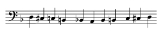
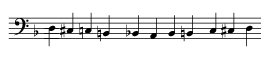
, a chromatic fourth, or passus duriusculus, is a melody
or melodic fragment spanning a perfect fourth
with all or almost all chromatic interval
s filled in (chromatic line). The quintessential example is in D minor
with the tonic and dominant notes as boundaries, :
The chromatic fourth was first used in the madrigal
s of the 16th Century. The Latin term itself ("suffered somewhat hard") originates in Christoph Bernhard
's 17th century Tractatus compositionis augmentatus (1648-49), where it appears to refer to repeated melodic motion by semitone creating consecutive semitones. The term may also relate to the pianto
associated with weeping. In the Baroque, Johann Sebastian Bach
used it in his choral as well as his instrumental music, in the Well-Tempered Clavier, for example (the chromatic fourth is indicated by a red bracket), :

In operas of the Baroque and Classical, the chromatic fourth was often used in the bass and for woeful arias, often being called a "lament bass
". In the penultimate pages of the first movement of Beethoven's Ninth Symphony
, the repetitions of the chromatic fourth in the cellos and basses stir up a sense of inevitable tragedy.
This doesn't mean that the chromatic fourth was always used in a sorrowful or foreboding way, or that the boundaries should always be the tonic and dominant notes. One counterexample comes from the Minuet of Wolfgang Amadeus Mozart
's String Quartet in G major
, K. 387 (the chromatic fourths are conveniently bracketed by the slurs and set apart with note-to-note dynamics changes), :

Music
Music is an art form whose medium is sound and silence. Its common elements are pitch , rhythm , dynamics, and the sonic qualities of timbre and texture...
, a chromatic fourth, or passus duriusculus, is a melody
Melody
A melody , also tune, voice, or line, is a linear succession of musical tones which is perceived as a single entity...
or melodic fragment spanning a perfect fourth
Perfect fourth
In classical music from Western culture, a fourth is a musical interval encompassing four staff positions , and the perfect fourth is a fourth spanning five semitones. For example, the ascending interval from C to the next F is a perfect fourth, as the note F lies five semitones above C, and there...
with all or almost all chromatic interval
Interval (music)
In music theory, an interval is a combination of two notes, or the ratio between their frequencies. Two-note combinations are also called dyads...
s filled in (chromatic line). The quintessential example is in D minor
D minor
D minor is a minor scale based on D, consisting of the pitches D, E, F, G, A, B, and C. In the harmonic minor, the C is raised to C. Its key signature has one flat ....
with the tonic and dominant notes as boundaries, :
The chromatic fourth was first used in the madrigal
Madrigal (music)
A madrigal is a secular vocal music composition, usually a partsong, of the Renaissance and early Baroque eras. Traditionally, polyphonic madrigals are unaccompanied; the number of voices varies from two to eight, and most frequently from three to six....
s of the 16th Century. The Latin term itself ("suffered somewhat hard") originates in Christoph Bernhard
Christoph Bernhard
Christoph Bernhard was born in Kolberg, Pomerania, and died in Dresden. He studied with former Sweelinck-pupil Paul Siefert in Danzig and in Warsaw By the age of 20 he was singing at the electoral court in Dresden under Heinrich Schütz...
's 17th century Tractatus compositionis augmentatus (1648-49), where it appears to refer to repeated melodic motion by semitone creating consecutive semitones. The term may also relate to the pianto
Pianto
In music, the pianto is the motif of a descending minor second, has represented laments and been associated textually with weeping, sighing ; or pain, grief, etc.; since the 16th century. For example the passus duriusculus. "It was present equally in vocal and instrumental music."...
associated with weeping. In the Baroque, Johann Sebastian Bach
Johann Sebastian Bach
Johann Sebastian Bach was a German composer, organist, harpsichordist, violist, and violinist whose sacred and secular works for choir, orchestra, and solo instruments drew together the strands of the Baroque period and brought it to its ultimate maturity...
used it in his choral as well as his instrumental music, in the Well-Tempered Clavier, for example (the chromatic fourth is indicated by a red bracket), :
In operas of the Baroque and Classical, the chromatic fourth was often used in the bass and for woeful arias, often being called a "lament bass
Lament bass
In music, the lament bass is a ground bass, built from a descending perfect fourth from tonic to dominant, with each step harmonized. The diatonic version is the upper tetrachord from the natural minor scale, known as the Phrygian tetrachord, while the chromatic version, the chromatic fourth, has...
". In the penultimate pages of the first movement of Beethoven's Ninth Symphony
Symphony No. 9 (Beethoven)
The Symphony No. 9 in D minor, Op. 125, is the final complete symphony of Ludwig van Beethoven. Completed in 1824, the symphony is one of the best known works of the Western classical repertoire, and has been adapted for use as the European Anthem...
, the repetitions of the chromatic fourth in the cellos and basses stir up a sense of inevitable tragedy.
This doesn't mean that the chromatic fourth was always used in a sorrowful or foreboding way, or that the boundaries should always be the tonic and dominant notes. One counterexample comes from the Minuet of Wolfgang Amadeus Mozart
Wolfgang Amadeus Mozart
Wolfgang Amadeus Mozart , baptismal name Johannes Chrysostomus Wolfgangus Theophilus Mozart , was a prolific and influential composer of the Classical era. He composed over 600 works, many acknowledged as pinnacles of symphonic, concertante, chamber, piano, operatic, and choral music...
's String Quartet in G major
String Quartet No. 14 (Mozart)
The String Quartet No. 14 in G major, K. 387, nicknamed the "Spring" quartet, was composed by Wolfgang Amadeus Mozart in 1782 while in Vienna. In the composer's inscription on the title page of the autograph score is stated: "li 31 di decembre 1782 in vienna". The work was perhaps edited in 1783...
, K. 387 (the chromatic fourths are conveniently bracketed by the slurs and set apart with note-to-note dynamics changes), :