

Chine

Encyclopedia
Old English language
Old English or Anglo-Saxon is an early form of the English language that was spoken and written by the Anglo-Saxons and their descendants in parts of what are now England and southeastern Scotland between at least the mid-5th century and the mid-12th century...
"Cinan" meaning a gap or yawn.
The word is in use in central Southern England
Southern England
Southern England, the South and the South of England are imprecise terms used to refer to the southern counties of England bordering the English Midlands. It has a number of different interpretations of its geographic extents. The South is considered by many to be a cultural region with a distinct...
; in East Devon
East Devon
East Devon is a local government district in Devon, England. Its council is based in Sidmouth, and the largest town is Exmouth.The district was formed on 1 April 1974 by the merger of the borough of Honiton with the urban districts of Budleigh Salterton, Exmouth, Ottery St. Mary, Seaton, Sidmouth...
, Dorset
Dorset
Dorset , is a county in South West England on the English Channel coast. The county town is Dorchester which is situated in the south. The Hampshire towns of Bournemouth and Christchurch joined the county with the reorganisation of local government in 1974...
, Hampshire
Hampshire
Hampshire is a county on the southern coast of England in the United Kingdom. The county town of Hampshire is Winchester, a historic cathedral city that was once the capital of England. Hampshire is notable for housing the original birthplaces of the Royal Navy, British Army, and Royal Air Force...
, and particularly the Isle of Wight
Isle of Wight
The Isle of Wight is a county and the largest island of England, located in the English Channel, on average about 2–4 miles off the south coast of the county of Hampshire, separated from the mainland by a strait called the Solent...
. In Devon
Devon
Devon is a large county in southwestern England. The county is sometimes referred to as Devonshire, although the term is rarely used inside the county itself as the county has never been officially "shired", it often indicates a traditional or historical context.The county shares borders with...
, Sherbrooke Chine is west of Budleigh Salterton
Budleigh Salterton
Budleigh Salterton is a small town on the south coast of Devon, England 15 miles south of Exeter. It is situated within an Area of Outstanding Natural Beauty designated East Devon AONB.- Features :...
, and Seaton Chine is at the western end of the West Walk esplanade, Seaton
Seaton, Devon
Seaton is a seaside town in East Devon on the south coast of England. It faces onto Lyme Bay, to the west of the mouth of the River Axe with red cliffs to one side and white cliffs on the other. Axmouth and Beer are nearby...
. In Dorset, west of Bournemouth
Bournemouth
Bournemouth is a large coastal resort town in the ceremonial county of Dorset, England. According to the 2001 Census the town has a population of 163,444, making it the largest settlement in Dorset. It is also the largest settlement between Southampton and Plymouth...
are found Flaghead Chine, Branksome Chine, Alum Chine, Middle Chine and Durley Chine, and east towards Boscombe
Boscombe
Boscombe is a suburb of Bournemouth. Located to the east of Bournemouth town centre and west of Southbourne, It developed rapidly from a small village as a seaside resort alongside Bournemouth after the first Boscombe pier was built in 1888...
, Honeycombe Chine. Becton Bunny and Chewton Bunny are other examples of chines near Barton on Sea
Barton on Sea
Barton on Sea is a coastal village situated in Hampshire, England. As a settlement, Barton has a history dating back to Anglo-Saxon times, although the modern village was largely built in the 20th century. It is effectively a suburb of New Milton...
, Hampshire ("Bunny" being the New Forest
New Forest
The New Forest is an area of southern England which includes the largest remaining tracts of unenclosed pasture land, heathland and forest in the heavily-populated south east of England. It covers south-west Hampshire and extends into south-east Wiltshire....
term equivalent to "Chine").
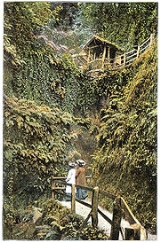
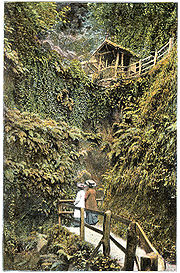
There are twenty chines on the Isle of Wight including the popular tourist attraction Shanklin Chine
Shanklin Chine
Shanklin Chine is a geological feature and tourist attraction in the town of Shanklin, on the Isle of Wight, England. A wooded coastal ravine, it contains waterfalls, trees and lush vegetation, with footpaths and walkways allowing paid access for visitors, and a heritage centre explaining its...
. All chines are in a state of constant change due to erosion, and the best-known example, Blackgang Chine
Blackgang Chine
Blackgang Chine is the location of a now-destroyed chine in the soft Cretaceous cliffs about 6 miles from Ventnor at the southern tip of the Isle of Wight just below St Catherine's Down. Since 1843 it has been home to the Blackgang Chine amusement park, run by the Dabell family who also run the...
, has been destroyed by landslides and coastal erosion during the 20th century.
Chines appear at the outlet of small river valleys when a particular combination of geology, stream volume and coastal recession rate creates a knickpoint
Knickpoint
A knickpoint is a term in geomorphology to describe a location in a river or channel where there is a sharp change in channel slope, such as a waterfall or lake, resulting from differential rates of erosion above and below the knickpoint. Differential rates of erosion can result from a change in...
, usually starting at a waterfall at the cliff edge, that initiates rapid erosion and deepening of the stream bed into a gully leading down to the sea.
As the walls of the chines and cliffs of the south coast of the Isle of Wight are so unstable and erode continually, the strata are clearly visible. Chines are therefore very important for their fossil records, their archaeology and the unique flora and fauna, such as invertebrates and rare insects, for which they provide shelter.
There is also some fascinating folklore attached to the chines because of their history with local smuggling, fishing and shipwrecks. Shanklin Chine is also famous for its involvement in the Second World War, when it was used to carry one of the Operation Pluto
Operation Pluto
Operation Pluto was a World War II operation by British scientists, oil companies and armed forces to construct undersea oil pipelines under the English Channel between England and France. The scheme was developed by Arthur Hartley, chief engineer with the Anglo-Iranian Oil Company...
pipelines and as training area for the 40 Royal Marine Commando
40 Commando
40 Commando RM is a battalion sized formation of the British Royal Marines and subordinate unit within 3 Commando Brigade, the principal Commando formation, under the Operational Command of Commander in Chief Fleet....
battalion before the 1942 Dieppe Raid
Dieppe Raid
The Dieppe Raid, also known as the Battle of Dieppe, Operation Rutter or later on Operation Jubilee, during the Second World War, was an Allied attack on the German-occupied port of Dieppe on the northern coast of France on 19 August 1942. The assault began at 5:00 AM and by 10:50 AM the Allied...
.
Chines are very dependent on the farmed landscape around them because crops are typically grown right up to the edges of the chines themselves, and water drains into the chines from this farmland.
Chines on the Isle of Wight
Of the twenty named chines on the island, that in Alum BayAlum Bay
Alum Bay is a bay near the westernmost point of the Isle of Wight, England, within sight of the Needles. Of geological interest and a tourist attraction, the bay is noted for its multi-coloured sand cliffs.-Geology:...
, Widdick Chine
Widdick Chine
Widdick Chine is a geological feature on the west coast of the Isle of Wight, England. It is west of the village of Totland.It is a steep coastal gully, which is overgrown with vegetation. The water that used to flow down the slope has been redirected through a pipe which takes it to beach level to...
in Totland
Totland
Totland is a village and civil parish at the western tip of the Isle of Wight. It lies on the coast at Colwell Bay, which is the closest part of the island to the British mainland...
and those in Colwell Bay
Colwell Bay
Colwell Bay is a bay in the west of the Isle of Wight. It is located between the towns of Totland and Yarmouth. The bay's northernmost point is Cliff's End the closest point of the Island to the British mainland, with Hurst Castle lying at the end of a long peninsula just 1500 metres to the...
(Colwell Chine, Brambles Chine and Linstone Chine) are in Tertiary
Tertiary
The Tertiary is a deprecated term for a geologic period 65 million to 2.6 million years ago. The Tertiary covered the time span between the superseded Secondary period and the Quaternary...
rocks; the remainder, on the island's south coast, are in Cretaceous
Cretaceous
The Cretaceous , derived from the Latin "creta" , usually abbreviated K for its German translation Kreide , is a geologic period and system from circa to million years ago. In the geologic timescale, the Cretaceous follows the Jurassic period and is followed by the Paleogene period of the...
. Clockwise from Cowes:
- Shanklin ChineShanklin ChineShanklin Chine is a geological feature and tourist attraction in the town of Shanklin, on the Isle of Wight, England. A wooded coastal ravine, it contains waterfalls, trees and lush vegetation, with footpaths and walkways allowing paid access for visitors, and a heritage centre explaining its...
- Luccombe ChineLuccombe ChineLuccombe Chine is a geological feature and visitor attraction south of the village of Luccombe on the Isle of Wight, England. A wooded coastal ravine, one of a number of such chines on the island created by stream erosion of soft Cretaceous rocks, it leads from the clifftop to Luccombe Bay.The...
- Blackgang ChineBlackgang ChineBlackgang Chine is the location of a now-destroyed chine in the soft Cretaceous cliffs about 6 miles from Ventnor at the southern tip of the Isle of Wight just below St Catherine's Down. Since 1843 it has been home to the Blackgang Chine amusement park, run by the Dabell family who also run the...
- New ChineNew ChineNew Chine is a geological feature on the south west coast of the Isle of Wight, England . It is west of the village of Chale. It is a sandy coastal ravine, one of a number of such chines on the island created by stream erosion of soft Cretaceous rocks...
- Walpen ChineWalpen ChineWalpen Chine is a geological feature on the south west coast of the Isle of Wight, England. It is west of the village of Chale. It is a sandy coastal ravine, one of a number of such chines on the island created by stream erosion of soft Cretaceous rocks...
or Old Walpen Chine - Ladder ChineLadder ChineLadder Chine is a geological feature on the south west coast of the Isle of Wight, England . It is west of the village of Chale. It is a sandy coastal ravine, one of a number of such chines on the island created by stream erosion of soft Cretaceous rocks...
- Whale ChineWhale ChineWhale Chine is a geological feature near Chale on the south-west coast of the Isle of Wight, England . One of a number of such chines on the island created by stream erosion of soft Cretaceous rocks, it is a narrow and steep coastal ravine dropping 140 feet through Lower Greensand rocks from...
- Shepherd's ChineShepherd's ChineShepherd's Chine is a geological feature on the south west coast of the Isle of Wight, England. It lies to the west of the village of Little Atherfield.This chine is one of the largest on the Isle of Wight...
- Cowleaze ChineCowleaze ChineCowleaze Chine is a geological feature on the south west coast of the Isle of Wight, England. It lies to the west of the village of Little Atherfield.This chine is just to the west of the larger Shepherd's Chine...
- Barnes ChineBarnes ChineBarnes Chine is a geological feature on the south west coast of the Isle of Wight, England. The chine lies just to the west of a small rise called Barnes High and south west of the hamlet of Yafford...
- Grange/Marsh ChineGrange/Marsh ChineGrange Chine and Marsh Chine form a geological feature on the south west coast of the Isle of Wight, England. They lie to the south of the village of Brighstone.These two chines form the largest chine feature on the Isle of Wight...
- Chilton ChineChilton ChineChilton Chine is a geological feature on the south west coast of the Isle of Wight, England. It lies to the west of the village of Brighstone...
- Brook ChineBrook ChineBrook Chine is a geological feature on the south west coast of the Isle of Wight, England. It lies just to the west of the village of Brook. The hamlet of Brookgreen runs along its southern edge....
- Churchill ChineChurchill ChineChurchill Chine is a geological feature on the south west coast of the Isle of Wight, England. It is west of the village of Brook and just east of Hanover Point. It is a small sandy coastal gully, one of a number of such chines on the island created by stream erosion of soft Cretaceous rocks...
- Shippards ChineShippards ChineShippards Chine is a geological feature on the south west coast of the Isle of Wight, England. It is west of the village of Brook and just north of Hanover Point....
- Compton ChineCompton ChineCompton Chine is a geological feature on the south west coast of the Isle of Wight, England. It lies between the village of Brook to the east and Freshwater Bay to the west. It is a small sandy coastal gully, one of a number of such chines on the island created by stream erosion of soft Cretaceous...
- Alum Bay Chine
- Widdick ChineWiddick ChineWiddick Chine is a geological feature on the west coast of the Isle of Wight, England. It is west of the village of Totland.It is a steep coastal gully, which is overgrown with vegetation. The water that used to flow down the slope has been redirected through a pipe which takes it to beach level to...
- Colwell Chine
- Brambles Chine
- Linstone Chine