

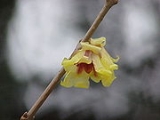
Chimonanthus

Encyclopedia
Chimonanthus is a genus of flowering plant
s in the family Calycanthaceae
, endemic
to China
. It is also grown in Iran, called "Ice Flower" and probably imported from China. The genus includes three to six species depending on taxonomic interpretation; three are accepted by the Draft Flora of China
. The name means winter flower in Greek.
or evergreen
shrub
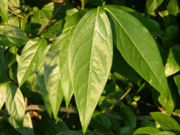
s growing to 2–13 m tall. The leaves
are opposite, entire, 7–20 cm long and 3–7 cm broad. The flower
s are 2–3 cm wide, with numerous spirally-arranged yellow or white tepal
s; they are strongly scented, and produced in late winter or early spring before the new leaves. The fruit
is an elliptic dry capsule
3–4 cm long.
Source: MBG
 Chimonanthus praecox, "wintersweet", is the only species widely grown as an ornamental plant
, for its spicily scented winter flowers; these are also used in floristry as cut flowering branches, which can also be forced as with forsythia. The plant prefers medium exposure to sunlight or high dappled shade, a fresh climate (hardy to USDA Zone 7), and soft, acid
ic permeable ground not waterlogged in winter. A protected, south-facing wall encourages early flowering, and a position should be chosen where its spicy perfume can be appreciated while coming and going from the house. Space needs to be allowed for its eventual spread to 3 m (10 ft), since untimely summer pruning to keep an ill-sited shrub in check will sacrifice flowering the following winter.
In China Chimonanthus was domesticated during the Song Dynasty
and inspired courtly poems from the eleventh century; it flowers at the Chinese New Year
, when flowering sprigs are used as hair ornaments. In China, prunings are dried and kept to perfume linen cupboards. The shrub was introduced to Japanese gardens from China in the early Edo period
(probably between 1611 and 1629, according to Garden Plants of Japan). Its introduction into European gardens, from Japan, is noted for England, 1766, when it was grown under glass for the sixth Earl of Coventry
in the conservatory at Croome Court, Worcestershire. By 1799 that shrub had grown to be 16 feet high and 10 feet wide. By that time it had been tried out of doors without winter protection and proved hardy in the south of England. Slips of it were distributed among nurserymen and so it entered European horticulture. A larger-flowered (though less fragant) variety, "grandiflorus" was grown by the comtesse de Vandes in Bayswater, London, before 1819. A yellow-flowered variety (luteus, 1814) and a large-flowered variety (grandiflorus, 1812) are also noted.
No notice has yet been found of Chimonanthus in an American colonial garden; it was first offered in an American catalogue in 1811. It is hardy at least to New York, where frosts interrupt, but do not stop the flowering.
At the end of its flowering, since it flowers most freely on ripened young wood and has little summer and autumn interest, it is thinned and pruned similarly to Forsythia
by partly heading back and a few thick old stems removed at the ground.
Chimonanthus plants are frequently subject to attacks from aphids, and may be attacked by mites
and leaf beetle
s.
Flowering plant
The flowering plants , also known as Angiospermae or Magnoliophyta, are the most diverse group of land plants. Angiosperms are seed-producing plants like the gymnosperms and can be distinguished from the gymnosperms by a series of synapomorphies...
s in the family Calycanthaceae
Calycanthaceae
The Calycanthaceae is a small family of flowering plants included in the order Laurales. The family contains four genera and only 6-11 species, restricted to warm temperate and tropical regions:...
, endemic
Endemic (ecology)
Endemism is the ecological state of being unique to a defined geographic location, such as an island, nation or other defined zone, or habitat type; organisms that are indigenous to a place are not endemic to it if they are also found elsewhere. For example, all species of lemur are endemic to the...
to China
China
Chinese civilization may refer to:* China for more general discussion of the country.* Chinese culture* Greater China, the transnational community of ethnic Chinese.* History of China* Sinosphere, the area historically affected by Chinese culture...
. It is also grown in Iran, called "Ice Flower" and probably imported from China. The genus includes three to six species depending on taxonomic interpretation; three are accepted by the Draft Flora of China
Flora of China (journal)
Flora of China is a scientific publication aimed at describing the plants native to China.The is a collaborative scientific effort to publish the first modern English-language account of the approximately 31,000 species of vascular plants of China...
. The name means winter flower in Greek.
Description
They are deciduousDeciduous
Deciduous means "falling off at maturity" or "tending to fall off", and is typically used in reference to trees or shrubs that lose their leaves seasonally, and to the shedding of other plant structures such as petals after flowering or fruit when ripe...
or evergreen
Evergreen
In botany, an evergreen plant is a plant that has leaves in all seasons. This contrasts with deciduous plants, which completely lose their foliage during the winter or dry season.There are many different kinds of evergreen plants, both trees and shrubs...
shrub
Shrub
A shrub or bush is distinguished from a tree by its multiple stems and shorter height, usually under 5–6 m tall. A large number of plants may become either shrubs or trees, depending on the growing conditions they experience...
s growing to 2–13 m tall. The leaves
Leaf
A leaf is an organ of a vascular plant, as defined in botanical terms, and in particular in plant morphology. Foliage is a mass noun that refers to leaves as a feature of plants....
are opposite, entire, 7–20 cm long and 3–7 cm broad. The flower
Flower
A flower, sometimes known as a bloom or blossom, is the reproductive structure found in flowering plants . The biological function of a flower is to effect reproduction, usually by providing a mechanism for the union of sperm with eggs...
s are 2–3 cm wide, with numerous spirally-arranged yellow or white tepal
Tepal
Tepals are elements of the perianth, or outer part of a flower, which include the petals or sepals. The term tepal is more often applied specifically when all segments of the perianth are of similar shape and color, or undifferentiated, which is called perigone...
s; they are strongly scented, and produced in late winter or early spring before the new leaves. The fruit
Fruit
In broad terms, a fruit is a structure of a plant that contains its seeds.The term has different meanings dependent on context. In non-technical usage, such as food preparation, fruit normally means the fleshy seed-associated structures of certain plants that are sweet and edible in the raw state,...
is an elliptic dry capsule
Capsule (fruit)
In botany a capsule is a type of simple, dry fruit produced by many species of flowering plants. A capsule is a structure composed of two or more carpels that in most cases is dehiscent, i.e. at maturity, it splits apart to release the seeds within. A few capsules are indehiscent, for example...
3–4 cm long.
Species
- Chimonanthus caespitosus T.B. Chao
- Chimonanthus campanulatus R.H. Chang & C.S. Ding
- Chimonanthus grammatus M.C. Liu
- Chimonanthus nitensChimonanthus nitensChimonanthus nitens is a species of the genus of wintersweets Chimonanthus and member of the family Calycanthaceae Chimonanthus nitens is a species of the genus of wintersweets Chimonanthus and member of the family Calycanthaceae Chimonanthus nitens is a species of the genus of wintersweets...
Oliv.- Chimonanthus campanulatus R.H. Chang & C.S. Ding
- Chimonanthus zhejiangensis M.C. Liu
- Chimonanthus praecoxChimonanthus praecoxChimonanthus praecox also known as Japanese allspice is a species of the wintersweet genus Chimonanthus and a member of the family Calycanthaceae.-Description:...
(L.) Link- Chimonanthus fragrans Lindl.
- Chimonanthus parviflorus Raf.
- Chimonanthus yunnanensis W.W. Sm.
- Chimonanthus salicifoliusChimonanthus salicifoliusChimonanthus salicifolius is a species of the genus of wintersweets Chimonanthus and member of the family Calycanthaceae.-Description:...
S.Y. Hu
Source: MBG
Cultivation and uses
Ornamental plant
Ornamental plants are plants that are grown for decorative purposes in gardens and landscape design projects, as house plants, for cut flowers and specimen display...
, for its spicily scented winter flowers; these are also used in floristry as cut flowering branches, which can also be forced as with forsythia. The plant prefers medium exposure to sunlight or high dappled shade, a fresh climate (hardy to USDA Zone 7), and soft, acid
Acid
An acid is a substance which reacts with a base. Commonly, acids can be identified as tasting sour, reacting with metals such as calcium, and bases like sodium carbonate. Aqueous acids have a pH of less than 7, where an acid of lower pH is typically stronger, and turn blue litmus paper red...
ic permeable ground not waterlogged in winter. A protected, south-facing wall encourages early flowering, and a position should be chosen where its spicy perfume can be appreciated while coming and going from the house. Space needs to be allowed for its eventual spread to 3 m (10 ft), since untimely summer pruning to keep an ill-sited shrub in check will sacrifice flowering the following winter.
In China Chimonanthus was domesticated during the Song Dynasty
Song Dynasty
The Song Dynasty was a ruling dynasty in China between 960 and 1279; it succeeded the Five Dynasties and Ten Kingdoms Period, and was followed by the Yuan Dynasty. It was the first government in world history to issue banknotes or paper money, and the first Chinese government to establish a...
and inspired courtly poems from the eleventh century; it flowers at the Chinese New Year
Chinese New Year
Chinese New Year – often called Chinese Lunar New Year although it actually is lunisolar – is the most important of the traditional Chinese holidays. It is an all East and South-East-Asia celebration...
, when flowering sprigs are used as hair ornaments. In China, prunings are dried and kept to perfume linen cupboards. The shrub was introduced to Japanese gardens from China in the early Edo period
Edo period
The , or , is a division of Japanese history which was ruled by the shoguns of the Tokugawa family, running from 1603 to 1868. The political entity of this period was the Tokugawa shogunate....
(probably between 1611 and 1629, according to Garden Plants of Japan). Its introduction into European gardens, from Japan, is noted for England, 1766, when it was grown under glass for the sixth Earl of Coventry
George Coventry, 6th Earl of Coventry
George William Coventry, 6th Earl of Coventry , known as Viscount Deerhurst from 1744 to 1751, was a British peer and Tory politician....
in the conservatory at Croome Court, Worcestershire. By 1799 that shrub had grown to be 16 feet high and 10 feet wide. By that time it had been tried out of doors without winter protection and proved hardy in the south of England. Slips of it were distributed among nurserymen and so it entered European horticulture. A larger-flowered (though less fragant) variety, "grandiflorus" was grown by the comtesse de Vandes in Bayswater, London, before 1819. A yellow-flowered variety (luteus, 1814) and a large-flowered variety (grandiflorus, 1812) are also noted.
No notice has yet been found of Chimonanthus in an American colonial garden; it was first offered in an American catalogue in 1811. It is hardy at least to New York, where frosts interrupt, but do not stop the flowering.
At the end of its flowering, since it flowers most freely on ripened young wood and has little summer and autumn interest, it is thinned and pruned similarly to Forsythia
Forsythia
Forsythia is a genus of flowering plants in the family Oleaceae . There are about 11 species, mostly native to eastern Asia, but one native to southeastern Europe. The common name is also Forsythia; the genus is named after William Forsyth.-Growth:They are deciduous shrubs typically growing to a...
by partly heading back and a few thick old stems removed at the ground.
Chimonanthus plants are frequently subject to attacks from aphids, and may be attacked by mites
MITES
MITES, or Minority Introduction to Engineering and Science, is a highly selective six-week summer program for rising high school seniors held at the Massachusetts Institute of Technology. Its purpose is to expose students from minority, or otherwise disadvantaged backgrounds, to the fields of...
and leaf beetle
Leaf beetle
Beetles in the family Chrysomelidae are commonly known as leaf beetles. This is a family of over 35,000 species in more than 2,500 genera, one of the largest and most commonly encountered of all beetle families....
s.