
Home      Discussion      Topics      Dictionary      Almanac
Signup       Login
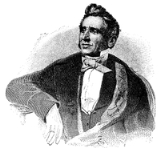
Charles Goodyear

Charles Goodyear

Overview
Charles Goodyear was an American inventor who developed a process to vulcanize rubber in 1839 -- a method that he perfected while living and working in Springfield, Massachusetts
Springfield, Massachusetts
Springfield is the most populous city in Western New England, and the seat of Hampden County, Massachusetts, United States. Springfield sits on the eastern bank of the Connecticut River near its confluence with three rivers; the western Westfield River, the eastern Chicopee River, and the eastern...

 in 1844, and for which he received patent number 3633 from the United States Patent Office
United States Patent and Trademark Office
The United States Patent and Trademark Office is an agency in the United States Department of Commerce that issues patents to inventors and businesses for their inventions, and trademark registration for product and intellectual property identification.The USPTO is based in Alexandria, Virginia,...

 on June 15, 1844
Discussion
Ask a question about 'Charles Goodyear'
Start a new discussion about 'Charles Goodyear'
Answer questions from other users
Full Discussion Forum
 
Recent Discussions
Encyclopedia
Charles Goodyear was an American inventor who developed a process to vulcanize rubber in 1839 -- a method that he perfected while living and working in Springfield, Massachusetts
Springfield, Massachusetts
Springfield is the most populous city in Western New England, and the seat of Hampden County, Massachusetts, United States. Springfield sits on the eastern bank of the Connecticut River near its confluence with three rivers; the western Westfield River, the eastern Chicopee River, and the eastern...

 in 1844, and for which he received patent number 3633 from the United States Patent Office
United States Patent and Trademark Office
The United States Patent and Trademark Office is an agency in the United States Department of Commerce that issues patents to inventors and businesses for their inventions, and trademark registration for product and intellectual property identification.The USPTO is based in Alexandria, Virginia,...

 on June 15, 1844

Although Goodyear is often credited with its invention, modern evidence has proven that the Mesoamericans used stabilized rubber for balls and other objects as early as 1600 BC.

Goodyear discovered the vulcanization process accidentally after five years of searching for a more stable rubber.

Early life


Charles Goodyear was born in New Haven, Connecticut
New Haven, Connecticut
New Haven is the second-largest city in Connecticut and the sixth-largest in New England. According to the 2010 Census, New Haven's population increased by 5.0% between 2000 and 2010, a rate higher than that of the State of Connecticut, and higher than that of the state's five largest cities, and...

, the son of Amasa Goodyear, and the oldest of six children. His father was a descendant of Stephen Goodyear, one of the founders of the colony of New Haven in 1638.

In 1814, Charles left his home and went to Philadelphia to learn the hardware business. He worked industriously until he was twenty-one years old, and then, returning to Connecticut
Connecticut
Connecticut is a state in the New England region of the northeastern United States. It is bordered by Rhode Island to the east, Massachusetts to the north, and the state of New York to the west and the south .Connecticut is named for the Connecticut River, the major U.S. river that approximately...

, entered into partnership in his father's business in Naugatuck, where they manufactured not only ivory and metal buttons, but a variety of agricultural implements.

Marriage and early career


In August 1824 he married Clarissa Beecher. Two years later the family moved to Philadelphia, and there Charles Goodyear opened a hardware store. This is where he did most of his work. His specialties were the valuable agricultural implements that his firm had been manufacturing, and after the first distrust of domestically-made goods had worn away — for all agricultural implements were imported from England
England
England is a country that is part of the United Kingdom. It shares land borders with Scotland to the north and Wales to the west; the Irish Sea is to the north west, the Celtic Sea to the south west, with the North Sea to the east and the English Channel to the south separating it from continental...

 at that time — he found himself heading a successful business.

This continued to increase until it seemed that he was to be a wealthy man. Between 1829 and 1830 he broke down in health, being troubled with dyspepsia
Dyspepsia
Dyspepsia , also known as upset stomach or indigestion, refers to a condition of impaired digestion. It is a medical condition characterized by chronic or recurrent pain in the upper abdomen, upper abdominal fullness and feeling full earlier than expected when eating...

. At the same time came the failure of a number of business houses that seriously embarrassed his firm. They struggled on, however, for some time, but were finally obliged to fail.

Between the years 1831 and 1832, Goodyear heard about gum elastic
Rubber
Natural rubber, also called India rubber or caoutchouc, is an elastomer that was originally derived from latex, a milky colloid produced by some plants. The plants would be ‘tapped’, that is, an incision made into the bark of the tree and the sticky, milk colored latex sap collected and refined...

 and very carefully examined every article that appeared in the newspapers relative to this new material. The Roxbury Rubber Company, of Boston
Boston
Boston is the capital of and largest city in Massachusetts, and is one of the oldest cities in the United States. The largest city in New England, Boston is regarded as the unofficial "Capital of New England" for its economic and cultural impact on the entire New England region. The city proper had...

, had been for some time experimenting with the gum, and believed it had found means for manufacturing goods from it. It had a large plant and was sending its goods all over the country. It was some of Roxbury's goods that first attracted Goodyear's attention. Soon after this, Goodyear visited New York
New York City
New York is the most populous city in the United States and the center of the New York Metropolitan Area, one of the most populous metropolitan areas in the world. New York exerts a significant impact upon global commerce, finance, media, art, fashion, research, technology, education, and...

, and his attention went to life preservers
Lifebuoy
A lifebuoy, ring buoy, lifering, lifesaver, life preserver or lifebelt, also known as a "kisby ring" or "perry buoy", is a life saving buoy designed to be thrown to a person in the water, to provide buoyancy, to prevent drowning...

, and it struck him that the tube used for inflation was not very effective nor well-made. Therefore, upon returning to Philadelphia, he made some tubes and brought them back to New York and showed them to the manager of the Roxbury Rubber Company.

The manager was pleased with the ingenuity that Goodyear had shown in manufacturing the tubes. He confessed to Goodyear that the business was on the verge of ruin, and that his products had to be tested for a year before it could be determined if they were perfect or not. To their surprise, thousands of dollars worth of goods that they had determined to be of good quality were being returned, the gum having rotted, making them useless. Goodyear at once made up his mind to experiment on this gum and see if he could overcome the problems with these rubber products.

However, when he returned to Philadelphia, a creditor had him arrested and imprisoned. While there, he tried his first experiments with India rubber
Rubber
Natural rubber, also called India rubber or caoutchouc, is an elastomer that was originally derived from latex, a milky colloid produced by some plants. The plants would be ‘tapped’, that is, an incision made into the bark of the tree and the sticky, milk colored latex sap collected and refined...

. The gum was inexpensive then, and by heating it and working it in his hands, he managed to incorporate in it a certain amount of magnesia
Magnesium oxide
Magnesium oxide , or magnesia, is a white hygroscopic solid mineral that occurs naturally as periclase and is a source of magnesium . It has an empirical formula of and consists of a lattice of Mg2+ ions and O2– ions held together by ionic bonds...

 which produced a beautiful white compound and appeared to take away the stickiness.

He thought he had discovered the secret, and through the kindness of friends was enabled to improve his invention in New Haven. The first thing that he made was shoes, and he used his own house for grinding, calendering and vulcanizing, with the help of his wife and children. His compound at this time consisted of India rubber, lampblack
Soot
Soot is a general term that refers to impure carbon particles resulting from the incomplete combustion of a hydrocarbon. It is more properly restricted to the product of the gas-phase combustion process but is commonly extended to include the residual pyrolyzed fuel particles such as cenospheres,...

, and magnesia, the whole dissolved in turpentine
Turpentine
Turpentine is a fluid obtained by the distillation of resin obtained from trees, mainly pine trees. It is composed of terpenes, mainly the monoterpenes alpha-pinene and beta-pinene...

 and spread upon the flannel cloth which served as the lining for the shoes. It was not long, however, before he discovered that the gum, even treated this way, became sticky. His creditors, completely discouraged, decided that he would not be allowed to go further in his research.

Goodyear, however, had no mind to stop here in his experiments. Selling his furniture and placing his family in a quiet boarding place, he went to New York and in an attic, helped by a friendly druggist, continued his experiments. His next step was to compound the rubber with magnesia and then boil it in quicklime
Calcium oxide
Calcium oxide , commonly known as quicklime or burnt lime, is a widely used chemical compound. It is a white, caustic, alkaline crystalline solid at room temperature....

 and water. This appeared to solve the problem. At once it was noticed abroad that he had treated India rubber to lose its stickiness, and he received international acclamation. He seemed on the high road to success, until one day he noticed that a drop of weak acid
Acid
An acid is a substance which reacts with a base. Commonly, acids can be identified as tasting sour, reacting with metals such as calcium, and bases like sodium carbonate. Aqueous acids have a pH of less than 7, where an acid of lower pH is typically stronger, and turn blue litmus paper red...

, falling on the cloth, neutralized the alkali
Alkali
In chemistry, an alkali is a basic, ionic salt of an alkali metal or alkaline earth metal element. Some authors also define an alkali as a base that dissolves in water. A solution of a soluble base has a pH greater than 7. The adjective alkaline is commonly used in English as a synonym for base,...

 and immediately caused the rubber to become soft again. This proved to him that his process was not a successful one. He therefore continued experimenting, and after preparing his mixtures in his attic in New York, would walk three miles to a mill in Greenwich Village
Greenwich Village
Greenwich Village, , , , .in New York often simply called "the Village", is a largely residential neighborhood on the west side of Lower Manhattan in New York City. A large majority of the district is home to upper middle class families...

 to try various experiments.

In the line of these, he discovered that rubber dipped in nitric acid
Nitric acid
Nitric acid , also known as aqua fortis and spirit of nitre, is a highly corrosive and toxic strong acid.Colorless when pure, older samples tend to acquire a yellow cast due to the accumulation of oxides of nitrogen. If the solution contains more than 86% nitric acid, it is referred to as fuming...

 formed a surface cure, and he made many products with this acid cure which were held in high regard, and he even received a letter of commendation from Andrew Jackson
Andrew Jackson
Andrew Jackson was the seventh President of the United States . Based in frontier Tennessee, Jackson was a politician and army general who defeated the Creek Indians at the Battle of Horseshoe Bend , and the British at the Battle of New Orleans...

.

Exposure to harsh chemicals, such as nitric acid and lead oxide
Lead oxide
Lead oxide may refer to:* Lead oxide, PbO, litharge, massicot* Lead oxide, Pb3O4, minium, red lead* Lead dioxide , PbO2Less common lead oxides are:* Lead oxide, Pb2O3, lead sesquioxide...

, adversely affected his health, and once nearly suffocated by gas generated in his laboratory. Goodyear survived, but the resulting fever came close to taking his life.

Together with an old business partner, he built up a factory and began to make clothing, life preservers, rubber shoes, and a great variety of rubber goods. They also had a large factory with special machinery, built at Staten Island
Staten Island
Staten Island is a borough of New York City, New York, United States, located in the southwest part of the city. Staten Island is separated from New Jersey by the Arthur Kill and the Kill Van Kull, and from the rest of New York by New York Bay...

, where he moved his family and again had a home of his own. Just about this time, when everything looked bright, the panic of 1837
Panic of 1837
The Panic of 1837 was a financial crisis or market correction in the United States built on a speculative fever. The end of the Second Bank of the United States had produced a period of runaway inflation, but on May 10, 1837 in New York City, every bank began to accept payment only in specie ,...

 came and swept away the entire fortune of his associate and left Goodyear penniless.

His next move was to go to Boston, where he became acquainted with J. Haskins, of the Roxbury Rubber Company. Goodyear found him to be a good friend, who lent him money and stood by him when no one would have anything to do with the visionary inventor. A man named Mr. Chaffee was also exceedingly kind and ever ready to lend a listening ear to his plans, and to also assist him in a pecuniary way. About this time it occurred to Mr. Chaffee that much of the trouble that they had experienced in working India rubber might come from the solvent that was used. He therefore invented a huge machine for doing the mixing by mechanical means. The goods that were made in this way were beautiful to look at, and it appeared, as it had before, that all difficulties were overcome.

Goodyear discovered a new method for making rubber shoes and received a patent which he sold to the Providence Company in Rhode Island
Rhode Island
The state of Rhode Island and Providence Plantations, more commonly referred to as Rhode Island , is a state in the New England region of the United States. It is the smallest U.S. state by area...

. However, a method had not yet been found to process rubber so that it would withstand hot and cold temperatures and acids, and so the rubber goods were constantly growing sticky, decomposing and being returned to the manufacturers.

Vulcanization trials


In 1838, Goodyear met Nathaniel Hayward in Woburn
Woburn, Massachusetts
Woburn is a city in Middlesex County, Massachusetts, USA. The population was 38,120 at the 2010 census. Woburn is located north of Boston, Massachusetts, and just south of the intersection of I-93 and I-95.- History :...

, Massachusetts
Massachusetts
The Commonwealth of Massachusetts is a state in the New England region of the northeastern United States of America. It is bordered by Rhode Island and Connecticut to the south, New York to the west, and Vermont and New Hampshire to the north; at its east lies the Atlantic Ocean. As of the 2010...

, where Hayward was running a factory. Some time after this Goodyear himself moved to Woburn, all the time continuing his experiments. He was very much interested in Hayward's sulfur experiments for drying rubber. Hayward told Goodyear that he had used sulfur
Sulfur
Sulfur or sulphur is the chemical element with atomic number 16. In the periodic table it is represented by the symbol S. It is an abundant, multivalent non-metal. Under normal conditions, sulfur atoms form cyclic octatomic molecules with chemical formula S8. Elemental sulfur is a bright yellow...

 in rubber manufacturing.

The circumstances attending the discovery of his celebrated process is thus described by Mr. Goodyear himself in his book, "Gum Elastic and Its Varieties, with a detailed account of its application and uses and of the Discovery of Vulcanization." Perhaps showing humility, or following scientific convention, Goodyear used only third person references when speaking about himself. Or perhaps he did not want people to think he was bragging and wanted their truthful opinion.

Some say (Damian Francis Mullin, circa Feb 1865) that Goodyear tried the experiment with a similar material over an open flame, and saw that the gum elastic was charred, but on the edge of the charred areas were portions that were not charred, but were instead perfectly cured. Other sources claim that Goodyear accidentally spilled the rubber mixture on a hot stove. The key discovery was that heating natural rubber and sulfur created vulcanized rubber. This process was eventually refined to become the vulcanizing process.

The inventor himself admitted that the discovery of the vulcanizing process was not the direct result of the scientific method
Scientific method
Scientific method refers to a body of techniques for investigating phenomena, acquiring new knowledge, or correcting and integrating previous knowledge. To be termed scientific, a method of inquiry must be based on gathering empirical and measurable evidence subject to specific principles of...

, but claims that it was not accidental. Rather it was the result of application and observation.

Now that Goodyear was sure that he had the key to the intricate puzzle that he had worked over for so many years, he began at once to tell his friends about it and to try to secure capital, but they had listened so many times that his efforts were futile. For a number of years he struggled and experimented and worked along in a small way, his family suffering with himself the pangs of the extremest poverty. At last he went to New York
New York City
New York is the most populous city in the United States and the center of the New York Metropolitan Area, one of the most populous metropolitan areas in the world. New York exerts a significant impact upon global commerce, finance, media, art, fashion, research, technology, education, and...

 and showed some of his samples to William Ryder, who, with his brother Emory, at once appreciated the value of the discovery and started manufacture. Even here, Goodyear's bad luck seemed to follow him, for the Ryder Bros. had failed and it was impossible to continue the business.

Perfection and Patent of Vulcanization in Springfield, Mass.


Several years earlier, Goodyear had, however, started a small factory at Springfield, Massachusetts
Springfield, Massachusetts
Springfield is the most populous city in Western New England, and the seat of Hampden County, Massachusetts, United States. Springfield sits on the eastern bank of the Connecticut River near its confluence with three rivers; the western Westfield River, the eastern Chicopee River, and the eastern...

, to which he moved his primary operations in 1842. The factory was run largely by Nelson and Henry Goodyear, Charles' brothers. Charles Goodyear's brother-in-law, Mr. De Forest, who was a wealthy woolen manufacturer, took Ryder's place. The work of making the invention practical was continued. In 1844, in Springfield, the process was sufficiently perfected that Goodyear felt it safe to take out a patent. The first vulcanization of rubber is considered one of the major "firsts" that contributes to the City of Springfield's nickname, "The City of Firsts." In 1844, Goodyear's brother Henry introduced mechanical mixing of the mixture in place of the use of solvents.

Court cases regarding vulcanization


In the year 1852 Goodyear went to Europe
Europe
Europe is, by convention, one of the world's seven continents. Comprising the westernmost peninsula of Eurasia, Europe is generally 'divided' from Asia to its east by the watershed divides of the Ural and Caucasus Mountains, the Ural River, the Caspian and Black Seas, and the waterways connecting...

, a trip that he had long planned, and saw Thomas Hancock
Thomas Hancock (inventor)
Thomas Hancock , elder brother of inventor Walter Hancock, was an English inventor who founded the British rubber industry...

, then in the employ of Charles Macintosh & Company. Hancock claimed to have invented vulcanization independently, and received a British patent, initiated in 1843, but finalized in 1844. In 1855, in the last of three patent disputes with fellow British rubber pioneer, Stephen Moulton
Stephen Moulton
Stephen Moulton was an Englishman who, as an agent of the U.S. rubber pioneer Charles Goodyear, first brought samples of vulcanized rubber to the UK...

, Hancock's patent was challenged with the claim that Hancock had copied Goodyear. Goodyear attended the trial. If Hancock lost, Goodyear stood to have his own British patent application granted, allowing him to claim royalties from both Hancock and Moulton. Both had examined Goodyear's vulcanized rubber in 1842, but several chemists testified that it would not have been possible to determine how it was made by studying it. Hancock prevailed.

Despite his misfortune with patents, Goodyear is claimed to have said, “Life should not be estimated exclusively by the standard of dollars and cents. I am not disposed to complain that I have planted and others have gathered the fruits. A man has cause for regret only when he sows and no one reaps.”

Death and legacy


Goodyear died July 1, 1860, while traveling to see his dying daughter. After arriving in New York, he was informed that she had already died. He collapsed and was taken to the Fifth Avenue Hotel in New York City, where he died at the age of 59. He is buried in New Haven at Grove Street Cemetery.

In 1898, almost four decades after his death, the Goodyear Tire and Rubber Company
Goodyear Tire and Rubber Company
The Goodyear Tire & Rubber Company was founded in 1898 by Frank Seiberling. Goodyear manufactures tires for automobiles, commercial trucks, light trucks, SUVs, race cars, airplanes, farm equipment and heavy earth-mover machinery....

 was founded and named after Goodyear by Frank Seiberling
Frank Seiberling
Franklin Augustus Seiberling was an American inventor and founder. He is most famous for founding the Goodyear Tire and Rubber Company and the Seiberling Rubber Company...

.

On February 8, 1976, he was among six individuals selected for induction into the National Inventors Hall of Fame
National Inventors Hall of Fame
The National Inventors Hall of Fame is a not-for-profit organization dedicated to recognizing, honoring and encouraging invention and creativity through the administration of its programs. The Hall of Fame honors the men and women responsible for the great technological advances that make human,...

.

In Woburn, Massachusetts
Woburn, Massachusetts
Woburn is a city in Middlesex County, Massachusetts, USA. The population was 38,120 at the 2010 census. Woburn is located north of Boston, Massachusetts, and just south of the intersection of I-93 and I-95.- History :...

, there is an elementary school named after him.

The city of Goodyear, Arizona
Goodyear, Arizona
Goodyear is a city in Maricopa County, Arizona, United States. According to the 2010 census, the population of the city is 65,275...

 was named after Goodyear.

See also

  • Leverett Candee
    Leverett Candee
    Leverett Candee was an industrialist, businessman, and pioneer rubber manufacturer.-Life:Candee went to New Haven at the age of fifteen after receiving a minimal education at the local school in Oxford, Connecticut. There he obtained employment first with a Gad Peck who was a merchant in foreign...

    , first person to manufacture rubber footwear under the Goodyear vulcanization process.
  • William Henry Goodyear
    William Henry Goodyear
    William Henry Goodyear was a noted American archaeologist, art historian, and museum curator. He was the son of Charles Goodyear , inventor of rubber vulcanization, and Clarissa Beecher Goodyear....

    , his son
  • Goodyear Tire and Rubber Company
    Goodyear Tire and Rubber Company
    The Goodyear Tire & Rubber Company was founded in 1898 by Frank Seiberling. Goodyear manufactures tires for automobiles, commercial trucks, light trucks, SUVs, race cars, airplanes, farm equipment and heavy earth-mover machinery....

  • Rubber
    Rubber
    Natural rubber, also called India rubber or caoutchouc, is an elastomer that was originally derived from latex, a milky colloid produced by some plants. The plants would be ‘tapped’, that is, an incision made into the bark of the tree and the sticky, milk colored latex sap collected and refined...

  • Vulcanization
    Vulcanization
    Vulcanization or vulcanisation is a chemical process for converting rubber or related polymers into more durable materials via the addition of sulfur or other equivalent "curatives." These additives modify the polymer by forming crosslinks between individual polymer chains. Vulcanized material is...


External links


  • The Charles Goodyear Story
  • Today in Science History - Goodyear's U.S. Patent No. 240: Improvement in the Process of Divesting Caoutchouc, Gum-Elastic, or India-Rubber of its Adhesive Properties, and also of Bleaching the Same, and Thereby Adapting it to Various Useful Purposes.