
All Topics  
Catholic University of Leuven


   Email Print
   Bookmark   Link


Catholic University of Leuven


The Catholic University of Leuven, or Louvain, was the largest, oldest and most prominent university in Belgium
Belgium

* A small German-speaking Community of Belgium exists in eastern Wallonia. Belgium's linguistic diversity and related political and cultural conflicts are reflected in the history of Belgium and a complex Communities and regions of Belgium....
. It was founded in 1425 by Pope Martin V, and refounded in 1835 after the disruptions of the French Revolutionary Wars
French Revolutionary Wars

The French Revolutionary Wars were a series of major conflicts, from 1792 until 1802, fought between the French Revolutionary government and several European states....
. The university split in 1968 to form two universities:


This entry deals with the historical university, 1425-1797 and 1835-1968. For the current successor institutions and their separate development since 1968 see the individual articles listed above.

he 15th century the city of Leuven, with the support of John IV, Duke of Brabant
John IV, Duke of Brabant

John IV, Duke of Brabant was the son of Antoine, Duke of Brabant and Jeanne de St. Pol. He succeeded his father in 1415, after his death at the Battle of Agincourt....
, made a formal request for a university.


Discussion
Ask a question about 'Catholic University of Leuven'
Start a new discussion about 'Catholic University of Leuven'
Answer questions from other users
Full Discussion Forum


Encyclopedia


The Catholic University of Leuven, or Louvain, was the largest, oldest and most prominent university in Belgium
Belgium

* A small German-speaking Community of Belgium exists in eastern Wallonia. Belgium's linguistic diversity and related political and cultural conflicts are reflected in the history of Belgium and a complex Communities and regions of Belgium....
. It was founded in 1425 by Pope Martin V, and refounded in 1835 after the disruptions of the French Revolutionary Wars
French Revolutionary Wars

The French Revolutionary Wars were a series of major conflicts, from 1792 until 1802, fought between the French Revolutionary government and several European states....
. The university split in 1968 to form two universities:

  • Katholieke Universiteit Leuven
    Katholieke Universiteit Leuven

    The Katholieke Universiteit Leuven is the Flemish offshoot of the oldest university in the Low Countries which was originally founded in 1425 ....
    , Dutch-speaking, which is situated in Leuven
    Leuven

    Leuven is the capital of the province of Flemish Brabant in the Flanders, Belgium. It is located about 30 kilometers east of Brussels, with as other neighbouring cities Mechelen, Aarschot, Tienen, and Wavre....
  • Université catholique de Louvain
    Université catholique de Louvain

    The Universit? catholique de Louvain, sometimes known as UCL, is Belgium's largest French language-speaking university, and a successor institution to the oldest university in the Low Countries....
    , French-speaking, which is situated in Louvain-la-Neuve
    Louvain-la-Neuve

    Louvain-la-Neuve, an example of the "automobile under" type of New Pedestrianism, is a planned city in the municipality of Ottignies-Louvain-la-Neuve, Belgium....
    , Belgium


This entry deals with the historical university, 1425-1797 and 1835-1968. For the current successor institutions and their separate development since 1968 see the individual articles listed above.

History


The "Old" University (1425-1797)

In the 15th century the city of Leuven, with the support of John IV, Duke of Brabant
John IV, Duke of Brabant

John IV, Duke of Brabant was the son of Antoine, Duke of Brabant and Jeanne de St. Pol. He succeeded his father in 1415, after his death at the Battle of Agincourt....
, made a formal request for a university. Pope Martin V
Pope Martin V

Pope Martin V , born Odo Colonna was Pope from 1417 to 1431. His election effectively ended the Western Schism ....
 issued a papal bull
Papal bull

A Papal bull is a particular type of letters patent or charter issued by a pope. It is named after the bulla that was appended to the end to authenticate it....
 dated 9 December 1425 founding the University in Leuven as a Studium Generale. As such it is the oldest Catholic university in the world still in existence today (and counting from the refoundation in 1835, the oldest with the name "Catholic University"). In its early days this university was modelled on the universities of Paris
Paris

Paris is the Capital of France and the country's largest city. It is situated on the river Seine, in northern France, at the heart of the ?le-de-France Regions of France ....
, Cologne
Cologne

Cologne is Germany's fourth-largest city , and is the largest city both in the German Federal State of North Rhine-Westphalia and within the Rhine-Ruhr, one of the major European metropolitan areas with more than ten million inhabitants....
 and Vienna
Vienna

Vienna is the Capital of Republic of Austria and also one of the nine states of Austria. Vienna is Austria's primary city, with a population of about 1.7 million...
. The university flourished in the 16th century due to the presence of famous scholars and professors, such as Adriaan Florenszoon Boeyens (Pope Adrian VI
Pope Adrian VI

Pope Adrian VI , born Adriaan Florenszoon Boeyens, served as Bishop of Rome from 9 January 1522 until his death some 18 months later. He was the last non-Italian pope until John Paul II, 456 years later....
), Desiderius Erasmus
Desiderius Erasmus

Desiderius Erasmus Roterodamus was a Netherlands Renaissance humanist and Roman Catholic Church Christian theology. His scholarly name Desiderius Erasmus Roterodamus comprises the following three elements: the Latin noun desiderium ; the Greek adjective ???s???? meaning "desired", and, in the form Erasmus, also the name of a St....
, Johannes Molanus, Joan Lluís Vives, Andreas Vesalius and Gerardus Mercator
Gerardus Mercator

Gerardus Mercator was a Flanders cartographer. He was born in Rupelmonde in the County of Flanders. He is remembered for the Mercator projection world map named after him....
.

The Catholic University (1835-1968)

In 1797 the old university, a bastion of reactionaries, was closed down by the French Republic, as the region was annexed to France during the French Revolutionary Wars
French Revolutionary Wars

The French Revolutionary Wars were a series of major conflicts, from 1792 until 1802, fought between the French Revolutionary government and several European states....
. When the region was part of the United Kingdom of the Netherlands
United Kingdom of the Netherlands

United Kingdom of the Netherlands was the unofficial name used to refer to a new unified European state created from part of the First French Empire during the Congress of Vienna in 1815....
 (1815-1830), William I of the Netherlands
William I of the Netherlands

William I Frederick, born Willem Frederik Prins van Oranje-Nassau , was a Prince of Orange and the first King of the Netherlands and Grand Duke of Luxembourg....
 founded a new university in 1816 in Leuven as a Rijksuniversiteit (E: State university). Belgium became independent in 1830, and the Belgian bishops founded a new Roman Catholic university in 1834, at Mechelen
Mechelen

Mechelen is a Dutch-speaking city and municipality in the province of Antwerp , Flanders, Belgium. The municipality comprises the city of Mechelen proper, some quarters at its outskirts, the hamlets of Nekkerspoel and Battel , as well as the villages of Walem, Heffen, Leest, Hombeek, and Muizen....
, which in 1835 was able to return to Leuven, where the Rijksuniversiteit had been closed.

The split (1962-1970)

While the academic language of the "old" university had been Latin, the refounded university provided lectures in both Latin and French. By the end of the 19th century it was, in effect, a French-language institution. Lectures in Dutch, the other official language of Belgium, began to be provided in 1930. In 1962, in line with the constitutional reforms governing official language use, the French and Dutch sections of the university became autonomous within a common governing structure. The division of the university, however, continued to be a demand of Flemish nationalists
Flemish movement

The Flemish Movement is a popular term used to describe the political movement for emancipation and greater autonomy of the Belgium region of Flanders, for protection of the Dutch language, and for the over-all protection of Flemish culture and history....
, and Dutch-speakers continued to express resentment at privileges given to French-speaking academic staff and the perceived disdain of the local French-speaking community for their Dutch-speaking neighbours, in a city that lies within Flanders
Flanders

Flanders is a geographical region located in parts of present-day Belgium, France, and the Netherlands. Over the course of history, the geographical territory that was called "Flanders" has varied....
.

When a French-speaking social geographer suggested in a televised lecture that an objective case could be made for changing the administrative status of the city of Leuven, including it in a larger, bilingual 'Greater-Brussels', even mainstream Flemish politicians and students began demonstrating under the slogan 'Leuven Vlaams - Walen Buiten' ('Leuven Flemish - Walloons
Walloons

Walloons are a Romance-speaking people partly from Germanic origin and Celtic origin; in any case a melting-pot speaking French language, living in Belgium principally in Wallonia, more generally the inhabitants of Wallonia....
 Out'; the agitation is remembered in Flanders as , in Wallonia as ). Student demonstrations increased in violence throughout the mid-60s, and it was this issue that brought down the Belgian government in February 1968.

The dispute was resolved in June 1968 by making the Dutch-language section an independent Katholieke Universiteit Leuven
Katholieke Universiteit Leuven

The Katholieke Universiteit Leuven is the Flemish offshoot of the oldest university in the Low Countries which was originally founded in 1425 ....
, which remained in Leuven, while the French-speaking university, the Université catholique de Louvain
Université catholique de Louvain

The Universit? catholique de Louvain, sometimes known as UCL, is Belgium's largest French language-speaking university, and a successor institution to the oldest university in the Low Countries....
, was moved to a greenfield campus, Louvain-la-Neuve
Ottignies-Louvain-la-Neuve

Ottignies-Louvain-la-Neuve is a Wallonia municipality located in the Belgium province of Walloon Brabant. On January 1 2006 Ottignies-Louvain-la-Neuve had a total population of 29,521....
, 20 km south-east of Brussels, in a part of the country where French is the official language. Acrimony about the split was long-lasting, but research collaborations and student exchanges between the two "sister universities" now take place with increasing frequency.

Library

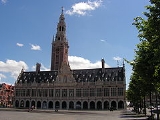
Lueven University Library
The first library was located inside the university halls, and was enlarged in 1725 in a baroque
Baroque

In the the arts, the Baroque was a Western cultural Epoch , starting roughly at the beginning of the 17th century in Rome, Italy. It was exemplified by drama and grandeur in Baroque sculpture, Baroque painting, literature, Baroque dance, and Baroque music....
 style. In 1914, during World War I
World War I

World War I, or the First World War , was a global military conflict which involved the Great powers, organized into two opposing military alliances: the Allies of World War I and the Central Powers....
, Leuven was plundered by German troops, and a large part of the city was set fire to, effectively destroying about half of the city. The library was lost, as well as about 300,000 books, and a huge collection of manuscripts, such as the Easter Island
Easter Island

Easter Island is a Polynesian island in the southeastern Pacific Ocean, at the southeastern most point of the Polynesian triangle. The island is a special territory of Chile....
 tablet bearing Rongorongo text E
Rongorongo text E

Text E of the rongorongo corpus, also known as Keiti, is one of two dozen known rongorongo texts, though it survives only in reproductions....
. In the early stages of the war allied propaganda made much of this as a reflection on German Kultur.

The new main library was built between 1921 and 1928 and designed by the American architect
Architect

An architect is trained and licenced in planning and designing buildings, and participates in supervising the construction of a building. Etymologically, architect derives from the Latin architectus, itself derived from the Greek arkhitekton , i.e....
 Whitney Warren in Low Countries
Low Countries

The Low Countries, the historical region of de Nederlanden, are the country on low-lying land around the river delta of the Rhine, Scheldt, and Meuse River rivers....
 neorenaissance style. Its monumentality is a reflection of the victory against Germany
Germany

Germany , officially the Federal Republic of Germany , is a country in Central Europe. It is bordered to the north by the North Sea, Denmark, and the Baltic Sea; to the east by Poland and the Czech Republic; to the south by Austria and Switzerland; and to the west by France, Luxembourg, Belgium, and the Netherlands....
. It is one of the largest university buildings in the city. However, in 1940, during the second German invasion of Leuven, the building largely burnt down, including its (at that time) 900,000 manuscripts and books. It was rebuilt after the war in accordance with Warren's design and is now the Central Library of the Katholieke Universiteit Leuven. The paintwork decorations of the original design were completed only in 2000, to mark the 475th anniversary of the university's foundation.

The split of the university into separate French-language and Dutch-language institutions in 1968 entailed a division of the central library holdings, which was carried out on the basis of alternate shelfmarks (except in cases where a work clearly belonged to one section or the other, e.g. was written by a member of faculty or bequeathed by an alumnus whose linguistic allegiance was clear). This gave rise to the factoid
Factoid

A factoid is a spurious?unverified, incorrect, or fabricated?statement formed and asserted as a fact, but with no wikt:Veracity. The word appears in the Oxford English Dictionary as "something which becomes accepted as fact, although it may not be true."...
 that encyclopedias and runs of periodicals were divided by volume between the two universities, but in fact such series bear single shelfmarks.

Notable alumni

For post-1968 alumni, see Katholieke Universiteit Leuven
Katholieke Universiteit Leuven

The Katholieke Universiteit Leuven is the Flemish offshoot of the oldest university in the Low Countries which was originally founded in 1425 ....
 or Université Catholique de Louvain
Université catholique de Louvain

The Universit? catholique de Louvain, sometimes known as UCL, is Belgium's largest French language-speaking university, and a successor institution to the oldest university in the Low Countries....
.

  • Jan Standonck
    Jan Standonck

    Jan Standonck was a Netherlands priest and reformer.He was part of the great movement for reform in the XVth century French church. His approach was to reform the recruitment and education of the clergy, along very ascetic lines, heavily influenced by Francis of Paola....
     (1454 - 1504), priest and reformer, Master of the Collège de Montaigu
    Collège de Montaigu

    The Coll?ge de Montaigu was one of the constituent colleges of the Faculty of Arts of the University of Paris. The college, originally called the Coll?ge des Aicelins, was founded in 1314 by Giles Aicelin, the Archbishop of Rouen....
     in Paris
    Paris

    Paris is the Capital of France and the country's largest city. It is situated on the river Seine, in northern France, at the heart of the ?le-de-France Regions of France ....
    .
  • Adriaan Floriszoon Boeyens (1459 - 1523), Pope Adrian VI
    Pope Adrian VI

    Pope Adrian VI , born Adriaan Florenszoon Boeyens, served as Bishop of Rome from 9 January 1522 until his death some 18 months later. He was the last non-Italian pope until John Paul II, 456 years later....
    .
  • Desiderius Erasmus
    Desiderius Erasmus

    Desiderius Erasmus Roterodamus was a Netherlands Renaissance humanist and Roman Catholic Church Christian theology. His scholarly name Desiderius Erasmus Roterodamus comprises the following three elements: the Latin noun desiderium ; the Greek adjective ???s???? meaning "desired", and, in the form Erasmus, also the name of a St....
     (1466 - 1536), humanist.
  • Gerard Mercator (1512 - 1594), cartographer.
  • Andreas Vesalius (1514 - 1564), father of modern anatomy.
  • Rembert Dodoens
    Rembert Dodoens

    Rembert Dodoens was a Flemings physician and botanist, also known under his Latinisation name Rembertus Dodonaeus.In 1530 he started his studies of medicine, cosmography and geography at the University of Leuven, where he graduated in 1535....
     (1517 - 1585), botanist.
  • Justus Lipsius
    Justus Lipsius

    Justus Lipsius, Joost Lips or Josse Lips , was a Flemings philologist and Humanism. Lipsius wrote a series of works designed to revive ancient Stoicism in a form that would be compatible with Christianity....
     (1547 - 1606), humanist.
  • Leonardus Lessius
    Leonardus Lessius

    Leonardus Lessius was a Jesuit Moral Theology and a pioneer in Business ethics....
     1554-1623, ethics and economy
  • Cornelius Otto Jansen (1585 - 1638), father of Jansenism
    Jansenism

    Jansenism was a branch of Roman Catholic Church thought which arose in the frame of the Counter-Reformation and the aftermath of the Council of Trent ....
    .
  • Charles Nerinckx
    Charles Nerinckx

    Rev. Charles Nerinckx was a missionary priest in Kentucky, and the founder of the Sisters of Loretto religious order. Nerinckx was born in Herffelingen, Belgium on October 2, 1761 and died at Ste....
     (1761 - 1824), founder of Sisters of Loretto
    Sisters of Loretto

    Sisters of Loretto or the Loretto Community is a Roman Catholic Church religious institution, which, according to their mission statement, "strive[s] to bring the healing Spirit of God into our world" and is committed "to improving the conditions of those who suffer from injustice, oppression, and deprivation of dignity"....
    .
  • Bernard du Bus de Gisignies
    Bernard du Bus de Gisignies

    Jonkheer Bernard Aim? L?onard du Bus de Gisignies was a Netherlands nobleman and later on a Belgium politician, ornithologist and paleontologist....
     (1808 - 1874), law, politician, ornithologist and paleontologist.
  • Hippoliet Van Peene
    Hippoliet van Peene

    Hippoliet Jan van Peene was a Flanders physician and playwright. In modern Belgian texts the name appears as Hippoliet Van Peene.He studied Medicine at the Catholic University of Leuven and became a physician in Kaprijke and later in Ghent....
     (1811 - 1864), physician and playwright, wrote the lyrics of the Flemish anthem De Vlaamse Leeuw
    De Vlaamse Leeuw

    De Vlaamse Leeuw is the national anthem of Flanders, a region in the federal kingdom of Belgium....
  • Charles-Louis-Joseph-Xavier de la Vallée-Poussin
    Charles-Louis-Joseph-Xavier de la Vallée-Poussin

    Charles-Louis-Joseph-Xavier de la Vall?e-Poussin was a Belgian geologist and Mineralogy. His son was the mathematician Charles Jean de la Vall?e-Poussin....
     (1827 - 1903), a minerologist and geologist
  • Antanas Baranauskas
    Antanas Baranauskas

    Antanas Baranauskas...
     (1835 - 1902), Polish-Lithuanian poet.
  • Arthur Vierendeel (1852 – 1940) civil engineer.
  • Albrecht Rodenbach
    Albrecht Rodenbach

    Albrecht Rodenbach was a Flanders poet, and a leader in the Flemish movement that occurred in the late 19th Century. He is more noteworthy as a symbol of the Flemish movement, than for his actual activities, since he died at the age of 23....
     (1856 - 1880), poet.
  • Albin van Hoonacker
    Albin van Hoonacker

    Albin-Augustin van Hoonacker was a theologian, professor at the Catholic University of Leuven, a member of The Royal Academy of Belgium and Knight of the Order of Leopold ....
     (1857 - 1933) Catholic theologian and Biblical scholar
  • Charles Jean de la Vallée-Poussin
    Charles Jean de la Vallée-Poussin

    Charles-Jean ?tienne Gustave Nicolas, Baron de la Vall?e Poussin was a Belgium mathematician. He is most well-known for proving the Prime number theorem....
     (1866 - 1962), mathematician who proved the prime number theorem
    Prime number theorem

    In number theory, the prime number theorem describes the asymptotic analysis distribution of the prime numbers. The prime number theorem gives a rough description of how the primes are distributed....
    .
  • Edgar Sengier
    Edgar Sengier

    Edgar Sengier was the director of the Belgian Union Mini?re du Haut Katanga during World War II. Sengier is credited with giving the American government access to much of the uranium necessary for the Manhattan Project....
     (1879 - 1963), director of the Union Minière du Haut Katanga
    Union Minière du Haut Katanga

    The Union Mini?re du Haut Katanga was a Belgium mining company, once operating in Katanga Province, in what is now the Democratic Republic of the Congo ....
    .
  • Frans Van Cauwelaert
    Frans Van Cauwelaert

    Frans van Cauwelaert , was a Belgium Roman Catholic politician and lawyer.Van Cauwelaert was born at Roosdaal. He was a member of the Flemish movement, Professor of psychology at the Universite Catholique de Louvain , mayor of Antwerp, and co-founder of the journal De Standaard....
     (1880 - 1961), politician.
  • Jean-Baptiste Janssens
    Jean-Baptiste Janssens

    Jean-Baptiste Janssens, S.J. was the twenty-seventh Superior General of the Society of Jesus. He was born in Mechelen, Belgium....
    , S.J. (1889 - 1964), twenty-seventh Superior General of the Society of Jesus
    Society of Jesus

    The Society of Jesus is a Roman Catholic religious order of clerks regular whose members are called Jesuits, Soldiers of Jesus Christ, and Foot soldiers of the Pope, because the founder, Saint Ignatius of Loyola, was a knight before becoming a Holy Orders....
    .
  • Weng Wenhao
    Weng Wenhao

    Weng Wenhao was a Chinese geologist, educator, and paramount politician.He was one of the earliest modern Chinese geologists, and is regarded as the founder of modern Chinese geology and the father of modern Chinese oil industry in many literature....
     (1889 - 1971), founder of modern Chinese geography.
  • Georges Lemaître
    Georges Lemaître

    Monsignor Georges Henri Joseph ?douard Lema?tre was a Belgium Roman Catholic priest, Monsignor, professor of physics and astronomy at the Catholic University of Leuven....
     (1894 - 1966), astronomer, priest and proposer of the Big Bang
    Big Bang

    The Big Bang is the physical cosmology model of the initial conditions and subsequent development of the universe supported by the most comprehensive and accurate explanations from current scientific method and observation....
     theory.
  • Fulton J. Sheen
    Fulton J. Sheen

    Fulton John Sheen was an United States bishop of the Roman Catholic Church. He was also a pioneer in the field of television evangelism. His cause for canonization for sainthood was officially opened in 2002, and so he is now referred to as a Servant of God....
     (1895 - 1979), American archbishop, television personality, preacher and writer.
  • Rafael Ángel Calderón Guardia
    Rafael Ángel Calderón Guardia

    Rafael ?ngel del Socorro Calder?n Guardia was the president of Costa Rica from 1940 to 1944....
    , (1900 - 1970), physician, social reformer, president of Costa Rica
    Costa Rica

    Costa Rica, officially the Republic of Costa Rica is a country in Central America, bordered by Nicaragua to the north, Panama to the east and south, the Pacific Ocean to the west and south and the Caribbean Sea to the east....
     1940-1944
  • Saint Alberto Hurtado
    Alberto Hurtado

    Saint Alberto Hurtado Cruchaga , popularly known in Chile as Padre Hurtado , was a Chilean Jesuit priest, lawyer, social worker and writer, founder of the Hogar de Cristo movement....
    , (1901-1952), Chilean Jesuit priest, social worker and writer. Canonized in 2005.
  • Victor Delhez
    Victor Delhez

    Victor Delhez, , best known for his engravings, was born in Antwerp, Belgium, and died in Argentina.Delhez was one of seven children. He studied at Antwerp's Royal Academy of Fine Arts from 1916-1918 and at the University of Leuven from 1918-1923, graduating as an agronomist with chemistry as his primary subject....
    , (1902 – 1985), engraver and artist.
  • Hendrik Elias
    Hendrik Elias

    Hendrik Josef Elias was a Belgium politician and Flemish people nationalism....
    , (1902 - 1973), Flemish Nationalist, quisling
    Quisling

    Quisling, after Norway politician Vidkun Quisling, who assisted Nazi Germany to conquer his own country, is a term used to describe treason and collaborationism....
    .
  • Maurice Anthony Biot
    Maurice Anthony Biot

    Maurice Anthony Biot was a Belgian-American physicist and the founder of the theory of poroelasticity.He studied at Catholic University of Leuven in Belgium where he received a bachelor's degrees in philosophy , mining engineering and electrical engineering , and Doctor of Science in 1931....
     (1905 - 1985), Belgian-American physicist and the founder of the theory of poroelasticity.
  • Léon Degrelle
    Léon Degrelle

    L?on Joseph Marie Ignace Degrelle was a Wallonia Belgium politician, who founded Rexism and later joined the Nazi Germany Waffen SS . After World War II, he was a prominent figure in the Neo-nazism movements....
    , (1906 - 1994), founder of Rexism
    Rexism

    Rexism was a fascism political movement in the first half of the twentieth century in Belgium.It was the ideology of the Rexist Party , officially called Christ King, founded in 1930 by L?on Degrelle, a Walloons....
    , quisling
    Quisling

    Quisling, after Norway politician Vidkun Quisling, who assisted Nazi Germany to conquer his own country, is a term used to describe treason and collaborationism....
    .
  • Jean Charles Snoy et d'Oppuers
    Jean Charles Snoy et d'Oppuers

    Count Jean Charles Snoy et d'Oppuers , son of Baron Thierry Snoy, was a Belgium civil servant, diplomat and Roman Catholic politician for the Christian Social Party ....
     (1907-1991), law, diplomat, businessman.
  • Herman Van Breda
    Herman Van Breda

    Herman Leo Van Breda was a Franciscan, philosopher and founder of the Husserl archives at the Higher Institute of Philosophy of the Catholic University of Leuven in Belgium....
     (1911 - 1974), founder of the Husserl Archives.
  • André Molitor
    André Molitor

    Andr? Molitor , is a former Belgium senior civil servant of the Belgian State and former principal private secretary of King Baudouin I of Belgium for 17 years....
     (1911 - 2005), law, private secretary of Baudouin I of Belgium.
  • Otto von Habsburg
    Otto von Habsburg

    Otto von Habsburg has been the head of the House of Habsburg since 1922. He is the eldest son of Charles I of Austria, the last Emperor of Austria and King of Hungary,Croatia and Bohemia, and his wife, Zita of Bourbon-Parma....
     (1912 - ), the current head of the Habsburg family.
  • Tang Yuhan
    Tang Yuhan

    Tang Yuhan , or Hans Tang, is an eminent Physician and cancerologist in Hong Kong. He was the president of Hong Kong Chinese Medical Association and the founder of Tang Fund ....
    , (1912 - ), Chinese oncologist.
  • Pieter De Somer
    Pieter De Somer

    Pieter De Somer was a Belgium physician and biologist. He studied medicine from 1935 up to 1942 at the Catholic University of Leuven . He did research and later became a professor at the Department of medicine, where he specialised in microbiology and immunology....
     (1917 - 1985), first rector
    Rector

    The word rector has a number of different meanings, but all of them indicate an academic, religious or political administrator.The word "rector" also appears in many modern languages, such as Albanian, Dutch language, Spanish language, Catalan language and Romanian language....
     of the Katholieke Universiteit Leuven
    Katholieke Universiteit Leuven

    The Katholieke Universiteit Leuven is the Flemish offshoot of the oldest university in the Low Countries which was originally founded in 1425 ....
    .
  • Christian de Duve
    Christian de Duve

    Christian Ren? de Duve is an internationally acclaimed cytologist and biochemist. De Duve was born in Thames-Ditton, United Kingdom of Great Britain and Ireland, as a son of Belgium immigrants....
     (1917 - ), Nobel Prize in Medicine
    Nobel Prize in Physiology or Medicine

    The Nobel Prize in Physiology or Medicine is awarded once a year by the Swedish Karolinska Institutet. It is one of the five Nobel Prizes established by the will of Alfred Nobel in 1895, awarded for outstanding contributions in Nobel Prize in Physics, Nobel Prize in Chemistry, Nobel Prize in Literature, Nobel Peace Prize, and Physiology or Medic...
     1974, for his discoveries concerning the structural and functional organization of the cell
    Cell (biology)

    The cell is the structural and functional unit of all known Life organisms. It is the smallest unit of an organism that is classified as living, and is often called the building bricks of life....
    .
  • Anton van Wilderode
    Anton van Wilderode

    Cyriel Paul Coup? , pseudonym Anton van Wilderode was a Belgium writer and poet.He was ordained as a priest on 21 May 1944, and he graduated in Classical philology at the Katholieke Universiteit Leuven....
     (1919-1998), Flemish activist and writer.
  • Aster Berkhof
    Lode Van Den Bergh

    Lode Van Den Bergh , pseudonym Aster Berkhof and Piet Visser, is a Belgium writer. He is married to Nora Steyaert....
    , (1920 - ), Flemish writer.
  • Malachi Martin
    Malachi Martin

    Fr. Malachi Brendan Martin Doctor of Philosophy Jesuit was a former Jesuit priest, theologian, writer on the Roman Catholic church and professor at the Vatican Pontifical Biblical Institute....
     (1921 - 1999), Irish writer.
  • Antoon Vergote (1921 -), catholic priest, theologian, philosopher, psychologist and psychoanalyst (also known as Antoine Vergote).
  • Jan Zaprudnik
    Jan Zaprudnik

    Jan Zaprudnik is an USA historian and publicist of Belarusian descent. He is also one of the leaders of the Belarusian Americans in the United States and an honoured member of the Belarusian International PEN....
     (1924 - ), Belarusian American historian and poet.
  • Geza Vermes
    Geza Vermes

    G?za Vermes is a Jewish Hungary scholar and writer on religious history, particularly Judaism and Christian. He is a noted authority on the Dead Sea Scrolls and other ancient works in Aramaic, and on the life and religion of Jesus....
     (1924 - ), religious historian and translator into English of the Dead Sea Scrolls
    Dead Sea scrolls

    The Dead Sea scrolls consist of roughly 900 documents, including texts from the Hebrew Bible, discovered between 1947 and 1956 in eleven caves in and around the Wadi Qumran near the ruins of the ancient settlement of Qumran, on the northwest shore of the Dead Sea....
    .
  • José J. Fripiat
    José J. Fripiat

    Jos? J. Fripiat is a Belgium scientist and former professor at the Universite Catholique de Louvain. He obtained a M.S. degree in Chemistry and Physics in 1944 at the Universite Catholique de Louvain....
    , a chemist, and laureate of the 1967 Francqui Prize
    Francqui Prize

    The Francqui Prize is a prestigious Belgium scholarly and Science prize, awarded each year since 1933 by the Francqui Foundation in recognition of the achievements of a young Belgian scholar or scientist....
  • Gustavo Gutiérrez
    Gustavo Gutiérrez

    File:Gustavo gutierrez.jpgGustavo Guti?rrez Merino, O.P. is a Peruvian theologian and Dominican Order priest regarded as the founder of Liberation Theology....
     (1928 - ), Peru
    Peru

    Peru , officially the Republic of Peru , is a country in western South America. It is bordered on the north by Ecuador and Colombia, on the east by Brazil, on the southeast by Bolivia, on the south by Chile, and on the west by the Pacific Ocean....
    vian Dominican
    Dominican Order

    The Order of Preachers , after the 15th century more commonly known as the Dominican Order or Dominicans, is a Roman Catholic religious order founded by Saint Dominic in the early 13th century in France....
     theologian, founder of Liberation Theology
    Liberation theology

    Liberation theology is a school of theology within Christianity, particularly in the Roman Catholic Church. It emphasizes the Christian mission to bring justice to the poor and oppressed, particularly through political activism....
    .
  • (1928 - 2003), theologian
  • Jacques Taminiaux
    Jacques Taminiaux

    Jacques Taminiaux is a Belgium philosopher, since 1989 Professor at Boston College in Chestnut Hill, Massachusetts, Massachusetts . He studied philosophy at the Universite Catholique de Louvain ....
     (1928 - ), philosopher, 1977 laureate of the Francqui Prize
    Francqui Prize

    The Francqui Prize is a prestigious Belgium scholarly and Science prize, awarded each year since 1933 by the Francqui Foundation in recognition of the achievements of a young Belgian scholar or scientist....
  • Camilo Torres
    Camilo Torres Restrepo

    Father Camilo Torres Restrepo was a Colombian Roman Catholicism priest, a predecessor of the Liberation Theology and a member of the National Liberation Army guerrilla group....
     (1929 - 1966), Colombian priest and guerillero.
  • Jean-Pierre de Launoit (1935 - ), businessman.
  • Abdul Qadeer Khan
    Abdul Qadeer Khan

    Abdul Qadeer Khan is a Pakistani nuclear scientist and Metallurgy, widely regarded as the founder of Pakistan and weapons of mass destruction. His middle name is occasionally rendered as Quadeer, Qadir or Qadeer, and his given names are usually abbreviated to A.Q.....
     (1936 - ), Pakistani metallurgist considered to be the father of Pakistan's nuclear weapons program.
  • Jacques van Ypersele de Strihou
    Jacques van Ypersele de Strihou

    Jacques van Ypersele de Strihou , is the Principal Private Secretary to the King of Belgium. When Albert II of Belgium succeeded his brother Baudouin I of Belgium, he kept his private secretary, so Jacques van Ypersele de Strihou has served two kings....
     (1936 - ), private secretary of the King of Belgium.
  • Nguza Karl-i-Bond
    Jean Nguza Karl-i-Bond

    Jean Nguza Karl-i-Bond was a prominent Zaire Politics.Born in Musumba, Lualaba Province, a member of the Lunda people tribe and a nephew of the Katangan leader, Moise Tshombe, Nguza was a pock-marked child who rose rapidly through government posts and gained the favour of Heads of state of the Democratic Republic of the Congo Mobutu Sese S...
     (1938 - 2003), notable Zairian
    Zaire

    The Republic of Zaire was the name of the present Democratic Republic of the Congo between 27 October 1971, and 17 May 1997. The name of Zaire derives from the , itself an adaptation of the Kongo language word nzere or nzadi, or "the river that swallows all rivers", and is often still used to refer to that state, perhaps because "Zai...
     politician.
  • Emile Boulpaep
    Emile Boulpaep

    Emile L. Boulpaep is a Belgium physiologist and since 1977 President of the Belgian American Educational Foundation. He is a member of the board of the Francqui Foundation....
     (1938 - ), MD, President of the Belgian American Educational Foundation.
  • Baron Piet Van Waeyenberge
    Piet Van Waeyenberge

    Baron Piet Paul August Van Waeyenberge is a Belgium businessman. He is a son of Camille Van Waeyenberge and a brother of Jozef Van Waeyenberge....
     (1938 - ), economics, President of De Warande
    De Warande (Club)

    De Warande is a Flanders business club, located in Brussels, Belgium. The club was founded in Brussels in 1988, by Flemish businesspeople and the Flemish government....
    .
  • Bernard Lietaer
    Bernard Lietaer

    Bernard Lietaer is an economist and author. He studies monetary systems and promotes the idea that communities can benefit from creating their own local or Complementary currency, which circulate parallel with national currencies....
     (1942 - ), economist and author.
  • Arthur Ulens
    Arthur Ulens

    Arthur Ulens is a Belgium businessman and former head of Glaverbel which groups the world-wide flat glass activities of the Asahi Glass Company ....
     (1946 - ), chemistry and economics, businessman
  • Afif Safieh
    Afif Safieh

    Afif Safieh is a Palestinian diplomat. He is the current Palestinian ambassador to the Russian Federation.Safieh was born in Jerusalem in 1950....
     (1950 - ), Palestinian diplomat, ambassador to the Russian Federation.
  • Herman Van Den Berghe
    Herman Van Den Berghe

    Herman Van den Berghe is a Belgian pioneer in human genetics. He founded the Centrum voor Menselijke Erfelijkheid at the medical faculty of the Katholieke Universiteit Leuven in Leuven , Belgium....
    , founder of the Centrum voor Menselijke Erfelijkheid (Belgian Centre for Human Heredity).


See also

  • University of Lovanium
    University of Lovanium

    The University of Lovanium was a Catholic Jesuit university in Leopoldville/Leopoldstad in Belgian Congo....