

Casuarinaceae

Encyclopedia
Casuarinaceae is a family
of dicotyledonous flowering plant
s placed in the order Fagales
, consisting of 3 or 4 genera and approximately 70 species of trees and shrubs native to the Old World
tropics
(Indo-Malaysia), Australia
, and the Pacific Islands
. At one time, all of the species were placed in the genus Casuarina, but these were split in 1982 into the genera Allocasuarina
, Casuarina
, Ceuthostoma, and Gymnostoma. Somewhat controversial at the time, the monophyly of these genera was later supported in a 2003 molecular study of the family. In the Wettstein system
, this family was the only one placed in the order Verticillatae. Likewise, in the Engler
, Cronquist
and Kubitzki
systems, Casuarinaceae was the only family placed in the order Casuarinales.
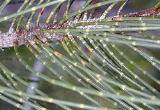
Members of this family are characterized by drooping equisetoid (meaning "looking like Equisetum") twigs, are evergreen
, and monoecious or dioecious
. The roots have nitrogen-fixing nodules that contain the soil actinomycete Frankia
.
The most widely used common name for Casuarinaceae species is sheoak or she-oak (a comparison of the timber quality with English Oak). Other common names include ironwood, bull-oak or buloke, and beefwood.
The Shire of Buloke in Victoria, Australia is named after the species Allocasuarina luehmannii
.
Family (biology)
In biological classification, family is* a taxonomic rank. Other well-known ranks are life, domain, kingdom, phylum, class, order, genus, and species, with family fitting between order and genus. As for the other well-known ranks, there is the option of an immediately lower rank, indicated by the...
of dicotyledonous flowering plant
Flowering plant
The flowering plants , also known as Angiospermae or Magnoliophyta, are the most diverse group of land plants. Angiosperms are seed-producing plants like the gymnosperms and can be distinguished from the gymnosperms by a series of synapomorphies...
s placed in the order Fagales
Fagales
The Fagales are an order of flowering plants, including some of the best known trees. The order name is derived from genus Fagus, Beeches. They belong among the rosid group of dicotyledons...
, consisting of 3 or 4 genera and approximately 70 species of trees and shrubs native to the Old World
Old World
The Old World consists of those parts of the world known to classical antiquity and the European Middle Ages. It is used in the context of, and contrast with, the "New World" ....
tropics
Tropics
The tropics is a region of the Earth surrounding the Equator. It is limited in latitude by the Tropic of Cancer in the northern hemisphere at approximately N and the Tropic of Capricorn in the southern hemisphere at S; these latitudes correspond to the axial tilt of the Earth...
(Indo-Malaysia), Australia
Australia
Australia , officially the Commonwealth of Australia, is a country in the Southern Hemisphere comprising the mainland of the Australian continent, the island of Tasmania, and numerous smaller islands in the Indian and Pacific Oceans. It is the world's sixth-largest country by total area...
, and the Pacific Islands
Pacific Islands
The Pacific Islands comprise 20,000 to 30,000 islands in the Pacific Ocean. The islands are also sometimes collectively called Oceania, although Oceania is sometimes defined as also including Australasia and the Malay Archipelago....
. At one time, all of the species were placed in the genus Casuarina, but these were split in 1982 into the genera Allocasuarina
Allocasuarina
Allocasuarina is a genus of trees in the flowering plant family Casuarinaceae. They are endemic to Australia, occurring primarily in the south. Like the closely related genus Casuarina, they are commonly called sheoaks or she-oaks, they are notable for their long, segmented branchlets that...
, Casuarina
Casuarina
Casuarina is a genus of 17 species in the family Casuarinaceae, native to Australasia, southeast Asia, and islands of the western Pacific Ocean. It was once treated as the sole genus in the family, but has been split into three genera .They are evergreen shrubs and trees growing to 35 m tall...
, Ceuthostoma, and Gymnostoma. Somewhat controversial at the time, the monophyly of these genera was later supported in a 2003 molecular study of the family. In the Wettstein system
Wettstein system
A system of plant taxonomy, the Wettstein system recognised the following main groups, according to* I. phylum Schizophyta*::: 1. classis Schizophyceae*::: 2. classis Schizomycetes* II. phylum Monadophyta* III. phylum Myxophyta...
, this family was the only one placed in the order Verticillatae. Likewise, in the Engler
Engler system
One of the prime systems of plant taxonomy, the Engler system was devised by Adolf Engler.According to Engler, Syllabus der Pflanzenfamilien the main groups of plants are:* I. divisio Schizophyta* II. divisio Phytosarcodina...
, Cronquist
Cronquist system
The Cronquist system is a taxonomic classification system of flowering plants. It was developed by Arthur Cronquist in his texts An Integrated System of Classification of Flowering Plants and The Evolution and Classification of Flowering Plants .Cronquist's system places flowering plants into two...
and Kubitzki
Kubitzki system
A system of plant taxonomy, the Kubitzki system is the product of an ongoing survey of vascular plants, entitled The Families and Genera of Vascular Plants....
systems, Casuarinaceae was the only family placed in the order Casuarinales.
Members of this family are characterized by drooping equisetoid (meaning "looking like Equisetum") twigs, are evergreen
Evergreen
In botany, an evergreen plant is a plant that has leaves in all seasons. This contrasts with deciduous plants, which completely lose their foliage during the winter or dry season.There are many different kinds of evergreen plants, both trees and shrubs...
, and monoecious or dioecious
Dioecious
Dioecy is the property of a group of biological organisms that have males and females, but not members that have organs of both sexes at the same time. I.e., those whose individual members can usually produce only one type of gamete; each individual organism is thus distinctly female or male...
. The roots have nitrogen-fixing nodules that contain the soil actinomycete Frankia
Frankia
Frankia is a genus of nitrogen fixing, filamentous bacteria that live in symbiosis with actinorhizal plants, similar to the Rhizobia bacteria that are found in the root nodules of legumes in the Fabaceae family. Bacteria of this genus also form root nodules.The genus Frankia was originally named by...
.
The most widely used common name for Casuarinaceae species is sheoak or she-oak (a comparison of the timber quality with English Oak). Other common names include ironwood, bull-oak or buloke, and beefwood.
The Shire of Buloke in Victoria, Australia is named after the species Allocasuarina luehmannii
Allocasuarina luehmannii
Allocasuarina luehmannii is a species of she-oak native to Australia. Stands are endangered by farming practices in the Wimmera region of western Victoria, where it is integral to the survival of the endangered southeastern subspecies of the Red-tailed Black Cockatoo for feeding and nesting.The...
.
External links
- Research team from IRD working on FrankiaFrankiaFrankia is a genus of nitrogen fixing, filamentous bacteria that live in symbiosis with actinorhizal plants, similar to the Rhizobia bacteria that are found in the root nodules of legumes in the Fabaceae family. Bacteria of this genus also form root nodules.The genus Frankia was originally named by...
-Casuarinaceae mycorrhizal and nitrogen-fixing symbioses