
All Topics  
Cannabis

 
Cannabis

   Email Print
   Bookmark   Link


Cannabis


Cannabis (Cán-na-bis
Syllable stress of Botanical Latin

Syllable stress of botanical names varies with the language spoken by the person using the botanical name. In English-speaking countries the Botanical Latin places syllable stress for botanical names derived from ancient Greek and Latin broadly according to two systems, either the Reformed academic pronunciation, or the pronunciation develop...
) is a genus
Genus

A genus is a low-level taxonomic rank used in the classification of living and fossil organisms. The taxonomic ranks are domain , kingdom , phylum, class , order , family , genus, and species....
 of flowering plant
Flowering plant

The flowering plants or angiosperms are the most widespread group of Embryophytes. The flowering plants and the gymnosperms are the only extant groups of Spermatophyte....
s that includes three putative species, Cannabis sativa L., Cannabis indica Lam., and Cannabis ruderalis Janisch. These three taxa are indigenous
Indigenous

Indigenous may refer to:*Indigenous peoples, population groups with ancestral connections to place prior to formally recorded history**Indigenous intellectual property, a legal term identifying the right to claim knowledge within their culture...
 to central Asia
Central Asia

Central Asia is a region of Asia from the Caspian Sea in the west to central China in the east, and from southern Russia in the north to northern India in the south....
 and surrounding regions. Cannabis has long been used for fibre (hemp
Hemp

File:Industrialhemp.jpgHemp is the common name for plants of the entire genus Cannabis, although the term is often used to refer only to Cannabis strains cultivated for industrial use....
), for medicinal purposes
Medical cannabis

Medical cannabis refers to the use of the Cannabis plant as a physician-recommended Cannabis or herbal therapy as well as synthetic THC and cannabinoids....
, and as a psychoactive
Cannabis (drug)

Cannabis, also known as Marijuana or marihuana, or ganja , is a psychoactive drug extracted from the plant Cannabis sativa, or more often, Cannabis sativa subsp....
. Industrial hemp
Hemp

File:Industrialhemp.jpgHemp is the common name for plants of the entire genus Cannabis, although the term is often used to refer only to Cannabis strains cultivated for industrial use....
 products are made from Cannabis plants selected to produce an abundance of fiber and minimal levels of THC
THC

The acronym THC has several possible meanings:* Tetrahydrocannabinol, the main active chemical compound in Cannabis* Toronto Hemp Company, the world's largest Hemp and Cannabis Culture store, located in Toronto, Canada....
 (?9- tetrahydrocannabinol), a psychoactive molecule that produces the "high" associated with marijuana
Cannabis (drug)

Cannabis, also known as Marijuana or marihuana, or ganja , is a psychoactive drug extracted from the plant Cannabis sativa, or more often, Cannabis sativa subsp....
.


Discussion
Ask a question about 'Cannabis'
Start a new discussion about 'Cannabis'
Answer questions from other users
Full Discussion Forum


Recent Posts


Quotations


I'm not going to be Bill Clinton and say I never inhaled. I did inhale. I liked tobacco a lot better.

A poem: Slowly the foreign air enter me. I feel tingles and sensations. My life becomes a fantasy. Cannabis now rules thee.

Legalize it, and I will advertise it.

Not just pot rights.. but grass rights.. the right of grass not to be mowed.

O Anna Niemus

Please don't throw your shit at me... unless that shit resembles a bag of marijuana.

You bet I did -— and I enjoyed it.

Michael Bloomberg - New York City Mayor, when asked if he had ever smoked marijuana.


Encyclopedia


Cannabis (Cán-na-bis
Syllable stress of Botanical Latin

Syllable stress of botanical names varies with the language spoken by the person using the botanical name. In English-speaking countries the Botanical Latin places syllable stress for botanical names derived from ancient Greek and Latin broadly according to two systems, either the Reformed academic pronunciation, or the pronunciation develop...
) is a genus
Genus

A genus is a low-level taxonomic rank used in the classification of living and fossil organisms. The taxonomic ranks are domain , kingdom , phylum, class , order , family , genus, and species....
 of flowering plant
Flowering plant

The flowering plants or angiosperms are the most widespread group of Embryophytes. The flowering plants and the gymnosperms are the only extant groups of Spermatophyte....
s that includes three putative species, Cannabis sativa L., Cannabis indica Lam., and Cannabis ruderalis Janisch. These three taxa are indigenous
Indigenous

Indigenous may refer to:*Indigenous peoples, population groups with ancestral connections to place prior to formally recorded history**Indigenous intellectual property, a legal term identifying the right to claim knowledge within their culture...
 to central Asia
Central Asia

Central Asia is a region of Asia from the Caspian Sea in the west to central China in the east, and from southern Russia in the north to northern India in the south....
 and surrounding regions. Cannabis has long been used for fibre (hemp
Hemp

File:Industrialhemp.jpgHemp is the common name for plants of the entire genus Cannabis, although the term is often used to refer only to Cannabis strains cultivated for industrial use....
), for medicinal purposes
Medical cannabis

Medical cannabis refers to the use of the Cannabis plant as a physician-recommended Cannabis or herbal therapy as well as synthetic THC and cannabinoids....
, and as a psychoactive
Cannabis (drug)

Cannabis, also known as Marijuana or marihuana, or ganja , is a psychoactive drug extracted from the plant Cannabis sativa, or more often, Cannabis sativa subsp....
. Industrial hemp
Hemp

File:Industrialhemp.jpgHemp is the common name for plants of the entire genus Cannabis, although the term is often used to refer only to Cannabis strains cultivated for industrial use....
 products are made from Cannabis plants selected to produce an abundance of fiber and minimal levels of THC
THC

The acronym THC has several possible meanings:* Tetrahydrocannabinol, the main active chemical compound in Cannabis* Toronto Hemp Company, the world's largest Hemp and Cannabis Culture store, located in Toronto, Canada....
 (?9- tetrahydrocannabinol), a psychoactive molecule that produces the "high" associated with marijuana
Cannabis (drug)

Cannabis, also known as Marijuana or marihuana, or ganja , is a psychoactive drug extracted from the plant Cannabis sativa, or more often, Cannabis sativa subsp....
. The psychoactive consists of dried flowers and leaves of plants selected to produce high levels of THC. Various extracts including hashish
Hashish

Hashish is a preparation of cannabis composed of the compressed trichomes collected from the cannabis plant. It contains the same active ingredients but in higher concentrations than other parts of the plant such as the buds or the leaves....
 and hash oil are also produced from the plant. The cultivation and possession of Cannabis for recreational use is outlawed in most countries.

Etymology

The plant name cannabis is from Greek
Ancient Greek

Ancient Greek is the historical stage in the development of the Greek language spanning across the Archaic Greece , Classical Greece , and Hellenistic civilization periods of ancient Greece and the classical antiquity....
  (), via Latin
Latin

Latin is an Italic language, historically spoken in Latium and Ancient Rome. Through the Military history of the Roman Empire, Latin spread throughout the Mediterranean and a large part of Europe....
 , a Scythian
Scythian languages

The Scythian languages form a North Eastern branch of the Iranian languages and comprise the distinctive languagesspoken by the Scythian tribes of nomadic pastoralists in Scythia between the 8th century BC and the 5th century AD....
 or Thracian
Thracian language

The Thracian language was the Indo-European language spoken in ancient times by the Thracians in South-Eastern Europe....
 word, also loaned into Persian
Persian language

name=Persian|nativename=|pronunciation=[f??r'si]|image=|caption=Farsi in Perso-Arabic script |states= Iran, Afghanistan, Tajikistan, Uzbekistan, and Bahrain....
 as . English hemp
Hemp

File:Industrialhemp.jpgHemp is the common name for plants of the entire genus Cannabis, although the term is often used to refer only to Cannabis strains cultivated for industrial use....
 (Old English ) may be an early loan (predating Grimm's Law
Grimm's law

Grimm's law named for Jacob Grimm, is a set of statements describing the inherited Proto-Indo-European language stops as they developed in Proto-Germanic in the 1st millennium BC....
) from the same source. In Hebrew
Hebrew language

Hebrew is a Semitic languages of the Afro-Asiatic languages. Modern Hebrew is spoken by more than seven million people in Israel and Classical Hebrew is used for prayer or study in Jews communities around the world....
, the word is ?????????? [qan:a'bos]. Old Akkadian qunnabtu, Neo-Assyrian
Assyrian

Assyrian may refer to:in antiquity:*ancient Assyria**the Old Assyrian period **the Middle Assyrian period **the Neo-Assyrian period *Assyria , a province of the Achaemenid Empire...
 and Neo-Babylonian qunnabu were used to refer to the plant.

The further origin of the Scythian term is uncertain.

Description

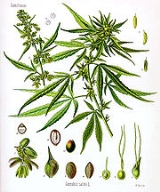
Cannabis is an annual
Annual plant

An annual plant is a plant that usually germinates flowers and dies in one year. True annuals will only live longer than a year if they are prevented from setting seed....
, dioecious
Dioecious

Dioecious - from Greek language for "two households" - refers to species of seed-bearing plants having separate male and female plants. That is, no individual plant of the species produces both microspores and megaspores; individual plants are either male or female ....
, flowering
Flowering plant

The flowering plants or angiosperms are the most widespread group of Embryophytes. The flowering plants and the gymnosperms are the only extant groups of Spermatophyte....
 herb
Herb

A herb is a plant that is valued for qualities such as medicinal properties, flavor, scent, or the like....
. The leaves
Leaf

In botany, a leaf is an above-ground plant Organ specialized for photosynthesis. For this purpose, a leaf is typically flat and thin, to expose the cells containing chloroplast to light over a broad area, and to allow light to penetrate fully into the tissues....
 are palmately compound
Leaf shape

In botany, the following terms are used to describe the shape of plant leaf:* Acicular : Slender and pointed, needle-like* Acuminate : Tapering to a long point...
, with serrate leaflet
Leaflet

A leaflet in botany is a part of a compound leaf. A leaflet may resemble an entire leaf leaf, but it is not borne on a Plant stem as a leaf is, but rather on a vein of the whole leaf ....
s. The first pair of leaves usually have a single leaflet, the number gradually increasing up to a maximum of about thirteen leaflets per leaf (usually seven or nine), depending on variety and growing conditions. At the top of a flowering plant, this number again diminishes to a single leaflet per leaf. The lower leaf pairs usually occur in an opposite leaf arrangement
Phyllotaxis

In botany, phyllotaxis or phyllotaxy is the arrangement of the leaf on the plant stem of a plant....
 and the upper leaf pairs in an alternate arrangement on the main stem of a mature plant.

Cannabis normally has imperfect
Plant sexuality

Plant sexuality covers the wide variety of sexual reproduction systems found across the plant kingdom. This article describes Morphology aspects of sexual reproduction of plants....
 flowers, with staminate
Stamen

The stamen is the male organ of a flower. Each stamen generally has a stalk called the filament , and, on top of the filament, an anther , and pollen sacs, called sporangium....
 "male" and pistillate "female" flowers occurring on separate plants. It is not unusual, however, for individual plants to bear both male and female flowers. Although monoecious plants are often referred to as "hermaphrodites," true hermaphrodites (which are less common) bear staminate and pistillate structures on individual flowers, whereas monoecious plants bare male and female flowers at different locations on the same plant. Male flowers are normally borne on loose panicle
Panicle

A panicle is a compound raceme, a loose, much-branched Indeterminate growth inflorescence with Pedicel flowers attached along the secondary branches ....
s, and female flowers are borne on raceme
Raceme

A raceme is a type of inflorescence that is unbranched and indeterminate growth and bears pedicellate flowers — flowers having short floral stalks called Pedicel s — along the axis....
s.

All known strains of Cannabis are wind-pollinated
Anemophily

Anemophily or wind pollination is a form of pollination whereby pollen is distributed by wind. Anemophilous plants may be either gymnosperms or angiosperms ....
 and produce "seed
Seed

A seed is a small Plant embryogenesis plant enclosed in a covering called the seed coat, usually with some Food storage. It is the product of the ripened ovule of gymnosperm and angiosperm plants which occurs after fertilization and some growth within the mother plant....
s" that are technically called achene
Achene

An achene is a type of simple dry fruit produced by many species of flowering plants. Achenes are "monocarpellate" and wikt:indehiscent . Achenes contain a single seed that nearly fills the pericarp, but does not adhere to it....
s. Most strains of Cannabis are short day plants
Photoperiodism

Photoperiodicity is the physiological reaction of organisms to the length of day or night. It occurs in plants and animals....
, with the possible exception of C. sativa subsp. sativa var. spontanea (= C. ruderalis), which is commonly described as "auto-flowering" and may be day-neutral
Photoperiodism

Photoperiodicity is the physiological reaction of organisms to the length of day or night. It occurs in plants and animals....
.

Cannabis is naturally diploid
Ploidy

Ploidy is the number of complete sets of non-homologous chromosomes in a biological cell. In humans, the somatic cells that comprise the body are diploid , but sex cells are haploid....
, having a chromosome
Chromosome

A chromosome is an organized structure of DNA and protein that is found in Cell . A chromosome is a single piece of DNA that contains many genes, regulatory sequence and other genetic sequence....
 complement of 2n=20, although polyploid individuals have been artificially produced. The plant is believed to have originated in the mountainous regions northwest of the Himalayas. It is also known as hemp, although this term is often used to refer only to varieties of Cannabis cultivated for non-drug use. Cannabis plants produce a group of chemicals called cannabinoids, which produce mental and physical effects when consumed. Cannabinoids
Cannabinoids

Cannabinoids are a group of terpenephenolic compounds present in Cannabis . The broader definition of cannabinoids refers to a group of substances that are structurally related to tetrahydrocannabinol or that bind to cannabinoid receptors....
, terpenoids, and other compounds are secreted by glandular trichomes that occur most abundantly on the floral calyxes
Sepal

A sepal is a part of the flower of angiosperms . Sepals in a "typical" flower are green and lie under the more conspicuous petals. As a collective unit the sepals are called the Wiktionary:calyx, and the collection of petals is called the Wiktionary:corolla....
 and bract
Bract

In botany, a bract is a modified or specialized leaf. Bracts are ordinarily associated with reproductive structures . They are ordinarily reduced in size relative to foliage leaves, or of a different color or texture from foliage leaves, or both....
s of female plants. As a drug it usually comes in the form of dried flower buds (marijuana
Cannabis (drug)

Cannabis, also known as Marijuana or marihuana, or ganja , is a psychoactive drug extracted from the plant Cannabis sativa, or more often, Cannabis sativa subsp....
), resin
Resin

Resin is a hydrocarbon secretion of many plants, particularly Pinophyta. It is valued for its chemical constituents and uses, such as varnishes and adhesives, as an important source of raw materials for organic synthesis, or for incense and perfume....
 (hashish
Hashish

Hashish is a preparation of cannabis composed of the compressed trichomes collected from the cannabis plant. It contains the same active ingredients but in higher concentrations than other parts of the plant such as the buds or the leaves....
), or various extracts collectively known as hashish oil. In the early 20th century, it became illegal in most of the world to cultivate or possess Cannabis for drug purposes.

Taxonomy

Marijuana
The genus Cannabis was formerly placed in the Nettle
Nettle

Nettle is the common name for between 30-45 species of flowering plants of the genus Urtica in the family Urticaceae, with a cosmopolitan distribution though mainly temperate distribution....
 (Urticaceae
Urticaceae

Urticaceae, or the nettle family, is a family of flowering plants. The family name comes from the genus Urtica . Urticaceae includes a number of well-known, interesting and useful plants, including genus Urtica , Boehmeria nivea , Pipturus albidus , and Debregeasia saeneb ....
) or Mulberry
Mulberry

Morus or Mulberry is a genus of 10?16 species of deciduous trees native to warm, temperate, and subtropical regions of Asia, Africa, Europe, and the Americas, with the majority of the species native to Asia....
 (Moraceae
Moraceae

Morus-alba.jpgMoraceae ? often called the mulberry family or fig family ? is a family of flowering plants comprising about 40 genera and over 1000 species....
) family, but is now considered along with hops
Hop (plant)

Humulus, is a small genus of flowering plants, native to the temperate Northern Hemisphere. The female flowers often called cones, of one species are called hops, and are used as flavoring and Food additive#Categoriess, especially for brewing beer....
 (Humulus sp.) to belong to the Hemp
Hemp

File:Industrialhemp.jpgHemp is the common name for plants of the entire genus Cannabis, although the term is often used to refer only to Cannabis strains cultivated for industrial use....
 family (Cannabaceae
Cannabaceae

Cannabaceae is a small family of flowering plants.According to the Royal Botanical Gardens database, there are 170 species grouped in nine to fifteen genera, including three well-known genera Cannabis , Hop and Hackberry ....
). Recent phylogenetic studies based on cpDNA restriction site analysis and gene sequencing
Gene sequencing

Gene Sequencing may refer to: DNA sequencing, or a comprehensive variant of it: Full genome sequencing...
 strongly suggest that the Cannabaceae arose from within the Celtidaceae clade
Clade

A clade is a term used in modern alpha taxonomy, the scientific classification of living and fossil organisms, to describe a monophyletic group, defined as a group consisting of a single common ancestor and all its descendants.The term "monophyletic group" is used in this article in the conventional sense of "an a...
, and that the two families should be merged to form a single monophyletic group.

Various types of Cannabis have been described, and classified as species
Species

In biology, a species is one of the basic units of biological classification and a taxonomic rank. A species is often defined as a group of organisms capable of interbreeding and producing fertile offspring....
, subspecies
Subspecies

In biology, subspecies is the taxonomic rank immediately subordinate to a species. A subspecies is a taxonomic group which is less distinct than the Common descent or species from which it originates....
, or varieties
Variety (biology)

Variety is a low-level taxonomic rank used in botanical nomenclature.In botanical nomenclature or biological nomenclature, variety is a low-level taxonomic rank below that of species and signifies members of different populations can interbreed easily, but not usually such that all traits will run true, and in fact usually will blend...
:
  • plants cultivated for fiber and seed production, described as low-intoxicant, non-drug, or fiber types
  • plants cultivated for drug production, described as high-intoxicant or drug types
  • escaped or wild forms of either of the above types.


Cannabis plants produce a unique family of terpeno-phenolic compounds called cannabinoids, which produce the "high" one experiences from smoking marijuana. The two cannabinoids usually produced in greatest abundance are cannabidiol (CBD
Cannabidiol

Cannabidiol, also known as CBD, is a Cannabinoids found in Cannabis. It is a major constituent of the plant, representing up to 40% in its extracts....
) and/or ?9-tetrahydrocannabinol (THC
THC

The acronym THC has several possible meanings:* Tetrahydrocannabinol, the main active chemical compound in Cannabis* Toronto Hemp Company, the world's largest Hemp and Cannabis Culture store, located in Toronto, Canada....
), but only THC is psychoactive. Since the early 1970s, Cannabis plants have been categorized by their chemical phenotype
Phenotype

A phenotype is any observable characteristic or trait_ of an organism: such as its morphology , development, biochemical or physiological properties, or behavior....
 or "chemotype," based on the overall amount of THC produced, and on the ratio of THC to CBD. Although overall cannabinoid production is influenced by environmental factors, the THC/CBD ratio is genetically determined and remains fixed throughout the life of a plant. Non-drug plants produce relatively low levels of THC and high levels of CBD, while drug plants produce high levels of THC and low levels of CBD. When plants of these two chemotypes cross-pollinate, the plants in the first filial (F1) generation have an intermediate chemotype and produce similar amounts of CBD and THC. Female plants of this chemotype may produce enough THC to be utilized for drug production.

Whether the drug and non-drug, cultivated and wild types of Cannabis constitute a single, highly variable species, or the genus is polytypic with more than one species, has been a subject of debate for well over two centuries. This is a contentious issue because there is no universally accepted definition of a species
Species

In biology, a species is one of the basic units of biological classification and a taxonomic rank. A species is often defined as a group of organisms capable of interbreeding and producing fertile offspring....
. One widely applied criterion for species recognition is that species are "groups of actually or potentially interbreeding natural populations which are reproductively isolated from other such groups." Populations that are physiologically capable of interbreeding, but morphologically or genetically divergent and isolated by geography or ecology, are sometimes considered to be separate species. Physiological barriers to reproduction
Reproductive isolation

An important concept in evolutionary biology, reproductive isolation is a category of mechanisms that prevent two or more populations from exchanging genes....
 are not known to occur within Cannabis, and plants from widely divergent sources are interfertile. However, physical barriers to gene exchange (such as the Himalayan mountain range) might have enabled Cannabis gene pools to diverge before the onset of human intervention, resulting in speciation. It remains controversial whether sufficient morphological and genetic divergence occurs within the genus as a result of geographical or ecological isolation to justify recognition of more than one species.

Early classifications


The Cannabis genus was first classified
Scientific classification

Biological classification or scientific classification in biology, is a method by which biologists group and categorize species of organisms....
 using the "modern" system of taxonomic nomenclature
Binomial nomenclature

In biology, binomial nomenclature is the formal system of naming species. The system is called binominal nomenclature , binary nomenclature , or the binomial classification system....
 by Carolus Linnaeus
Carolus Linnaeus

Carl Linnaeus was a Sweden botanist, physician, and zoologist, who laid the foundations for the modern scheme of binomial nomenclature. He is known as the father of modern alpha taxonomy, and is also considered one of the fathers of modern ecology....
 in 1753, who devised the system still in use for the naming of species. He considered the genus to be monotypic, having just a single species that he named Cannabis sativa L. (L. stands for Linnaeus, and indicates the authority who first named the species). Linnaeus was familiar with European hemp, which was widely cultivated at the time. In 1785, noted evolutionary biologist Jean-Baptiste de Lamarck published a description of a second species of Cannabis, which he named Cannabis indica Lam. Lamarck based his description of the newly named species on plant specimens collected in India. He described C. indica as having poorer fiber quality than C. sativa, but greater utility as an inebriant
Psychoactive drug

A psychoactive drug or psychotropic substance is a chemical substance that acts primarily upon the central nervous system where it alters brain function, resulting in temporary changes in perception, mood , consciousness and behaviour....
. Additional Cannabis species were proposed in the 19th century, including strains from China and Vietnam (Indo-China) assigned the names Cannabis chinensis Delile, and Cannabis gigantea Delile ex Vilmorin. However, many taxonomists found these putative species difficult to distinguish. In the early 20th century, the single-species concept was still widely accepted, except in the Soviet Union where Cannabis continued to be the subject of active taxonomic study. The name Cannabis indica was listed in various Pharmacopoeia
Pharmacopoeia

Pharmacopoeia , in its modern technical sense, is a book containing directions for the identification of samples and the preparation of compound medicines, and published by the authority of a government or a medical or pharmaceutical society....
s, and was widely used to designate Cannabis suitable for the manufacture of medicinal preparations.

20th Century

In 1924, Russian botanist D.E. Janichevsky concluded that ruderal Cannabis in central Russia is either a variety of C. sativa or a separate species, and proposed C. sativa L. var. ruderalis Janisch. and Cannabis ruderalis Janisch. as alternative names. In 1929, renowned plant explorer Nikolai Vavilov
Nikolai Vavilov

Nikolai Ivanovich Vavilov was a prominent Russian and Soviet Union botanist and geneticist best known for having identified the Vavilov_Center of cultivated plants....
 assigned wild or feral populations of Cannabis in Afghanistan to C. indica Lam. var. kafiristanica Vav., and ruderal populations in Europe to C. sativa L. var. spontanea Vav. In 1940, Russian botanists Serebriakova and Sizov proposed a complex classification in which they also recognized C. sativa and C. indica as separate species. Within C. sativa they recognized two subspecies: C. sativa L. subsp. culta Serebr. (consisting of cultivated plants), and C. sativa L. subsp. spontanea (Vav.) Serebr. (consisting of wild or feral plants). Serebriakova and Sizov split the two C. sativa subspecies into 13 varieties, including four distinct groups within subspecies culta. However, they did not divide C. indica into subspecies or varieties. This excessive splitting of C. sativa proved too unwieldy, and never gained many adherents.

In the 1970s, the taxonomic classification of Cannabis took on added significance in North America. Laws prohibiting Cannabis in the United States and Canada specifically named products of C. sativa as prohibited materials. Enterprising attorneys for the defense in a few drug busts argued that the seized Cannabis material may not have been C. sativa, and was therefore not prohibited by law. Attorneys on both sides recruited botanists to provide expert testimony. Among those testifying for the prosecution was Dr. Ernest Small, while Dr. Richard E. Schultes and others testified for the defense. The botanists engaged in heated debate (outside of court), and both camps impugned the other's integrity. The defense attorneys were not often successful in winning their case, because the intent of the law was clear.

In 1976, Canadian botanist Ernest Small and American taxonomist Arthur Cronquist
Arthur Cronquist

Arthur John Cronquist was a North American botany and a specialist on Compositae. He is considered one of the most influential botanist of the 20th century, largely due to his formulation of the Cronquist system....
 published a taxonomic revision that recognizes a single species of Cannabis with two subspecies: C. sativa L. subsp. sativa, and C. sativa L. subsp. indica (Lam.) Small & Cronq. The authors hypothesized that the two subspecies diverged primarily as a result of human selection; C. sativa subsp. sativa was presumably selected
Artificial selection

Artificial selection describes intentional breeding for certain traits, or combination of traits. It was defined by Charles Darwin in contrast to natural selection, in which the differential reproduction of organisms with certain traits is attributed to improved survival or reproductive ability ....
 for traits that enhance fiber or seed production, whereas C. sativa subsp. indica was primarily selected for drug production. Within these two subspecies, Small and Cronquist described C. sativa L. subsp. sativa var. spontanea Vav. as a wild or escaped variety of low-intoxicant Cannabis, and C. sativa subsp. indica var. kafiristanica (Vav.) Small & Cronq. as a wild or escaped variety of the high-intoxicant type. This classification was based on several factors including interfertility, chromosome uniformity, chemotype, and numerical analysis of phenotypic characters.

Professors William Emboden, Loran Anderson, and Harvard botanist Richard E. Schultes and coworkers also conducted taxonomic studies of Cannabis in the 1970s, and concluded that stable morphological
Morphology (biology)

The term morphology in biology refers to form, structure and configuration of an organism. This includes aspects of the outward appearance as well as the form and structure of the internal parts like bones and organs....
 differences exist that support recognition of at least three species, C. sativa, C. indica, and C. ruderalis. For Schultes, this was a reversal of his previous interpretation that Cannabis is monotypic, with only a single species. According to Schultes' and Anderson's descriptions, C. sativa is tall and laxly branched with relatively narrow leaflets, C. indica is shorter, conical in shape, and has relatively wide leaflets, and C. ruderalis is short, branchless, and grows wild in central Asia
Central Asia

Central Asia is a region of Asia from the Caspian Sea in the west to central China in the east, and from southern Russia in the north to northern India in the south....
. This taxonomic interpretation was embraced by Cannabis aficionados who commonly distinguish narrow-leafed "sativa" drug strains
Cannabis strains

File:Kush-trichome-closeup.jpgCannabis strains are either pure breeds or hybrid breeds of Cannabis, typically of the subspecies Cannabis_sativa#C._sativa_subsp._indica or Cannabis_sativa#C._sativa_subsp._sativa....
 from wide-leafed "indica" drug strains.

Ongoing research

Molecular analytical techniques
Molecular biology

Molecular biology is the study of biology at a molecule level. The field overlaps with other areas of biology and chemistry, particularly genetics and biochemistry....
 developed in the late twentieth century are being applied to questions of taxonomic classification. This has resulted in many reclassifications based on evolutionary systematics
History of plant systematics

The history of plant systematics—the biological classification of plants—stretches from the work of ancient Greek to modern evolutionary biology....
. Several studies of Random Amplified Polymorphic DNA (RAPD
RAPD

RAPD stands for Random Amplification of Polymorphic DNA. It is a type of PCR reaction, but the segments of DNA that are amplified are random....
) and other types of genetic markers have been conducted on drug and fiber strains of Cannabis, primarily for plant breeding and forensic purposes. Dutch Cannabis researcher E.P.M. de Meijer and coworkers described some of their RAPD studies as showing an "extremely high" degree of genetic polymorphism between and within populations, suggesting a high degree of potential variation for selection, even in heavily selected hemp cultivars. They also commented that these analyses confirm the continuity of the Cannabis gene pool throughout the studied accessions, and provide further confirmation that the genus comprises a single species, although theirs was not a systematic study per se.

Karl W. Hillig, a graduate
Graduate

Graduate refers to someone who has been the subject of a Graduation. See also: Alumnus.It may also refer to:*...
 student in the laboratory of long-time Cannabis researcher Paul G. Mahlberg at Indiana University, conducted a systematic investigation of genetic, morphological, and chemotaxonomic variation among 157 Cannabis accessions of known geographic origin, including fiber, drug, and feral populations. In 2004, Hillig and Mahlberg published a chemotaxomic analysis of cannabinoid variation in their Cannabis germplasm
Germplasm

A germplasm is a collection of genetic resources for an organism. For plants, the germplasm may be stored as a seed collection or, for trees, in a nursery....
 collection. They used gas chromatography to determine cannabinoid content and to infer allele
Allele

An allele is one member of a pair or series of different forms of a gene. Usually alleles are coding region, but sometimes the term is used to refer to a junk DNA....
 frequencies of the gene
Gene

A gene is the basic unit of heredity in a living organism. All living things depend on genes. Genes hold the information to build and maintain their cell and pass genetic trait to offspring....
 that controls CBD and THC production within the studied populations, and concluded that the patterns of cannabinoid variation support recognition of C. sativa and C. indica as separate species, but not C. ruderalis. The authors assigned fiber/seed landraces and feral populations from Europe, central Asia, and Asia Minor to C. sativa. Narrow-leaflet and wide-leaflet drug accessions, southern and eastern Asian hemp accessions, and feral Himalayan populations were assigned to C. indica. In 2005, Hillig published a genetic analysis of the same set of accessions (this paper was the first in the series, but was delayed in publication), and proposed a three-species classification, recognizing C. sativa, C. indica, and (tentatively) C. ruderalis. In his doctoral dissertation published the same year, Hillig stated that principal components analysis
Principal components analysis

Principal component analysis involves a mathematical procedure that transforms a number of possibly correlated variables into a smaller number of uncorrelated variables called principal components....
 of phenotypic (morphological) traits failed to differentiate the putative species, but that canonical variates analysis
Canonical analysis

In statistics, canonical analysis belongs to the family of regression methods for data analysis. Regression analysis quantifies a relationship between a predictor variable and a criterion variable by the coefficient of correlation r, coefficient of determination , and the standard regression coefficient ?....
 resulted in a high degree of discrimination of the putative species and infraspecific taxa. Another paper in the series on chemotaxonomic variation in the terpenoid
Terpenoid

The terpenoids , sometimes called isoprenoids, are a large and diverse class of naturally-occurring organic compound similar to terpenes, derived from five-carbon isoprene units assembled and modified in thousands of ways....
 content of the essential oil of Cannabis revealed that several wide-leaflet drug strains in the collection had relatively high levels of certain sesquiterpene
Sesquiterpene

Sesquiterpenes are a class of terpenes that consist of three isoprene units and have the molecular formula C15H24. Like monoterpenes, sesquiterpenes may be acyclic or contain rings, including many unique combinations....
 alcohols, including guaiol and isomers of eudesmol, that set them apart from the other putative taxa. Hillig concluded that the patterns of genetic, morphological, and chemotaxonomic variation support recognition of C. sativa and C. indica as separate species. He also concluded there is little support to treat C. ruderalis as a separate species from C. sativa at this time, but more research on wild and weedy populations is needed because they were underrepresented in their collection.

In September 2005, New Scientist
New Scientist

New Scientist is a liberal weekly international science magazine and website covering recent developments in science and technology for a general English language-speaking audience....
 reported that researchers at the Canberra Institute of Technology had identified a new type of Cannabis based on analysis of mitochondrial and chloroplast
Chloroplast

Chloroplasts are organelles found in plant cells and other eukaryote organisms that conduct photosynthesis. Chloroplasts capture light energy to conserve Thermodynamic free energy in the form of Adenosine triphosphate and reduce NADP to NADPH through a complex set of processes called photosynthesis....
 DNA. The New Scientist story, which was picked up by many news agencies and web sites, indicated that the research was to be published in the journal Forensic Science International. When the article was finally published, there was no mention of "Rasta."

As of 2007, most taxonomy web sites continue to list Cannabis as a single species.

Popular usage

The scientific debate regarding taxonomy has had little effect on the terminology in widespread use among cultivators and users of drug-type Cannabis. Cannabis aficionados recognize three distinct types based on such factors as morphology, native range, aroma, and subjective psychoactive characteristics. "Sativa" is the term used to describe the most widespread variety, which is usually tall, laxly branched, and found in warm lowland regions. "Indica" is used to designate shorter, bushier plants adapted to cooler climates and highland environments. "Ruderalis" is the term used to describe the short plants that grow wild in Europe and central Asia.

Breeders, seed companies, and cultivators of drug type Cannabis often describe the ancestry or gross phenotypic
Phenotype

A phenotype is any observable characteristic or trait_ of an organism: such as its morphology , development, biochemical or physiological properties, or behavior....
 characteristics of cultivar
Cultivar

A cultivar is a cultivated plant that has been selected and given a unique name because of its decorative or useful characteristics; it is usually distinct from similar plants and when Plant propagation it retains those characteristics....
s by categorizing them as "pure indica," "mostly indica," "indica/sativa," "mostly sativa", or "pure sativa."

Wild Cannabis

In the U.S., wild (feral) "ditch weed" grows in great abundance in mid-western states such as Kansas and Nebraska. These plants have escaped from cultivation, which was encouraged during World War II. They produce very little THC, and are not valued for recreational use. In many areas, wild or naturalized populations of Cannabis are considered invasive species
Invasive species

Invasive species is a phrase with several definitions. The first definition expresses the phrase in terms of non-indigenous species that adversely affect the habitats they invade economically, environmentally or ecologically....
, and are often targeted by government-sponsored eradication programs. Feral C. sativa subsp. sativa (= C. sativa var. spontanea) shows great local variation; for example, in temperate climates it can reach heights up to 20 feet (6 m), but in colder regions it may only reach 1 foot (30 cm) in height at maturity. Feral Cannabis plants have long, thin, "airy" inflorescences, and may be branched or unbranched. Wild C. sativa subsp. indica (= C. indica var. kafiristanica), which primarily grows in Asia, has tiny seeds that fall from the plant at maturity, and is sometimes used by the locals for hashish production.

Reproduction


Breeding systems

Cannabisseeds
Cannabis Female Flowers Close Up
Cannabis is predominantly dioecious
Dioecious

Dioecious - from Greek language for "two households" - refers to species of seed-bearing plants having separate male and female plants. That is, no individual plant of the species produces both microspores and megaspores; individual plants are either male or female ....
, although many monoecious varieties have been described. Subdioecy (the occurrence of monoecious individuals and dioecious individuals within the same population) is widespread. Many populations have been described as sexually labile.

As a result of intensive selection in cultivation, Cannabis exhibits many sexual phenotypes that can be described in terms of the ratio of female to male flowers occurring in the individual, or typical in the cultivar. Dioecious varieties are preferred for drug production, where only the female plants
Cannabis (drug) cultivation

Cannabis cultivation is the cultivation of the Cannabis Sativa plant. Subspecies are C. sativa subsp. sativa and C. sativa subsp....
 are used. Dioecious varieties are also preferred for textile fiber production, whereas monoecious varieties are preferred for pulp and paper production. It has been suggested that the presence of monoecy can be used to differentiate licit crops of monoecious hemp from illicit drug crops. However, the so-called "sativa" drug strains often produce monoecious individuals, probably as a result of inbreeding.

Mechanisms of sex determination


Cannabis has been described as having one of the most complicated mechanisms of sex determination among the dioecious plants. Many models have been proposed to explain sex determination in Cannabis.

Based on studies of sex reversal in hemp
Hemp

File:Industrialhemp.jpgHemp is the common name for plants of the entire genus Cannabis, although the term is often used to refer only to Cannabis strains cultivated for industrial use....
, it was first reported by K. Hirata in 1924 that an XY sex-determination system
XY sex-determination system

The XY sex-determination system is the sex-determination system found in humans, most other mammals, some insects and some plants . In this system, females have two of the same kind of sex chromosome , and are called the homogametic sex....
 is present. At the time, the XY system was the only known system of sex determination. The X:A system
X0 sex-determination system

The X0 sex-determination system is a system that hymenoptera, grasshoppers, crickets, cockroaches, and some other insects use to determine the sex of their offspring....
 was first described in Drosophila spp in 1925. Soon thereafter, Schaffner disputed Hirata's interpretation, and published results from his own studies of sex reversal in hemp, concluding that an X:A system was in use and that furthermore sex was strongly influenced by environmental conditions.

Since then, many different types of sex determination systems have been discovered, particularly in plants. Dioecy is relatively uncommon in the plant kingdom, and a very low percentage of dioecious plant species have been determined to use the XY system. In most cases where the XY system is found it is believed to have evolved recently and independently.

Since the 1920s, a number of sex determination models have been proposed for Cannabis. Ainsworth describes sex determination in the genus as using "an X/autosome dosage type".

The question of whether heteromorphic sex chromosomes are indeed present is most conveniently answered if such chromosomes were clearly visible in a karyotype
Karyotype

A karyotype is the characteristic chromosome complement of a eukaryote species. The preparation and study of karyotypes is part of cytogenetics....
. Cannabis was one of the first plant species to be karyotyped; however, this was in a period when karyotype preparation was primitive by modern standards (see History of Cytogenetics
Cytogenetics

Cytogenetics is a branch of genetics that is concerned with the study of the structure and function of the cell, especially the chromosomes. It includes routine analysis of G banding chromosomes, other cytogenetic banding techniques, as well as molecular cytogenetics such as fluorescent in situ hybridization and comparative genomic hybridiz...
). Heteromorphic sex chromosomes were reported to occur in staminate individuals of dioecious "Kentucky" hemp, but were not found in pistillate individuals of the same variety. Dioecious "Kentucky" hemp was assumed to use an XY mechanism. Heterosomes were not observed in analyzed individuals of monoecious "Kentucky" hemp, nor in an unidentified German cultivar. These varieties were assumed to have sex chromosome composition XX. According to other researchers, no modern karyotype of Cannabis had been published as of 1996. Proponents of the XY system state that Y chromosome is slightly larger than the X, but difficult to differentiate cytologically.

More recently, Sakamoto and various co-authors have used RAPD
RAPD

RAPD stands for Random Amplification of Polymorphic DNA. It is a type of PCR reaction, but the segments of DNA that are amplified are random....
 to isolate several genetic marker
Genetic marker

A genetic marker is a gene or DNA sequence with a known location on a chromosome and associated with a particular gene or trait. It can be described as a variation, which may arise due to mutation or alteration in the genomic loci, that can be observed....
 sequences that they name Male-Associated DNA in Cannabis (MADC), and which they interpret as indirect evidence of a male chromosome. Several other research groups have reported identification of male-associated markers using RAPD and AFLP
Amplified fragment length polymorphism

Amplified fragment length polymorphism PCR is a polymerase chain reaction tool used in genetics research, DNA fingerprinting, and in the practice of genetic engineering....
. Ainsworth commented on these findings, stating,
It is not surprising that male-associated markers are relatively abundant. In dioecious plants where sex chromosomes have not been identified, markers for maleness indicate either the presence of sex chromosomes which have not been distinguished by cytological methods or that the marker is tightly linked to a gene involved in sex determination.


Environmental sex determination is known to occur in a variety of species. Many researchers have suggested that sex in Cannabis is determined or strongly influenced by environmental factors. Ainsworth reviews that treatment with auxin
Auxin

Auxins are a class of plant growth substance . Auxins play an essential role in coordination of many growth and behavioral processes in the plant life cycle, they and the behavior they played in plant growth was first revealed by a Dutch scientist named Fritz Went ....
 and ethylene
Ethylene

Ethylene is the chemical compound with the formula C2H4. It is the simplest alkene. Because it contains a carbon-carbon double bond, ethylene is called an unsaturated hydrocarbon or an olefin....
 have feminizing effects, and that treatment with cytokinins and gibberellins have masculinizing effects. It has been reported that sex can be reversed in Cannabis using chemical treatment. A PCR-based method for the detection of female-associated DNA polymorphisms
Polymorphism (biology)

Polymorphism in biology occurs when two or more clearly different phenotypes exist in the same population of a species ? in other words, the occurrence of more than one form or morph....
 by genotyping
Genotyping

Genotyping refers to the process of determining the genotype of an individual by the use of bioassay. Current methods of doing this include PCR, DNA sequencing, Allele specific oligonucleotide probes, and Sequencing by hybridization to DNA microarrays or beads....
 has been developed.

Human uses

Cannabis plants, more commonly known as hemp
Hemp

File:Industrialhemp.jpgHemp is the common name for plants of the entire genus Cannabis, although the term is often used to refer only to Cannabis strains cultivated for industrial use....
 for this end, is used for a wide variety of purposes, including the manufacture of cordage of varying tensile strength
Tension (mechanics)

In physics, tension is the magnitude of the pulling force exerted by a string, cable, chain, or similar object on another object. Tension is measured newtons or pounds-force and is always parallel to the string on which it applies....
, clothing, and nutritional products. Industrial hemp products are made from Cannabis plants selected to produce an abundance of fiber and minimal levels of THC
THC

The acronym THC has several possible meanings:* Tetrahydrocannabinol, the main active chemical compound in Cannabis* Toronto Hemp Company, the world's largest Hemp and Cannabis Culture store, located in Toronto, Canada....
 (?9- tetrahydrocannabinol). The bast fibers can be used in 100% hemp products, but are commonly blended with fibers such as flax
Flax

Flax is a member of the genus Linum in the family Linaceae. It is native to the region extending from the eastern Mediterranean region to India and was probably first domesticated in the Fertile Crescent....
, cotton
Cotton

Cotton is a soft, staple fiber that grows in a form known as a boll around the seeds of the cotton plant a shrub native to tropical and subtropical regions around the world, including the Americas, India and Africa....
 or silk
Silk

Silk is a natural protein fiber, some forms of which can be weaving into textiles. The best-known type of silk is obtained from Pupa#Cocoons made by the larvae of the mulberry silkworm Bombyx mori reared in captivity ....
, for apparel and furnishings, most commonly at a 55%/45% hemp/cotton blend. The inner two fibers of hemp are more woody, and are more often used in non-woven items and other industrial applications, such as mulch
Mulch

In agriculture and gardening, is a protective cover placed over the soil, primarily to modify the effects of the local climate. A wide variety of nature and Synthetic fiber materials are used....
, animal bedding and litter. The oil from the fruits
Hemp oil

Hempseed oil is pressed from the seed of the hemp plant . This oil typically contains between 30-35% oil by weight, and is extremely high in essential fatty acids....
 ("seeds") dries on exposure to air (similar to linseed oil) and is sometimes used in the manufacture of oil-based paints, in creams as a moisturising agent, for cooking, and in plastics. Hemp seeds have been used in bird seed mix. Due to the a psychoactive molecule that produces the "high" associated with marijuana
Cannabis (drug)

Cannabis, also known as Marijuana or marihuana, or ganja , is a psychoactive drug extracted from the plant Cannabis sativa, or more often, Cannabis sativa subsp....
, the cultivation and possession of Cannabis for recreational use is outlawed in most countries. Various extracts including hashish
Hashish

Hashish is a preparation of cannabis composed of the compressed trichomes collected from the cannabis plant. It contains the same active ingredients but in higher concentrations than other parts of the plant such as the buds or the leaves....
 and hash oil are also produced from the plant.

Aspects of Cannabis production and use


  • Medical Cannabis
    Medical cannabis

    Medical cannabis refers to the use of the Cannabis plant as a physician-recommended Cannabis or herbal therapy as well as synthetic THC and cannabinoids....
     discusses its use as a medication.
  • Cannabis (drug)
    Cannabis (drug)

    Cannabis, also known as Marijuana or marihuana, or ganja , is a psychoactive drug extracted from the plant Cannabis sativa, or more often, Cannabis sativa subsp....
     discusses its use as a recreational drug
    Drug

    A drug, broadly speaking, is any chemical substance that, when absorbed into the body of a living organism, alters normal bodily function....
    .
  • Spiritual use of cannabis
    Spiritual use of cannabis

    Cannabis has an ancient history of ritual usage as an aid to trance and has been traditionally used in a Religion and drugs throughout the old world....
     discusses sacramental and religious use.
  • Hemp
    Hemp

    File:Industrialhemp.jpgHemp is the common name for plants of the entire genus Cannabis, although the term is often used to refer only to Cannabis strains cultivated for industrial use....
     discusses its uses as a source of housing
    House

    A house generally refers to a or building that is a dwelling or place for habitation by humans. The term includes many kinds of dwellings ranging from rudimentary huts of nomadic tribes to high-rise apartment buildings....
    , oil, food
    Food

    Food is any substance, usually composed of carbohydrates, fats, proteins and water, that can be Eating or Drinking by an animal or human for nutrition or pleasure....
    , fibers
    Fiber crop

    Fiber crops are field crops grown for their fibers, which are traditionally used to make paper, cloth, or rope. The fibers may be chemically modified, like in viscose or cellophane....
    , and industrial materials.
  • Cannabis (drug) cultivation
    Cannabis (drug) cultivation

    Cannabis cultivation is the cultivation of the Cannabis Sativa plant. Subspecies are C. sativa subsp. sativa and C. sativa subsp....
     discusses aspects of cultivation for medicinal and recreational drug purposes
  • Legality of cannabis focuses on the law and enforcement aspects of growing, transporting, selling and using cannabis as a drug.
    • Cannabis rescheduling in the United States
      Cannabis rescheduling in the United States

      Removal of cannabis from Schedule I of the Controlled Substances Act refers to the proposed removal of cannabis from Schedule I, the most tightly-restricted category of drugs, by the United States Congress or the United States Attorney General....
    • Drug policy of the Netherlands
      Drug policy of the Netherlands

      In the Netherlands, the national drug policy has officially four major objectives:* To prevent drug use and to treat and rehabilitate drug users.* To reduce harm to users....
  • Health issues and the effects of cannabis
    Health issues and the effects of cannabis

    This article focuses upon the effects of cannabis on the human body. Cannabis is considered a semi-psychoactive drug, and its effects on the brain are mediated through cannabinoids, most notably tetrahydrocannabinol ....
     discusses the pharmacology
    Pharmacology

    Pharmacology is the study of drug action. More specifically it is the study of the interactions that occur between a living organism and exogenous chemicals that alter normal biochemical function....
    , physical, and mental effects of Cannabis when used as drug.


Gallery of images


See also

  • Medical Cannabis
    Medical cannabis

    Medical cannabis refers to the use of the Cannabis plant as a physician-recommended Cannabis or herbal therapy as well as synthetic THC and cannabinoids....
  • Spiritual use of cannabis
    Spiritual use of cannabis

    Cannabis has an ancient history of ritual usage as an aid to trance and has been traditionally used in a Religion and drugs throughout the old world....
  • Cannabis (drug)
    Cannabis (drug)

    Cannabis, also known as Marijuana or marihuana, or ganja , is a psychoactive drug extracted from the plant Cannabis sativa, or more often, Cannabis sativa subsp....
  • Legality of cannabis by country
    Legality of cannabis by country

    This is a list of the legality of cannabis by country....
  • Cannabis_Social_Club
    Cannabis Social Club

    A Cannabis Social Club is a concept of the pan-European non-government organisation ENCOD made in 2005 to enable a legal way of production and distribution of cannabis for adult persons....


Further reading

  • Cannabis: A History (2005) Martin Booth ISBN 0-312-32220-8
  • Herer, Jack. The Emperor Wears No Clothes: The Authoritative Historical Record of Cannabis and the Conspiracy Against Marijuana. Ah Ha Publishing Company, 2000. ISBN 1-878125-02-8
  • Herer, Jack.


External links

  • - Contains medical information to the Endocannabinoid System
  • .