

Canellales

Encyclopedia
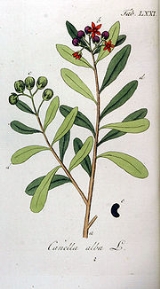
Canellales is the botanical name
for an order of flowering plants, one of the four orders of the magnoliids. It is defined to contain two families: Canellaceae
and Winteraceae
, which comprise 136 species of fragrant tree
s and shrub
s. The Canellaceae are found in tropical America and Africa, and the Winteraceae are part of the Antarctic flora
(found in diverse parts of the southern hemisphere). Although the order was defined based on phylogenetic studies, a number of possible synapomorphies have been suggested, relating to the pollen tube, the seeds, the thickness of the integument, and other aspects of the morphology
.
Until 1999, these two families were not considered to be closely related. Instead the Winteraceae
were considered to be a primitive family (due to the structure of the xylem
and carpel, a structure which now seems to be derived from xylem and carpels more typical of the angiosperms as a whole). The Canellaceae
was often considered to be related to the Myristicaceae
. However, studies starting in 1999, based on molecular phylogeny
or morphology, have supported uniting these two families.
Botanical name
A botanical name is a formal scientific name conforming to the International Code of Botanical Nomenclature and, if it concerns a plant cultigen, the additional cultivar and/or Group epithets must conform to the International Code of Nomenclature for Cultivated Plants...
for an order of flowering plants, one of the four orders of the magnoliids. It is defined to contain two families: Canellaceae
Canellaceae
The Canellaceae are a family of flowering plants. The family has sixteen species in six genera. The species are highly aromatic evergreen plants, mostly trees and rarely shrubs, which produce essential oils...
and Winteraceae
Winteraceae
The Winteraceae are a family of flowering plants. The family includes 120 species of trees and shrubs in 9 genera.The Winteraceae are a mostly southern-hemisphere family associated with the Antarctic flora, found in tropical to temperate climate regions of Malesia, Oceania, eastern Australia, New...
, which comprise 136 species of fragrant tree
Tree
A tree is a perennial woody plant. It is most often defined as a woody plant that has many secondary branches supported clear of the ground on a single main stem or trunk with clear apical dominance. A minimum height specification at maturity is cited by some authors, varying from 3 m to...
s and shrub
Shrub
A shrub or bush is distinguished from a tree by its multiple stems and shorter height, usually under 5–6 m tall. A large number of plants may become either shrubs or trees, depending on the growing conditions they experience...
s. The Canellaceae are found in tropical America and Africa, and the Winteraceae are part of the Antarctic flora
Antarctic flora
The Antarctic flora is a distinct community of vascular plants which evolved millions of years ago on the supercontinent of Gondwana, and is now found on several separate areas of the Southern Hemisphere, including southern South America, southernmost Africa, New Zealand, Australia and New Caledonia...
(found in diverse parts of the southern hemisphere). Although the order was defined based on phylogenetic studies, a number of possible synapomorphies have been suggested, relating to the pollen tube, the seeds, the thickness of the integument, and other aspects of the morphology
Plant morphology
Plant morphology or phytomorphology is the study of the physical form and external structure of plants. This is usually considered distinct from plant anatomy, which is the study of the internal structure of plants, especially at the microscopic level...
.
Until 1999, these two families were not considered to be closely related. Instead the Winteraceae
Winteraceae
The Winteraceae are a family of flowering plants. The family includes 120 species of trees and shrubs in 9 genera.The Winteraceae are a mostly southern-hemisphere family associated with the Antarctic flora, found in tropical to temperate climate regions of Malesia, Oceania, eastern Australia, New...
were considered to be a primitive family (due to the structure of the xylem
Xylem
Xylem is one of the two types of transport tissue in vascular plants. . The word xylem is derived from the Classical Greek word ξυλον , meaning "wood"; the best-known xylem tissue is wood, though it is found throughout the plant...
and carpel, a structure which now seems to be derived from xylem and carpels more typical of the angiosperms as a whole). The Canellaceae
Canellaceae
The Canellaceae are a family of flowering plants. The family has sixteen species in six genera. The species are highly aromatic evergreen plants, mostly trees and rarely shrubs, which produce essential oils...
was often considered to be related to the Myristicaceae
Myristicaceae
Myristicaceae is the botanical name for a family of flowering plants. The family has been recognised by most taxonomists; it is sometimes called the "nutmeg family", after its most famous member, Nutmeg ....
. However, studies starting in 1999, based on molecular phylogeny
Molecular phylogeny
Molecular phylogenetics is the analysis of hereditary molecular differences, mainly in DNA sequences, to gain information on an organism's evolutionary relationships. The result of a molecular phylogenetic analysis is expressed in a phylogenetic tree...
or morphology, have supported uniting these two families.
| {clade| style=font-size:75%;line-height:75% | label1=Magnoliidae Magnoliidae Magnoliids are a group of about 9,000 species of flowering plants, including magnolias, nutmeg, bay laurel, cinnamon, avocado, black pepper, and many others. They are characterized by trimerous flowers, pollen with one pore, and usually branching-veined leaves.-Classification:Traditionally,... |
1= }} |
| The current composition and phylogeny Phylogenetics In biology, phylogenetics is the study of evolutionary relatedness among groups of organisms , which is discovered through molecular sequencing data and morphological data matrices... of the Canellales. |