


Plant morphology

Encyclopedia
Plant morphology or phytomorphology is the study of the physical form and external structure
of plant
s. This is usually considered distinct from plant anatomy
, which is the study of the internal structure
of plants, especially at the microscopic level. Plant morphology is useful in the identification of plants.
First of all, morphology is comparative, meaning that the morphologist examines structures in many different plants of the same or different species, then draws comparisons and formulates ideas about similarities. When structures in different species are believed to exist and develop as a result of common, inherited genetic
pathways, those structures are termed homologous
. For example, the leaves
of pine, oak
, and cabbage
all look very different, but share certain basic structures and arrangement of parts. The homology of leaves is an easy conclusion to make. The plant morphologist goes further, and discovers that the spines of cactus also share the same basic structure and development as leaves in other plants, and therefore cactus spines are homologous to leaves as well. This aspect of plant morphology overlaps with the study of plant evolution
and paleobotany
.
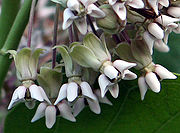 Secondly, plant morphology observes both the vegetative (somatic) structures of plants, as well as the reproductive structures. The vegetative structures of vascular plant
s includes the study of the shoot system, composed of stems
and leaves
, as well as the root
system. The reproductive structures are more varied, and are usually specific to a particular group of plants, such as flower
s and seed
s, fern sori
, and moss
capsules. The detailed study of reproductive structures in plants led to the discovery of the alternation of generations
found in all plants and most algae. This area of plant morphology overlaps with the study of biodiversity
and plant systematics.
Thirdly, plant morphology studies plant structure at a range of scales. At the smallest scales are ultrastructure
, the general structural features of cells visible only with the aid of an electron microscope
, and cytology
, the study of cells using optical microscopy. At this scale, plant morphology overlaps with plant anatomy
as a field of study. At the largest scale is the study of plant growth habit, the overall architecture of a plant. The pattern of branching in a tree
will vary from species to species, as will the appearance of a plant as a tree
, herb
, or grass
.
Fourthly, plant morphology examines the pattern of development, the process by which structures originate and mature as a plant grows. While animals produce all the body parts they will ever have from early in their life, plants constantly produce new tissues and structures throughout their life. A living plant always has embryonic tissues. The way in which new structures mature as they are produced may be affected by the point in the plants life when they begin to develop, as well as by the environment to which the structures are exposed. A morphologist studies this process, the causes, and its result. This area of plant morphology overlaps with plant physiology
and ecology
.
Understanding which characteristics and structures belong to each type is an important part of understanding plant evolution
. The evolutionary biologist relies on the plant morphologist to interpret structures, and in turn provides phylogenies
of plant relationships that may lead to new morphological insights.
plumosa and stems of Asparagus setaceus
both have the same feathery branching appearance, even though one is an alga and one is a flowering plant. The similarity in overall structure occurs independently as a result of convergence. The growth form of many cacti and species of Euphorbia is very similar, even though they belong to widely distant families. The similarity results from common solutions to the problem of surviving in a hot, dry environment.
The vegetative (somatic) structures of vascular plant
s include two major organ systems: (1) a shoot system, composed of stems
and leaves
, and (2) a root system. These two systems are common to nearly all vascular plants, and provide a unifying theme for the study of plant morphology.
By contrast, the reproductive structures are varied, and are usually specific to a particular group of plants. Structures such as flower
s and fruit
s are only found in the angiosperms; sori
are only found in fern
s; and seed cones
are only found in conifers and other gymnosperms. Reproductive characters are therefore regarded as more useful for the classification of plants than vegetative characters.
When characters are used in descriptions or for identification they are called diagnostic or key characters which can be either qualitative and quantitative.
Both kinds of characters can be very useful for the identification of plants.
, found in all plants and most algae, by the German botanist Wilhelm Hofmeister
. This discovery is one of the most important made in all of plant morphology, since it provides a common basis for understanding the life cycle of all plants.
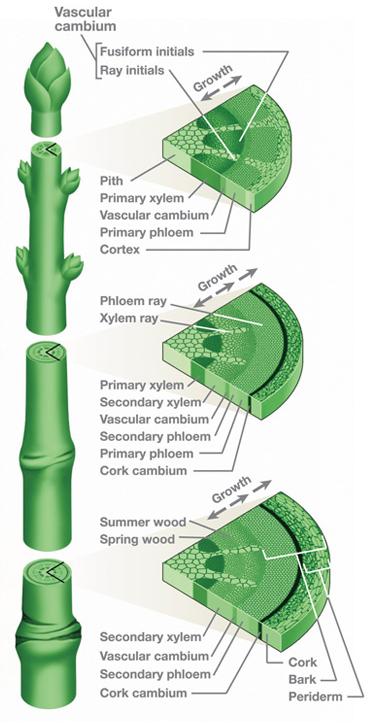 Plant development is the process by which structures originate and mature as a plant grows. It is a subject studies in plant anatomy
and plant physiology
as well as plant morphology.
The process of development in plants is fundamentally different from that seen in vertebrate
animals. When an animal embryo
begins to develop, it will very early produce all of the body parts that it will ever have in its life. When the animal is born (or hatches from its egg), it has all its body parts and from that point will only grow larger and more mature. By contrast, plants constantly produce new tissues and structures throughout their life from meristem
s located at the tips of organs, or between mature tissues. Thus, a living plant always has embryonic tissues.
The properties of organization seen in a plant are emergent properties
which are more than the sum of the individual parts. "The assembly of these tissues and functions into an integrated multicellular organism yields not only the characteristics of the separate parts and processes but also quite a new set of characteristics which would not have been predictable on the basis of examination of the separate parts." In other words, knowing everything about the molecules in a plant are not enough to predict characteristics of the cells; and knowing all the properties of the cells will not predict all the properties of a plant's structure.
begins from a single celled zygote
, formed by fertilisation
of an egg cell by a sperm cell. From that point, it begins to divide to form a plant embryo
through the process of embryogenesis. As this happens, the resulting cells will organize so that one end becomes the first root, while the other end forms the tip of the shoot. In seed
plants, the embryo will develop one or more "seed leaves" (cotyledon
s). By the end of embryogenesis, the young plant will have all the parts necessary to begin in its life.
Once the embryo germinates
from its seed or parent plant, it begins to produce additional organs (leaves, stems, and roots) through the process of organogenesis. New roots grow from root meristem
s located at the tip of the root, and new stems and leaves grow from shoot meristem
s located at the tip of the shoot. Branching occurs when small clumps of cells left behind by the meristem, and which have not yet undergone cellular differentiation
to form a specialized tissue, begin to grow as the tip of a new root or shoot. Growth from any such meristem at the tip of a root or shoot is termed primary growth and results in the lengthening of that root or shoot. Secondary growth
results in widening of a root or shoot from divisions of cells in a cambium
.
In addition to growth by cell
division, a plant may grow through cell elongation. This occurs when individual cells or groups of cells grow longer. Not all plant cells will grow to the same length. When cells on one side of a stem grow longer and faster than cells on the other side, the stem will bend to the side of the slower growing cells as a result. This directional growth can occur via a plant's response to a particular stimulus, such as light (phototropism
), gravity (gravitropism
), water, (hydrotropism
), and physical contact (thigmotropism
).
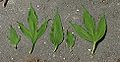 Although plants produce numerous copies of the same organ during their lives, not all copies of a particular organ will be identical. There is variation among the parts of a mature plant resulting from the relative position where the organ is produced. For example, along a new branch the leaves may vary in a consistent pattern along the branch. The form of leaves produced near the base of the branch will differ from leaves produced at the tip of the plant, and this difference is consistent from branch to branch on a given plant and in a given species. This difference persists after the leaves at both ends of the branch have matured, and is not the result of some leaves being younger than others.
s and emergent plant
s.
, are often different from those that are produced by the same plant when it is older. This phenomenon is known as juvenility. For example, young trees will produce longer, leaner branches that grow upwards more than the branches they will produce as a fully grown tree. In addition, leaves produced during early growth tend to be larger, thinner, and more irregular than leaves on the adult plant. Species of juvenile plants may look so completely different from the adult leaves that egg-laying insects do not recognize the plant as food for their young.
has revised fundamental concepts of comparative morphology such as the concept of homology
. He emphasized that homology should also include partial homology and quantitative homology. This leads to a continuum morphology that demonstrates a continuum between the morphological categories of root, shoot, stem (caulome), leaf (phyllome), and hair (trichome). How intermediates between the categories are best described has been discussed by Bruce K. Kirchoff et al.
Honoring Agnes Arber, author of the partial-shoot theory of the leaf
, Rutishauser and Isler called the continuum approach Fuzzy Arberian Morphology (FAM). “Fuzzy” refers to fuzzy logic
, “Arberian” to Agnes Arber
. Rutishauser and Isler emphasized that this approach is not only supported by many morphological data but also by evidence from molecular genetics.
Process morphology (dynamic morphology) describes and analyzes the dynamic continuum of plant form. According to this approach, structures do not have process(es), they are process(es). Thus, the structure/process dichotomy is overcome by "an enlargement of our concept of 'structure' so as to include and recognize that in the living organism it is not merely a question of spatial structure with an 'activity' as something over or against it, but that the concrete organism is a spatio-temporal structure and that this spatio-temporal structure is the activity itself."
For Jeune, Barabé and Lacroix, classical morphology (that is, mainstream morphology, based on a qualitative homology concept implying mutually exclusive categories) and continuum morphology are sub-classes of the more encompassing process morphology (dynamic morphology).
Morphology (biology)
In biology, morphology is a branch of bioscience dealing with the study of the form and structure of organisms and their specific structural features....
of plant
Plant
Plants are living organisms belonging to the kingdom Plantae. Precise definitions of the kingdom vary, but as the term is used here, plants include familiar organisms such as trees, flowers, herbs, bushes, grasses, vines, ferns, mosses, and green algae. The group is also called green plants or...
s. This is usually considered distinct from plant anatomy
Plant anatomy
Plant anatomy or phytotomy is the general term for the study of the internal structure of plants. While originally it included plant morphology, which is the description of the physical form and external structure of plants, since the mid-20th century the investigations of plant anatomy are...
, which is the study of the internal structure
Anatomy
Anatomy is a branch of biology and medicine that is the consideration of the structure of living things. It is a general term that includes human anatomy, animal anatomy , and plant anatomy...
of plants, especially at the microscopic level. Plant morphology is useful in the identification of plants.
Scope
Plant morphology "represents a study of the development, form, and structure of plants, and, by implication, an attempt to interpret these on the basis of similarity of plan and origin." There are four major areas of investigation in plant morphology, and each overlaps with another field of the biological sciences.First of all, morphology is comparative, meaning that the morphologist examines structures in many different plants of the same or different species, then draws comparisons and formulates ideas about similarities. When structures in different species are believed to exist and develop as a result of common, inherited genetic
Genetics
Genetics , a discipline of biology, is the science of genes, heredity, and variation in living organisms....
pathways, those structures are termed homologous
Homology (biology)
Homology forms the basis of organization for comparative biology. In 1843, Richard Owen defined homology as "the same organ in different animals under every variety of form and function". Organs as different as a bat's wing, a seal's flipper, a cat's paw and a human hand have a common underlying...
. For example, the leaves
Leaf
A leaf is an organ of a vascular plant, as defined in botanical terms, and in particular in plant morphology. Foliage is a mass noun that refers to leaves as a feature of plants....
of pine, oak
Oak
An oak is a tree or shrub in the genus Quercus , of which about 600 species exist. "Oak" may also appear in the names of species in related genera, notably Lithocarpus...
, and cabbage
Cabbage
Cabbage is a popular cultivar of the species Brassica oleracea Linne of the Family Brassicaceae and is a leafy green vegetable...
all look very different, but share certain basic structures and arrangement of parts. The homology of leaves is an easy conclusion to make. The plant morphologist goes further, and discovers that the spines of cactus also share the same basic structure and development as leaves in other plants, and therefore cactus spines are homologous to leaves as well. This aspect of plant morphology overlaps with the study of plant evolution
Evolution
Evolution is any change across successive generations in the heritable characteristics of biological populations. Evolutionary processes give rise to diversity at every level of biological organisation, including species, individual organisms and molecules such as DNA and proteins.Life on Earth...
and paleobotany
Paleobotany
Paleobotany, also spelled as palaeobotany , is the branch of paleontology or paleobiology dealing with the recovery and identification of plant remains from geological contexts, and their use for the biological reconstruction of past environments , and both the evolutionary history of plants, with a...
.
Vascular plant
Vascular plants are those plants that have lignified tissues for conducting water, minerals, and photosynthetic products through the plant. Vascular plants include the clubmosses, Equisetum, ferns, gymnosperms and angiosperms...
s includes the study of the shoot system, composed of stems
Plant stem
A stem is one of two main structural axes of a vascular plant. The stem is normally divided into nodes and internodes, the nodes hold buds which grow into one or more leaves, inflorescence , conifer cones, roots, other stems etc. The internodes distance one node from another...
and leaves
Leaf
A leaf is an organ of a vascular plant, as defined in botanical terms, and in particular in plant morphology. Foliage is a mass noun that refers to leaves as a feature of plants....
, as well as the root
Root
In vascular plants, the root is the organ of a plant that typically lies below the surface of the soil. This is not always the case, however, since a root can also be aerial or aerating . Furthermore, a stem normally occurring below ground is not exceptional either...
system. The reproductive structures are more varied, and are usually specific to a particular group of plants, such as flower
Flower
A flower, sometimes known as a bloom or blossom, is the reproductive structure found in flowering plants . The biological function of a flower is to effect reproduction, usually by providing a mechanism for the union of sperm with eggs...
s and seed
Seed
A seed is a small embryonic plant enclosed in a covering called the seed coat, usually with some stored food. It is the product of the ripened ovule of gymnosperm and angiosperm plants which occurs after fertilization and some growth within the mother plant...
s, fern sori
Sorus
A sorus is a cluster of sporangia .In fungi and lichens, the sorus is surrounded by an external layer. In some red algae it may take the form of a depression into the thallus....
, and moss
Moss
Mosses are small, soft plants that are typically 1–10 cm tall, though some species are much larger. They commonly grow close together in clumps or mats in damp or shady locations. They do not have flowers or seeds, and their simple leaves cover the thin wiry stems...
capsules. The detailed study of reproductive structures in plants led to the discovery of the alternation of generations
Alternation of generations
Alternation of generations is a term primarily used in describing the life cycle of plants . A multicellular sporophyte, which is diploid with 2N paired chromosomes , alternates with a multicellular gametophyte, which is haploid with N unpaired chromosomes...
found in all plants and most algae. This area of plant morphology overlaps with the study of biodiversity
Biodiversity
Biodiversity is the degree of variation of life forms within a given ecosystem, biome, or an entire planet. Biodiversity is a measure of the health of ecosystems. Biodiversity is in part a function of climate. In terrestrial habitats, tropical regions are typically rich whereas polar regions...
and plant systematics.
Thirdly, plant morphology studies plant structure at a range of scales. At the smallest scales are ultrastructure
Ultrastructure
Ultrastructure is the detailed structure of a biological specimen, such as a cell, tissue, or organ, that can be observed by electron microscopy...
, the general structural features of cells visible only with the aid of an electron microscope
Electron microscope
An electron microscope is a type of microscope that uses a beam of electrons to illuminate the specimen and produce a magnified image. Electron microscopes have a greater resolving power than a light-powered optical microscope, because electrons have wavelengths about 100,000 times shorter than...
, and cytology
Cell biology
Cell biology is a scientific discipline that studies cells – their physiological properties, their structure, the organelles they contain, interactions with their environment, their life cycle, division and death. This is done both on a microscopic and molecular level...
, the study of cells using optical microscopy. At this scale, plant morphology overlaps with plant anatomy
Plant anatomy
Plant anatomy or phytotomy is the general term for the study of the internal structure of plants. While originally it included plant morphology, which is the description of the physical form and external structure of plants, since the mid-20th century the investigations of plant anatomy are...
as a field of study. At the largest scale is the study of plant growth habit, the overall architecture of a plant. The pattern of branching in a tree
Tree
A tree is a perennial woody plant. It is most often defined as a woody plant that has many secondary branches supported clear of the ground on a single main stem or trunk with clear apical dominance. A minimum height specification at maturity is cited by some authors, varying from 3 m to...
will vary from species to species, as will the appearance of a plant as a tree
Tree
A tree is a perennial woody plant. It is most often defined as a woody plant that has many secondary branches supported clear of the ground on a single main stem or trunk with clear apical dominance. A minimum height specification at maturity is cited by some authors, varying from 3 m to...
, herb
Herb
Except in botanical usage, an herb is "any plant with leaves, seeds, or flowers used for flavoring, food, medicine, or perfume" or "a part of such a plant as used in cooking"...
, or grass
Grass
Grasses, or more technically graminoids, are monocotyledonous, usually herbaceous plants with narrow leaves growing from the base. They include the "true grasses", of the Poaceae family, as well as the sedges and the rushes . The true grasses include cereals, bamboo and the grasses of lawns ...
.
Fourthly, plant morphology examines the pattern of development, the process by which structures originate and mature as a plant grows. While animals produce all the body parts they will ever have from early in their life, plants constantly produce new tissues and structures throughout their life. A living plant always has embryonic tissues. The way in which new structures mature as they are produced may be affected by the point in the plants life when they begin to develop, as well as by the environment to which the structures are exposed. A morphologist studies this process, the causes, and its result. This area of plant morphology overlaps with plant physiology
Plant physiology
Plant physiology is a subdiscipline of botany concerned with the functioning, or physiology, of plants. Closely related fields include plant morphology , plant ecology , phytochemistry , cell biology, and molecular biology.Fundamental processes such as photosynthesis, respiration, plant nutrition,...
and ecology
Ecology
Ecology is the scientific study of the relations that living organisms have with respect to each other and their natural environment. Variables of interest to ecologists include the composition, distribution, amount , number, and changing states of organisms within and among ecosystems...
.
A comparative science
A plant morphologist makes comparisons between structures in many different plants of the same or different species. Making such comparisons between similar structures in different plants tackles the question of why the structures are similar. It is quite likely that similar underlying causes of genetics, physiology, or response to the environment have led to this similarity in appearance. The result of scientific investigation into these causes can lead to one of two insights into the underlying biology:- HomologyHomology (biology)Homology forms the basis of organization for comparative biology. In 1843, Richard Owen defined homology as "the same organ in different animals under every variety of form and function". Organs as different as a bat's wing, a seal's flipper, a cat's paw and a human hand have a common underlying...
- the structure is similar between the two species because of shared ancestry and common genetics. - ConvergenceConvergent evolutionConvergent evolution describes the acquisition of the same biological trait in unrelated lineages.The wing is a classic example of convergent evolution in action. Although their last common ancestor did not have wings, both birds and bats do, and are capable of powered flight. The wings are...
- the structure is similar between the two species because of independent adaptation to common environmental pressures.
Understanding which characteristics and structures belong to each type is an important part of understanding plant evolution
Evolution
Evolution is any change across successive generations in the heritable characteristics of biological populations. Evolutionary processes give rise to diversity at every level of biological organisation, including species, individual organisms and molecules such as DNA and proteins.Life on Earth...
. The evolutionary biologist relies on the plant morphologist to interpret structures, and in turn provides phylogenies
Phylogenetics
In biology, phylogenetics is the study of evolutionary relatedness among groups of organisms , which is discovered through molecular sequencing data and morphological data matrices...
of plant relationships that may lead to new morphological insights.
Homology
When structures in different species are believed to exist and develop as a result of common, inherited genetic pathways, those structures are termed homologous. For example, the leaves of pine, oak, and cabbage all look very different, but share certain basic structures and arrangement of parts. The homology of leaves is an easy conclusion to make. The plant morphologist goes further, and discovers that the spines of cactus also share the same basic structure and development as leaves in other plants, and therefore cactus spines are homologous to leaves as well.Convergence
When structures in different species are believed to exist and develop as a result of common adaptive responses to environmental pressure, those structures are termed convergent. For example, the fronds of BryopsisBryopsis
In taxonomy, Bryopsis is a genus of marine algae, specifically of the Bryopsidaceae. It is frequently a pest in aquariums, where it is commonly referred to as hair algae.-Species List:* Bryopsis adriatica* Bryopsis africana...
plumosa and stems of Asparagus setaceus
Asparagus setaceus
Asparagus setaceus, commonly known as Common Asparagus Fern, Lace Fern, Climbing Asparagus, or Ferny Asparagus, is a vine plant in the genus Asparagus. Despite its common name, the plant is not a true fern, but has leaves that resemble one.It is native to Southern Africa, and is grown elsewhere as...
both have the same feathery branching appearance, even though one is an alga and one is a flowering plant. The similarity in overall structure occurs independently as a result of convergence. The growth form of many cacti and species of Euphorbia is very similar, even though they belong to widely distant families. The similarity results from common solutions to the problem of surviving in a hot, dry environment.
Vegetative and reproductive characters
Plant morphology treats both the vegetative structures of plants, as well as the reproductive structures.The vegetative (somatic) structures of vascular plant
Vascular plant
Vascular plants are those plants that have lignified tissues for conducting water, minerals, and photosynthetic products through the plant. Vascular plants include the clubmosses, Equisetum, ferns, gymnosperms and angiosperms...
s include two major organ systems: (1) a shoot system, composed of stems
Plant stem
A stem is one of two main structural axes of a vascular plant. The stem is normally divided into nodes and internodes, the nodes hold buds which grow into one or more leaves, inflorescence , conifer cones, roots, other stems etc. The internodes distance one node from another...
and leaves
Leaf
A leaf is an organ of a vascular plant, as defined in botanical terms, and in particular in plant morphology. Foliage is a mass noun that refers to leaves as a feature of plants....
, and (2) a root system. These two systems are common to nearly all vascular plants, and provide a unifying theme for the study of plant morphology.
By contrast, the reproductive structures are varied, and are usually specific to a particular group of plants. Structures such as flower
Flower
A flower, sometimes known as a bloom or blossom, is the reproductive structure found in flowering plants . The biological function of a flower is to effect reproduction, usually by providing a mechanism for the union of sperm with eggs...
s and fruit
Fruit
In broad terms, a fruit is a structure of a plant that contains its seeds.The term has different meanings dependent on context. In non-technical usage, such as food preparation, fruit normally means the fleshy seed-associated structures of certain plants that are sweet and edible in the raw state,...
s are only found in the angiosperms; sori
Sorus
A sorus is a cluster of sporangia .In fungi and lichens, the sorus is surrounded by an external layer. In some red algae it may take the form of a depression into the thallus....
are only found in fern
Fern
A fern is any one of a group of about 12,000 species of plants belonging to the botanical group known as Pteridophyta. Unlike mosses, they have xylem and phloem . They have stems, leaves, and roots like other vascular plants...
s; and seed cones
Conifer cone
A cone is an organ on plants in the division Pinophyta that contains the reproductive structures. The familiar woody cone is the female cone, which produces seeds. The male cones, which produce pollen, are usually herbaceous and much less conspicuous even at full maturity...
are only found in conifers and other gymnosperms. Reproductive characters are therefore regarded as more useful for the classification of plants than vegetative characters.
Use in identification
Plant biologists use morphological characters of plants which can be compared, measured counted and described to assess the differences or similarities in plant taxa and use these characters for plant identification, classification and descriptions.When characters are used in descriptions or for identification they are called diagnostic or key characters which can be either qualitative and quantitative.
- Quantitative characters are morphological features that can be counted or measured for example a plant species has flower petals 10–12 mm wide.
- Qualitative characters are morphological features such as leaf shape, flower color or pubescence.
Both kinds of characters can be very useful for the identification of plants.
Alternation of generations
The detailed study of reproductive structures in plants led to the discovery of the alternation of generationsAlternation of generations
Alternation of generations is a term primarily used in describing the life cycle of plants . A multicellular sporophyte, which is diploid with 2N paired chromosomes , alternates with a multicellular gametophyte, which is haploid with N unpaired chromosomes...
, found in all plants and most algae, by the German botanist Wilhelm Hofmeister
Wilhelm Hofmeister
Wilhelm Friedrich Benedikt Hofmeister was a German biologist and botanist. He "stands as one of the true giants in the history of biology and belongs in the same pantheon as Darwin and Mendel." He was largely self-taught....
. This discovery is one of the most important made in all of plant morphology, since it provides a common basis for understanding the life cycle of all plants.
Development
Plant anatomy
Plant anatomy or phytotomy is the general term for the study of the internal structure of plants. While originally it included plant morphology, which is the description of the physical form and external structure of plants, since the mid-20th century the investigations of plant anatomy are...
and plant physiology
Plant physiology
Plant physiology is a subdiscipline of botany concerned with the functioning, or physiology, of plants. Closely related fields include plant morphology , plant ecology , phytochemistry , cell biology, and molecular biology.Fundamental processes such as photosynthesis, respiration, plant nutrition,...
as well as plant morphology.
The process of development in plants is fundamentally different from that seen in vertebrate
Vertebrate
Vertebrates are animals that are members of the subphylum Vertebrata . Vertebrates are the largest group of chordates, with currently about 58,000 species described. Vertebrates include the jawless fishes, bony fishes, sharks and rays, amphibians, reptiles, mammals, and birds...
animals. When an animal embryo
Embryo
An embryo is a multicellular diploid eukaryote in its earliest stage of development, from the time of first cell division until birth, hatching, or germination...
begins to develop, it will very early produce all of the body parts that it will ever have in its life. When the animal is born (or hatches from its egg), it has all its body parts and from that point will only grow larger and more mature. By contrast, plants constantly produce new tissues and structures throughout their life from meristem
Meristem
A meristem is the tissue in most plants consisting of undifferentiated cells , found in zones of the plant where growth can take place....
s located at the tips of organs, or between mature tissues. Thus, a living plant always has embryonic tissues.
The properties of organization seen in a plant are emergent properties
Emergence
In philosophy, systems theory, science, and art, emergence is the way complex systems and patterns arise out of a multiplicity of relatively simple interactions. Emergence is central to the theories of integrative levels and of complex systems....
which are more than the sum of the individual parts. "The assembly of these tissues and functions into an integrated multicellular organism yields not only the characteristics of the separate parts and processes but also quite a new set of characteristics which would not have been predictable on the basis of examination of the separate parts." In other words, knowing everything about the molecules in a plant are not enough to predict characteristics of the cells; and knowing all the properties of the cells will not predict all the properties of a plant's structure.
Growth
A vascular plantVascular plant
Vascular plants are those plants that have lignified tissues for conducting water, minerals, and photosynthetic products through the plant. Vascular plants include the clubmosses, Equisetum, ferns, gymnosperms and angiosperms...
begins from a single celled zygote
Zygote
A zygote , or zygocyte, is the initial cell formed when two gamete cells are joined by means of sexual reproduction. In multicellular organisms, it is the earliest developmental stage of the embryo...
, formed by fertilisation
Fertilisation
Fertilisation is the fusion of gametes to produce a new organism. In animals, the process involves the fusion of an ovum with a sperm, which eventually leads to the development of an embryo...
of an egg cell by a sperm cell. From that point, it begins to divide to form a plant embryo
Embryo
An embryo is a multicellular diploid eukaryote in its earliest stage of development, from the time of first cell division until birth, hatching, or germination...
through the process of embryogenesis. As this happens, the resulting cells will organize so that one end becomes the first root, while the other end forms the tip of the shoot. In seed
Seed
A seed is a small embryonic plant enclosed in a covering called the seed coat, usually with some stored food. It is the product of the ripened ovule of gymnosperm and angiosperm plants which occurs after fertilization and some growth within the mother plant...
plants, the embryo will develop one or more "seed leaves" (cotyledon
Cotyledon
A cotyledon , is a significant part of the embryo within the seed of a plant. Upon germination, the cotyledon may become the embryonic first leaves of a seedling. The number of cotyledons present is one characteristic used by botanists to classify the flowering plants...
s). By the end of embryogenesis, the young plant will have all the parts necessary to begin in its life.
Once the embryo germinates
Germination
Germination is the process in which a plant or fungus emerges from a seed or spore, respectively, and begins growth. The most common example of germination is the sprouting of a seedling from a seed of an angiosperm or gymnosperm. However the growth of a sporeling from a spore, for example the...
from its seed or parent plant, it begins to produce additional organs (leaves, stems, and roots) through the process of organogenesis. New roots grow from root meristem
Meristem
A meristem is the tissue in most plants consisting of undifferentiated cells , found in zones of the plant where growth can take place....
s located at the tip of the root, and new stems and leaves grow from shoot meristem
Meristem
A meristem is the tissue in most plants consisting of undifferentiated cells , found in zones of the plant where growth can take place....
s located at the tip of the shoot. Branching occurs when small clumps of cells left behind by the meristem, and which have not yet undergone cellular differentiation
Cellular differentiation
In developmental biology, cellular differentiation is the process by which a less specialized cell becomes a more specialized cell type. Differentiation occurs numerous times during the development of a multicellular organism as the organism changes from a simple zygote to a complex system of...
to form a specialized tissue, begin to grow as the tip of a new root or shoot. Growth from any such meristem at the tip of a root or shoot is termed primary growth and results in the lengthening of that root or shoot. Secondary growth
Secondary growth
In many vascular plants, secondary growth is the result of the activity of the two lateral meristems, the cork cambium and vascular cambium. Arising from lateral meristems, secondary growth increases the girth of the plant root or stem, rather than its length. As long as the lateral meristems...
results in widening of a root or shoot from divisions of cells in a cambium
Cambium (botany)
A cambium , in botany, is a tissue layer that provide undifferentiated cells for plant growth. It forms parallel rows of cells, which result in secondary tissues....
.
In addition to growth by cell
Cell (biology)
The cell is the basic structural and functional unit of all known living organisms. It is the smallest unit of life that is classified as a living thing, and is often called the building block of life. The Alberts text discusses how the "cellular building blocks" move to shape developing embryos....
division, a plant may grow through cell elongation. This occurs when individual cells or groups of cells grow longer. Not all plant cells will grow to the same length. When cells on one side of a stem grow longer and faster than cells on the other side, the stem will bend to the side of the slower growing cells as a result. This directional growth can occur via a plant's response to a particular stimulus, such as light (phototropism
Phototropism
Phototropism is directional growth in which the direction of growth is determined by the direction of the light source. In other words, it is the growth and response to a light stimulus. Phototropism is most often observed in plants, but can also occur in other organisms such as fungi...
), gravity (gravitropism
Gravitropism
Gravitropism is a turning or growth movement by a plant or fungus in response to gravity. Charles Darwin was one of the first to scientifically document that roots show positive gravitropism and stems show negative gravitropism. That is, roots grow in the direction of gravitational pull and stems...
), water, (hydrotropism
Hydrotropism
Hydrotropism is a plant's growth response in which the direction of growth is determined by a stimulus or gradient in water concentration...
), and physical contact (thigmotropism
Thigmotropism
Thigmotropism is a movement in which an organism moves or grows in response to touch or contact stimuli. The prefix thigmo- θιγμος comes from the Greek for "touch". Usually thigmotropism occurs when plants grow around a surface, such as a wall, pot, or trellis. Climbing plants, such as vines,...
).
Morphological variation
Plants exhibit natural variation in their form and structure. While all organisms vary from individual to individual, plants exhibit an additional type of variation. Within a single individual, parts are repeated which may differ in form and structure from other similar parts. This variation is most easily seen in the leaves of a plant, though other organs such as stems and flowers may show similar variation. There are three primary causes of this variation: positional effects, environmental effects, and juvenility.Positional effects
Environmental effects
The way in which new structures mature as they are produced may be affected by the point in the plants life when they begin to develop, as well as by the environment to which the structures are exposed. This can be seen in aquatic plantAquatic plant
Aquatic plants are plants that have adapted to living in aquatic environments. They are also referred to as hydrophytes or aquatic macrophytes. These plants require special adaptations for living submerged in water, or at the water's surface. Aquatic plants can only grow in water or in soil that is...
s and emergent plant
Emergent plant
An emergent plant is one which grows in water but which pierces the surface so that it is partially in air. Collectively, such plants are emergent vegetation....
s.
Juvenility
The organs and tissues produced by a young plant, such as a seedlingSeedling
thumb|Monocot and dicot seedlingsA seedling is a young plant sporophyte developing out of a plant embryo from a seed. Seedling development starts with germination of the seed. A typical young seedling consists of three main parts: the radicle , the hypocotyl , and the cotyledons...
, are often different from those that are produced by the same plant when it is older. This phenomenon is known as juvenility. For example, young trees will produce longer, leaner branches that grow upwards more than the branches they will produce as a fully grown tree. In addition, leaves produced during early growth tend to be larger, thinner, and more irregular than leaves on the adult plant. Species of juvenile plants may look so completely different from the adult leaves that egg-laying insects do not recognize the plant as food for their young.
Some recent developments
Rolf SattlerRolf Sattler
Rolf Sattler, Ph.D., D.Sc. , F.L.S., F.R.S.C., is a Canadian plant morphologist, biologist, philosopher, and educator. He is considered one of the most significant contributors to the field of plant morphology. His contributions are not only empirical but involved also a revision of the most...
has revised fundamental concepts of comparative morphology such as the concept of homology
Homology (biology)
Homology forms the basis of organization for comparative biology. In 1843, Richard Owen defined homology as "the same organ in different animals under every variety of form and function". Organs as different as a bat's wing, a seal's flipper, a cat's paw and a human hand have a common underlying...
. He emphasized that homology should also include partial homology and quantitative homology. This leads to a continuum morphology that demonstrates a continuum between the morphological categories of root, shoot, stem (caulome), leaf (phyllome), and hair (trichome). How intermediates between the categories are best described has been discussed by Bruce K. Kirchoff et al.
Honoring Agnes Arber, author of the partial-shoot theory of the leaf
Agnes Arber
Agnes Robertson Arber was a renowned British plant morphologist and anatomist, historian of botany and philosopher of biology. She was born in London but lived most of her life in Cambridge, including the last 51 years of her life...
, Rutishauser and Isler called the continuum approach Fuzzy Arberian Morphology (FAM). “Fuzzy” refers to fuzzy logic
Fuzzy logic
Fuzzy logic is a form of many-valued logic; it deals with reasoning that is approximate rather than fixed and exact. In contrast with traditional logic theory, where binary sets have two-valued logic: true or false, fuzzy logic variables may have a truth value that ranges in degree between 0 and 1...
, “Arberian” to Agnes Arber
Agnes Arber
Agnes Robertson Arber was a renowned British plant morphologist and anatomist, historian of botany and philosopher of biology. She was born in London but lived most of her life in Cambridge, including the last 51 years of her life...
. Rutishauser and Isler emphasized that this approach is not only supported by many morphological data but also by evidence from molecular genetics.
Process morphology (dynamic morphology) describes and analyzes the dynamic continuum of plant form. According to this approach, structures do not have process(es), they are process(es). Thus, the structure/process dichotomy is overcome by "an enlargement of our concept of 'structure' so as to include and recognize that in the living organism it is not merely a question of spatial structure with an 'activity' as something over or against it, but that the concrete organism is a spatio-temporal structure and that this spatio-temporal structure is the activity itself."
For Jeune, Barabé and Lacroix, classical morphology (that is, mainstream morphology, based on a qualitative homology concept implying mutually exclusive categories) and continuum morphology are sub-classes of the more encompassing process morphology (dynamic morphology).
See also
- List of plant morphology terms
- Portal:plants
- Plant anatomyPlant anatomyPlant anatomy or phytotomy is the general term for the study of the internal structure of plants. While originally it included plant morphology, which is the description of the physical form and external structure of plants, since the mid-20th century the investigations of plant anatomy are...
- Plant identificationPlant identificationPlant identification is the process of matching a specimen plant to a known taxon. It uses various methods, most commonly dichotomous keys or multi-access keys. The natural key systems use morphological characteristics that can be compared with known databases to achieve typically the plants' genus...
- Plant physiologyPlant physiologyPlant physiology is a subdiscipline of botany concerned with the functioning, or physiology, of plants. Closely related fields include plant morphology , plant ecology , phytochemistry , cell biology, and molecular biology.Fundamental processes such as photosynthesis, respiration, plant nutrition,...
- Plant evolutionary developmental biologyPlant evolutionary developmental biologyEvolutionary developmental biology refers to the study of developmental programs and patterns from an evolutionary perspective. It seeks to understand the various influences shaping the form and nature of life on the planet. Evo-devo arose as a separate branch of science rather recently. An early...
- TaxonomyTaxonomyTaxonomy is the science of identifying and naming species, and arranging them into a classification. The field of taxonomy, sometimes referred to as "biological taxonomy", revolves around the description and use of taxonomic units, known as taxa...
- Simulated growth of plantsSimulated growth of plantsThe simulated growth of plants is a significant task in of systems biology and mathematical biology, which seeks to reproduce plant morphology with computer software.Electronic trees usually use L-systems to simulate growth...