

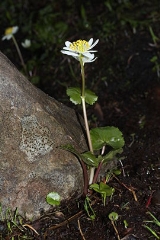
Caltha leptosepala

Encyclopedia
Caltha leptosepala is a species of flowering plant in the buttercup family
. It is native to western North America from Alaska
to New Mexico
, where it grows in wet mountain habitats in alpine
and subalpine
regions. There are two general wild types of this species, one native to the interior and one that grows along the Pacific coast and coastal mountains, but these are not always treated separately.
 This is a perennial herb growing a mostly naked stem with leaves located basally. The leaves are up to 13 or 15 centimeters long and may have smooth, wrinkled, or toothed edges. The inflorescence
bears one or more flowers. Each flower is 1 to 4 centimeters wide and lacks petals, having instead petallike sepals which are usually white or sometimes yellow. In the center are many long, flat stamen
s and fewer pistils
.
Ranunculaceae
Ranunculaceae are a family of about 1700 species of flowering plants in about 60 genera, distributed worldwide....
. It is native to western North America from Alaska
Alaska
Alaska is the largest state in the United States by area. It is situated in the northwest extremity of the North American continent, with Canada to the east, the Arctic Ocean to the north, and the Pacific Ocean to the west and south, with Russia further west across the Bering Strait...
to New Mexico
New Mexico
New Mexico is a state located in the southwest and western regions of the United States. New Mexico is also usually considered one of the Mountain States. With a population density of 16 per square mile, New Mexico is the sixth-most sparsely inhabited U.S...
, where it grows in wet mountain habitats in alpine
Alpine climate
Alpine climate is the average weather for a region above the tree line. This climate is also referred to as mountain climate or highland climate....
and subalpine
Subalpine
The subalpine zone is the biotic zone immediately below tree line around the world. Species that occur in this zone depend on the location of the zone on the Earth, for example, Snow Gum in Australia, or Subalpine Larch, Mountain Hemlock and Subalpine Fir in western North America.Trees in the...
regions. There are two general wild types of this species, one native to the interior and one that grows along the Pacific coast and coastal mountains, but these are not always treated separately.
Inflorescence
An inflorescence is a group or cluster of flowers arranged on a stem that is composed of a main branch or a complicated arrangement of branches. Strictly, it is the part of the shoot of seed plants where flowers are formed and which is accordingly modified...
bears one or more flowers. Each flower is 1 to 4 centimeters wide and lacks petals, having instead petallike sepals which are usually white or sometimes yellow. In the center are many long, flat stamen
Stamen
The stamen is the pollen producing reproductive organ of a flower...
s and fewer pistils
Gynoecium
Gynoecium is most commonly used as a collective term for all carpels in a flower. A carpel is the ovule and seed producing reproductive organ in flowering plants. Carpels are derived from ovule-bearing leaves which evolved to form a closed structure containing the ovules...
.
External links
- USDA Plants Profile
- Edibility of Caltha leptosepala: Visual identification and edible parts of Caltha leptosepala.