

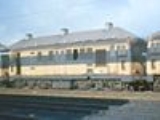
CIE 101 Class

Encyclopedia
The Córas Iompair Éireann
101 Class locomotive
s, numbered B101-B112, were built in 1956 by the Birmingham Railway Carriage and Wagon Company
. They were fitted with Sulzer 6LDA28 engines of 960 hp, with four Metropolitan-Vickers
MV157 traction motors. They were of A1A-A1A wheel arrangement
, weighed 75 tonnes and had a maximum speed of 120 km/h (75mph).
With their design, size and axle loading, they were intended for mixed traffic duties, hauling both freight and passenger trains. They found regular use primarily on the Waterford
-Mallow
-Tralee line and also on the Tralee-Newcastle West
-Limerick
line. Given that they were the first main group of diesel locos used in Ireland, they proved very successful and quickly gained a reputation for comfort and reliability by contrast to the poor cab conditions and suspension rocking of the Class 113
and the interminable breakdowns of the 001
/201
. However during the 1960s many of the secondary lines that they were used on were closed and following the arrival of the 181 Class
, the 101s were relegated to goods, permanent way and pilot duties.
The first withdrawal took place in 1969 (B111), and the last in February 1978 (B106). A proposal to re-engine them in the light of similar refurbishments of the Class 001 and Class 201 came to nought, and the decision was taken to order new locomotives in the form of the 071 Class instead.
After withdrawal, the entire class was lined up together with the two 113 Class
locomotives to form a sound barrier around Inchicore Works. Official withdrawal of the class came in April 1984, and the majority were scrapped between December 1986 and March 1987. However, No. 103 survived and has been preserved by the Irish Traction Group
at Carrick-on-Suir. .
Córas Iompair Éireann
Córas Iompair Éireann , or CIÉ, is a statutory corporation of the Irish state, answerable to the Irish Government and responsible for most public transport in the Republic of Ireland and, jointly with its Northern Ireland counterpart, the Northern Ireland Transport Holding Company, between the...
101 Class locomotive
Locomotive
A locomotive is a railway vehicle that provides the motive power for a train. The word originates from the Latin loco – "from a place", ablative of locus, "place" + Medieval Latin motivus, "causing motion", and is a shortened form of the term locomotive engine, first used in the early 19th...
s, numbered B101-B112, were built in 1956 by the Birmingham Railway Carriage and Wagon Company
Birmingham Railway Carriage and Wagon Company
The Birmingham Railway Carriage and Wagon Company was a railway locomotive and carriage builder, founded in Birmingham, England and, for most of its existence, located at nearby Smethwick, with the factory was divided by the boundary between the two places...
. They were fitted with Sulzer 6LDA28 engines of 960 hp, with four Metropolitan-Vickers
Metropolitan-Vickers
Metropolitan-Vickers, Metrovick, or Metrovicks, was a British heavy electrical engineering company of the early-to-mid 20th century formerly known as British Westinghouse. Highly diversified, they were particularly well known for their industrial electrical equipment such as generators, steam...
MV157 traction motors. They were of A1A-A1A wheel arrangement
UIC classification
The UIC classification of locomotive axle arrangements describes the wheel arrangement of locomotives, multiple units and trams. It is set out in the International Union of Railways "Leaflet 650 - Standard designation of axle arrangement on locomotives and multiple-unit sets". It is used in much...
, weighed 75 tonnes and had a maximum speed of 120 km/h (75mph).
With their design, size and axle loading, they were intended for mixed traffic duties, hauling both freight and passenger trains. They found regular use primarily on the Waterford
Waterford
Waterford is a city in the South-East Region of Ireland. It is the oldest city in the country and fifth largest by population. Waterford City Council is the local government authority for the city and its immediate hinterland...
-Mallow
Mallow, County Cork
Mallow is the "Crossroads of Munster" and the administrative capital of north County Cork, in Ireland. The Northern Divisional Offices of Cork County Council are located in the town....
-Tralee line and also on the Tralee-Newcastle West
Newcastle West
Newcastle West is a town in west County Limerick, Ireland. The town is the largest town in the county, excluding Limerick city, and is sited on the River Arra which flows into the River Deel...
-Limerick
Limerick
Limerick is the third largest city in the Republic of Ireland, and the principal city of County Limerick and Ireland's Mid-West Region. It is the fifth most populous city in all of Ireland. When taking the extra-municipal suburbs into account, Limerick is the third largest conurbation in the...
line. Given that they were the first main group of diesel locos used in Ireland, they proved very successful and quickly gained a reputation for comfort and reliability by contrast to the poor cab conditions and suspension rocking of the Class 113
CIE 113 Class
The Córas Iompair Éireann 113 class locomotives were the first mainline diesel locomotives used in Ireland, being built in January 1950 and October 1951 by CIÉ at their Inchicore Works. They were fitted with Sulzer 6LDA28 engines of 915hp , with four Metropolitan-Vickers MV157 traction motors...
and the interminable breakdowns of the 001
CIE 001 Class
The Córas Iompair Éireann 001 Class locomotive was manufactured by Metropolitan-Vickers at their Dukinfield Works in Manchester.The 001 Class locomotive was the backbone of mainline passenger and freight train services on the Irish railway network for forty years from 1955 until the mid-1990s when...
/201
CIE 201 Class
The Córas Iompair Éireann 201 Class was a class of 34 diesel electric locomotives manufactured by Metropolitan-Vickers at their Dukinfield Works in Manchester. They were a smaller, lighter and less powerful version of the 001 Class and were originally intended for branch line passenger and freight...
. However during the 1960s many of the secondary lines that they were used on were closed and following the arrival of the 181 Class
CIE 181 Class
The Córas Iompair Éireann 181 Class locomotives were built in 1966 by General Motors Electro-Motive Division and numbered B181 to B192.These locomotives were virtually identical to the earlier 141 Class locomotives, but fitted with the more powerful 645 engine and thermostatically controlled engine...
, the 101s were relegated to goods, permanent way and pilot duties.
The first withdrawal took place in 1969 (B111), and the last in February 1978 (B106). A proposal to re-engine them in the light of similar refurbishments of the Class 001 and Class 201 came to nought, and the decision was taken to order new locomotives in the form of the 071 Class instead.
After withdrawal, the entire class was lined up together with the two 113 Class
CIE 113 Class
The Córas Iompair Éireann 113 class locomotives were the first mainline diesel locomotives used in Ireland, being built in January 1950 and October 1951 by CIÉ at their Inchicore Works. They were fitted with Sulzer 6LDA28 engines of 915hp , with four Metropolitan-Vickers MV157 traction motors...
locomotives to form a sound barrier around Inchicore Works. Official withdrawal of the class came in April 1984, and the majority were scrapped between December 1986 and March 1987. However, No. 103 survived and has been preserved by the Irish Traction Group
Irish Traction Group
The Irish Traction Group is a railway preservation society dedicated to preserving diesel locomotives from Irish Railways. It was formed in 1989, with the intention of attempting to preserve at least one example of every type of diesel locomotive to have operated on Irish Rail.They currently own 13...
at Carrick-on-Suir. .
Model
A resin model was previously available from "Q Kits", but this company is no longer trading as the owner has retired.External links
- Eiretrains - Irish Locomotives
- Irish Traction Group webpage for preserved 103
- Sulzer engines from around the world