
All Topics  
Bundi


   Email Print
   Bookmark   Link


Bundi


Bundi is a city and a municipality
Municipality

A municipality is an administrative entity composed of a clearly defined territory and its population and commonly denotes a city, town, or village, or a small grouping of them....
 of approximately 88,000 inhabitants (2001) in the Hadoti
Hadoti

Hadoti , is a List of regions in India of Rajasthan state in western India. The bigest cities are Bundi and Kota, Rajasthan.It includes the districts of Bundi, Baran, Jhalawar and Kota, Rajasthan, and is bounded on the west by the Mewar, on the northwest by Ajmer region regions of Rajasthan, and on the south by the Malwa, on the east by th...
 region
List of regions in India

This is a list of unofficial, or quasi-official regions of India. Some are geographic regions, others ethnic, linguistic, dialect, or cultural regions, and some correspond to historic countries, states or provinces....
 of Rajasthan
Rajasthan

Rajasthan is the largest States and territories of India of the Republic of India in terms of area. It encompasses most of the area of the large, inhospitable Great Indian Desert , which has an edge paralleling the Sutlej-Indus river valley along its border with Pakistan....
 state
States and territories of India

India is a Federal_republic union of states comprising twenty-eight State s and seven Union Territory. The states and territories are further Subdivisions of India into districts and so on....
 in northwest India
India

India, officially the Republic of India , is a country in South Asia. It is the List of countries and outlying territories by total area country by geographical area, the List of countries by population country, and the most populous liberal democracy in the world....
. It is of particular architectural note for its ornate forts, palaces, and stepwell
Stepwell

Stepwells, also called bawdi or baoli , are in essence water wells in which the water can be reached by descending a set of steps....
 reservoirs known as baoris. It is the administrative headquarters of Bundi District
Bundi district

Bundi District is a district of the States and territories of India of Rajasthan in western India. The town of Bundi is the district headquarters....
.

town of Bundi is situated 36 km from Kota
Kota, Rajasthan

Kota formerly known as Kotah, is a city in the northern Indian States and territories of India of Rajasthan. Situated on the banks of Chambal River, the city is the trade centre for an area in which cotton, millet, wheat, coriander and oilseeds are grown; industries include cotton and oilseed milling, textile weaving, distilling, dairyin...
 and 206 km from Jaipur
Jaipur

Jaipur , also popularly known as the Pink City, is the capital of Rajasthan States and territories of India, India. Historically rendered as Jeypore, Jaipur is the former capital of the princely state of Jaipur State....
. It is located at and an average elevation of 268 metres (879 feet).


Discussion
Ask a question about 'Bundi'
Start a new discussion about 'Bundi'
Answer questions from other users
Full Discussion Forum


Encyclopedia


Bundi is a city and a municipality
Municipality

A municipality is an administrative entity composed of a clearly defined territory and its population and commonly denotes a city, town, or village, or a small grouping of them....
 of approximately 88,000 inhabitants (2001) in the Hadoti
Hadoti

Hadoti , is a List of regions in India of Rajasthan state in western India. The bigest cities are Bundi and Kota, Rajasthan.It includes the districts of Bundi, Baran, Jhalawar and Kota, Rajasthan, and is bounded on the west by the Mewar, on the northwest by Ajmer region regions of Rajasthan, and on the south by the Malwa, on the east by th...
 region
List of regions in India

This is a list of unofficial, or quasi-official regions of India. Some are geographic regions, others ethnic, linguistic, dialect, or cultural regions, and some correspond to historic countries, states or provinces....
 of Rajasthan
Rajasthan

Rajasthan is the largest States and territories of India of the Republic of India in terms of area. It encompasses most of the area of the large, inhospitable Great Indian Desert , which has an edge paralleling the Sutlej-Indus river valley along its border with Pakistan....
 state
States and territories of India

India is a Federal_republic union of states comprising twenty-eight State s and seven Union Territory. The states and territories are further Subdivisions of India into districts and so on....
 in northwest India
India

India, officially the Republic of India , is a country in South Asia. It is the List of countries and outlying territories by total area country by geographical area, the List of countries by population country, and the most populous liberal democracy in the world....
. It is of particular architectural note for its ornate forts, palaces, and stepwell
Stepwell

Stepwells, also called bawdi or baoli , are in essence water wells in which the water can be reached by descending a set of steps....
 reservoirs known as baoris. It is the administrative headquarters of Bundi District
Bundi district

Bundi District is a district of the States and territories of India of Rajasthan in western India. The town of Bundi is the district headquarters....
.

Geography

The town of Bundi is situated 36 km from Kota
Kota, Rajasthan

Kota formerly known as Kotah, is a city in the northern Indian States and territories of India of Rajasthan. Situated on the banks of Chambal River, the city is the trade centre for an area in which cotton, millet, wheat, coriander and oilseeds are grown; industries include cotton and oilseed milling, textile weaving, distilling, dairyin...
 and 206 km from Jaipur
Jaipur

Jaipur , also popularly known as the Pink City, is the capital of Rajasthan States and territories of India, India. Historically rendered as Jeypore, Jaipur is the former capital of the princely state of Jaipur State....
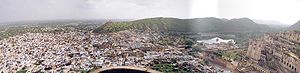
. It is located at and an average elevation of 268 metres (879 feet). The city lies near a narrow gorge, and is surrounded on three sides by hills of the Aravalli Range
Aravalli Range

The Aravalli Range is a range of mountains in western India running approximately 800 km from northeast to southwest across Rajasthan state. The northern end of the range continues as isolated hills and rocky ridges into Haryana state, ending near Delhi....
. A substantial wall with four gateways encircles the city.

Demographics

In the 2001 Indian census
Census

A census is the procedure of systematically acquiring and recording information about the members of a given population. It is a regularly occurring and official count of a particular population....
, Bundi had a population of 88,313. Males constitute 53% of the population and females 47%. Bundi has an average literacy rate of 67%, higher than the national average of 59.5%; with male literacy of 75% and female literacy of 57%. 14% of the population is under 6 years of age.

History


In ancient times, the area around Bundi was apparently inhabited by various local tribes, of which the Parihar
Parihar Meenas

Parihar or Pratihara Meenas is one of the sub group of Meenas. They are mainly found in the region of Bundi city. They were initial builder of Bundi and Bundi is named after the King Bandu Meena....
 Meenas
Meenas

Meenas, Meena or Mina is a caste and community mainly found in Rajasthan, India. The name Mina is derived from Meen, meaning 'fish' in Sanskrit, and the Minas claim descent from the Matsya Avatar, or fish incarnation, of Vishnu....
 were prominent. Bundi and the eponymous princely state
Princely state

For other uses, see Principality, Princely state#Other princely statesA Princely State was a nominally sovereign entity of British rule in India that was not directly administered by the British, but rather by an Indian ruler under a form of indirect rule such as suzerainty or paramountcy....
 are said to derive their names from a former Meena king called Bunda Meena. Bundi was previously called “Bunda-Ka-Nal", Nal meaning “narrow ways”. Later the region was governed by Rao Deva Hara, who took over Bundi from Jaita Meena in A.D. 1342, renaming the surrounding area Haravati or Haroti.

Princely Bundi

The Hadoti
Hadoti

Hadoti , is a List of regions in India of Rajasthan state in western India. The bigest cities are Bundi and Kota, Rajasthan.It includes the districts of Bundi, Baran, Jhalawar and Kota, Rajasthan, and is bounded on the west by the Mewar, on the northwest by Ajmer region regions of Rajasthan, and on the south by the Malwa, on the east by th...
 region in which Bundi stands takes is named for the Hada
Hada

Hada is the name of a clan of Rajputs. They are in fact a branch of the Chauhan clan of Agnivanshi rajputs. They ruled the states of Bundi and Kotah in the present-day Indian state of Rajasthan for several centuries until 1947....
 Rajput
Rajput

A Rajput is a member of one of the major Hindu Kshatriya groups of Indian subcontinent. The Rajputs trace their roots to Rajputana. They enjoy a reputation as formidable soldiers and it is common to find many of them serving in the Indian Armed Forces....
s, an offshoot of the Chauhan
Chauhan

Chauhan or Chohan - are a Rajput clan found in the Indian subcontinent. The Chauhan gotra Rajputs come from the region around the lakes of Sambhar Lake and Pushkar Lake in Rajasthan, near Amber, India and present-day Marwar, Mewar Jaipur....
 clan. The Hadas settled in the region in the 12th century and dominated the area for several centuries thereafter. Bundi was conquered by them in 1241 and nearby Kota
Kota, Rajasthan

Kota formerly known as Kotah, is a city in the northern Indian States and territories of India of Rajasthan. Situated on the banks of Chambal River, the city is the trade centre for an area in which cotton, millet, wheat, coriander and oilseeds are grown; industries include cotton and oilseed milling, textile weaving, distilling, dairyin...
 in 1264. At one time, the Hada-ruled state of Bundi encompassed the present-day districts of Baran
Baran

Baran may refer to:* A Persian language word meaning 'rainfall'* A Persian given name* A Kurdish language name meaning 'rain'* A Poland surname ...
, Bundi, Kota, and Jhalawar
Jhalawar

Jhalawar is a city in southeastern Rajasthan. It was the capital of the former princely state of Jhalawar, and is the administrative headquarters of Jhalawar District.In old days known as Brijnagar....
. Over the next 200 years subsequent rulers formed a close alliance with the Sisodias of Mewar, intermarrying with and assisting them during times of war.

After the two younger brothers of Rao Bundu (1470 to 1491) converted to Islam they rebelled and sent him into exile. After his father’s death 11 years later his son Narayan Das set out with small group of loyalists to take back the throne. Pretending to be paying his respects, he left his followers outside the fort and armed only with a lance and sword he approached his uncles who felt secure enough to have no guards present. When they apprehended what he intended to do they fled for a safety but Narayan Das was too quick and speared one while killing the other with his sword.

The Mughal Era

Rao Surjan (1554-85) surrendered Ranthambore Fort
Ranthambore Fort

Ranthambore Fort is a formidable fort and has been a focal point of historical developments of Rajasthan. It is situated near Sawai Madhopur town in Rajasthan....
 which he was governing on behalf of the Sisodias to Akbar in 1533. He was subsequently rewarded by Akbar with additional territory which expanded his kingdom. Both he and his successors entered the service of the Mughals and became one of their closest allies. From this time the rulers of Bundi bore the title of “rao raja“.

One of the most notable rulers was Rao Rattan Singh (1607-31) who saw service during the reign of the Emperor Jahangir
Jahangir

Nur-ud-din Salim Jahangir Born as Prince Muhammad Salim, he was the third and eldest surviving son of Mughal Empire Emperor Akbar. Akbar's twin sons, Hasan and Hussain, died in infancy....
. When Mughal Prince Khurram rebelled against his father, and gained the support of 22 Rajput princes, Rattan Singh stayed loyal to Jahangir. He defeated Prince Khurram at the battle of Burhanpur during which two of his sons were badly wounded. As a reward for his service Jahangir gave Rattan Singh many honours. With his 14 year old son Madho Singh having proven himself during the suppression of the rebellion as a courageous warrior Rattan Singh carved out of Bundi in 1580 sufficient land to create for Madho Singh the independent principality of Kota. Part of Kota was later used to create the separate Jhalawar
Jhalawar

Jhalawar is a city in southeastern Rajasthan. It was the capital of the former princely state of Jhalawar, and is the administrative headquarters of Jhalawar District.In old days known as Brijnagar....
 state in 1838. Despite the loss of land to the new kingdom Rattan Singh retained sufficient territory and revenues to begin construction of the Garh palace.

Rao Chhattar Sal (1632-58) built the temple of Keshavarao at Patan and Chattra Mahal at Bundi. He saw service with the Mughal forces in the Deccan and was trusted by Dara Shikoh with governorship of Delhi, a rare privilege for a Rajput. He remained loyal to Shah Jahan and Dara Shikoh during the rebellion of Aurangzeb despite many temptations and died fighting at the head of his troops at the battle of Samurgarh in 1658 along with his youngest son Bharat Singh. Rao Bhao Singh (1658-78) the eldest son of Chhattar Sal succeeded his father to the throne of Bundi. When after the defeat of Dara Shikoh and his imprisonment of Shah Jahan, Aurangzeb became the Mughul emperor he dispatched troop under the command of Atmaram Gaur and Barh Singh Bundela to conquer Bundi. When they failed Aurangzeb made peace with Bhao Singh. Bhao Singh became sufficiently reconciled to Aurangzeb that he fought for him against Shivaji and at one time served as governor of Aurangabad. When his own son died during his lifetime he adopted Kishan Singh, the son of his brother Bhim Singh. When Kishan Singh too died early his 15 year old son Anirudh Singh (1682 to 1696) succeeded Bhao Singh on the throne.

Anirudh Singh served Aurangzeb in the Deccan and in the northwest under Prince Muazzam where he died. He was succeed by his eldest son Budha Singh, whose service to Muazzam (later Emperor Bahadur Shah I) in the war of succession to the Mughul throne saw the Bundi become dominate over Kota those ruler had backed the losing side.

During the reign of Rao Budh Singh (1696 to 1735) despite him being married to the sister of Jai Singh II of Jaipur, a bitter feud broke out between Bundi and the Kachwaha
Kachwaha

The Kachwaha are a Suryavanshi Rajput clan who ruled a number of kingdoms and princely states in India such as Alwar, Maihar, Talcher, while the largest kingdom was Jaipur which was founded by Maharaja Sawai Jai Singh II in 1727....
 rulers of Amber (later called Jaipur) which lead to him being expelled from his kingdom by surprise attack by the Kachwaha forces in 1702. He regained and lost his kingdom four times before he died in exile while Jaipur and Kota annexed large portion of his territory. It wasn’t until 1739 before the Bundi rulers were able were able to regain control of their kingdom after enlisting the aid of Malbar Rao Holkar who kept the estate of Patan for his services.

Relations became uneasy with Mewar after Prince Ajit Singh the heir to the Bundi throne killed Rana Ari Singh of Udaipur during the annual Aheria (Bundi’s ritual spring hunt) in 1773. Through claimed to be an accident Mewar historical records consider that it was an assassination which removed an unpopular ruler.

According to an ancient prophecy made by a dying sati it was said that if the rulers of Bundi and Mewar should ever meet at the event one of the two would die. According to legend (as quoted by Crump and Toh ) over the centuries such a meeting took place four times and on each occasion one of the rulers was killed by the other. Mewar sources indicate that there was only one other occasion when a Mewar ruler died when in 1531 Maharana Ratan Singh II of Mewar, accompanied Prince Surajmal of Bundi on a hunt. The two men despised each other. During the hunt the Maharana attacked Prince Surajmal which ended with both dying within minutes of each other.

The British Era

In 1804 Rao Raja Bishan Singh (1773-1821) gave valuable assistance to Colonel Monson in his disastrous retreat before Holkar, in revenge for which the Maratha Empire
Maratha Empire

The Maratha Empire or the Maratha Confederacy was a Hindu state located in present-day India. It existed from 1674 to 1818. At its peak, the empire's territories covered much of South Asia....
 and Pindaris continually ravaged his state and forced the kingdom to pay tribute up to 1817 This lead to Bishan Singh signing a treaty of alliance with the British East India Company on 10th of February 1818 which bought him under their protection. Bishan Singh was responsible for the creation of pleasure palace of Sukh Niwas on the outskirts of Bundi.

Bishan Singh when dying of cholera entrusted Colonel James Tod
James Tod

Lieutenant-Colonel James Tod , a United Kingdom officer, historian of Rajasthan and numismatist, was born on March 20 1782. He went to India as a cadet in the Bengal army of the British East India Company in 1799....
 with guardianship of his 11 year old son, Ram Singh. Maharao Raja Ram Singh (1821-89) grew up to be a much respected ruler who initiated economic and administrative reforms as well as establishing schools for the teaching of Sanskrit. On the throne for 68 years he was described as a grand specimen of the Rajput gentleman and "the most conservative prince in conservative Rajputana." His rule was popular and beneficial; and though during the mutiny of 1857 his attitude was equivocal, he continued to enjoy the confidence of the British, being created G.C.S.I. and a counsellor of the empire in 1877 and C.I.E. in 1878. He was succeeded by his adopted son Raghubir Singh (1889-1927), who was made a K.C.S.I. in 1897 and a G.C.I.E. in 1901. His reign was blighted by two disastrous famines which despite his best attempts to alleviated saw the population of his kingdom reduced from some 258,000 to 171,000 by 1901 due to death and immigration. Raghubir Singh supported the British during the World War I.

Maharao Bahadur Singh (1945-77) also supported the British and served in the Burma campaign where he earned the Military Cross for his gallantry before succeeding to the throne.

Independence

After the independence of India in 1947, Bundi became part of the Dominion of India
Dominion of India

The Union of India sometimes known as the Dominion of India, was an independent state that existed between 15 August, 1947 and 26 January, 1950....
 (later the Union of India).

Rulers

The hereditary rulers of Bundi used the title ‘Rao’ before being granted the prefix ‘Raja’ by the Mughals. A Raja is a ruler of exalted rank but inferior to Maharana or Maharawal.

  • Rao Deva (1343 to 1343).
  • Rao Napuji.
  • Rao Hamuli (1384 to 1400).
  • Rao Birsingh (1400 to 1415).
  • Rao Biru (1415 to 1470).
  • Rao Bandu (1470 to 1491).
  • Rao Narayan Das (1491 to 1527).
  • Rao Suraj Mal (1527 to 1531).
  • Rao Surtan Singh (1531 to 1544).
  • Rao Raja Surjan Singh (1544 to 1585).
  • Rao Raja Bhoj Singh (1585 to 1608).
  • Rao Raja Ratan Singh (1608 to 1632).
  • Rao Raja Chhattar Sal Singh (1632 to 1658).
  • Rao Raja Bhao Singh (1658 to1682).
  • Rao Raja Anirudh Singh (1682 to 1696).
  • Rao Raja Budh Singh (1696 to 1735).
  • Rao Raja Dalel Singh (1735 to 1749).
  • Rao Raja Umaid Singh (1749 to 1770) and again (1773 to 1804).
  • Rao Raja Ajit Singh (1770 to1773).
  • Rao Raja Bishen Singh (1804 to 1821).
  • Maharao Raja Ram Singh Sahib Bahadur (1821 to 1889).
  • Colonel HH Maharao Raja Shri Sir Raghubir Singh Sahib Bahadur (12 April 1889 to 1927).
  • Major HH Maharao Raja Shri Sir Iishwari Singh Bahadur (1927 to 1945).
  • Col. HH Maharao Raja Shri Bahadur Singh Bahadur (1945 to 1977).
  • HH Maharao Raja Ranjit Singh (1977 to present day).


Coat of arms: Bundi’s coat of arms
Coat of arms

A coat of arms, more properly called an armorial achievement, armorial bearings or often just arms for short, in European tradition, is a design belonging to a particular person and used by them in a wide variety of ways....
 is a shield depicting Garuda
Garuda

The Garuda is a large mythical bird or bird-like creature that appears in both Hinduism and Buddhism mythology.Garuda is the Hindu name for the constellation Aquila and the Brahminy kite is considered to be the contemporary representation of Garuda...
, the mount of Vishnu
Vishnu

Vishnu , , is the Supreme God in Vaishnavite tradition of Hinduism. Smarta followers of Adi Shankara, among others, venerate Vishnu as one of panchadeva, and his supreme status is declared in the Hindu sacred texts like Yajurveda, the Rigveda and the Bhagavad Gita....
, flanked by winged griffin
Griffin

The griffin is a fantasy creature with the body of a lion and the head and often wings of an eagle. As the lion was traditionally considered the king of the beasts and the eagle the king of the birds, the griffin was thought to be an especially powerful and majestic creature....
s. The shield is flanked by bulls representing dharma
Dharma

The term , is an Indian Indian philosophy and Indian religions term, that means one's righteous duty or any virtuous path in the common sense of the term....
 or righteousness; it is crowned by a warrior emerging from flames, signifying the creation-legend of the ruling Chauhan clan, which was supposedly created from fire.

Tourist attractions

  • The Taragarh Fort
    Taragarh Fort

    Taragarh Fort or 'Star Fort' is the most impressive of structures of city of Bundi in Indian state of Rajasthan. A rather ramshackle fort, with its overgrown vegetation, is located around 39 km from Kota....
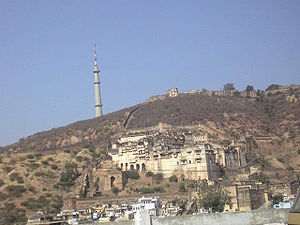
    , or 'Star Fort' is the most impressive of the city's structures. It was constructed in AD 1354 upon the top of steep hillside overlooking the city. The largest of its battlement
    Battlement

    A battlement, in defensive architecture such as that of city walls or castles, comprises a parapet , in which portions have been cut out at intervals to allow the discharge of arrows or other missiles....
    s is the 16th century bastion
    Bastion

    A 'bastion' is a structure projecting outward from the main enclosure of a fortification, situated in both corners of a straight wall , with the shape of a sharp point, facilitating active defense against assaulting troops....
     known as the Bhim Burj, on which was once mounted a particularly large cannon
    Cannon

    A cannon is any tubular piece of artillery, that uses gunpowder or other usually explosive-based propellants to launch a projectile over a distance....
     called Garbh Gunjam, or 'Thunder from the Womb'. The fort is a popular tourist viewpoint of the city below. The fort contains three tanks which never dry up. The technique with which they were built has been long since lost but the tanks survive as a testament to the advanced methods of construction and engineering in medieval India.
  • The Bundi Palace is situated on the hillside adjacent to the Taragarh Fort and is notable for its lavish traditional mural
    Mural

    A mural is a painting on a wall, ceiling, or other large permanent surface....
    s and fresco
    Fresco

    Fresco is any of several related painting types, done on plaster on walls or ceilings. The word fresco comes from the Italian word affresco which derives from the adjective fresco , which has Latin origins....
    es. The Chitrashala (picture gallery) of the palace is open to the general public.
  • The largest of Bundi's baoris or stepwells is the intricately-carved Raniji ki Baori. Some 46 m deep, it was built in 1699 by Rani Nathavatji. The steps built into the sides of the water-well made water accessible even when at a very low level. The baori is one of the largest examples of its kind in Rajasthan
    Rajasthan

    Rajasthan is the largest States and territories of India of the Republic of India in terms of area. It encompasses most of the area of the large, inhospitable Great Indian Desert , which has an edge paralleling the Sutlej-Indus river valley along its border with Pakistan....
    .
  • The Nawal Sagar is a large square-shaped artificial lake in the centre of Bundi containing many small islets. A temple dedicated to Varuna
    Varuna

    In Historical Vedic religion, Varuna or Waruna is a god of the sky, of waters and of the celestial ocean, as well as a god of law and of the underworld....
    , the vedic god
    Rigvedic deities

    There are 1028 hymns in the Rigveda, most of them dedicated to specific deity.Indra, a heroic god, slayer of Vrtra and destroyer of the Vala, liberator of the cows and the rivers; Agni the sacrificial fire and messenger of the gods; and Soma the ritual drink dedicated to Indra are the most prominent deities....
     of water, stands half-submerged in the middle of the lake. the lake feeds the numerous bavdis in the old city by creating an artificial water table.
  • The Nagar Sagar twin step wells are identical step wells crafted in pristine masonry on either side of the main spine of Bundi town. The kunds (pools) are currently full of waste from the ancient vegetable market in the vicinity.
  • The Dabhai Kund also known as the jail kund, is the largest of the kunds in Bundi. Though slightly overgrown, it is well worth a visit for the spectacular carvings on the numerous steps leading down to the water level.


  • Sukh Mahal
  • Jait Sagar Lake
  • Phool sagar
  • Kshar Bagh
  • Eighty four pillared cenotaph


Excursions
  • Kedareshwar Dham ( Bag Ganga)
  • Keshoraipatan
    Keshoraipatan

    Keshoraipatan is a city and a municipality in Bundi district in the Indian States and territories of India of Rajasthan....
  • Ramgarh
  • Bijolia
  • Menal
  • Talwas
  • Rameshwaram
  • Dugari
  • Indragarh


The Stepwells

There are over 50 stepwells in Bundi, of which only a handful have been maintained. They used to be the only source of water for the town until a piped water system was introduced. After that these stepwells were abandoned and the monuments fell into disrepair. Most of the former stepwells inside the town have become garbage dumps, and are slipping out of the public consciousness.

External links


Further reading