


Bugatti Type 13

Encyclopedia
Bugatti
Automobiles E. Bugatti was a French car manufacturer founded in 1909 in Molsheim, Alsace, as a manufacturer of high-performance automobiles by Italian-born Ettore Bugatti....
car. Production of the Type 13 and later Types 15, 17, 22, and 23, began with the company's founding in 1910 and lasted through 1920 with 435 examples produced. Most road cars used an 8-valve engine, though five Type 13 racers had 16-valve
Multi-valve
In automotive engineering a multi-valve or multivalve engine is one where each cylinder has more than two valves. A multi-valve engine has better breathing and can operate at higher revolutions per minute than a two-valve engine, delivering more power.- Multi-valve rationale :A multi-valve design...
heads, one of the first ever produced. The road cars became known as "pur-sang" ("thoroughbred
Thoroughbred
The Thoroughbred is a horse breed best known for its use in horse racing. Although the word thoroughbred is sometimes used to refer to any breed of purebred horse, it technically refers only to the Thoroughbred breed...
") in keeping with Ettore Bugatti's feelings for his designs.
The car was brought back after World War I
World War I
World War I , which was predominantly called the World War or the Great War from its occurrence until 1939, and the First World War or World War I thereafter, was a major war centred in Europe that began on 28 July 1914 and lasted until 11 November 1918...
with multi-valve
Multi-valve
In automotive engineering a multi-valve or multivalve engine is one where each cylinder has more than two valves. A multi-valve engine has better breathing and can operate at higher revolutions per minute than a two-valve engine, delivering more power.- Multi-valve rationale :A multi-valve design...
engines to bring fame to the marque at Brescia
Brescia
Brescia is a city and comune in the region of Lombardy in northern Italy. It is situated at the foot of the Alps, between the Mella and the Naviglio, with a population of around 197,000. It is the second largest city in Lombardy, after the capital, Milan...
. The production "Brescia Tourer" also brought in much-needed cash.
Type 10
The Bugatti automobile was prototyped as the Type 10 in Ettore BugattiEttore Bugatti
right|thumb|Ettore Bugatti in 1932Ettore Arco Isidoro Bugatti was an Italian-born and French naturalized citizen automobile designer and manufacturer....
's basement in 1908 and 1909 while he was chief engineer at Deutz Gasmotoren Fabrik in Cologne, Germany.
The Type 10 used a monoblocGeorgano, G. N. Cars: Early and Vintage, 1886-1930. (London: Grange-Universal, 1985) straight-four
Straight-4
The inline-four engine or straight-four engine is an internal combustion engine with all four cylinders mounted in a straight line, or plane along the crankcase. The single bank of cylinders may be oriented in either a vertical or an inclined plane with all the pistons driving a common crankshaft....
engine of Ettore's own design. it was an overhead cam unit with 2 valves per cylinder, highly advanced for the time. A very-undersquare design, it had a 60 mm bore and 100 mm stroke for a total of 1.1 L (1131 cc/69 in3). This was attached to an open roadster
Roadster
A roadster is a two-seat open car with emphasis on sporty handling and without a fixed roof or side weather protection. Strictly speaking a roadster with wind-up windows is a convertible but as true roadsters are no longer made the distinction is now irrelevant...
body with solid axles front and rear. Leaf spring
Leaf spring
Originally called laminated or carriage spring, a leaf spring is a simple form of spring, commonly used for the suspension in wheeled vehicles...
s suspended the front with no suspension at all in the rear. Cables operated rear drum brake
Drum brake
A drum brake is a brake in which the friction is caused by a set of shoes or pads that press against a rotating drum-shaped part called a brake drum....
s.
On ending his contract with Deutz, Ettore loaded his family into the Type 10 and headed to the Alsace
Alsace
Alsace is the fifth-smallest of the 27 regions of France in land area , and the smallest in metropolitan France. It is also the seventh-most densely populated region in France and third most densely populated region in metropolitan France, with ca. 220 inhabitants per km²...
region of France
France
The French Republic , The French Republic , The French Republic , (commonly known as France , is a unitary semi-presidential republic in Western Europe with several overseas territories and islands located on other continents and in the Indian, Pacific, and Atlantic oceans. Metropolitan France...
looking for a factory to begin producing cars of his own.
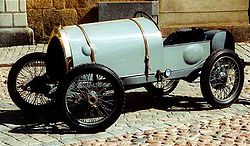
The car was preserved and nicknamed "la baignoire" ("the bathtub") by the staff at Molsheim in later years due to its shape. Ettore restored it in 1939 and repainted it an orange-red color, earning it a new nickname, "le homard" ("the lobster"). It was moved to Bordeaux
Bordeaux
Bordeaux is a port city on the Garonne River in the Gironde department in southwestern France.The Bordeaux-Arcachon-Libourne metropolitan area, has a population of 1,010,000 and constitutes the sixth-largest urban area in France. It is the capital of the Aquitaine region, as well as the prefecture...
for the duration of World War II
World War II
World War II, or the Second World War , was a global conflict lasting from 1939 to 1945, involving most of the world's nations—including all of the great powers—eventually forming two opposing military alliances: the Allies and the Axis...
and remained there for decades before falling into private ownership. Today, the car is in California
California
California is a state located on the West Coast of the United States. It is by far the most populous U.S. state, and the third-largest by land area...
in the hands of a private collector.
Type 13
Upon starting operations at his new factory in MolsheimMolsheim
Molsheim is a commune in the Bas-Rhin department in Alsace in north-eastern France. The total population in 2006 was 9,382. Molsheim had been a very fast growing city between the French censuses of 1968 and 1999, passing from 5,739 to 9,331 inhabitants, but this increase came to a noticeable halt...
, Bugatti refined his light shaft-driven car into the Type 13 racer. This included boring the engine out to 65 mm for a total of 1.4 L (1368 cc/83 in3). A major advance was the 4-valve
Multi-valve
In automotive engineering a multi-valve or multivalve engine is one where each cylinder has more than two valves. A multi-valve engine has better breathing and can operate at higher revolutions per minute than a two-valve engine, delivering more power.- Multi-valve rationale :A multi-valve design...
head Bugatti designed — one of the first of its type ever conceived. Power output with dual Zenith Carburetters
Zenith Carburetters
Zenith Carburetters was a British company making carburettors. In 1955 they joined with their major pre-war rival Solex Carburettors and over time the Zenith brand name fell into disuse...
reached 30 hp (22 kW) at 4500 rpm, more than adequate for the 660 lb (300 kg) car. Leaf spring
Leaf spring
Originally called laminated or carriage spring, a leaf spring is a simple form of spring, commonly used for the suspension in wheeled vehicles...
s were now fitted all around, and the car rode on a roughly 2 m (79 in) wheelbase.
The new company produced five examples in 1910, and entered the French Grand Prix
French Grand Prix
The French Grand Prix was a race held as part of Fédération Internationale de l'Automobile's annual Formula One automobile racing championships....
at Le Mans
Le Mans
Le Mans is a city in France, located on the Sarthe River. Traditionally the capital of the province of Maine, it is now the capital of the Sarthe department and the seat of the Roman Catholic diocese of Le Mans. Le Mans is a part of the Pays de la Loire region.Its inhabitants are called Manceaux...
in 1911. The tiny Bugatti looked out of place at the race, but calmly took second place after seven hours of racing.
World War I
World War I
World War I , which was predominantly called the World War or the Great War from its occurrence until 1939, and the First World War or World War I thereafter, was a major war centred in Europe that began on 28 July 1914 and lasted until 11 November 1918...
caused production to halt in the disputed region. Ettore took two completed Type 13 cars with him to Milan
Milan
Milan is the second-largest city in Italy and the capital city of the region of Lombardy and of the province of Milan. The city proper has a population of about 1.3 million, while its urban area, roughly coinciding with its administrative province and the bordering Province of Monza and Brianza ,...
for the duration of the war, leaving the parts for three more buried near the factory. After the war, Bugatti returned, unearthed the parts, and prepared five Type 13s for racing.
Type 15
The Type 15 was a version of the Type 13 with a long 2400 mm (94.5 in) wheelbase. It had a six-sided radiator in front and semi-elliptic rear leaf springLeaf spring
Originally called laminated or carriage spring, a leaf spring is a simple form of spring, commonly used for the suspension in wheeled vehicles...
s.
Type 17
Another version, the Type 17, was also produced. This used a 2550 mm (100.4 in) wheelbase. It shared its hexagonal radiator and rear springs with the Type 15.Type 22
The Type 15 was updated in 1913 as the Type 22. It had a larger roadgoing body, an oval radiator, and quarter-circle springs.Type 23
A 2-valve version of the Type 17 with a boat-tail body was built in 1913 as the Type 23. It also had the oval radiator of the Type 22.Type 13 Brescia
A Grand Prix for VoituretteVoiturette
Voiturette is a word mostly used to describe a miniature automobile; however, it has several nuanced meanings, depending largely on the usage date.-History:...
s at Le Mans was the only French event of 1920, and Bugatti entered the two completed cars from Milan and one more from the remaining parts. Ettore's illegal act of placing a hand on the radiator cap during the race brought disqualification to the leading car, however.
The Type 13 was unbeatable. Bugatti's cars placed 1, 2, 3, 4 at the Brescia Grand Prix in 1921, and orders poured in. Capitalizing on this victory, all subsequent 4-valve
Multi-valve
In automotive engineering a multi-valve or multivalve engine is one where each cylinder has more than two valves. A multi-valve engine has better breathing and can operate at higher revolutions per minute than a two-valve engine, delivering more power.- Multi-valve rationale :A multi-valve design...
Bugatti models would bear the Brescia moniker.
These were the only Bugatti models to locate the carburettor on the left hand side of the engine and the exhaust on the right. Front wheel brakes were added in 1926.
Type 23 Brescia Tourer
Multi-valve
In automotive engineering a multi-valve or multivalve engine is one where each cylinder has more than two valves. A multi-valve engine has better breathing and can operate at higher revolutions per minute than a two-valve engine, delivering more power.- Multi-valve rationale :A multi-valve design...
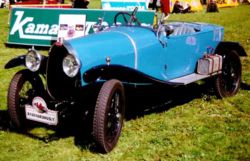
Brescia engine, and 2,000 examples were built from 1920 through 1926, making it the first full-production multi-valve car ever made.
External links
- 1925 Bugatti Brescia Type-22 found at bottom of lake, sells for 260,500 euros - Radio France InternationaleRadio France InternationaleRadio France Internationale was created in 1975 as part of Radio France by the Government of France, and replaced the Poste Colonial , Paris Mondial , Radio Paris , RTF Radio Paris and ORTF Radio Paris...