
All Topics  
Bucket argument


   Email Print
   Bookmark   Link


Bucket argument


Isaac Newton
Isaac Newton

Sir Isaac Newton, Fellow of the Royal Society was an English people physicist, mathematician, Astronomy, Natural philosophy, Alchemy, and Theology and one of the the 100 in human history....
's rotating bucket argument (also known as "Newton's bucket") attempts to demonstrate that true rotational motion cannot be defined as the relative rotation of the body with respect to the immediately surrounding bodies. It is one of five argument
Argument

* In logic, an Argument is a set of one or more meaningful declarative sentences known as the premises along with another meaningful declarative sentence known as the conclusion....
s from the "properties, causes, and effects" of true motion and rest that support his contention that, in general, true motion and rest cannot be defined as special instances of motion or rest relative to other bodies, but instead can be defined only by reference to absolute space.


Discussion
Ask a question about 'Bucket argument'
Start a new discussion about 'Bucket argument'
Answer questions from other users
Full Discussion Forum


Recent Posts


Encyclopedia


Isaac Newton
Isaac Newton

Sir Isaac Newton, Fellow of the Royal Society was an English people physicist, mathematician, Astronomy, Natural philosophy, Alchemy, and Theology and one of the the 100 in human history....
's rotating bucket argument (also known as "Newton's bucket") attempts to demonstrate that true rotational motion cannot be defined as the relative rotation of the body with respect to the immediately surrounding bodies. It is one of five argument
Argument

* In logic, an Argument is a set of one or more meaningful declarative sentences known as the premises along with another meaningful declarative sentence known as the conclusion....
s from the "properties, causes, and effects" of true motion and rest that support his contention that, in general, true motion and rest cannot be defined as special instances of motion or rest relative to other bodies, but instead can be defined only by reference to absolute space. Alternatively, these experiments provide an operational definition
Operational definition

Operational definition is a demonstration of a process — such as a variable, terminology, or object — relative in terms of the specific process or set of Formal verification used to determine its presence and quantity....
 of what is meant by "absolute rotation", and do not pretend to address the question of "rotation relative to what?".

Background

These arguments, and a discussion of the distinctions between absolute and relative time, space, place and motion, appear in a Scholium
Scholium

Scholia , are grammar, critical, or explanatory comments, either original or extracted from pre-existing commentaries, which are inserted on the margin of the manuscript of an ancient author, as gloss....
  at the very beginning of his great work, The Mathematical Principles of Natural Philosophy (1687), which established the foundations of classical mechanics
Classical mechanics

Classical mechanics is used for describing the motion of macroscopic objects, from projectiles to parts of machinery, as well as astronomical objects, such as spacecraft, planets, stars, and galaxies....
 and introduced his law of universal gravitation, which yielded the first quantitatively adequate dynamical explanation of planetary motion. See the Principia on line at pp. 77-82.

Despite their embrace of the principle of rectilinear inertia and the recognition of the kinematical relativity of apparent motion (which underlies whether the Ptolemaic
Geocentric model

In astronomy, the geocentric model or The Ptolemaic worldview of the universe is the Superseded scientific theories#Superseded astronomical and cosmological theories that the Earth is the center of the universe and other objects go around it....
 or the Copernican
Heliocentrism

In astronomy, heliocentrism is the theory that the Sun is at the center of the Universe. The word came from the Greek language . Historically, heliocentrism was opposed to geocentrism, which placed the earth at the center....
 system is correct), natural philosophers of the seventeenth century continued to consider true motion and rest as physically separate descriptors of an individual body. The dominant view Newton opposed was devised by René Descartes
René Descartes

Ren? Descartes , , also known as Renatus Cartesius , was a French philosophy, mathematician, scientist, and writer who spent most of his adult life in the Dutch Republic....
, and was supported (in part) by Gottfried Leibniz
Gottfried Leibniz

Gottfried Wilhelm Leibniz was a Germany polymath who wrote primarily in Latin and French language.He occupies an equally grand place in both the history of philosophy and the history of mathematics....
. It held that empty space is a metaphysical impossibility because space is nothing other than the extension of matter, or, in other words, that when one speaks of the space between things one is actually making reference to the relationship that exists between those things and not to some entity that stands between them. Concordant with the above understanding, any assertion about the motion of a body boils down to a description over time in which the body under consideration is at t1 found in the vicinity of one group of "landmark" bodies and at some t2 is found in the vicinity of some other "landmark" body or bodies.

Descartes recognized that there would be a real difference, however, between a situation in which a body with movable parts and originally at rest with respect to a surrounding ring was itself accelerated to a certain angular velocity with respect to the ring, and another situation in which the surrounding ring was given a contrary acceleration with respect to the central object. With sole regard to the central object and the surrounding ring, the motions would be indistinguishable from each other assuming that both the central object and the surrounding ring were absolutely rigid objects. However, if neither the central object nor the surrounding ring were absolutely rigid then the parts of one or both of them would tend to fly out from the axis of rotation. People who have noticed a train originally at rest beside them in the railway station pulling away from them, and have soon thereafter noticed with surprise that it is not their train that remains parked at the station, have experienced the basic nature of the Descartes experiment. Frequently these observers first question their initial impressions when they sense g forces from the acceleration of their own train.

For contingent reasons having to do with the Inquisition, Descartes spoke of motion as both absolute and relative. However, his real position was that motion is absolute.

A contrasting position was taken by Mach, who contended that all motion was relative.

The argument

Newton discusses a bucket
Bucket

A bucket, also called a pail, is a watertight, vertical cylinder or Truncation Cone , with an open top and a flat bottom, usually attached to a semicircular carrying handle called the bail....
 filled with water
Water

Water is a common chemical substance that is essential for the survival of all known forms of life. In typical usage, water refers only to its liquid form or States of matter, but the substance also has a solid state, ice, and a gaseous state, water vapor or steam....
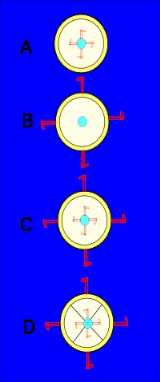
 hung by a cord. If the cord is twisted up tightly on itself and then the bucket is released, it begins to spin rapidly, not only with respect to the experimenter, but also in relation to the water it contains. (This situation would correspond to diagram B above.)

Although the relative motion at this stage is the greatest, the surface of the water remains flat, indicating that the parts of the water have no tendency to recede from the axis of relative motion, despite proximity to the pail. Eventually, as the cord continues to unwind, the surface of the water assumes a concave shape as it acquires the motion of the bucket spinning relative to the experimenter. This concave shape shows that the water is rotating, that despite the fact that the water is at rest relative to the pail. In other words, it is not the relative motion of the pail and water that causes concavity of the water, contrary to the idea that motions can only be relative, and that there is no absolute motion. (This situation would correspond to diagram D.) Possibly the concavity of the water shows rotation relative to something else: say absolute space? The argument is incomplete, as it limits the participants relevant to the experiment to only the pail and the water, which has not been established. In fact, the concavity of the water clearly involves gravitational attraction, and by implication the Earth also is a participant. Here is a critique due to Mach:

In the 1846 Andrew Motte translation of Newton's words:

A supplementary thought experiment with the same objective of determining the occurrence of absolute rotation also was proposed by Newton: the example of observing two identical spheres in rotation about their center of gravity and tied together by a string. Occurrence of tension in the string is indicative of absolute rotation; see Rotating spheres
Rotating spheres

Isaac Newton's rotating spheres argument attempts to demonstrate that true rotational motion can be defined by observing the tension in the string joining two identical spheres....
.
Coriolis Effect11

Detailed analysis

Of course, the historic interest of the rotating bucket experiment is its usefulness in suggesting one can detect absolute rotation by observation of the shape of the surface of the water. See Figure 1. However, one might question just how rotation brings about this change. Below are three approaches to understanding the concavity of the surface of rotating water in a bucket.

Newton's laws of motion

The shape of the surface of a rotating liquid in a bucket can be determined using Newton's laws for the various forces on an element of the surface. For example, see Knudsen and Hjorth. Figure 2 sets up the analysis in the co-rotating frame where the water appears stationary. The height of the water h is a function of the radial distance r from the axis of rotation O, h = h(r), and the aim is to determine this function. An element of water volume on the surface is shown to be subject to three forces: (i) The vertical force due to gravity Fg, (ii) The horizontal, radially outward centrifugal force FCfgl and (iii) The force normal to the surface of the water Fn due to the rest of the water surrounding the selected element of surface. The force due to surrounding water is known to be normal to the surface of the water because a liquid in equilibrium cannot support shear stress
Shear stress

File:Shear stress.JPGA shear stress, denoted , is defined as a stress which is applied parallel or tangent to a face of a material, as opposed to a normal stress which is applied perpendicularly....
es. To quote Anthony and Brackett: Moreover, because the element of water does not move, the sum of all three forces must be zero. To sum to zero, the force of the water must point oppositely to the sum of the centrifugal and gravity forces, which means the surface of the water must adjust so its normal points in this direction. (A very similar problem is the design of a banked turn
Centripetal force

The centripetal force is the external force required to make a body follow a curved path. Hence centripetal force is a kinematic force requirement, not a particular kind of force like gravity or electromagnetism....
, where the slope of the turn is set so a car will not slide off the road. The analogy in the case of rotating bucket is that the element of water surface will "slide" up or down the surface unless the normal to the surface aligns with the vector resultant formed by the vector addition Fg + FCfgl.)

As r increases, the centrifugal force increases according to the relation (the equations are written per unit mass): where O is the constant rate of rotation of the water. The gravitational force is unchanged at with g = acceleration due to gravity
Gravitational acceleration

In physics, gravitational acceleration is the acceleration of an object caused by the force of gravity from another object. In the absence of any other forces, any object will accelerate in a gravitational field at the same rate, regardless of the mass of the object....
. These two forces add to make a resultant at an angle f from the vertical given by which clearly becomes larger as r increases. To insure that this resultant is normal to the surface of the water, and therefore can be effectively nulled by the force of the water beneath, the normal to the surface must have the same angle, that is, leading to the ordinary differential equation for the shape of the surface: or, integrating: where h(0) is the height of the water at r = 0. In words, the surface of the water is parabolic in its dependence upon the radius.

Potential energy

The shape of the water's surface can be found in a different, very intuitive way using the interesting idea of the potential energy
Potential energy

Potential energy can be thought of as energy stored within a physical system. It is called potential energy because it has the potential to be converted into other forms of energy, such as kinetic energy, and to do Mechanical work in the process....
 associated with the centrifugal force in the co-rotating frame. In a reference frame uniformly rotating at angular rate O, the fictitious centrifugal force is conservative
Conservative force

A conservative force is defined as a force with the following property: when an object moves from one location to another, the force changes the potential energy of the object by an amount that does not depend on the path taken....
 and has a potential energy of the form:

where r is the radius from the axis of rotation. This result can be verified by taking the gradient of the potential to obtain the radially outward force:

  The meaning of the potential energy is that movement of a test body from a larger radius to a smaller radius involves doing work
Mechanical work

In physics, mechanical work is the amount of energy transferred by a force acting through a distance. Like energy, it is a scalar quantity, with SI of joules....
 against the centrifugal force.

The potential energy is useful, for example, in understanding the concavity of the water surface in a rotating bucket. Notice that at equilibrium
Mechanical equilibrium

A standard definition of is:This is a strict definition, and often the term "static equilibrium" is used in a more relaxed manner interchangeably with "mechanical equilibrium", as defined next....
 the surface adopts a shape such that an element of volume at any location on its surface has the same potential energy as at any other. That being so, no element of water on the surface has any incentive to move position, because all positions are equivalent in energy. That is, equilibrium is attained. On the other hand, were surface regions with lower energy available, the water occupying surface locations of higher potential energy would move to occupy these positions of lower energy, inasmuch as there is no barrier to lateral movement in an ideal liquid.

We might imagine deliberately upsetting this equilibrium situation by somehow momentarily altering the surface shape of the water to make it different from an equal-energy surface. This change in shape would not be stable, and the water would not stay in our artificially contrived shape, but engage in a transient exploration of many shapes until non-ideal frictional forces introduced by sloshing, either against the sides of the bucket or by the non-ideal nature of the liquid, killed the oscillations and the water settled down to the equilibrium shape.

To see the principle of an equal-energy surface at work, imagine gradually increasing the rate of rotation of the bucket from zero. The water surface is flat at first, and clearly a surface of equal potential energy because all points on the surface are at the same height in the gravitational field acting upon the water. At some small angular rate of rotation, however, an element of surface water can achieve lower potential energy by moving outward under the influence of the centrifugal force. Because water is incompressible and must remain within the confines of the bucket, this outward movement increases the depth of water at the larger radius, increasing the height of the surface at larger radius, and lowering it at smaller radius. The surface of the water becomes slightly concave, with the consequence that the potential energy of the water at the greater radius is increased by the work done against gravity to achieve the greater height. As the height of water increases, movement toward the periphery becomes no longer advantageous, because the reduction in potential energy from working with the centrifugal force is balanced against the increase in energy working against gravity. Thus, at a given angular rate of rotation, a concave surface represents the stable situation, and the more rapid the rotation, the more concave this surface. If rotation is arrested, the energy stored in fashioning the concave surface must be dissipated, for example through friction, before an equilibrium flat surface is restored.

To implement a surface of constant potential energy quantitatively, let the height of the water be : then the potential energy per unit mass contributed by gravity is and the total potential energy per unit mass on the surface is

with the background energy level independent of r. In a static situation (no motion of the fluid in the rotating frame), this energy is constant independent of position r. Requiring the energy to be constant, we obtain the parabolic form:

where h(0) is the height at r = 0 (the axis). See Figures 1 and 2.

The principle of operation of the centrifuge
Centrifuge

A centrifuge is a piece of equipment, generally driven by a motor, that puts an object in rotation around a fixed axis, applying a force perpendicular to the axis....
 also can be simply understood in terms of this expression for the potential energy, which shows that it is favorable energetically when the volume far from the axis of rotation is occupied by the heavier substance.

Fluid mechanics

A more complete discussion of the rotating bucket is based upon fluid mechanics
Fluid mechanics

Fluid mechanics is the study of how fluids move and the forces on them. Fluid mechanics can be divided into fluid statics, the study of fluids at rest, and fluid dynamics, the study of fluids in motion....
. For example, what is the explanation of the concave water surface in an inertial frame of reference? In this frame, the water is observed to rotate, and therefore executes uniform circular motion. This motion requires a centripetal force
Centripetal force

The centripetal force is the external force required to make a body follow a curved path. Hence centripetal force is a kinematic force requirement, not a particular kind of force like gravity or electromagnetism....
, and this centripetal force is supplied for a surface element of water by the horizontal component of the normal force from the water beneath. (The vertical component counteracts gravity.) This force from the water in turn derives from the walls of the bucket, which force the adjacent water to move in a circle by supplying centripetal force. That force is transmitted by the incompressible water to its surface.

This explanation is consistent with what has been said so far, but here is an unanswered question: at the vertical and bottom walls of the bucket, the walls transmit a constraining force to the adjacent water that causes that water to move in circular motion; but how does the shape of the bucket affect the solution?

The answer to this question comes from the equation of motion of a volume element in the fluid. Consider an elementary volume of fluid of mass per unit volume ? with a velocity v. The motion of this element of fluid is described by Euler's equation: where p is the pressure inside the element of fluid and g is the acceleration due to gravity
Gravitational acceleration

In physics, gravitational acceleration is the acceleration of an object caused by the force of gravity from another object. In the absence of any other forces, any object will accelerate in a gravitational field at the same rate, regardless of the mass of the object....
.

For the rotating fluid in the bucket rotating at angular rate O, assume for the moment that water rotates like a rigid body. Then the velocity of an elementary volume of water is given by: with a unit vector perpendicular to the radial direction pointing in the direction of rotation and a unit vector in the radial direction. Euler's equation becomes: where gravity is taken to be in the downward (negative) vertical z-direction with unit vector . To find a curve of constant pressure, suppose ds is a displacement along such a curve. In order that no change in pressure occur, we require the pressure gradient to be orthogonal to the displacement: or,

Thus, a curve of constant pressure is given by: which resembles the earlier result for the free concave surface of water. The pressure at a point
(r, z) is: and is the same for all angles ?. The constant of integration c is found by locating the free surface. At the free surface, the pressure is zero, and z = h(r): as before, with the depth of water at r = 0 determining c as  

This solution uses an assumed form for the velocity of the water that is only approximate. (The water is assumed to rotate like a rigid body.) As a result, the solution does not account for the behavior near the bottom of the bucket or the transition from horizontal to vertical walls supposing, say, the bucket has the shape of a half-cylinder. The approximate solution actually does not apply all the way to the bucket walls, but is valid only in the central region of the bucket, as described next.

Lamb points out that the assumed velocity of the liquid has a non-zero curl, and hence
cannot be realized in an ideal liquid that cannot support tangential forces. Another way to put this is that the velocity cannot be represented as the gradient of a velocity potential
Velocity potential

A velocity potential is used in fluid dynamics, when a fluid occupies a simply-connected region and is irrotational. In such a case,where denotes the flow velocity of the fluid....
, it is not
irrotational, a rather anomalous situation. In particular, it can be shown that any motion generated from rest by impulsive pressure only is necessarily irrotational. For example, if we begin with a stationary fluid with a flat surface, its velocity has zero curl. Then it can be shown that any subsequent velocity configuration obtained by gradually increasing the rotation of the water also will have zero curl. To escape this predicament, one approach is to assume the angular velocity of the liquid is not O but some angular velocity ? = ?(r) that varies with radial position. In this case a velocity with zero curl can be "cooked up". These Rankine vortex
Rankine vortex

The Rankine vortex model is an attempt to describe the velocity profile through Vortex in real, Viscosity, fluids. It is named after its creator, William John Macquorn Rankine....
 or Lamb-Oseen vortex
Lamb-Oseen vortex

In fluid dynamics, the Lamb?Oseen vortex models a line vortex that decays due to viscosity. This vortex is named after Horace Lamb and Carl Wilhelm Oseen....
 solutions splice together a concave region near the center of the bucket resembling the solution just found, and a convex solution outside this core region extending to the bucket wall. Once the existence of a velocity potential is established, for an incompressible fluid this potential satisfies Laplace's equation
Laplace's equation

In mathematics, Laplace's equation is a partial differential equation named after Pierre-Simon Laplace who first studied its properties. The solutions of Laplace's equation are important in many fields of science, notably the fields of electromagnetism, astronomy, and fluid dynamics, because they describe the behavior of electric, gravitation...
, opening the way to application of all its methods of solution and incorporation of whatever boundary conditions the bucket may impose. In this way solutions may be obtained that reflect the shape of the bucket, and do not depart significantly from the above results for the free surface in the central region of the bucket assuming the water has sufficient depth and the bucket has sufficient radius.

For a real bucket and a real liquid, the solution near the bucket walls may become quite complicated, involving boundary layers and a realistic model for the liquid. The Navier-Stokes equations
Navier-Stokes equations

The Navier?Stokes equations, named after Claude-Louis Navier and George Gabriel Stokes, describe the motion of fluid substances, that is substances which can flow....
 must be solved, not just Laplace's equation.

Further reading


The isotropy of the cosmic background radiation is another indicator that the universe does not rotate. See , , and

External links

  • from Stanford Encyclopedia of Philosophy, article by Robert Rynasiewicz. At the end of this article, loss of fine distinctions in the translations as compared to the original Latin text is discussed.
  • see section on Space, Time and Indiscernibles for Leibniz arguing against the idea of space acting as a causal agent.


See also

  • Mach's principle
    Mach's principle

    In theoretical physics, particularly in discussions of :Category:Theories of gravitation, Mach's principle is the name given by Albert Einstein to a vague hypothesis first supported by the physicist and philosopher Ernst Mach....
  • Sagnac effect
    Sagnac effect

    The Sagnac effect , named after French physicist Georges Sagnac, is a phenomenon encountered in interferometry that is elicited by rotation. The Sagnac effect manifests itself in a setup called ring interferometry....
  • Rotating spheres
    Rotating spheres

    Isaac Newton's rotating spheres argument attempts to demonstrate that true rotational motion can be defined by observing the tension in the string joining two identical spheres....
  • Inertial frame of reference
    Inertial frame of reference

    In physics, an inertial frame of reference is a frame of reference, tied to the state of motion of an Observer , with the property that each physical law portrays itself in the same form in every inertial frame....
  • Rotating reference frame
    Rotating reference frame

    A rotating frame of reference is a special case of a non-inertial reference frame that is rotation relative to an inertial reference frame. An everyday example of a rotating reference frame is the surface of the Earth....
  • Mechanics of planar particle motion
    Mechanics of planar particle motion

    This article describes a particle in planar motion when observed from non-inertial frame of reference. The most famous examples of planar motion are related to the motion of two spheres that are gravitationally attracted to one another, and the generalization of this problem to planetary motion....
  • Centrifugal force (rotating reference frame)
  • Philosophy of space and time: Absolutism vs. relationalism
    Philosophy of space and time

    Philosophy of space and time is the branch of philosophy concerned with the issues surrounding the ontology, epistemology, and character of space and time....