
All Topics  
Brugmansia

 
Brugmansia

   Email Print
   Bookmark   Link


Brugmansia


Brugmansia is a genus of six species of flowering plant
Flowering plant

The flowering plants or angiosperms are the most widespread group of Embryophytes. The flowering plants and the gymnosperms are the only extant groups of Spermatophyte....
s in the family Solanaceae
Solanaceae

The Solanaceae is a family of flowering plants, that contains a number of important agricultural plants as well as many toxic plants. The name of the family comes from the Latin Solanum "the nightshade plant", but the further etymology of that word is unclear....
, native to subtropical regions of South America
South America

South America is the southern continent of the Americas, situated entirely in the Western Hemisphere and mostly in the Southern Hemisphere, with a relatively small portion in the Northern Hemisphere....
, along the Andes
Andes

The Andes form the world's longest exposed mountain range. They lie as a continuous chain of highland along the western coast of South America. The range is over 7,000 km long, 200-700 km wide , and of an average height of about 4,000 m ....
 from Colombia
Colombia

Colombia , officially the Republic of Colombia , is a country in north-western South America. Colombia is bordered to the east by Venezuela and Brazil; to the south by Ecuador and Peru; to the north by the Caribbean Sea; to the north west by Panama; and to the west by the Pacific Ocean....
 to northern Chile
Chile

Chile, officially the Republic of Chile , is a country in South America occupying a long and narrow coastal strip wedged between the Andes mountains and the Pacific Ocean....
, and also in southeastern Brazil
Brazil

Brazil , officially the Federative Republic of Brazil , is a country in South America. It is the List of countries and outlying territories by total area country by geographical area, occupying nearly half of South America, the List of countries by population country, and the fourth most populous democracy in the world....
. They are known as Angel's Trumpets, incorrectly sharing that name in the past with the closely related genus Datura
Datura

Datura is a genus of nine species of Vespertine flowering plants belonging to the family Solanaceae. Their exact natural distribution is uncertain, due to extensive cultivation and naturalisation throughout the temperate and tropical regions of the globe, but is most likely restricted to the Americas, from the United States south throug...
, commonly known as "Thorn Apple". Brugmansia differs from Datura in being perennial and woody (Datura species are herbaceous), and in having pendulous (not erect) flowers.


rugmansia are large shrub
Shrub

A shrub or bush is a horticulture rather than strictly Botany category of woody plant, distinguished from a tree by its multiple stems and lower height, usually less than 5-6 m tall....
s or small tree
TREE

TREE was a Boston hardcore punk band formed in the summer of 1990. They were active in the Boston music scene until disbanding in 2002....
s, reaching heights of 3–11 m, with tan, slightly rough bark.

The leaves
Leaf

In botany, a leaf is an above-ground plant Organ specialized for photosynthesis. For this purpose, a leaf is typically flat and thin, to expose the cells containing chloroplast to light over a broad area, and to allow light to penetrate fully into the tissues....
 are alternate, generally large, 10–30 cm long and 4–18 cm broad, with an entire or coarsely toothed margin, and are covered with fine hairs.

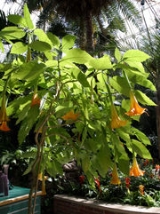
The name Angel's Trumpet refers to the large, very dramatic, pendulous trumpet-shaped flower
Flower

A flower, sometimes known as a bloom or blossom, is the reproduction structure found in flowering plants . The biological function of a flower is to mediate the union of male sperm with female ovum in order to produce seeds....
s, 14–50 cm to 20 inches long and 10–35 cm across at the wide end.


Discussion
Ask a question about 'Brugmansia'
Start a new discussion about 'Brugmansia'
Answer questions from other users
Full Discussion Forum


Encyclopedia


Brugmansia is a genus of six species of flowering plant
Flowering plant

The flowering plants or angiosperms are the most widespread group of Embryophytes. The flowering plants and the gymnosperms are the only extant groups of Spermatophyte....
s in the family Solanaceae
Solanaceae

The Solanaceae is a family of flowering plants, that contains a number of important agricultural plants as well as many toxic plants. The name of the family comes from the Latin Solanum "the nightshade plant", but the further etymology of that word is unclear....
, native to subtropical regions of South America
South America

South America is the southern continent of the Americas, situated entirely in the Western Hemisphere and mostly in the Southern Hemisphere, with a relatively small portion in the Northern Hemisphere....
, along the Andes
Andes

The Andes form the world's longest exposed mountain range. They lie as a continuous chain of highland along the western coast of South America. The range is over 7,000 km long, 200-700 km wide , and of an average height of about 4,000 m ....
 from Colombia
Colombia

Colombia , officially the Republic of Colombia , is a country in north-western South America. Colombia is bordered to the east by Venezuela and Brazil; to the south by Ecuador and Peru; to the north by the Caribbean Sea; to the north west by Panama; and to the west by the Pacific Ocean....
 to northern Chile
Chile

Chile, officially the Republic of Chile , is a country in South America occupying a long and narrow coastal strip wedged between the Andes mountains and the Pacific Ocean....
, and also in southeastern Brazil
Brazil

Brazil , officially the Federative Republic of Brazil , is a country in South America. It is the List of countries and outlying territories by total area country by geographical area, occupying nearly half of South America, the List of countries by population country, and the fourth most populous democracy in the world....
. They are known as Angel's Trumpets, incorrectly sharing that name in the past with the closely related genus Datura
Datura

Datura is a genus of nine species of Vespertine flowering plants belonging to the family Solanaceae. Their exact natural distribution is uncertain, due to extensive cultivation and naturalisation throughout the temperate and tropical regions of the globe, but is most likely restricted to the Americas, from the United States south throug...
, commonly known as "Thorn Apple". Brugmansia differs from Datura in being perennial and woody (Datura species are herbaceous), and in having pendulous (not erect) flowers.

  • Brugmansia arborea. Andes (Ecuador to northern Chile).
  • Brugmansia aurea
    Brugmansia aurea

    Brugmansia aurea is a species of plant in the Solanaceae family. It is Endemism to Ecuador....
    . Andes (Colombia to Ecuador).
  • Brugmansia longifolia
    Brugmansia longifolia

    Brugmansia longifolia is a species of plant in the Solanaceae family. It is Endemism to Ecuador....
  • Brugmansia sanguinea. Andes (Colombia to Peru and Bolivia).
  • Brugmansia suaveolens. Southeast Brazil west to Bolivia and Peru.
  • Brugmansia versicolor
    Brugmansia versicolor

    Brugmansia versicolor is a species of plant in the Solanaceae family. It is Endemism to Ecuador....
    . Ecuador.
  • Brugmansia vulcanicola.


Description

Brugmansia are large shrub
Shrub

A shrub or bush is a horticulture rather than strictly Botany category of woody plant, distinguished from a tree by its multiple stems and lower height, usually less than 5-6 m tall....
s or small tree
TREE

TREE was a Boston hardcore punk band formed in the summer of 1990. They were active in the Boston music scene until disbanding in 2002....
s, reaching heights of 3–11 m, with tan, slightly rough bark.

The leaves
Leaf

In botany, a leaf is an above-ground plant Organ specialized for photosynthesis. For this purpose, a leaf is typically flat and thin, to expose the cells containing chloroplast to light over a broad area, and to allow light to penetrate fully into the tissues....
 are alternate, generally large, 10–30 cm long and 4–18 cm broad, with an entire or coarsely toothed margin, and are covered with fine hairs.

The name Angel's Trumpet refers to the large, very dramatic, pendulous trumpet-shaped flower
Flower

A flower, sometimes known as a bloom or blossom, is the reproduction structure found in flowering plants . The biological function of a flower is to mediate the union of male sperm with female ovum in order to produce seeds....
s, 14–50 cm to 20 inches long and 10–35 cm across at the wide end. They are white, yellow, pink, orange or red, and have a delicate, attractive scent with light, lemony overtones, most noticeable in early evening.

Warning

All parts of Brugmansia plants contain dangerous levels of poison and may be fatal if ingested by humans or animals, including livestock and pets. Some municipalities prohibit the purchase, sale, or cultivation of Brugmansia plants.

Cultivation

Brugmansia are easily grown in a moist, fertile, well-drained soil
Soil

Soil is the naturally occurring, unconsolidated or loose covering on the Earth's surface. Soil is composed of particles of broken rock that have been altered by chemical and environmental processes including weathering and erosion....
, in full sun to part shade, in frost-free climates. They begin to flower in mid to late spring in warm climates and continue into the fall, often continuing as late as early winter in warm conditions. In cool winters, outdoor plants need protection, but the roots are hardy and will resprout in April or May. The species from the higher elevations, B. sanguinea and B. vulcanicola, prefer moderate temperatures and cool nights, and may not flower if temperatures are very hot. Most Brugmansias may be propagated easily by rooting 10–20 cm cuttings taken from the end of a branch during the summer.

Several hybrids and numerous cultivar
Cultivar

A cultivar is a cultivated plant that has been selected and given a unique name because of its decorative or useful characteristics; it is usually distinct from similar plants and when Plant propagation it retains those characteristics....
s have been developed for use as ornamental plant
Ornamental plant

Ornamental plants are typically grown in the flower garden or as house plants. Most commonly they are grown for the display of their flowers. Other common ornamental features include leaves, scent, fruit, Plant stem and bark....
s. B. × candida is a hybrid between B. aurea and B. versicolor, while B. × insignis is a hybrid between B. suaveolens and B. versicolor. Some cultivars of B. × candida produce white, yellow, pale orange or pink flowers; B. × insignis produces white or peach flowers; B. versicolor flowers start off white and turn salmon pink. There are cultivars producing double flowers, and some with variegated leaves.

Uses

As with Datura, all parts of Brugmansia are highly toxic. The plants are sometimes ingested for recreational or shamanic intoxication
Intoxication

Intoxication is the state of being affected by one or more Psychoactive drug. It can also refer to the effects caused by the ingestion of poison or by the overconsumption of normally harmless substances....
 as the plant contains the tropane alkaloid
Tropane alkaloid

Tropane alkaloids, also known as Belladonna alkaloids are a class of alkaloids and secondary metabolites that contain a tropane ring in their chemical structure....
s scopolamine
Scopolamine

Scopolamine, known by the names levo-duboisine and hyoscine, is a tropane alkaloid Medication with muscarinic antagonist effects. It is obtained from plants of the family Solanaceae , such as henbane, jimson weed and Angel's Trumpets , and corkwood ....
 and atropine
Atropine

Atropine is a tropane alkaloid extracted from deadly nightshade , jimsonweed , Mandrake and other plants of the family Solanaceae. It is a secondary metabolite of these plants and serves as a hard drug with a wide variety of effects....
; however because the potency of the toxic compounds in the plant is variable, the degree of intoxication is unpredictable and can be fatal.

Urarina Shaman B Dean
Ritualized Brugmansia consumption is an important aspect of the shamanic complexes noted among many Indigenous peoples of western Amazonia, such as the Jivaroan speaking peoples. Likewise, it is a central component in the cosmology
Cosmology

Cosmology is study of the Universe in its totality, and by extension, humanity's place in it. Though the word cosmology is recent , study of the Universe has a long history involving science, philosophy, esotericism, and religion....
 and shamanic practices of the Urarina
Urarina

The Urarina are an indigenous people of the Peruvian Amazon Basin who inhabit the Chambira, Urituyacu, and Corrientes Rivers. According to both archaeological and historical sources, they have resided in the Chambira Basin of contemporary northeastern Peru for centuries....
 peoples of Loreto
Loreto

Loreto is Italian laurel-wood. It may refer to:...
, Peru
Peru

Peru , officially the Republic of Peru , is a country in western South America. It is bordered on the north by Ecuador and Colombia, on the east by Brazil, on the southeast by Bolivia, on the south by Chile, and on the west by the Pacific Ocean....
.

Plant Registration

ABADS (American Brugmansia & Datura Society, Inc.), is designated in the 2004 edition of the International Code of Nomenclature for Cultivated Plants
International Code of Nomenclature for Cultivated Plants

The International Code of Nomenclature for Cultivated Plants regulates the naming of cultivars, cultivar Groups and graft-chimaeras. Examples are...
 [the 2004 Code] as the official International Cultivar Registration Authority
International Cultivar Registration Authority

International Cultivar Registration Authorities are appointed by the ISHS Commission for Nomenclature and Cultivar Registration. In the 50 years that the ICRA system has been established it has contributed significantly to the stability of cultivated plant nomenclature....
 [ICRA] for Brugmansia and Datura (Solanaceae). This role was delegated to ABADS by the International Society for Horticultural Science
International Society for Horticultural Science

The International Society for Horticultural Science is the world's leading independent organization of Horticulture. Its aim is "to promote and encourage research and education in all branches of horticultural science and to facilitate cooperation and knowledge transfer on a global scale through its Symposium and Academic conference, publica...
 [ISHS] in 2002.

Further reading

  • Lockwood, T. E. (1973). Generic recognition of Brugmansia. Bot. Mus. Leafl. 23: 273–283.
  • Hayman, J. (1985). Datura Poisoning – The Angel's Trumpet. Pathology. 17: 465-466.
  • Huxley, A. (1992). The New RHS Dictionary of Gardening. Macmillan.


External links