
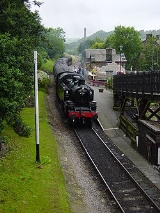
The
Keighley and Worth Valley Railway is a 5 miles (8 km) long branch line that served mills and villages in the
Worth ValleyWorth Valley is a ward on the western extremity of the Bradford Metropolitan District area. In the north it is bounded by North Yorkshire, in the west by Lancashire and in the south by Calderdale District. It contains the Keighley villages of Oakworth, Oldfield, Haworth, Cross Roads, Oxenhope and...
and is now a
heritage railwaythumb|right|the Historical [[Khyber train safari|Khyber Railway]] goes through the [[Khyber Pass]], [[Pakistan]]A heritage railway , preserved railway , tourist railway , or tourist railroad is a railway that is run as a tourist attraction, in some cases by volunteers, and...
line in
West YorkshireWest Yorkshire is a metropolitan county within the Yorkshire and the Humber region of England with a population of 2.2 million. West Yorkshire came into existence as a metropolitan county in 1974 after the passage of the Local Government Act 1972....
,
EnglandEngland is a country that is part of the United Kingdom. It shares land borders with Scotland to the north and Wales to the west; the Irish Sea is to the north west, the Celtic Sea to the south west, with the North Sea to the east and the English Channel to the south separating it from continental...
. It runs from
KeighleyKeighley is a town and civil parish within the metropolitan borough of the City of Bradford in West Yorkshire, England. It is situated northwest of Bradford and is at the confluence of the River Aire and the River Worth...
to
OxenhopeOxenhope is a village and civil parish with a population of 2,476 in the metropolitan borough of Bradford, West Yorkshire, England, near Keighley. Oxenhope railway station is the terminus for the Keighley and Worth Valley Railway...
. It connects to the national rail network line at
Keighley railway stationKeighley railway station serves the town of Keighley in West Yorkshire, England.First opened in March 1847 by the Leeds and Bradford Extension Railway , the station is located on the Airedale Line north west of Leeds. It is managed by Northern Rail, who operate most of the passenger trains...
. It is currently one of only two
heritage railwaythumb|right|the Historical [[Khyber train safari|Khyber Railway]] goes through the [[Khyber Pass]], [[Pakistan]]A heritage railway , preserved railway , tourist railway , or tourist railroad is a railway that is run as a tourist attraction, in some cases by volunteers, and...
s that operates a whole branch line in its original form, the other being the
Ecclesbourne Valley RailwayThe Ecclesbourne Valley Railway is a long heritage railway in Derbyshire, the headquarters of the railway centre around Wirksworth station and services operate between Wirksworth and Duffield and Wirksworth and Ravenstor...
.
History
The line was built in 1867 by mill owners, but operated by the
Midland RailwayThe Midland Railway was a railway company in the United Kingdom from 1844 to 1922, when it became part of the London, Midland and Scottish Railway....
, which owned most of the rail network in the area, and was bought by the Midland in part due to interest from the rival railway company, the
Great NorthernThe Great Northern Railway was a British railway company established by the Great Northern Railway Act of 1846. On 1 January 1923 the company lost its identity as a constituent of the newly formed London and North Eastern Railway....
. Upon sale of the railway, the mill owners made a profit, which was unusual for many lines of that type, as (for strategic reasons) the Midland wanted to prevent the GN from taking over its territory. After becoming part of the
London, Midland and Scottish RailwayThe London Midland and Scottish Railway was a British railway company. It was formed on 1 January 1923 under the Railways Act of 1921, which required the grouping of over 120 separate railway companies into just four...
in 1923 during the
Grouping ActThe Railways Act 1921, also known as the Grouping Act, was an enactment by the British government of David Lloyd George intended to stem the losses being made by many of the country's 120 railway companies, move the railways away from internal competition, and to retain some of the benefits which...
, ownership passed to
British RailBritish Railways , which from 1965 traded as British Rail, was the operator of most of the rail transport in Great Britain between 1948 and 1997. It was formed from the nationalisation of the "Big Four" British railway companies and lasted until the gradual privatisation of British Rail, in stages...
ways (BR) following nationalisation in 1948. As a result of the
Beeching AxeThe Beeching Axe or the Beeching Cuts are informal names for the British Government's attempt in the 1960s to reduce the cost of running British Railways, the nationalised railway system in the United Kingdom. The name is that of the main author of The Reshaping of British Railways, Dr Richard...
in the 1960s, British Railways closed the line at the end of 1962.
A preservation society was formed which bought the line from BR and reopened it in 1968 as a heritage railway. The line is now a major tourist attraction operated entirely by volunteers and carries more than 110,000 passengers a year. The KWVR is currently the only preserved railway that operates a complete branch line in its original form. It is celebrated among beer lovers for operating the only
buffet carA buffet car is a passenger car of a train, where snacks and beverages can be bought at a counter and consumed. Typically, passengers are not allowed to consume brought-along food and drinks in the car, and are therefore only able to eat in this area by buying their food in the car.- Further...
serving real ale.
The line and its bridges and tunnels, including a deviation, were built as
single trackA single track railway is where trains in both directions share the same track. Single track is normally used on lesser used rail lines, often branch lines, where the traffic density is not high enough to justify the cost of building double tracks....
but with provision for
duplicationA double track railway usually involves running one track in each direction, compared to a single track railway where trains in both directions share the same track.- Overview :...
, should the need arise. The deviation was built as a condition of the buy out of the Keighley and Worth Valley Railway by the Midland Railway. The need for the deviation was to avoid a large wooden trestle viaduct that crossed a mill pond, as the locals believed the viaduct was unsafe, and supposedly many alighted at Oakworth and continued on foot to Haworth to avoid crossing the viaduct. The original design for the deviation was to skirt the mill pond then through a cutting to rejoin the original formation. However during construction the material in the cutting proved to be unstable, resulting in the construction of the short Mytholmes Tunnel. The original trestle viaduct can be seen in a picture hanging in the booking hall of Oakworth station.
On 10 July 2008, the
Duke of KentThe Duke of Kent graduated from the Royal Military Academy Sandhurst on 29 July 1955 as a Second Lieutenant in the Royal Scots Greys, the beginning of a military career that would last over 20 years. He was promoted to captain on 29 July 1961. The Duke of Kent saw service in Hong Kong from 1962–63...
visited the railway following the 40th anniversary of its reopening. While at the railway, the Duke travelled on a specially prepared "
Royal TrainThe Royal Train is a set of railway carriages dedicated for the use of the British Monarch, other members of the Royal Family, and their staff. The train enables members of the Royal Family to carry out busy schedules over an extended period, in a secure environment which minimises disruption and...
", consisting of
tank locomotiveA tank locomotive or tank engine is a steam locomotive that carries its water in one or more on-board water tanks, instead of pulling it behind it in a tender. It will most likely also have some kind of bunker to hold the fuel. There are several different types of tank locomotive dependent upon...
41241, an LMS Class 2MT, pulling a single carriage,
The Old Gentleman's Saloon, as featured in
The Railway ChildrenThe Railway Children is a 1970 British drama film based on the novel of the same name by E. Nesbit. The film was directed by Lionel Jeffries, and stars Dinah Sheridan, Jenny Agutter , Sally Thomsett and Bernard Cribbins in leading roles...
, which is a former North Eastern Railway directors Saloon. While visiting, the Duke travelled in the carriage and on the locomotive footplate.
Stations and facilities
-
- Mainline connections to Leeds
Leeds is a city and metropolitan borough in West Yorkshire, England. In 2001 Leeds' main urban subdivision had a population of 443,247, while the entire city has a population of 798,800 , making it the 30th-most populous city in the European Union.Leeds is the cultural, financial and commercial...
, BradfordBradford lies at the heart of the City of Bradford, a metropolitan borough of West Yorkshire, in Northern England. It is situated in the foothills of the Pennines, west of Leeds, and northwest of Wakefield. Bradford became a municipal borough in 1847, and received its charter as a city in 1897...
, SkiptonSkipton is a market town and civil parish within the Craven district of North Yorkshire, England. It is located along the course of both the Leeds and Liverpool Canal and the River Aire, on the south side of the Yorkshire Dales, northwest of Bradford and west of York...
, Carlisle, LancasterLancaster is the county town of Lancashire, England. It is situated on the River Lune and has a population of 45,952. Lancaster is a constituent settlement of the wider City of Lancaster, local government district which has a population of 133,914 and encompasses several outlying towns, including...
, MorecambeMorecambe is a resort town and civil parish within the City of Lancaster in Lancashire, England. As of 2001 it has a resident population of 38,917. It faces into Morecambe Bay...
and LondonLondon is the capital city of :England and the :United Kingdom, the largest metropolitan area in the United Kingdom, and the largest urban zone in the European Union by most measures. Located on the River Thames, London has been a major settlement for two millennia, its history going back to its...
King's Cross
- Railway shop and buffet
- Turntable
- Picnic area
- Station restored to BR 1950s condition complete with cast-iron platform canopy on Platform 4, as once existed on all of the platforms
- Ingrow (West)
Ingrow railway station is a single-platform station serving the suburb of Ingrow in Keighley, West Yorkshire, England. It is served by the preserved Keighley and Worth Valley Railway.- History :...
- Access to the Vintage Carriages Trust's Museum of Rail Travel
The Museum of Rail Travel at Ingrow, England is operated by the Vintage Carriages Trust , a charity based just north of Ingrow railway station on the Keighley and Worth Valley Railway in West Yorkshire...
- Railway shop
- Access to the Bahamas Locomotive Society Museum "Ingrow Loco"
- Car parking
- The smallest standard-gauge railway station in Britain, complete with waiting room, booking office, signal box and level crossing
- Lit by gas
Gas lighting is production of artificial light from combustion of a gaseous fuel, including hydrogen, methane, carbon monoxide, propane, butane, acetylene, ethylene, or natural gas. Before electricity became sufficiently widespread and economical to allow for general public use, gas was the most...
and heated by coal stoves
- Featured as "Ormston" in the BBC
The British Broadcasting Corporation is a British public service broadcaster. Its headquarters is at Broadcasting House in the City of Westminster, London. It is the largest broadcaster in the world, with about 23,000 staff...
's Born and BredBorn and Bred is a light-hearted British drama series that aired on BBC One from 2002 to 2005. Created by Chris Chibnall and Nigel McCrery, Born and Breds cast was led by James Bolam and Michael French, who play a father and son who run a cottage hospital in Ormston, a fictional Lancashire village...

-
- Famous as the location for the filming of the 1970 film The Railway Children
The Railway Children is a 1970 British drama film based on the novel of the same name by E. Nesbit. The film was directed by Lionel Jeffries, and stars Dinah Sheridan, Jenny Agutter , Sally Thomsett and Bernard Cribbins in leading roles...
, starring Jenny AgutterJennifer Ann "Jenny" Agutter is an English film and television actress. She began her career as a child actress in the mid 1960s, starring in the BBC television series The Railway Children and the film adaptation of the same book, before moving on to adult roles and relocating to Hollywood.She...
, Dinah SheridanDinah Sheridan is an English actress who appeared in the films 29 Acacia Avenue and Genevieve .She made her film debut in 1937, and has frequently appeared on television...
, Bernard CribbinsBernard Cribbins, OBE is an English character actor, voice-over artist and musical comedian with a career spanning over half a century who came to prominence in films in the 1960s, has been in work consistently since his professional debut in the mid 1950s, and as of 2010 is still an active...
, Sally ThomsettSally Thomsett is a British actress.She is mainly remembered for starring in the 1970 film The Railway Children, and for playing Jo in the TV sitcom, Man About the House...
and Gary WarrenGary Warren was an English child actor, best remembered for his role as Peter in the 1970 film The Railway Children. He also played Cedric in the TV series Catweazle , and in the sitcom Alexander the Greatest .Warren is now retired from acting...
- Restored to Edwardian condition, the station is lit by gas lamps
- Heated by up to four coal fires in winter (around eight months each year)
- Civil Engineering yard, containing all engineering wagons (not open to public)
- Car parking (for 'Horseless Carriages')
- Railway shop
- Motive Power
Motive power depot, usually abbreviated to MPD, is a name given to places where locomotives are stored when not being used, and also repaired and maintained. They were originally known as "running sheds", "engine sheds", or, for short, just sheds. Facilities are provided for refuelling and...
& Civil Engineering Departments situated here (Not open to the public)
- Picnic area and engine shed viewing area
- Access to Haworth village and the Brontë
The Brontës were a nineteenth-century literary family associated with Haworth in the West Riding of Yorkshire, England. The sisters, Charlotte , Emily , and Anne , are well-known as poets and novelists...
Parsonage
- Gas lit platform
- An example of a 1950s country station
aug2006.jpg)
-
- Terminus of the branch
- New Heritage Lottery Fund
The National Lottery is the state-franchised national lottery in the United Kingdom and the Isle of Man.It is operated by Camelot Group, to whom the licence was granted in 1994, 2001 and again in 2007. The lottery is regulated by the National Lottery Commission, and was established by the then...
-supported exhibition shed; contains locomotives and carriages not currently in use and explains their history and that of the line as a whole
- Carriage & Wagon Maintenance department (Not open to the public)
- Railway shop and buffet
- Car parking
- Bus connections to Hebden Bridge
Hebden Bridge is a market town within the Metropolitan Borough of Calderdale, in West Yorkshire, England. It forms part of the Upper Calder Valley and lies 8 miles west of Halifax and 14 miles north east of Rochdale, at the confluence of the River Calder and the River Hebden .A 2004 profile of...
- Gas-lit platform, car park and waiting room
Commuter use
On weekends - in particular Saturday mornings, local residents who live in Oxenhope, Haworth, Oakworth and Ingrow catch the early morning diesel service to Keighley, and, often, from there to places beyond, to work or shop - returning later on Steam hauled services. During the weekday outside of the summer months, locals have to use the local bus services which typically take twice as long to reach a destination than any proposed commuter rail service, due to the nature of heavy traffic into and out of Keighley.
As a privately-owned heritage railway, the line does not specifically serve commuters; however, a study by Ove Arup & Partners funded by
MetroThe West Yorkshire Passenger Transport Executive is the Passenger Transport Executive for the county of West Yorkshire, England. It is the executive arm of the West Yorkshire Integrated Transport Authority and was originally formed on 1 April 1974 as the West Yorkshire Passenger Transport...
looked at the feasibility of a daily commuter service between Oxenhope and Keighley in 2009. After the first stage of the study was released, Metro stated concerns about a lack of funding and available rolling stock, meaning that services are unlikely to run in the short to medium term.
Another study recently undertaken on behalf of the Worth Valley Joint Transport Committee has found that running up to four commuter trains each way in the morning and evening is feasible.
Operational
| Number & Name |
Description |
History and Current Status |
Livery |
Photograph |
| No. 957 |
Class 25 "Ironclad" The Lancashire and Yorkshire Railway Class 25 is a class of 0-6-0 steam locomotive. They were introduced in 1876 by new locomotive superintendent William Barton Wright and 280 were built in total. 230 were later converted to saddle tanks by John Aspinall.... 0-6-0 |
Designed by Barton Wright for the Lancashire and Yorkshire RailwayThe Lancashire and Yorkshire Railway was a major British railway company before the 1923 Grouping. It was incorporated in 1847 from an amalgamation of several existing railways... in 1875/6, No 957 was delivered by Beyer Peacock in 1887. It was on the books of Goole Shed at groupingThe Railways Act 1921, also known as the Grouping Act, was an enactment by the British government of David Lloyd George intended to stem the losses being made by many of the country's 120 railway companies, move the railways away from internal competition, and to retain some of the benefits which... , when it became LMS 12044; and it remained there until January 1950 when British RailBritish Railways , which from 1965 traded as British Rail, was the operator of most of the rail transport in Great Britain between 1948 and 1997. It was formed from the nationalisation of the "Big Four" British railway companies and lasted until the gradual privatisation of British Rail, in stages... ways moved it to WakefieldWakefield is the main settlement and administrative centre of the City of Wakefield, a metropolitan district of West Yorkshire, England. Located by the River Calder on the eastern edge of the Pennines, the urban area is and had a population of 76,886 in 2001.... shed (25A).
No 957 was privately purchased from BR in 1959 and moved to KWVR in 1965 where it became famous for its role in The Railway Children. It is now used on summer vintage trains and during special events. Recently suffered a fracture of the firebox door. Boiler ticket expires 2011. |
L&Y Lined Black |
|
| No. 41241 |
LMS 2-6-2T Class 2MT |
No 41241 was built at Crewe Works Crewe railway works is a British railway engineering facility built in 1840 by the Grand Junction Railway. It is located in the town of Crewe, in the county of Cheshire.... in 1949 and from there went to Bath Green Park shed (71G). After a few shorts spells at other sheds and transfer back to 71G, it was transferred to Wellington shed (84H) in October 1959. In 1964, No 41241 was moved to Leamington SpaRoyal Leamington Spa, commonly known as Leamington Spa or Leamington or Leam to locals, is a spa town in central Warwickshire, England. Formerly known as Leamington Priors, its expansion began following the popularisation of the medicinal qualities of its water by Dr Kerr in 1784, and by Dr Lambe... (2L), back to Wellington, and to Wales, where it stayed at Bangor- United Kingdom :* Bangor, County Down, Northern Ireland** Bangor ** Bangor , until 1800* Bangor, Gwynedd, Wales, after which most of the ex-colonial Bangors are named.... (6H) and Croes NewyddCroes Newydd was a large steam locomotive shed, marshalling yard and junction in Wrexham, in Wales.-History:Wrexham's Croes Newydd locomotive shed was the last of the GWR 'northlight' designs, being a roundhouse and depending on a central turntable for access. It was built by the Great Western... (6C). In 1965, No 41241 went to LlandudnoLlandudno is a seaside resort and town in Conwy County Borough, Wales. In the 2001 UK census it had a population of 20,090 including that of Penrhyn Bay and Penrhynside, which are within the Llandudno Community... Junction shed (6G) for about 3 months before finally being transferred to SkiptonSkipton is a market town and civil parish within the Craven district of North Yorkshire, England. It is located along the course of both the Leeds and Liverpool Canal and the River Aire, on the south side of the Yorkshire Dales, northwest of Bradford and west of York... (10G). It was withdrawn in December 1966, where it was taken under its own steam to its present home on the KWVR, where it was destined to haul the re-opening special. It is now operational and used regularly; its boiler 'ticket' is due to expire in 2012. |
BR Lined Black |
 |
| No. 80002 |
BR 2-6-4T Class 4MTThe British Railways Standard Class 4 tank was a class of steam locomotive, one of the BR standard classes built during the 1950s. They were used primarily on commuter and outer suburban services.- Background :...
|
No 80002 was a member of the first batch of 10 to be ordered by the Scottish Region The Scottish Region was one of the six regions created on British Railways and consisted of ex-London, Midland and Scottish Railway and ex-London and North Eastern Railway lines in Scotland... from Derby WorksThe Midland Railway Locomotive Works, known locally as "the loco" comprised a number of British manufacturing facilities in Derby building locomotives and, initially, rolling stock in Derby, UK.-Early days:... and emerged in October 1952. It was sent north to Motherwell shedMotherwell TMD is a closed locomotive Traction Maintenance Depot situated in Motherwell, North Lanarkshire, Scotland. The depot code is ML.The depot was operated by EWS following the privatisation of British Rail and was used for the maintenance of their fleet of Diesel locomotives and wagons as... (66B) and moved to Polmadie (66A) the next month. After serving around Glasgow, in June 1962 No 80002 was transferred to Beattock shed (68D). After closure of branches around Beattock, it was moved back to Polmadie in April 1964, where it stayed until retirement in March 1967. After a short spell as a stationary steam heating boiler, No 80002 moved to KWVR in 1969. It is now operational and used regularly. The locomotive's boiler 'ticket' is due to last until Spring 2013. 80002 has appeared in numerous television adverts over the years. |
BR Lined Black |
|
| No. 90733 |
BRBritish Railways , which from 1965 traded as British Rail, was the operator of most of the rail transport in Great Britain between 1948 and 1997. It was formed from the nationalisation of the "Big Four" British railway companies and lasted until the gradual privatisation of British Rail, in stages... 2-8-0 Austerity |
The Vulcan Foundry Vulcan Foundry was a British locomotive builder sited at Newton-le-Willows, Lancashire .-History:It was originally opened in 1832 as Charles Tayleur and Company to produce girders for bridges, switches and crossings, and other ironwork following the opening of the Liverpool and Manchester Railway... built works No 5200 (WD No 79257) for the War Department in January 1945. This was then shipped over to The Netherlands and numbered NSR No 4464. Little is known about its time in Holland, but it is known to have been kept at Rietlanden at the beginning of 1949, before moving to Eindhoven. As Holland's modernisation plan moved apace, No 4464 was sold to Swedish State RailwaysThe Swedish State Railways or SJ, originally the Royal Railway Board , is a former government agency responsible for operating the state railways in Sweden.... in 1953; first it went to Örebro-Sites of interest:Örebro's old town Wadköping is located on the banks of Svartån . It contains many 18th and 19th century wooden houses, along with museums and exhibitions.... works to have a new (fully enclosed) cab, electric lighting and other standard Swedish equipment fitted along with shortening of the tender (to enable it to fit onto Swedish turntables and renumbering to become Swedish Railways Class G11 No 1931. It became mothballed in 1958 and moved to a remote forest clearing along with sister locomotive No 1931. It stayed there until 1972, when a small group from KWVR went to inspect it. Being the better of the two locomotives, it was bought and repatriated, arriving at IngrowIngrow is a suburb of Keighley, West Yorkshire, England.It is the location of the Ingrow Railway Centre with two railway museums: the Museum of Rail Travel owned by Vintage Carriages Trust, and Ingrow Loco, owned by the Bahamas Locomotive Society... in 1973.
After three years of operating KWVR trains (1973–76) No 1931 was withdrawn. A heavy overhaul began in 1993 and, after 14 years of work, was completed in 2007. The locomotive was renumbered to the number subsequent to the last UK BR owned WD 2-8-0 - No 90733 - and returned to traffic. It's now generally in regular use although currently out of traffic for repairs to axle boxes and horn guides and expected back in steam before 2011 is out. 90733's boiler 'ticket' is due to expire in 2017. |
BR Unlined Black |
|
| No. 43924 |
Midland Railway 3835 ClassThe Midland Railway 3835 Class is a class of 0-6-0 steam locomotive designed for freight work. The first two were introduced in 1911 by Henry Fowler. After the grouping in 1923 they continued to be built up to 1941 by the LMS as the LMS Fowler 4F.... 0-6-0 (LMS Class 4F) |
No 43924 was built in October 1920 at Derby Works The Midland Railway Locomotive Works, known locally as "the loco" comprised a number of British manufacturing facilities in Derby building locomotives and, initially, rolling stock in Derby, UK.-Early days:... and was allocated to Wellingborough shed where its primary duties were in the movement of heavily loaded coal trains to LondonLondon is the capital city of :England and the :United Kingdom, the largest metropolitan area in the United Kingdom, and the largest urban zone in the European Union by most measures. Located on the River Thames, London has been a major settlement for two millennia, its history going back to its... and return of empty wagons to the East Midlands. In March 1930, No 43924 was at Saltley Shed (21A) in BirminghamBirmingham is a city and metropolitan borough in the West Midlands of England. It is the most populous British city outside the capital London, with a population of 1,036,900 , and lies at the heart of the West Midlands conurbation, the second most populous urban area in the United Kingdom with a... and it moved to Gloucester Barnwood (22B) in July 1937 where it stayed for 25 years. Finally, it moved to Bristol Barrow Road (82E) in September 1962 before being withdrawn in July 1965. It was transferred to Woodham Brothers' Scrapyard in October of that year. In September 1968, No 43924 became the first locomotive ever to be rescued from a scrapyard. No. 43924 has recently been the subject of a heavy general overhaul; it re-entered revenue-earning passenger service in July 2011. |
BR Black |
|
| No. 1704 "Nunlow" |
Hudswell ClarkeHudswell, Clarke and Company Limited was an engineering and locomotive building company in Jack Lane, Hunslet, Leeds, West Yorkshire, England.-History:... 0-6-0T |
Works No 1704 was built in 1938 by Hudswell ClarkeHudswell, Clarke and Company Limited was an engineering and locomotive building company in Jack Lane, Hunslet, Leeds, West Yorkshire, England.-History:... to operate a 2 mile branch line connecting G&T Earle's cement works with the mainline at Hope on the ex-MidlandThe Midland Railway was a railway company in the United Kingdom from 1844 to 1922, when it became part of the London, Midland and Scottish Railway.... SheffieldSheffield is a city and metropolitan borough of South Yorkshire, England. Its name derives from the River Sheaf, which runs through the city. Historically a part of the West Riding of Yorkshire, and with some of its southern suburbs annexed from Derbyshire, the city has grown from its largely... to ManchesterManchester is a city and metropolitan borough in Greater Manchester, England. According to the Office for National Statistics, the 2010 mid-year population estimate for Manchester was 498,800. Manchester lies within one of the UK's largest metropolitan areas, the metropolitan county of Greater... line. It was named 'Nunlow' after a hill that stood on the works site. During the mid 1960s, Nunlow's role was taken over by diesel shunters. It was taken to the Dinting Railway Centre in 1969 and following the closure of this museum, moved to KWVR in 1990. It is operational and sees occasional use. Boiler ticket expires 2018. While this locomotive runs on the KWVR, it remains property of the Bahamas Locomotive Society. |
Green |
|
Currently elsewhere
| Number & Name |
Description |
History and Current Status |
Livery |
Photograph |
| No. 68077 |
Class J94 The London and North Eastern Railway J94 Class is a class of steam locomotive that was formed when 75 former "Austerity" 0-6-0STs were purchased by the LNER in 1946 from the War Department.- Overview :... 0-6-0ST |
Works No 2215 emerged from Andrew Barclay's works in KilmarnockKilmarnock is a large burgh in East Ayrshire, Scotland, with a population of 44,734. It is the second largest town in Ayrshire. The River Irvine runs through its eastern section, and the Kilmarnock Water passes through it, giving rise to the name 'Bank Street'... , ScotlandScotland is a country that is part of the United Kingdom. Occupying the northern third of the island of Great Britain, it shares a border with England to the south and is bounded by the North Sea to the east, the Atlantic Ocean to the north and west, and the North Channel and Irish Sea to the... in January 1947. It was soon sold to the LNER, numbered 8077, and put to work at Immingham DockImmingham Dock is a port facility, with linking railways, opened upstream from Grimsby by the Great Central Railway in 1912. It was first conceived in 1874, during the company's Manchester, Sheffield and Lincolnshire Railway days, after test borings north-west of Grimsby had been made by marine... s and allocated to Immingham ShedImmingham TMD is a railway Traction Maintenance Depot situated in Immingham, North East Lincolnshire outside Grimsby, England.- History :Originally built by the Great Central Railway in 1912 to service the newly opened Immingham Docks, it was taken over by the LNER and later Eastern Region of... (later 40B). At nationalisation, it became No 68077 and was given an extended bunker. In January 1959, No 68077 moved to Hornsey shedHornsey Electric Multiple Unit Depot is a railway maintenance depot for First Capital Connect's Great Northern fleet of electric multiple units, as well as carrying out those maintenance tasks on FCC's Thameslink Class 319 and 377 units which Bedford Cauldwell depot is unable to do... (34B); in July 1961 it was moved to BostonBoston is a town and small port in Lincolnshire, on the east coast of England. It is the largest town of the wider Borough of Boston local government district and had a total population of 55,750 at the 2001 census... (40F) and finally to Colwick (40E) in June 1962. No 68077 was purchased from BR by the NCBThe National Coal Board was the statutory corporation created to run the nationalised coal mining industry in the United Kingdom. Set up under the Coal Industry Nationalisation Act 1946, it took over the mines on "vesting day", 1 January 1947... and put to work in the collieries around Sheffield and Rotherham. Its extended coal bunker was removed, and it was renumbered No 14.
No 68077 arrived at the KWVR in 1971, steamed and then withdrawn requiring mechanical attention, not least concerned with fitting suitable vacuum brakes. The loco then stayed at Haworth for over 30 years, before an agreement was made in 2005 that would see it restored and run for a time at the Spa Valley RailwayThe Spa Valley Railway is a standard gauge heritage railway that runs between Tunbridge Wells, High Rocks, Groombridge, and Eridge railway station, where it links with the Oxted Line. En route it crosses the Kent and East Sussex border, a distance of 5 miles , along the former Three Bridges to... where the loco's dismantling is nearly done. |
N/A |
~ |
Undergoing Overhaul
| Number & Name |
Description |
History and Current Status |
Livery |
Photograph |
| No. 85 |
Taff Vale Railway O2 class The Taff Vale Railway O2 class was a class of 0-6-2T steam tank locomotives designed by Tom Hurry Riches and introduced to the Taff Vale Railway in 1899.-Numbering:-Withdrawal and disposal:... 0-6-2T |
Number 85, along with other members of its class, was introduced to the Taff Vale Railway The Taff Vale Railway is a railway in Glamorgan, South Wales, and is one of the oldest in Wales. It operated as an independent company from 1836 until 1922, when it became a constituent company of the Great Western Railway... in 1899. At the grouping in 1923, the Great Western RailwayThe Great Western Railway was a British railway company that linked London with the south-west and west of England and most of Wales. It was founded in 1833, received its enabling Act of Parliament in 1835 and ran its first trains in 1838... received nine O2 class engines. They were all withdrawn during the 1920s, but No 85 was bought by the Lambton Hetton & Joicey Colliery Co in DurhamDurham is a city in north east England. It is within the County Durham local government district, and is the county town of the larger ceremonial county... , numbered 52. It continued to work at the Philadelphia depot at Houghton-le-Spring until 1968.
Number 85 arrived at KWVR at the end of 1970. After its most recent overhaul, it was used regularly up to June 2009 Steam Gala. The boiler ticket expired September 2009, and it is now stripped down to its frames for overhaul. |
Taff Vale Lined Black with Taff Vale Railway emblem on coal bunker |
|
| No. 75078 |
BR standard class 4 4-6-0The British Railways Standard Class 4 4-6-0 is a class of steam locomotives, 80 of which were built during the 1950s. Six have been preserved.-Background:...
|
Boiler away at Crewe for overhaul. Tender almost complete, just awaiting repaint. Cylinder covers are in the process of being prepared and runs for the injectors have been fitted. The cab has been sandblasted, revealing some weak spots. Completion is expected in 2014. |
BR Lined Black |
~ |
No. 34092 "City of Wells"Wells is a cathedral city and civil parish in the Mendip district of Somerset, England, on the southern edge of the Mendip Hills. Although the population recorded in the 2001 census is 10,406, it has had city status since 1205...
|
SR 4-6-2 West Country ClassThe SR West Country and Battle of Britain classes, collectively known as Light Pacifics or informally as Spam Cans, are classes of air-smoothed 4-6-2 Pacific steam locomotive designed for the Southern Railway by its Chief Mechanical Engineer Oliver Bulleid...
|
Undegoing a heavy overhaul; the boiler cladding is now all on and the boiler is now being tackled. |
BR Brunswick Green |
~ |
| No. 1054 |
LNWR Webb Coal TankThe London and North Western Railway Webb Coal Tank is a class of 0-6-2T steam locomotive. They were called "Coal Tanks" because they were a side tank version of Webb's standard 17 in Coal Engine, an 0-6-0 tender engine for slow freight trains.... 0-6-2T |
Approaching the final stages of its lengthy overhaul at the Bahamas Locomotive Society's workshop at Ingrow (West) staion. The locomotive is owned and being restored by the Bahamas Locomotive Society. |
LNWR Black |
|
| No. 5820 "Big Jim" |
USATC S160 ClassThe United States Army Transportation Corps S160 Class is a class of 2-8-0 Consolidation steam locomotive designed for use in Europe during World War II for heavy freight work... 2-8-0 |
Under restoration; All main brake and suspension running gear has now been overhauled and refitted. The chassis is now back on the re-tyred wheels. Allowing the pony truck to be removed for overhaul. The truck has been completely disassembled. Cylinders and valves have been rebored. Work has begun refitting the motion. The boiler has been moved under cover, stays are being removed. Some welding work is also required. It is intended to perform all the work at Haworth, as much as possible in house, but using contractors where required. New tender bogies require minor modifications. The new tender tank, fabricated by a contractor has been received and is being painted (June 2009). Completion of the locomotive is expected in early 2012. |
N/A |
|
| No. 752 |
L&YR Class 23 0-6-0ST |
Undergoing restoration, the frames, smokebox and saddle tank are just about finished and the boiler has been steam tested, a few more jobs need to be done like putting the locomotive back together again, completion is some way off, with significant chassis work still required. |
N/A |
~ |
Stored, Static or on Display
| Number & Name |
Description |
History and Current Status |
Livery |
Photograph |
| No. 47279 |
LMS 0-6-0T Class 3F "Jinty" |
Built by the LMS following a previous MidlandThe Midland Railway was a railway company in the United Kingdom from 1844 to 1922, when it became part of the London, Midland and Scottish Railway.... design, No 7119 left the Vulcan Foundry in 1924. Under the LMS 1934 renumbering scheme, it became No 7279 and finally at Nationalisation, it became 47279. This locomotive had an active life, and transferred between many areas and sheds in the LMS and later LMR. It was bought by Woodham Brothers Scrapyard, and arrived at their scrapyard in Barry in 1967. After 12 years rotting in the scrapyard, No 47279 arrived at Haworth in 1979. The locomotive was retired from service on 23 July 2011 upon the expiry of its '10 year' boiler ticket. |
BR Unlined Black |
|
| No. 78022 |
BR 2-6-0 Class 2MTThe BR Standard Class 2 2-6-0 is a class of steam locomotive, one of the British Railways Standard classes of the 1950s. They were physically the smallest of the Standard classes; 65 were built....
|
Stored, withdrawn for ten year overhaul in 2000 and is currently on display in the museum at Oxenhope. |
BR Lined Black |
~ |
| No. 45596 London Midland and Scottish Railway Jubilee Class 5596 Bahamas is a preserved British steam locomotive.-History:... "Bahamas" |
LMS 4-6-0 Class 5XP JubileeThe London Midland and Scottish Railway Jubilee Class is a class of steam locomotive designed for mainline passenger work. 191 locomotives were built between 1934 and 1936...
|
Awaiting overhaul, the Bahamas Locomotive Society hope to have the loco back on the mainline between 2015 and 2017, funding is being arranged by the Bahamas Trust, and work will begin upon completion of the 'Coal Tank'. (Double chimney locomotive) |
BR Lined Green |
|
| No. 45212 |
LMS Black Five 4-6-0 |
No 5212 was built by Armstrong Whitworth'sSir W G Armstrong Whitworth & Co Ltd was a major British manufacturing company of the early years of the 20th century. Headquartered in Elswick, Newcastle upon Tyne, Armstrong Whitworth engaged in the construction of armaments, ships, locomotives, automobiles, and aircraft.-History:In 1847,... NewcastleNewcastle upon Tyne is a city and metropolitan borough of Tyne and Wear, in North East England. Historically a part of Northumberland, it is situated on the north bank of the River Tyne... works, and entered traffic in November 1935, with its home being Bradford Low Moor (25F), where it was often tasked with working TranspennineThe Pennines are a low-rising mountain range, separating the North West of England from Yorkshire and the North East.Often described as the "backbone of England", they form a more-or-less continuous range stretching from the Peak District in Derbyshire, around the northern and eastern edges of... trains. In November 1947, No 5212 moved to Fleetwood shed (24F), and in October of that year it was renumbered to become No 45212. In October 1964, it was shedded at Carnforth (10A); moving in March 1965 to Speke Junction (8C); back to Carnforth in June 1965; to Carlisle Kingmoor (12A) in September 1965 and upon closure, to Lostock Hall (10D). No 45212 moved to KWVR in October 1968. The loco is now withdrawn following expiry of its 10 year boiler certificate. |
BR Lined Black |
|
| No. 48431 |
LMS 2-8-0 Class 8F |
On display in the museum at Oxenhope, awaiting a full 10-yearly overhaul. |
BR Lined Black |
|
| No. 5775 |
5700 ClassThe Great Western Railway 5700 Class is a class of 0-6-0 pannier tank steam locomotive, built between 1929 and 1950. 863 were built, making them the second most-produced British class of steam locomotive.- Overview :... 0-6-0PT |
Built for the Great Western Railway in September 1929 and worked at NeathNeath is a town and community situated in the principal area of Neath Port Talbot, Wales, UK with a population of approximately 45,898 in 2001... shed in South WalesSouth Wales is an area of Wales bordered by England and the Bristol Channel to the east and south, and Mid Wales and West Wales to the north and west. The most densely populated region in the south-west of the United Kingdom, it is home to around 2.1 million people and includes the capital city of... . At Nationalisation, it was at 87C shed - Danygraig, where it stayed until transfer to CarmarthenCarmarthen is a community in, and the county town of, Carmarthenshire, Wales. It is sited on the River Towy north of its mouth at Carmarthen Bay. In 2001, the population was 14,648.... (87G) and finally to PontypoolPontypool is a town of approximately 36,000 people in the county borough of Torfaen, within the historic boundaries of Monmouthshire in South Wales.... Road (86G). Sold to London TransportLondon Transport was the public name and brand used by a series of public transport authorities in London, England, from 1933. Its most recognisable feature was the bar-and-circle 'roundel' logo... in July 1963, numbered L89 and repainted in LT maroon livery. No 5775 moved to KWVR in January 1970 before starring as the locomotive that hauled the Old Gentleman's train in 'The Railway Children'. Currently on display at Oxenhope. Requires general overhaul. |
BR brunswick green |
~ |
| No. 68 |
Class 21 "Pug"The L&YR Class 21 is a class of small 0-4-0ST steam locomotive built by the Lancashire and Yorkshire Railway for shunting duties. They were nicknamed Pugs.- Operational history :... 0-4-0ST |
Stored awaiting overhaul which is planned to start once 752 is finished |
L&YR black |
~ |
| No. 30072 |
Class USA 0-6-0T |
After WWII, the Southern Railway The Southern Railway was a British railway company established in the 1923 Grouping. It linked London with the Channel ports, South West England, South coast resorts and Kent... needed to replace ageing shunting engines at Southampton Docks. They decided to use the USATC built USA tanks. No 30072 started life at the Vulcan Iron Works in 1943 as works number 4446. After 4 years, the Southern Railway bought and 14 others of its class renumbering it No 72. At nationalisation, 30 000 was added to the number (as was customary for southern engines), and it stayed at Southampton. In 1962, its duties were taken over by diesel shunting engines and No 30072 was moved to Guildford (70C) shed. On 9th July 1967, it was moved to Salisbury for storage, from where it was bought.
When at the Keighley and Worth Valley Railway, it hauled the re-opening special with 41241. It operated as an oil burning locomotive from 1976 to 1987. No 30072 is currently on display in the Oxenhope museum requiring extensive firebox repairs. Awaits major overhaul. |
KWVR brown |
~ |
| No. 31 "Hamburg" |
0-6-0T |
Requires a new inner firebox and a general overhaul |
Black |
~ |
| No. 118 "Brussels" |
Hudswell ClarkeHudswell, Clarke and Company Limited was an engineering and locomotive building company in Jack Lane, Hunslet, Leeds, West Yorkshire, England.-History:... "Austerity" 0-6-0STThe Hunslet Engine Company Austerity 0-6-0ST is a steam locomotive designed for shunting. The class became the standard British shunting locomotive during the Second World War, and production continued until 1964 at various locomotive manufacturers....
|
Requires a general overhaul |
LMR The Longmoor Military Railway was a British military railway in Hampshire, built by the Royal Engineers from 1903 in order to train soldiers on railway construction and operations.-Route:... blue |
|
| No. 2258 "Tiny" |
Andrew Barclay 0-4-0ST |
On display at Ingrow West awaiting a general overhaul, owned by the Bahamas trust |
Black |
~ |
| No. 7069 "Southwick" |
Robert Stephenson and HawthornsRobert Stephenson and Hawthorns Ltd was a locomotive builder with works in North East England.-History:The company was formed in September 1937 when Robert Stephenson and Company, which was based in Darlington took over the locomotive building department of Hawthorn Leslie and Company, based in... 0-4-0 crane tankA crane tank is a steam locomotive with a crane fitted to it. The crane may be fitted at the front, centre or rear of the locomotive and gives it a rather "top heavy" appearance...
|
In store at Ingrow West awaiting overhaul |
N/A |
~ |
| "Lord Mayor" |
Manning WardleManning Wardle was a steam locomotive manufacturer based in Hunslet, Leeds, West Yorkshire, England.- Precursor companies :The city of Leeds was one of the earliest centres of locomotive building; Matthew Murray built the first commercially successful steam locomotive, Salamanca, in Holbeck, Leeds,... 0-4-0ST |
On display at Ingrow West awaiting overhaul |
Green |
~ |
Operational
|
Number & Name |
Description |
Current Status |
Livery |
Photograph |
| 1 |
No. D2511 |
BR 0-6-0 British Rail Class D2/12 British Rail Class D2/12 was a locomotive commissioned by British Rail in England. It was a diesel powered locomotive in the pre-TOPS period built by Hudswell Clarke with a Gardner engine...
|
In use as the Works train shunter after a recent engine and cylinder liner repair. Recently stopped due to failure of the fluid flywheel. Repairs in progress with hydraulic flywheel returned to manufacturer for overhaul. |
N/A |
~ |
| 2 |
No. 13336 (ex-08266) |
BR 0-6-0 Class 08The British Rail Class 08 is a class of diesel-electric shunting locomotive. From 1953 to 1962, 996 locomotives were produced, making it the most numerous of all British locomotive classes....
|
In use but restricted to Haworth yard duties as the locomotive is currently suffering from worn tyres. Appeared at 2008 diesel gala working shuttles between Keighley and Ingrow. |
BR Green with BR arrows |
~ |
| 3 |
No. 25059 (ex-D5209) |
BR Bo-Bo Class 25The British Rail Class 25 diesel locomotives were also known as Sulzer Type 2 and nicknamed Rats, as it was alleged they could be seen everywhere in Britain, and hence were "as common as rats"...
|
Restored to traffic following bodywork repairs, mainly to cab floors. Was in traffic for diesel gala, but then withdrawn from traffic again for the second cab to be repaired. Cab interior refurbishment and a repaint will follow. |
BR Blue |
~ |
| 4 |
No. 20031 (ex-D8031) |
BR Bo-Bo Class 20The British Rail Class 20, otherwise known as an English Electric Type 1, is a class of diesel-electric locomotive. In total, 228 locomotives in the class were built by English Electric between 1957 and 1968, the large number being in part because of the failure of other early designs in the same...
|
Returned to traffic in September 2008 after a second main generator repair. Currently available for use. |
Railfreight Coal Sector 3 Tone Grey |
~ |
| 5 |
No. D226 "Vulcan" |
BR 0-6-0 Prototype EE shunter |
Operational. |
BR Green. |
 |
| 6 |
Nos. 50928+51565 |
Class 108The British Rail Class 108 diesel multiple units were built by BR Derby from 1958 to 1961, with a final production quantity of 333 vehicles.... . |
In regular use but when the 101 set is in traffic this set will be withdrawn for overhaul. |
BR Green |
~ |
| 7 |
No. 79964 |
BR RailbusBritish Rail produced a variety of Railbuses as a means both of building new rolling stock cheaply, and to provide services on lightly used lines economically.-Terminology:...
|
In regular use on morning diesel services. |
BR Green. |
 |
Under Repair
|
Number & Name |
Description |
Current Status |
Livery |
Photograph |
| 8 |
No. 23 "Merlin" |
Port of Bristol Authority The Port of Bristol comprises the commercial, and former commercial, docks situated in and near the city of Bristol in England. The Port of Bristol Authority was the commercial title of the Bristol City, Avonmouth, Portishead and Royal Portbury Docks when they were operated by Bristol City Council,... Diesel Mechanical 0-6-0 |
Previously in use at Oxenhope station as the carriage and wagon yard shunter, now withdrawn due to poor mechanical condition and stored at Haworth MPD until its turn for overhaul, likely to be once No. 32 "Huskisson" is returned to traffic. |
Unlined Black |
~ |
| 9 |
No. 32 "Huskisson" |
Mersey Docks and Harbour Board Diesel Mechanical 0-6-0 |
Currently undergoing a long delayed axlebox overhaul. |
N/A |
~ |
| 10 |
Nos. 51803+51189 |
BR Class 101The British Rail Class 101 diesel multiple units were built by Metro-Cammell at Washwood Heath in Birmingham from 1956 to 1959, following construction of a series of prototype units. This class proved to be the most successful and longest-lived of all BR's First Generation DMUs, with the final five... unit. |
Under restoration. Both vehicles are receiving attention to their interior and bodywork. The unit is expected to start carrying passengers in 2010. |
BR Green. |
~ |
| 11 |
No. 79962 |
BR RailbusBritish Rail produced a variety of Railbuses as a means both of building new rolling stock cheaply, and to provide services on lightly used lines economically.-Terminology:... (See 7) |
Currently stored and sheeted over in Haworth yard, the engines restoration has been finished and once shed space is available the body, wheels and frames will be restored. |
N/A |
~ |
Normal Service Stock
The railway has two fixed rakes of assorted
British RailBritish Railways , which from 1965 traded as British Rail, was the operator of most of the rail transport in Great Britain between 1948 and 1997. It was formed from the nationalisation of the "Big Four" British railway companies and lasted until the gradual privatisation of British Rail, in stages...
ways
MK1British Railways Mark 1 was the family designation for the first standardised designs of railway carriages built by British Railways. Following nationalisation in 1948, BR had continued to build carriages to the designs of the "Big Four" companies , and the Mark 1 was intended to be the...
stock. Further to this, it also owns some special stock, such as
Buffet CarsA buffet car is a passenger car of a train, where snacks and beverages can be bought at a counter and consumed. Typically, passengers are not allowed to consume brought-along food and drinks in the car, and are therefore only able to eat in this area by buying their food in the car.- Further...
and Kitchen Cars. Often, there is extra stock in the workshop which is interchanged when that stock has been repaired/restored.
Vintage carriages
The railway has emassed a large collection of Vintage Carriages over the years. Some are used to carry passengers on specially selected open days.


- Great Northern Railway
The Great Northern Railway was a British railway company established by the Great Northern Railway Act of 1846. On 1 January 1923 the company lost its identity as a constituent of the newly formed London and North Eastern Railway....
1867 (body only). Stored awaiting restoration at Damems.
- MSLR
The Manchester, Sheffield and Lincolnshire Railway was formed by amalgamation in 1847. The MS&LR changed its name to the Great Central Railway in 1897 in anticipation of the opening in 1899 of its London Extension.-Origin:...
4-wheeler Tricomposite 154 built in 1876. Operational, though currently not used in vintage train.
- Lancashire and Yorkshire Railway
The Lancashire and Yorkshire Railway was a major British railway company before the 1923 Grouping. It was incorporated in 1847 from an amalgamation of several existing railways...
6-wheeler five compartment third 1507 built in 1882. Operational, and in regular vintage train use.
- Midland Railway
The Midland Railway was a railway company in the United Kingdom from 1844 to 1922, when it became part of the London, Midland and Scottish Railway....
6-wheeler Composite 258 built in 1886. On static display at Ingrow, whilst awaiting overhaul slot.
- Great Northern Railway
The Great Northern Railway was a British railway company established by the Great Northern Railway Act of 1846. On 1 January 1923 the company lost its identity as a constituent of the newly formed London and North Eastern Railway....
6-wheeler Brake Third 589 built in 1888. Currently in workshop.
- Lancashire and Yorkshire Railway
The Lancashire and Yorkshire Railway was a major British railway company before the 1923 Grouping. It was incorporated in 1847 from an amalgamation of several existing railways...
6-wheeler 4 compartment first 279 built in 1894. In the restoration queue, could be worked on once 47 is completed.
- Great Northern Railway
The Great Northern Railway was a British railway company established by the Great Northern Railway Act of 1846. On 1 January 1923 the company lost its identity as a constituent of the newly formed London and North Eastern Railway....
Composite Lavatory Brake 2856 built in 1896. Operational, and in regular vintage train use.
- NER
NER may refer to:* New England Region BBYO* New European Recordings, record label* ISO 3166-1 three letter code for Niger* Named entity recognition, a text processing task that identifies certain words as belonging to one class or another...
Clerestory Saloon 1661 built in 1904. Operational, and in regular vintage train use.
- Lancashire and Yorkshire Railway
The Lancashire and Yorkshire Railway was a major British railway company before the 1923 Grouping. It was incorporated in 1847 from an amalgamation of several existing railways...
Director's Saloon 135 built in 1908. On static display at Oxenhope.
- Lancashire and Yorkshire Railway
The Lancashire and Yorkshire Railway was a major British railway company before the 1923 Grouping. It was incorporated in 1847 from an amalgamation of several existing railways...
Brake Third 1474 built in 1910. Operational, and in regular vintage train use.
- Metropolitan Railway
Metropolitan Railway can refer to:* Metropolitan line, part of the London Underground* Metropolitan Railway, the first underground railway to be built in London...
'Dreadnought' Brake 427 built in 1910. Operational, and in regular vintage train use.
- Lancashire and Yorkshire Railway
The Lancashire and Yorkshire Railway was a major British railway company before the 1923 Grouping. It was incorporated in 1847 from an amalgamation of several existing railways...
Blackpool Club Car 47 built in 1912. Restored to service September 2011. Now operational, and in regular vintage train use.
- Metropolitan Railway
Metropolitan Railway can refer to:* Metropolitan line, part of the London Underground* Metropolitan Railway, the first underground railway to be built in London...
'Dreadnought' 9 compartment third 465 built in 1919. Operational, and in regular vintage train use.
- Metropolitan Railway
Metropolitan Railway can refer to:* Metropolitan line, part of the London Underground* Metropolitan Railway, the first underground railway to be built in London...
'Dreadnought' 7 compartment first 509. Operational, and in regular vintage train use.
- Southern Railway
The Southern Railway was a British railway company established in the 1923 Grouping. It linked London with the Channel ports, South West England, South coast resorts and Kent...
'Matchboard' Continental Brake Third built in 1924. Operational, and in regular vintage train use.
Freight Wagons
The Railway owns some freight wagons, which are often stored in sidings and yards along the line. These are used for works trains by the civil engineering department and for demonstration
freight trainsA freight train or goods train is a group of freight cars or goods wagons hauled by one or more locomotives on a railway, ultimately transporting cargo between two points as part of the logistics chain...
.
Other Rolling Stock
The railway owns three rail mounted
cranesA railroad crane, is a type of crane used on a railroad for one of three primary uses: freight handling in goods yards, permanent way maintenance, and accident recovery work...
: a 10T Grafton steam P-Way crane, a 15T Taylor Hubbard diesel P-Way Crane and an ex LMS 45T steam breakdown crane. Currently only the 15T Taylor Hubbard crane is in traffic. Furthermore, there are a variety of wagons used by the civil engineering department, largely at either Oakworth of Ingrow West.
Use in film and television
The line and its stations has been used numerous period film and television productions including films
The Railway ChildrenThe Railway Children is a 1970 British drama film based on the novel of the same name by E. Nesbit. The film was directed by Lionel Jeffries, and stars Dinah Sheridan, Jenny Agutter , Sally Thomsett and Bernard Cribbins in leading roles...
and
YanksYanks is a 1979 John Schlesinger film, set in World War II in the village of Dobcross, in Greater Manchester, England. Starring Richard Gere, Vanessa Redgrave, William Devane, Lisa Eichhorn, Rachel Roberts and Tony Melody....
and in an episode of the longest running sitcom
Last of the Summer WineLast of the Summer Wine is a British sitcom written by Roy Clarke that was broadcast on BBC One. Last of the Summer Wine premiered as an episode of Comedy Playhouse on 4 January 1973 and the first series of episodes followed on 12 November 1973. From 1983 to 2010, Alan J. W. Bell produced and...
in 1979.
External links