

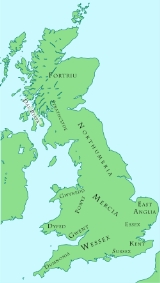
Britain in the Middle Ages

Overview
History of England
The history of England concerns the study of the human past in one of Europe's oldest and most influential national territories. What is now England, a country within the United Kingdom, was inhabited by Neanderthals 230,000 years ago. Continuous human habitation dates to around 12,000 years ago,...
during the Medieval period
Middle Ages
The Middle Ages is a periodization of European history from the 5th century to the 15th century. The Middle Ages follows the fall of the Western Roman Empire in 476 and precedes the Early Modern Era. It is the middle period of a three-period division of Western history: Classic, Medieval and Modern...
— from the end of Roman rule in Britain through to the Early Modern period
Early Modern Britain
Early modern Britain is the history of the island of Great Britain, roughly corresponding to the 16th, 17th, and 18th centuries. Major historical events in Early Modern British history include the English Renaissance, the English Reformation and Scottish Reformation, the English Civil War, the...
. It is in this formative period that England
England
England is a country that is part of the United Kingdom. It shares land borders with Scotland to the north and Wales to the west; the Irish Sea is to the north west, the Celtic Sea to the south west, with the North Sea to the east and the English Channel to the south separating it from continental...
emerged as a unified and political entity, and transformed over several centuries from a diverse, warring and fractious land of petty kingdom
Petty kingdom
A petty kingdom is one of a number of small kingdoms, described as minor or "petty" by contrast to an empire or unified kingdom that either preceded or succeeded it...
s, into one of Europe's most centralised, powerful and richest states.
Early Medieval England corresponds to Anglo-Saxon England, which began with the arrival of the Anglo-Saxons
Anglo-Saxons
Anglo-Saxon is a term used by historians to designate the Germanic tribes who invaded and settled the south and east of Great Britain beginning in the early 5th century AD, and the period from their creation of the English nation to the Norman conquest. The Anglo-Saxon Era denotes the period of...
in southern Britain.
Unanswered Questions
