

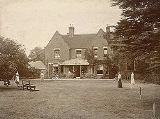
Borley Rectory

Encyclopedia
Borley Rectory was a Victorian era mansion located in the village of Borley
, Essex
, England
. It was constructed in 1863, on the site of a previous rectory
, and destroyed by fire in 1939.
The house gained a reputation for being haunted
after a series of residents reported unsettling phenomena. In 1929, the story of Borley was heavily covered by the Daily Mirror. Notably, it was investigated by paranormal investigator Harry Price
in 1937, who described it as "The Most Haunted House in England", a phrase which caught the imagination of the press. Price wrote two books on the subject, both of which sold well.
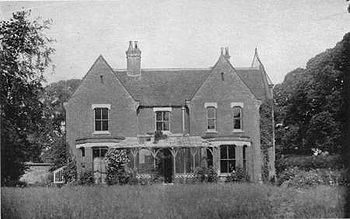 Borley Rectory was constructed near Borley Church by the Reverend Henry Dawson Ellis Bull in 1862, and he moved in a year after being named rector
of the parish. The large brick building was built in a style influenced by Augustus Welby Northmore Pugin, replacing the earlier Georgian house built for the previous rector, Reverend Herringham, which Henry Bull demolished. The rectory was eventually enlarged to house a family of fourteen children.
There is evidence for there having been a house on the rectory site before the Herringham rectory. The nearby church dates from the 12th century and serves a rather scattered rural community of the three hamlets that make up the parish. There are several substantial farmhouses, and the fragmentary remains of Borley Hall, once the seat of the Waldegrave family. Ghost-hunters like to quote the legend of a Benedictine
monastery
supposedly built in this area in about 1362, according to which, a monk
from the monastery carried on a relationship with a nun
from a nearby convent
. After their affair was discovered, the monk was executed and the nun bricked up alive in the convent walls. It was confirmed in 1938 that this legend had no historical basis and seemed to have been fabricated by the rector's children to romanticise their gothic-style red-brick rectory. The story of the walling-up of the nun was probably taken from a novel by Rider Haggard. Until the newspaper stories about the ghosts, there had been no mention in the local papers, or any other written source, of anything unusual happening at the rectory. The rectory and the parish gave every appearance of being a typical East Anglia
n rural parish.
events for which there are accounts apparently occurred in around 1863, since a few locals later remembered hearing unexplained footsteps within the house at about this date. On 28 July 1900, four of the daughters of the rector reported seeing what they thought was the ghost
of a nun
from 40 yards' distance near the house in twilight: they tried to talk to it, but it disappeared as they got closer. The local organist recalled that, at about that date, the family at the rectory were '... very convinced that they had seen an apparition on several occasions'. Various people were to claim to witness a variety of puzzling incidents, such as a phantom coach driven by two headless horsemen
, through the next four decades. Henry Dawson Ellis Bull died in 1892 and his son, the Reverend Harry Bull, took over the living. In 1911, he married a younger divorcée
, Ivy, and the couple moved with her daughter to nearby Borley Place until 1920 (when he took over the rectory), while his unmarried sisters moved to Chilton Lodge a few miles away.
On 9 June 1928, the rector, Harry Bull, died and the rectory again became vacant. In the following year, on 2 October, the Reverend Guy Eric Smith and his wife moved into the home. One day, soon after moving in, Mrs Smith was cleaning out a cupboard when she came across a brown paper package, inside which was the skull
of a young woman. Shortly after, the family would report a variety of incidents including the sounds of servant bells
ringing (on which the strings had been cut), lights appearing in windows and unexplained footsteps. In addition, Mrs Smith believed she saw a horse-drawn carriage at night. The Smiths contacted The Daily Mirror
to ask them to put them in touch with the Society for Psychical Research. On 10 June 1929, the newspaper sent a reporter who promptly wrote the first of a series of articles detailing the mysteries of Borley. The paper also arranged for Harry Price
, a paranormal researcher, to make his first visit to the place which would ultimately make his name famous. He arrived on 12 June. Immediately, objective "phenomena" of a new kind appeared, such as the throwing of stones, a vase and other objects. "Spirit messages" were tapped out from the frame of a mirror. As soon as Harry Price left, these ceased. Mrs Smith later maintained that she then suspected Harry Price, an expert conjurer, of causing the phenomena.
 The Smiths left Borley on 14 July 1929 and, after some difficulty in finding a replacement, the Reverend Lionel Foyster, a first cousin of the Bulls, and his wife Marianne moved into the rectory with their adopted daughter Adelaide, on 16 October 1930. Lionel Foyster wrote an account of the various strange incidents that happened, which he sent to Harry Price. Price estimated that, between when the Foysters moved in and October 1935, many incidents took place there, including bell-ringing, windows shattering, stones, bottle-throwing and wall-writing, and their daughter was locked in a room with no key. Marianne Foyster reported to her husband a whole range of poltergeist
phenomena which included her being thrown from her bed. On one occasion, Adelaide was attacked by "something horrible". Twice, Foyster tried to conduct an exorcism
, but his efforts were fruitless. In the middle of the first, Foyster was struck in the shoulder by a fist-size stone. Because of the publicity in The Daily Mirror, these incidents attracted much attention at the time from several psychic researchers who investigated, and were unanimous in suspecting that they were caused, consciously or unconsciously, by Marianne Foyster. Mrs Foyster later stated that she felt that some of the incidents were caused by her husband in collaboration with one of the psychic researchers, but other events appeared to her to be genuine paranormal phenomena. Marianne later admitted that she was having a sexual relationship with the lodger, Frank Peerless, and that she used 'paranormal' explanations to cover up her liaisons. The Foysters left Borley as a result of Lionel's ill health.
, the owners of the property.
Through an advertisement in The Times
on 25 May 1937, and subsequent personal interviews, he recruited a corp of 48 "official observers", mostly students, who spent periods, mainly at weekends, at the Rectory with instructions to report any phenomena which occurred. In March 1938, Helen Glanville (the daughter of S J Glanville, one of Price's helpers) conducted a Planchette
séance
in Streatham in south London. Price reported that Helen Glanville made contact with two spirits. The first was that of a young nun, who identified herself as Marie Lairre. She said that she had been murdered on the site of Borley Rectory. Her answers were consistent with the story told by the Bull sisters, but a previous seance had identified the nun as Evangeline Westcott. Marie Lairre was, according to the Planchette story, a French nun who left her religious order, married, and came to live in England. The groom was supposedly none other than Henry Waldegrave, the owner of the 17th-century manor house. She claimed to have been murdered in 1667. Price espoused the theory that the ghostly nun who had been seen for generations was Marie Lairre, condemned to wander restlessly as her spirit searched for a holy burial ground. The wall writings were her pleas for help. Despite an enormous amount of work by Mrs Cecil Baines, no trace of any historical evidence for this story was ever found.
The second spirit to be contacted identified himself by the name of "Sunex Amures". He claimed that he would set fire to the rectory at nine o'clock that night. He also said that, at that time, the bones of a murdered person would be revealed. The predictions of Sunex Amures came to pass, in a way, but not that night (27 March 1938). On 27 March 1939, the new owner of the rectory, Captain W.H. Gregson, reported that he was unpacking boxes when an oil lamp
in the hallway overturned. The fire quickly spread and Borley Rectory was severely damaged. An onlooker said she saw the figure of the ghostly nun in the upstairs window and, according to Harry Price, demanded a fee for her story. The burning of the rectory was investigated by the insurance company and determined to be fraudulent. Harry Price conducted a brief dig in the cellars of the ruined house and, almost immediately, two bones of a young woman were discovered, along with a medal of Saint Ignatius. A subsequent meticulous excavation of the cellars over three years revealed nothing further. The bones were given a Christian burial in Liston churchyard, after the parish of Borley refused to allow the ceremony to take place on account of the local opinion that the bones found were those of a pig. The Rector believed that the ceremony would enable the spirit of "Marie Lairre" to go to rest.
, two of whom had been Price's most loyal associates, investigated his claims about Borley and published their findings in a book, The Haunting of Borley Rectory, in 1956, which concluded that any evidence for a haunting was hopelessly confused by Harry Price's duplicity. The "Borley Report", as the SPR study has become known, stated that much of the phenomena were either faked or were due to natural causes such as rats and the strange acoustics due to the odd shape of the house. Subsequently, Robert Hastings, an SPR member, discussed several of the charges of duplicity and falsification of evidence made against Price in a paper to the SPR called An Examination of the "Borley Report", without being able to rebut them convincingly. Hastings' report was never published in book form and is often overlooked.
. It was produced by Joe Burroughs and was scheduled to be broadcast in September 1956; however, it was later abandoned due to concerns over a possible action by Marianne Foyster.
Further books on the Rectory hauntings have appeared over the years, including a collaboration in 1973 by ghost-hunter and author Peter Underwood
and Paul Tabori entitled The Ghosts of Borley, which were sympathetic to Price's investigations. In 1992, Robert Wood published a study of Marianne Foyster and Borley titled The Widow of Borley, which was critical of Price and in 1996, Ivan Banks published The Enigma of Borley Rectory, which supported much of Price's work. The bibliography continues into 2000 with Louis Mayerling's We Faked The Ghosts of Borley Rectory which, upon investigation, turned out to be fictional; Ted Babbs's Borley Rectory – The Final Analysis [2003] and The Borley Rectory Companion [2009] by Paul Adams, Eddie Brazil & Peter Underwood.
In 2004, Warner Independent Pictures
purchased the rights to a screenplay by Richard Potter which was based on Price's 1940 book about Borley, The Most Haunted House In England.
Borley Rectory is also the subject of My Life With Borley Rectory, a comic novel by James Turner, a poet-farmer, who lived for a time in the rectory cottage in the rectory grounds. The novel is loosely based upon his experiences. It was first published in 1950, and is currently out of print.
Borley
Borley is a village and civil parish in Essex, England. It is located on the River Stour, approximately northwest of Sudbury, Suffolk and is 39km north-northeast from the county town of Chelmsford. The village is in the district of Braintree and in the parliamentary constituency of Saffron...
, Essex
Essex
Essex is a ceremonial and non-metropolitan county in the East region of England, and one of the home counties. It is located to the northeast of Greater London. It borders with Cambridgeshire and Suffolk to the north, Hertfordshire to the west, Kent to the South and London to the south west...
, England
England
England is a country that is part of the United Kingdom. It shares land borders with Scotland to the north and Wales to the west; the Irish Sea is to the north west, the Celtic Sea to the south west, with the North Sea to the east and the English Channel to the south separating it from continental...
. It was constructed in 1863, on the site of a previous rectory
Rectory
A rectory is the residence, or former residence, of a rector, most often a Christian cleric, but in some cases an academic rector or other person with that title...
, and destroyed by fire in 1939.
The house gained a reputation for being haunted
Haunted house
A haunted house is a house or other building often perceived as being inhabited by disembodied spirits of the deceased who may have been former residents or were familiar with the property...
after a series of residents reported unsettling phenomena. In 1929, the story of Borley was heavily covered by the Daily Mirror. Notably, it was investigated by paranormal investigator Harry Price
Harry Price
Harry Price was a British psychic researcher and author.-Early life:Although Price claimed his birth was in Shropshire, he was actually born in London in Red Lion Square on the site of the South Place Ethical Society's Conway Hall. He was educated in New Cross, first at Waller Road Infants School...
in 1937, who described it as "The Most Haunted House in England", a phrase which caught the imagination of the press. Price wrote two books on the subject, both of which sold well.
History
Rector
The word rector has a number of different meanings; it is widely used to refer to an academic, religious or political administrator...
of the parish. The large brick building was built in a style influenced by Augustus Welby Northmore Pugin, replacing the earlier Georgian house built for the previous rector, Reverend Herringham, which Henry Bull demolished. The rectory was eventually enlarged to house a family of fourteen children.
There is evidence for there having been a house on the rectory site before the Herringham rectory. The nearby church dates from the 12th century and serves a rather scattered rural community of the three hamlets that make up the parish. There are several substantial farmhouses, and the fragmentary remains of Borley Hall, once the seat of the Waldegrave family. Ghost-hunters like to quote the legend of a Benedictine
Benedictine
Benedictine refers to the spirituality and consecrated life in accordance with the Rule of St Benedict, written by Benedict of Nursia in the sixth century for the cenobitic communities he founded in central Italy. The most notable of these is Monte Cassino, the first monastery founded by Benedict...
monastery
Monastery
Monastery denotes the building, or complex of buildings, that houses a room reserved for prayer as well as the domestic quarters and workplace of monastics, whether monks or nuns, and whether living in community or alone .Monasteries may vary greatly in size – a small dwelling accommodating only...
supposedly built in this area in about 1362, according to which, a monk
Monk
A monk is a person who practices religious asceticism, living either alone or with any number of monks, while always maintaining some degree of physical separation from those not sharing the same purpose...
from the monastery carried on a relationship with a nun
Nun
A nun is a woman who has taken vows committing her to live a spiritual life. She may be an ascetic who voluntarily chooses to leave mainstream society and live her life in prayer and contemplation in a monastery or convent...
from a nearby convent
Convent
A convent is either a community of priests, religious brothers, religious sisters, or nuns, or the building used by the community, particularly in the Roman Catholic Church and in the Anglican Communion...
. After their affair was discovered, the monk was executed and the nun bricked up alive in the convent walls. It was confirmed in 1938 that this legend had no historical basis and seemed to have been fabricated by the rector's children to romanticise their gothic-style red-brick rectory. The story of the walling-up of the nun was probably taken from a novel by Rider Haggard. Until the newspaper stories about the ghosts, there had been no mention in the local papers, or any other written source, of anything unusual happening at the rectory. The rectory and the parish gave every appearance of being a typical East Anglia
East Anglia
East Anglia is a traditional name for a region of eastern England, named after an ancient Anglo-Saxon kingdom, the Kingdom of the East Angles. The Angles took their name from their homeland Angeln, in northern Germany. East Anglia initially consisted of Norfolk and Suffolk, but upon the marriage of...
n rural parish.
Hauntings
The first alleged paranormalParanormal
Paranormal is a general term that designates experiences that lie outside "the range of normal experience or scientific explanation" or that indicates phenomena understood to be outside of science's current ability to explain or measure...
events for which there are accounts apparently occurred in around 1863, since a few locals later remembered hearing unexplained footsteps within the house at about this date. On 28 July 1900, four of the daughters of the rector reported seeing what they thought was the ghost
Ghost
In traditional belief and fiction, a ghost is the soul or spirit of a deceased person or animal that can appear, in visible form or other manifestation, to the living. Descriptions of the apparition of ghosts vary widely from an invisible presence to translucent or barely visible wispy shapes, to...
of a nun
Nun
A nun is a woman who has taken vows committing her to live a spiritual life. She may be an ascetic who voluntarily chooses to leave mainstream society and live her life in prayer and contemplation in a monastery or convent...
from 40 yards' distance near the house in twilight: they tried to talk to it, but it disappeared as they got closer. The local organist recalled that, at about that date, the family at the rectory were '... very convinced that they had seen an apparition on several occasions'. Various people were to claim to witness a variety of puzzling incidents, such as a phantom coach driven by two headless horsemen
Headless Horseman
The headless horseman has been a motif of European folklore since at least the Middle ages.The Headless Horseman is a fictional character who appears in a short story called “The Legend of Sleepy Hollow” which is in a collection of The Sketch Book of Geoffrey Crayon written by Washington Irving...
, through the next four decades. Henry Dawson Ellis Bull died in 1892 and his son, the Reverend Harry Bull, took over the living. In 1911, he married a younger divorcée
Divorcee
Divorcee, refers to a person whose marriage has ended in divorce, a legal dissolution of marriage before death by either spouse. The feminine form is "divorcée", and the masculine "divorcé". At one time the term had negative cultural and religious associations...
, Ivy, and the couple moved with her daughter to nearby Borley Place until 1920 (when he took over the rectory), while his unmarried sisters moved to Chilton Lodge a few miles away.
On 9 June 1928, the rector, Harry Bull, died and the rectory again became vacant. In the following year, on 2 October, the Reverend Guy Eric Smith and his wife moved into the home. One day, soon after moving in, Mrs Smith was cleaning out a cupboard when she came across a brown paper package, inside which was the skull
Human skull
The human skull is a bony structure, skeleton, that is in the human head and which supports the structures of the face and forms a cavity for the brain.In humans, the adult skull is normally made up of 22 bones...
of a young woman. Shortly after, the family would report a variety of incidents including the sounds of servant bells
Bell (instrument)
A bell is a simple sound-making device. The bell is a percussion instrument and an idiophone. Its form is usually a hollow, cup-shaped object, which resonates upon being struck...
ringing (on which the strings had been cut), lights appearing in windows and unexplained footsteps. In addition, Mrs Smith believed she saw a horse-drawn carriage at night. The Smiths contacted The Daily Mirror
The Daily Mirror
The Daily Mirror is a British national daily tabloid newspaper which was founded in 1903. Twice in its history, from 1985 to 1987, and from 1997 to 2002, the title on its masthead was changed to read simply The Mirror, which is how the paper is often referred to in popular parlance. It had an...
to ask them to put them in touch with the Society for Psychical Research. On 10 June 1929, the newspaper sent a reporter who promptly wrote the first of a series of articles detailing the mysteries of Borley. The paper also arranged for Harry Price
Harry Price
Harry Price was a British psychic researcher and author.-Early life:Although Price claimed his birth was in Shropshire, he was actually born in London in Red Lion Square on the site of the South Place Ethical Society's Conway Hall. He was educated in New Cross, first at Waller Road Infants School...
, a paranormal researcher, to make his first visit to the place which would ultimately make his name famous. He arrived on 12 June. Immediately, objective "phenomena" of a new kind appeared, such as the throwing of stones, a vase and other objects. "Spirit messages" were tapped out from the frame of a mirror. As soon as Harry Price left, these ceased. Mrs Smith later maintained that she then suspected Harry Price, an expert conjurer, of causing the phenomena.
Poltergeist
A poltergeist is a paranormal phenomenon which consists of events alluding to the manifestation of an imperceptible entity. Such manifestation typically includes inanimate objects moving or being thrown about, sentient noises and, on some occasions, physical attacks on those witnessing the...
phenomena which included her being thrown from her bed. On one occasion, Adelaide was attacked by "something horrible". Twice, Foyster tried to conduct an exorcism
Exorcism
Exorcism is the religious practice of evicting demons or other spiritual entities from a person or place which they are believed to have possessed...
, but his efforts were fruitless. In the middle of the first, Foyster was struck in the shoulder by a fist-size stone. Because of the publicity in The Daily Mirror, these incidents attracted much attention at the time from several psychic researchers who investigated, and were unanimous in suspecting that they were caused, consciously or unconsciously, by Marianne Foyster. Mrs Foyster later stated that she felt that some of the incidents were caused by her husband in collaboration with one of the psychic researchers, but other events appeared to her to be genuine paranormal phenomena. Marianne later admitted that she was having a sexual relationship with the lodger, Frank Peerless, and that she used 'paranormal' explanations to cover up her liaisons. The Foysters left Borley as a result of Lionel's ill health.
Price Investigation
Borley remained vacant for some time after the Foysters' departure in May 1937 and Price then took out a year long rental agreement with Queen Anne's BountyQueen Anne's Bounty
Queen Anne's Bounty was a fund established in 1704 to augment the incomes of the poorer clergy of the Church of England. The bounty was funded by the tax on the incomes of all Church of England clergy, which was paid to the Pope until the Reformation, and thereafter to the Crown.In 1890, the total...
, the owners of the property.
Through an advertisement in The Times
The Times
The Times is a British daily national newspaper, first published in London in 1785 under the title The Daily Universal Register . The Times and its sister paper The Sunday Times are published by Times Newspapers Limited, a subsidiary since 1981 of News International...
on 25 May 1937, and subsequent personal interviews, he recruited a corp of 48 "official observers", mostly students, who spent periods, mainly at weekends, at the Rectory with instructions to report any phenomena which occurred. In March 1938, Helen Glanville (the daughter of S J Glanville, one of Price's helpers) conducted a Planchette
Planchette
A planchette , from the French for "little plank", is a small, usually heart-shaped flat piece of wood that one moves around on a board to spell out messages or answer questions. Paranormal advocates believe that the planchette is moved by some extra-normal force. The motion is due to the...
séance
Séance
A séance is an attempt to communicate with spirits. The word "séance" comes from the French word for "seat," "session" or "sitting," from the Old French "seoir," "to sit." In French, the word's meaning is quite general: one may, for example, speak of "une séance de cinéma"...
in Streatham in south London. Price reported that Helen Glanville made contact with two spirits. The first was that of a young nun, who identified herself as Marie Lairre. She said that she had been murdered on the site of Borley Rectory. Her answers were consistent with the story told by the Bull sisters, but a previous seance had identified the nun as Evangeline Westcott. Marie Lairre was, according to the Planchette story, a French nun who left her religious order, married, and came to live in England. The groom was supposedly none other than Henry Waldegrave, the owner of the 17th-century manor house. She claimed to have been murdered in 1667. Price espoused the theory that the ghostly nun who had been seen for generations was Marie Lairre, condemned to wander restlessly as her spirit searched for a holy burial ground. The wall writings were her pleas for help. Despite an enormous amount of work by Mrs Cecil Baines, no trace of any historical evidence for this story was ever found.
The second spirit to be contacted identified himself by the name of "Sunex Amures". He claimed that he would set fire to the rectory at nine o'clock that night. He also said that, at that time, the bones of a murdered person would be revealed. The predictions of Sunex Amures came to pass, in a way, but not that night (27 March 1938). On 27 March 1939, the new owner of the rectory, Captain W.H. Gregson, reported that he was unpacking boxes when an oil lamp
Oil lamp
An oil lamp is an object used to produce light continuously for a period of time using an oil-based fuel source. The use of oil lamps began thousands of years ago and is continued to this day....
in the hallway overturned. The fire quickly spread and Borley Rectory was severely damaged. An onlooker said she saw the figure of the ghostly nun in the upstairs window and, according to Harry Price, demanded a fee for her story. The burning of the rectory was investigated by the insurance company and determined to be fraudulent. Harry Price conducted a brief dig in the cellars of the ruined house and, almost immediately, two bones of a young woman were discovered, along with a medal of Saint Ignatius. A subsequent meticulous excavation of the cellars over three years revealed nothing further. The bones were given a Christian burial in Liston churchyard, after the parish of Borley refused to allow the ceremony to take place on account of the local opinion that the bones found were those of a pig. The Rector believed that the ceremony would enable the spirit of "Marie Lairre" to go to rest.
Society for Psychical Research investigation
After Harry Price's death in 1948, three members of the English Society for Psychical ResearchSociety for Psychical Research
The Society for Psychical Research is a non-profit organisation in the United Kingdom. Its stated purpose is to understand "events and abilities commonly described as psychic or paranormal by promoting and supporting important research in this area" and to "examine allegedly paranormal phenomena...
, two of whom had been Price's most loyal associates, investigated his claims about Borley and published their findings in a book, The Haunting of Borley Rectory, in 1956, which concluded that any evidence for a haunting was hopelessly confused by Harry Price's duplicity. The "Borley Report", as the SPR study has become known, stated that much of the phenomena were either faked or were due to natural causes such as rats and the strange acoustics due to the odd shape of the house. Subsequently, Robert Hastings, an SPR member, discussed several of the charges of duplicity and falsification of evidence made against Price in a paper to the SPR called An Examination of the "Borley Report", without being able to rebut them convincingly. Hastings' report was never published in book form and is often overlooked.
Further investigations and publications
A short programme about Borley Rectory was also commissioned by the BBCBBC
The British Broadcasting Corporation is a British public service broadcaster. Its headquarters is at Broadcasting House in the City of Westminster, London. It is the largest broadcaster in the world, with about 23,000 staff...
. It was produced by Joe Burroughs and was scheduled to be broadcast in September 1956; however, it was later abandoned due to concerns over a possible action by Marianne Foyster.
Further books on the Rectory hauntings have appeared over the years, including a collaboration in 1973 by ghost-hunter and author Peter Underwood
Peter Underwood (parapsychologist)
This article is about the English paranormalist. For the Chief Justice of Tasmania, see Peter Underwood .Peter Underwood FRSA is an English author, broadcaster and paranormalist. Underwood was born in Letchworth Garden City, Hertfordshire on May 16 1923. He is a prolific author on books covering...
and Paul Tabori entitled The Ghosts of Borley, which were sympathetic to Price's investigations. In 1992, Robert Wood published a study of Marianne Foyster and Borley titled The Widow of Borley, which was critical of Price and in 1996, Ivan Banks published The Enigma of Borley Rectory, which supported much of Price's work. The bibliography continues into 2000 with Louis Mayerling's We Faked The Ghosts of Borley Rectory which, upon investigation, turned out to be fictional; Ted Babbs's Borley Rectory – The Final Analysis [2003] and The Borley Rectory Companion [2009] by Paul Adams, Eddie Brazil & Peter Underwood.
In 2004, Warner Independent Pictures
Warner Independent Pictures
Warner Independent Pictures was the specialty division of film studio Warner Bros. Entertainment. Established in August 2003, its first release was 2004's Before Sunset...
purchased the rights to a screenplay by Richard Potter which was based on Price's 1940 book about Borley, The Most Haunted House In England.
See also
- The Amityville HorrorThe Amityville HorrorThe Amityville Horror: A True Story is a book by Jay Anson, published in September 1977. It is also the basis of a series of films released between 1979 and 2005...
, another haunted house with similar alleged paranormal activity.
Borley Rectory is also the subject of My Life With Borley Rectory, a comic novel by James Turner, a poet-farmer, who lived for a time in the rectory cottage in the rectory grounds. The novel is loosely based upon his experiences. It was first published in 1950, and is currently out of print.
External links
- Harry Price Website – Contains a comprehensive section on Borley Rectory
- Ghostbuster of Fraud by Simon Edge, reprinted in HarryPrice website
- Local History site for Borley – Has a comprehensive historical analysis of the Borley Rectory affair
- Complete text of a book on the Borley Rectory affair written by a local Historian. The Bones of Borley
- Large collection of photographs of Borley Rectory and the various participants of the affair
- Harry Price papers including archives on Borley Rectory