
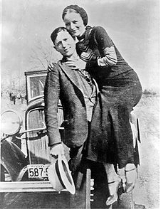
Bonnie Elizabeth Parker (October 1, 1910 – May 23, 1934) and
Clyde Chestnut Barrow (March 24, 1909 – May 23, 1934) were well-known outlaws, robbers, and criminals who traveled the
Central United StatesThe Central United States is sometimes conceived as between the Eastern United States and Western United States as part of a three-region model, roughly coincident with the Midwestern United States plus the western and central portions of the Southern United States; the term is also sometimes used...
with their gang during the
Great DepressionThe Great Depression was a severe worldwide economic depression in the decade preceding World War II. The timing of the Great Depression varied across nations, but in most countries it started in about 1929 and lasted until the late 1930s or early 1940s...
. Their exploits captured the attention of the American public during the "
public enemy eraPublic Enemy is an American hip hop group consisting of Chuck D, Flavor Flav, Professor Griff and his S1W group, DJ Lord , and Music Director Khari Wynn...
" between 1931 and 1934. Though known today for his dozen-or-so bank robberies, Barrow in fact preferred to rob small stores or rural gas stations. The gang is believed to have killed at least nine police officers and committed several civilian murders. The couple themselves were eventually ambushed and killed in Louisiana by law officers. Their reputation was cemented in American pop folklore by
Arthur Penn'sArthur Hiller Penn was an American film director and producer with a career as a theater director as well. Penn amassed a critically acclaimed body of work throughout the 1960s and 1970s.-Early years:...
1967 film
Bonnie and ClydeThe film was originally offered to François Truffaut, the best-known director of the New Wave movement, who made contributions to the script. He passed on the project to make Fahrenheit 451. The producers approached Jean-Luc Godard next...
.
Even during their lifetimes, the couple's depiction in the press was at considerable odds with the hardscrabble reality of their life on the road—particularly in the case of Parker. Though she was present at a hundred or more felonies during her two years as Barrow's companion, she was not the machine gun-wielding cartoon killer portrayed in the newspapers, newsreels, and pulp detective magazines of the day. Gang member
W. D. JonesWilliam Daniel Jones was a member of the Barrow Gang, whose spree throughout the southern Midwest in the early years of the Great Depression became part of American criminal folklore. Jones ran with Clyde Barrow and Bonnie Parker for eight and a half months, from Christmas Eve 1932 to early...
was unsure whether he had ever seen her fire at officers. Parker's reputation as a cigar-smoking
gun mollGun moll is a term that refers to the female companion of a male professional criminal. In some contexts, gun moll more specifically suggests that the woman handles a firearm....
grew out of a playful snapshot found by police at an abandoned hideout, released to the press, and published nationwide; while she did
chain-smokeChain smoking is the practice of lighting a new cigarette for personal consumption immediately after one that is finished, sometimes using the finished cigarette to light the next one. It is a common form of addiction.-Causes:...
CamelCamel is a brand of cigarettes that was introduced by American company R.J. Reynolds Tobacco in the summer of 1913. Most current Camel cigarettes contain a blend of Turkish tobacco and Virginia tobacco. Early in 2008 the blend was changed as was the package design.-History:In 1913, R.J...
cigarettes, she was not a cigar smoker.
Author-historian Jeff Guinn explains that it was the release of these very photos that put the outlaws on the media map and launched their legend: "
John DillingerJohn Herbert Dillinger, Jr. was an American bank robber in Depression-era United States. He was charged with, but never convicted of, the murder of an East Chicago, Indiana police officer during a shoot-out. This was his only alleged homicide. His gang robbed two dozen banks and four police stations...
had matinee-idol good looks and
Pretty Boy FloydCharles Arthur "Pretty Boy" Floyd was an American bank robber. He operated in the West South Central States, and his criminal exploits gained heavy press coverage in the 1930s. Like most other prominent outlaws of that era, he was killed by law enforcement officers...
had the best possible nickname, but the Joplin photos introduced new criminal superstars with the most titillating trademark of all—illicit sex. Clyde Barrow and Bonnie Parker were young and unmarried. They undoubtedly slept together—after all, the girl smoked cigars... Without Bonnie, the media outside Texas might have dismissed Clyde as a gun-toting punk, if it ever considered him at all. With her sassy photographs, Bonnie supplied the sex-appeal, the oomph, that allowed the two of them to transcend the small-scale thefts and needless killings that actually comprised their criminal careers."
Bonnie Parker
Bonnie Elizabeth Parker was born in
Rowena, TexasRowena is an unincorporated community in southwestern Runnels County, Texas, United States.Paul J. Baron designed the town in 1898.According to the US Census, the population was estimated at 483 in 2000, an increase of three percent from 1990s 466 Rowenans...
, the second of three children. Her father, Charles Parker, a bricklayer, died when Bonnie was four. Her mother, Emma Krause, moved with the children to her parents' home in Cement City, an industrial suburb of Dallas, where she found work as a garment sewer. Parker was one of the best students in her high school, winning top prizes in spelling, writing and public speaking. As an adult, her fondness for writing found expression in poems such as "The Story of Suicide Sal" and "The Trail's End" (known since as "The Story of Bonnie and Clyde").
Parker did not date until she was in her second year of high school, but in that year she fell in love with a classmate, Roy Thornton, whose good looks and smart clothes caught her schoolgirl's eye. The two quit school and were married on September 25, 1926, six days before Parker's sixteenth birthday. Their marriage, marked by his frequent absences and brushes with the law, was short-lived, and after January 1929 their paths never crossed again. But they were never divorced, and Parker was wearing Thornton's wedding ring when she died. Thornton was in prison in 1934 when he learned of his wife's ambush; his reaction was, "I'm glad they went out like they did. It's much better than being caught."
In 1929, between the breakdown of her marriage and her first meeting with Clyde Barrow in January 1930, Parker lived with her mother and worked as a waitress in Dallas; one of her regular customers in the café was postal worker
Ted HintonTed Hinton was a Dallas County, Texas, Deputy Sheriff, the youngest of the posse that ambushed and killed Bonnie and Clyde near Gibsland, Louisiana, on May 23, 1934.-History:...
, who would join the Dallas Sheriff's Department in 1932 and, as a posse member, would participate in her ambush in 1934. In the diary she kept briefly early in 1929, she wrote of her desperate loneliness, her impatience with life in provincial Dallas, and her love of a newfangled technology — talking pictures.
Clyde Barrow
Clyde Chestnut Barrow was born in
Ellis County, TexasAs of the census of 2000, there were 111,360 people, 37,020 households, and 29,653 families residing in the county. The population density was 118 people per square mile . There were 39,071 housing units at an average density of 42 per square mile...
, near
TelicoTelico is an unincorporated community in east central Ellis County, Texas, United States.The area that became Telico was settled before 1856...
, a town just south of
DallasDallas is the third-largest city in Texas and the ninth-largest in the United States. The Dallas-Fort Worth Metroplex is the largest metropolitan area in the South and fourth-largest metropolitan area in the United States...
. He was the fifth of seven children of Henry Basil Barrow (1874-1957) and Cumie T. Walker (1874-1943), a desperately poor farming family that emigrated, piecemeal, to Dallas in the early 1920s as part of a wave of resettlement from the impoverished nearby farms to the impoverished urban slum known as West Dallas. It was a place of flimsy shanties and tent cities, piles of garbage and teeming open sewers, swarming insects and rampaging epidemics. The Barrows had neither shanty nor tent: they spent their first months living under their wagon. When father Henry had earned enough money to buy a tent, it was a major step up for the family.
Clyde was first arrested in late 1926, after running when police confronted him over a rental car he had failed to return on time. His second arrest, with brother
Marvin "Buck" BarrowMarvin Ivan Barrow was a member of the Barrow Gang. He was the older brother of the gang's leader, Clyde Barrow. He and his wife Blanche were wounded in a gun battle with police four months after they joined up with Bonnie and Clyde...
, came soon after, this time for possession of stolen goods (
turkeyA turkey is a large bird in the genus Meleagris. One species, Meleagris gallopavo, commonly known as the Wild Turkey, is native to the forests of North America. The domestic turkey is a descendant of this species...
s). Despite having legitimate jobs during the period 1927 through 1929, he also cracked safes, robbed stores, and stole cars. After sequential arrests in 1928 and 1929, his luck ran out and he was sent to Eastham Prison Farm in April 1930. While in prison, he was sexually assaulted repeatedly for over a year by a dominant inmate, whose skull he eventually fractured with a length of pipe. It was Clyde Barrow's first killing.
Paroled in February 1932, Barrow emerged from Eastham a hardened and bitter criminal. His sister Nell remembered a conversation with sister Marie about the new parolee: "There's a new air about him—a funny sort of something I can't put my finger on.... I'm afraid he's not going to go straight." Marie was blunter: "Something awful sure must have happened to him in prison, because he wasn't the same person when he got out." Associate
Ralph FultsRalph Fults was a Depression-era outlaw and escape artist associated with Raymond Hamilton, Bonnie Parker and Clyde Barrow of the Barrow Gang.-Early life:...
was there, inside "The Walls" with Barrow, and said he watched him "change from a schoolboy to a rattlesnake."
In his post-Eastham career, he focused on smaller jobs, robbing grocery stores and gas stations, at a rate far outpacing the mere ten to fifteen bank robberies attributed to him and the Barrow Gang. Barrow's favored weapon was the M1918 Browning Automatic Rifle (called a BAR). According to John Neal Phillips, Barrow's goal in life was not to gain fame or fortune from robbing banks, but to seek revenge against the
Texas prison system for the abuses he suffered while serving time.
First meeting
There are several versions of the story describing Bonnie's and Clyde's first meeting, but the most credible version indicates that Bonnie Parker met Clyde Barrow in January 1930 at a friend's house. Parker was out of work and was staying in West Dallas to assist a girl friend with a broken arm. Barrow dropped by the girl's house while Parker was supposedly in the kitchen making hot chocolate.
When they met, both were smitten immediately; most historians believe Parker joined Barrow because she was in love. She remained a loyal companion to him as they carried out their crime spree and awaited the violent deaths they viewed as inevitable.
1932: Early jobs, early murders
After Barrow was released from prison in February 1932, he and Ralph Fults assembled a rotating core group of associates and began a series of small robberies, primarily of stores and gas stations; their goal was to collect enough money and firepower to launch a raid of liberation against Eastham prison. On April 19, Bonnie Parker and Fults were captured in a failed hardware store burglary in
Kaufman, TexasKaufman is a city in Kaufman County, Texas, United States. The population was 6,490 at the 2000 census. It is the county seat of Kaufman County.-Geography:Kaufman is located at ....
, and subsequently jailed. On April 30, Barrow was the wheelman in a robbery in
Hillsboro, TexasHillsboro is a city in and the county seat of Hill County in Central Texas. The population was 8,232 at the 2000 census.Hillsboro, located on Interstate 35 where I-35E and I-35W meet south of the Dallas-Fort Worth Metroplex, is the primary center for trade and commerce in Hill County...
, during which the store's owner, J.N. Bucher, was shot and killed. When shown mugshots, the victim's wife identified Barrow as one of the shooters, even though he had stayed outside in the car; it was his first murder accusation. Meanwhile, Parker remained in jail until June 17, writing poetry to while away the time. When the Kaufman County grand jury convened, it declined to indict her, and she was released. Within a few weeks, she reunited with Barrow.
On August 5, while Parker was visiting her mother in Dallas, Barrow,
Raymond HamiltonRaymond Hamilton was a member of the notorious Barrow Gang during the early 1930s. By the time he was 21 years old he had accumulated a prison sentence of 362 years.-The Barrow Gang:...
and Ross Dyer were drinking alcohol at a country dance in
Stringtown, OklahomaStringtown is a town in Atoka County, Oklahoma, United States. The population was 396 at the 2000 census. It is the second largest town in Atoka County.-Geography:Stringtown is located at ....
, when Sheriff C.G. Maxwell and his deputy, Eugene C. Moore, approached them in the parking lot. Barrow and Hamilton opened fire, killing the deputy and gravely wounding the sheriff; it was the first killing of a lawman by Barrow and his gang, a total eventually amounting to nine officers killed. Another civilian was added to the list on October 11, when storekeeper Howard Hall was killed during a robbery of his store in
Sherman, TexasSherman is a city in and the county seat of Grayson County, Texas, United States. The city's estimated population as of 2009 was 38,407. It is also one of two principal cities in the Sherman-Denison Metropolitan Statistical Area.-History:...
. The take: twenty-eight dollars and some groceries.
W. D. JonesWilliam Daniel Jones was a member of the Barrow Gang, whose spree throughout the southern Midwest in the early years of the Great Depression became part of American criminal folklore. Jones ran with Clyde Barrow and Bonnie Parker for eight and a half months, from Christmas Eve 1932 to early...
had been a friend of the Barrow family since childhood, and though he was only 16 years old on Christmas Eve 1932, he persuaded Barrow to let him join up with the pair and ride out of Dallas with them that night. The very next day, Jones was initiated into homicide when he and Barrow killed Doyle Johnson, a young family man, in the process of stealing his car in
Temple, TexasTemple is a city in Bell County, Texas, United States. Located near the county seat of Belton, Temple lies in the region referred to as Central Texas. Located off Interstate 35, Temple is 65 miles north of Austin and 34 miles south of Waco. In the 2010 Census, Temple's population was 66,102, an...
. Less than two weeks later, on January 6, 1933, Barrow killed Tarrant County Deputy Sheriff Malcolm Davis when he, Parker and Jones wandered into a police trap set for another criminal. The total murdered by the gang since April was now five.
1933: Buck joins the gang
On March 22, 1933, Buck Barrow was granted a full pardon and released from prison. Within days, he and his wife,
BlancheBennie Iva "Blanche" Frasure was the wife of Marvin "Buck" Barrow and the sister-in-law of Clyde Barrow. Buck and Blanche were part of the Barrow Gang from late March 1933 until their capture on July 24, 1933.-Early life:Blanche Barrow was born in Garvin, Oklahoma...
, had set up housekeeping with Clyde Barrow, Parker and Jones in a temporary
hideout at 3347 1/2 Oakridge DriveThe Bonnie and Clyde Garage Apartment is located at 3347½ Oak Ridge Drive in Joplin, Missouri, though it actually fronts on 34th Street. The apartment was the location where the Barrow gang hid out after a series of robberies in Missouri and neighboring states...
in
Joplin, MissouriJoplin is a city in southern Jasper County and northern Newton County in the southwestern corner of the US state of Missouri. Joplin is the largest city in Jasper County, though it is not the county seat. As of the 2010 census, the city population was 50,150...
. According to family sources, Buck and Blanche were there merely to visit, in an attempt to persuade Clyde to surrender to law enforcement. As was common with Bonnie and Clyde, their next brush with the law arose from their generally suspicious—and conspicuous—behavior, not because their identities had been discovered. Beer had just been legalized after Prohibition, and the group ran loud, alcohol-fueled card games late into the night in the quiet neighborhood. "We bought a case of beer a day," Blanche would later recall. The menfolk came and went noisily at all hours, and once, a BAR (Browning Automatic Rifle) discharged in the apartment while Clyde was cleaning it; the short burst did not bring any neighbors directly to the house, but at least one registered suspicions with the
Joplin Police DepartmentThe Joplin Police Department is the principal law enforcement agency responsible for serving the city of Joplin, Missouri-Department Structure and History:...
.
Unaware of what awaited them, the lawmen assembled only a two-car, five-man force on April 13 to confront the suspected
bootleggerRum-running, also known as bootlegging, is the illegal business of transporting alcoholic beverages where such transportation is forbidden by law...
s living in the rented apartment over a garage. Though taken by surprise, Clyde, noted for remaining cool under fire, was gaining far more experience in gun battles than most lawmen. He, Jones and Buck quickly killed Detective McGinnis and fatally wounded Constable Harryman. During the escape from the apartment, Parker laid down covering fire with her own BAR, forcing Highway Patrol sergeant G. B. Kahler to duck behind a large oak tree while
.30-06 slugsThe .30-06 Springfield cartridge or 7.62×63mm in metric notation, was introduced to the United States Army in 1906 and standardized, and was in use until the 1960s and early 1970s. It replaced the .30-03, 6 mm Lee Navy, and .30 US Army...
slammed into the other side, forcing wood splinters into the sergeant's face. Parker then got into the car with the others. The car slowed long enough to pull in Blanche Barrow from the street, where she was pursuing her fleeing dog, Snow Ball. The surviving officers later testified that their side had fired only fourteen rounds in the conflict, although one of these hit Jones in the side, one struck Clyde and was deflected by his suitcoat button, and one grazed Buck after ricocheting off a wall.
The group escaped the police at Joplin, but left most of their possessions at the rented apartment: Buck and Blanche's marriage license, Buck's parole papers (only three weeks old), a large arsenal—and a handwritten poem and camera with several rolls of exposed film. The film was developed at
The Joplin GlobeThe Joplin Globe is a seven-day daily newspaper published in Joplin, Missouri, USA, covering parts of 14 counties in southwestern Missouri. Since 2002, it has been owned by Community Newspaper Holdings Inc....
and yielded many now-famous photos of Barrow, Parker and Jones clowning and pointing ordnance at one another. When the poem and the photos, including one featuring the poetess clenching a cigar in her teeth and a pistol in her fist, went out on the newly installed newswire, the obscure fivesome from Dallas became front page news across America as The Barrow Gang, fully illustrated and with the rhyming-couplet "Story of 'Suicide Sal'" as a seeming instant backstory.
For the next three months, they ranged from Texas as far north as
MinnesotaMinnesota is a U.S. state located in the Midwestern United States. The twelfth largest state of the U.S., it is the twenty-first most populous, with 5.3 million residents. Minnesota was carved out of the eastern half of the Minnesota Territory and admitted to the Union as the thirty-second state...
. In May, they attempted to rob the bank in
Lucerne, IndianaLucerne is an unincorporated town in Harrison Township, Cass County, Indiana....
and robbed the bank in
Okabena, MinnesotaOkabena is a town in Jackson County, Minnesota, United States. The population was 188 at the 2010 census. The community's name is a Dakota term meaning "the nesting place of herons."- History :...
. Previously they had kidnapped Dillard Darby and Sophia Stone at
Ruston, LouisianaRuston is a city in and the parish seat of Lincoln Parish, Louisiana, United States. The population was 20,546 at the 2000 census. Ruston is near the eastern border of the Ark-La-Tex and is the home of Louisiana Tech University. Its economy caters to its college population...
, in the course of stealing Darby's car; this was one of several incidents between 1932 and 1934 in which they kidnapped lawmen or robbery victims, usually releasing them far from home, sometimes with money to help them return. Stories of these encounters made headlines, but so too did the darker encounters. The Barrow Gang would not hesitate to shoot anyone, lawman or civilian, who got in their way. Other members of the Barrow Gang known or thought to have committed murders included Raymond Hamilton, W.D. Jones, Buck Barrow and Henry Methvin. Eventually, the cold-bloodedness of the killings would not only sour the public perception of the outlaws, but lead directly to their undoing.
While the photos in the papers might have suggested a glamorous lifestyle for the Barrow Gang, in reality they were desperate and discontented, as noted in the account of their life written by Blanche Barrow while she was in jail through the latter 1930s. With their new fame—some would say notoriety—came difficulty in the smallest tasks of everyday living. Restaurants and tourist courts became less and less of an option; cooking and bathing became campfire and cold-stream propositions. The unrelieved, round-the-clock proximity of life among two couples, plus a fifth-wheel, in one car gave rise to vicious bickering. So unpleasant did it become that W.D. Jones, who was the actual wheelman in the theft of Dillard Darby's car in late April, used that car to get himself separated from the others—and managed to stay separated throughout May and up until June 8.
On June 10, while driving with Jones and Parker near
Wellington, TexasWellington is a city in Collingsworth County, Texas, United States. The population was 2,275 at the 2000 census. It is the county seat of Collingsworth County.-Geography:Wellington is located at ....
, Barrow missed warning signs at a bridge under construction and flipped their car into a ravine. Sources disagree on whether there was an actual gasoline fire or that Parker was doused with acid from the car's battery under the floorboards. What is certain is that she sustained horrific third degree burns to her right leg. The burn was so severe, the muscles contracted and caused the leg to "draw up"; near the end of her life, Parker could hardly walk and would either hop on her good leg or be carried by Clyde. After getting help from a nearby farm family and kidnapping two local lawmen, the three outlaws rendezvoused with Blanche and Buck Barrow again and they hid out in a tourist court near Ft. Smith, Arkansas, nursing Parker's grievous burns. Then Buck and Jones bungled a local robbery and killed Town
MarshalMarshal , is a word used in several official titles of various branches of society. The word is an ancient loan word from Old French, cf...
Henry D. Humphrey in
Alma, ArkansasAlma is a city in Crawford County located in the western part of U.S. state of Arkansas, along I-40 about 13 miles from the Oklahoma border. Alma's population is 4,734, making it the sixth largest city in the Fort Smith, Arkansas-Oklahoma Metropolitan Statistical Area...
. With the renewed pursuit from the law, they had to flee again, despite the grave condition of Bonnie Parker.
1933: Platte City and Dexfield Park
On July 18, 1933, the gang checked into the
Red Crown Tourist CourtThe Red Crown Tavern and Red Crown Tourist Court in Platte County, Missouri was the site of the July 20, 1933 gun battle between lawmen and outlaws Bonnie and Clyde and three members of their gang. The outlaws made their escape, but would be tracked down and cornered four days later near Dexter,...
south of
Platte City, MissouriPlatte City is a city in Platte County, Missouri, along the Little Platte River. The population was 3,866 at the 2000 census. It is the county seat of Platte County.-Geography:Platte City is located at...
(now within the city limits of
Kansas City, MissouriKansas City, Missouri is the largest city in the U.S. state of Missouri and is the anchor city of the Kansas City Metropolitan Area, the second largest metropolitan area in Missouri. It encompasses in parts of Jackson, Clay, Cass, and Platte counties...
across I-29 from
Kansas City International AirportKansas City International Airport , originally named Mid-Continent International Airport, is a public airport located 15 miles northwest of the central business district of Kansas City, in Platte County, Missouri, United States. In 2008, 10,469,892 passengers used the airport...
). The Red Crown Court was just two brick cabins joined by garages and the gang rented both. To the south stood the Red Crown Tavern, a popular restaurant and a favorite watering hole for Missouri Highway Patrolmen. Once again, the gang seemed to go out of their way to draw attention to themselves: owner Neal Houser became interested in the group immediately when Blanche Barrow registered the party as three guests, and Houser, out his rear window, could see
five people exiting their car—which the driver backed into the garage, "gangster style," for a quick getaway. Blanche paid the lodging tab with coins rather than paper money, and did the same thing again later when she purchased five dinners and five beers for, presumably, three guests. The next day, Houser noticed that his guests had taped newspapers over the windows of their cabin, and Blanche once again paid in silver for five meals. Even Blanche's outfit—saucy, tight
jodhpursJodhpurs in their modern form are tight-fitting trousers that reach to the ankle, where they end in a snug cuff, and are worn primarily for horse riding. The term is also used incorrectly as slang for a type of short riding boot, also called a paddock boot or a jodhpur boot, because they are worn...
riding breeches—attracted undue attention: they were just not the kind of thing the staid women of Platte City would ever wear, and were the first thing mentioned by eyewitnesses reminiscing even forty years later. It was all too much for Houser, who brought the conspicuous group to the attention of his restaurant patron, Captain William Baxter of the Highway Patrol.
When Clyde and Jones went into town to purchase bandages, crackers, cheese, and
atropineAtropine is a naturally occurring tropane alkaloid extracted from deadly nightshade , Jimson weed , mandrake and other plants of the family Solanaceae. It is a secondary metabolite of these plants and serves as a drug with a wide variety of effects...
sulfate to treat Bonnie's leg, the druggist contacted Sheriff
Holt CoffeyHolt Coffey was the sheriff of Platte County, Missouri from 1933 until 1937 and again from 1941 until 1945. Coffey, along with newly elected Platte City Prosecutor David Clevenger, was responsible for cleaning up much of the small time crime around Platte County, a suburb of freewheeling Kansas...
, who put the cabins under watch. Coffey had been alerted by Oklahoma, Texas, and
ArkansasArkansas is a state located in the southern region of the United States. Its name is an Algonquian name of the Quapaw Indians. Arkansas shares borders with six states , and its eastern border is largely defined by the Mississippi River...
to be on the lookout for strangers seeking such supplies. The sheriff contacted Captain Baxter, who called for reinforcements from
Kansas CityKansas City, Missouri is the largest city in the U.S. state of Missouri and is the anchor city of the Kansas City Metropolitan Area, the second largest metropolitan area in Missouri. It encompasses in parts of Jackson, Clay, Cass, and Platte counties...
including an armored car. At 11 p.m. that night, Sheriff Coffey led a group of officers armed with
Thompson submachine gunThe Thompson is an American submachine gun, invented by John T. Thompson in 1919, that became infamous during the Prohibition era. It was a common sight in the media of the time, being used by both law enforcement officers and criminals...
s toward the cabins. But in a pitched gunfight at considerable distances, the submachine guns proved no match for Clyde Barrow's preferred Browning Automatic Rifles, stolen July 7 from the National Guard
armoryAn armory or armoury is a place where arms and ammunition are made, maintained and repaired, stored, issued to authorized users, or any combination of those...
at
Enid, OklahomaEnid is a city in Garfield County, Oklahoma, United States. In 2010, the population was 49,379, making it the ninth largest city in Oklahoma. It is the county seat of Garfield County. Enid was founded during the opening of the Cherokee Outlet in the Land Run of 1893, and is named after Enid, a...
. The Barrows laid down withering fire and made their escape when a bullet short-circuited the horn on the armored car and the lawmen mistook it for a cease-fire signal. They did not pursue the retreating Barrow automobile.
Although the gang evaded law enforcement once again, Buck Barrow had sustained a horrific wound in the side of the head and Blanche Barrow was nearly blinded from glass fragments in both her eyes. Their prospects for holding out against the ensuing manhunt dwindled.
Five days later, on July 24, the Barrow Gang was camped at Dexfield Park, an abandoned amusement park near
Dexter, IowaDexter is a city in Dallas County, Iowa, United States. The population was 689 at the 2000 census. It is part of the Des Moines–West Des Moines Metropolitan Statistical Area...
. So plainly mortal was Buck's head wound that Clyde and Jones dug a grave for him. After their bloody bandages were noticed by local citizens, it was determined that the campers were the Barrow gang. Surrounded by local lawmen and approximately one hundred spectators, the Barrows once again found themselves under fire. Clyde Barrow, Parker, and W.D. Jones escaped on foot. Buck was shot again, in the back, and he and his wife were captured by the officers. Buck died five days later, at Kings Daughters Hospital in
Perry, IowaPerry is a city in Dallas County, Iowa, United States, along the North Raccoon River. The population was 7,633 at the 2000 census. It is part of the Des Moines–West Des Moines Metropolitan Statistical Area....
, of
pneumoniaPneumonia is an inflammatory condition of the lung—especially affecting the microscopic air sacs —associated with fever, chest symptoms, and a lack of air space on a chest X-ray. Pneumonia is typically caused by an infection but there are a number of other causes...
after surgery.
For the next six weeks, the remaining trio ranged far afield of their usual area of operations—west to Colorado, north to Minnesota, southeast to Mississippi—keeping a low profile and pulling only small robberies for daily-bread money. They restocked their arsenal when Barrow and Jones burglarized an armory at
Plattville, IllinoisPlattville is a village in Lisbon Township, Kendall County, Illinois, United States. The village was first formed in 1860 and was named after founder Daniel Platt, who first built a home there in 1834 on the Frink and Walker stagecoach route between Chicago and Ottawa, IL.Plattville was officially...
on August 20 and scored three BARs, handguns and lots of ammunition.
By early September, they risked a run back in to Dallas to see their families for the first time in four months, and Jones parted company with them, continuing on to Houston, where his mother had moved. He was arrested there without incident on November 16 and returned to Dallas. Through the autumn, Barrow executed a series of small-time robberies with a series of small-time local accomplices while his family, and Parker's, attended to her considerable medical needs.
On November 22, 1933, they again narrowly evaded arrest—but not bullets—while attempting to hook up with family members near
Sowers, TexasSowers, Texas is a ghost town located approximately 11 miles northwest of Dallas, Texas in Dallas County. Today, the once rural community is located entirely within the boundaries of Irving, Texas.Of the original townsite, only the cemetery remains....
. This time, it was their hometown Sheriff, Dallas's Smoot Schmid and his squad, lying in wait nearby. As Barrow drove up, he sensed a trap and drove right past his family's car, at which point Schmid and his deputies stood up and opened fire with machine guns and a
BARThe BAR is a gas-operated, semi-automatic rifle produced by the Browning Arms Company first in Belgium and later in Japan. The rifle loads from a box magazine detachable from a hinged floor plate. This rifle should not be confused with the M1918 military rifle, which is a completely different...
. The family members in the crossfire were not hit, but not so the outlaws: a single BAR slug penetrated the car—and the legs of both Parker and Barrow. The couple made their getaway that night, but the attempted ambush would prove to be a dry run for deputies Ted Hinton and Bob Alcorn, who would get another shot at the pair six months hence in Louisiana.
Bonnie Parker crossed an ominous personal threshold the following week when on November 28, a Dallas grand jury delivered a murder indictment on her and Barrow for the January 1933 killing of Tarrant County Deputy Malcolm Davis; it was the first murder warrant issued for Parker.
1934: Final run
On January 16, 1934, Barrow finally made his long-contemplated move against the Texas Department of Corrections as he orchestrated the escape of
Raymond HamiltonRaymond Hamilton was a member of the notorious Barrow Gang during the early 1930s. By the time he was 21 years old he had accumulated a prison sentence of 362 years.-The Barrow Gang:...
,
Henry MethvinHenry Methvin was an American criminal, bank robber and Depression-era outlaw. He is best remembered as the final member of Bonnie and Clyde's gang and whose father, Ivan Methvin, helped arrange their deaths at the hands of a posse headed by Texas lawman Frank Hamer in 1934...
and several others in the infamous "
EasthamEastham Unit is a Texas Department of Criminal Justice prison for men and located in unincorporated Houston County, Texas GPS Coordinates 30.978106, -95.632274. The prison is located at the dead end of Farm to Market Road 230, near Lovelady and west of Trinity...
Breakout" of 1934. The Texas prison system received national negative publicity from the brazen raid, and Barrow appeared to have achieved what Phillips describes as the burning passion in his life: exacting revenge on the Texas Department of Corrections.
During the jailbreak, escapee Joe Palmer shot prison officer Major Joe Crowson and this act would eventually bring the full power of the Texas and federal governments to bear on the manhunt for Barrow and Parker. As Crowson struggled for life, prison chief Lee Simmons reportedly promised him that all persons involved in the breakout would be hunted down and killed, and all were, except for Henry Methvin, whose life would eventually be exchanged for turning Barrow and Parker over to authorities. The Texas Department of Corrections then contacted former
Texas RangerThe Texas Ranger Division, commonly called the Texas Rangers, is a law enforcement agency with statewide jurisdiction in Texas, and is based in Austin, Texas...
Captain
Frank A. HamerFrancis Augustus Hamer was a Texas Ranger, known in popular culture for his involvement in tracking down and killing the criminal duo Bonnie Parker and Clyde Barrow in 1934...
, and persuaded him to accept an assignment to hunt down the Barrow Gang. Though retired, Hamer had retained his commission, which had not yet expired. He accepted the assignment as a
Texas Highway PatrolThe Texas Department of Public Safety is a department of the government of the state of Texas. The DPS is responsible for statewide law enforcement and vehicle regulation. The Public Safety Commission oversees the DPS. Its five members are appointed by the Governor of Texas and confirmed by the...
officer, secondarily assigned to the prison system as a special investigator, and given the specific task of hunting down Bonnie, Clyde and the Barrow Gang.
Frank Hamer was that
rara avis, a true legend in his own time. Tall, burly, cryptic and taciturn, unimpressed by authority, driven by an "inflexible adherence to right, or what he thinks is right," for twenty years Hamer had been feared and admired throughout
the Lone Star StateTexas is the second largest U.S. state by both area and population, and the largest state by area in the contiguous United States.The name, based on the Caddo word "Tejas" meaning "friends" or "allies", was applied by the Spanish to the Caddo themselves and to the region of their settlement in...
as "the walking embodiment of the 'One Riot, One Ranger' ethos." In accomplishing the aims of Texas law enforcement he "had acquired a formidable reputation as a result of several spectacular captures and the shooting of a number of Texas criminals." He was officially credited with fifty-three kills (and seventeen wounds to himself). Although prison boss Simmons always said publicly that Hamer had been his first choice for the Barrow hunt, there's evidence he approached two other Rangers first, both of whom had been queasy about shooting a woman and declined; Hamer apparently had no such qualms. Starting February 10, he became the constant shadow of Barrow and Parker, living out of his car, just a town or two behind the bandits. Three of Hamer's brothers were also Texas Rangers, and while brother Harrison was the best shot of the four, Frank was considered the most tenacious.
On April 1, 1934, Easter Sunday, Barrow and Henry Methvin killed two young highway patrolmen, H. D. Murphy and Edward Bryant Wheeler, at the intersection of Route 114 and Dove Road near
Grapevine, TexasGrapevine is a city in northeast Tarrant County, Texas, United States located within the Dallas-Fort Worth metropolitan area. As of the 2010 census the city population was 46,334. The city's moniker is derived from the native grapes prevalent in the area. In recent years several wineries have...
(now the neighboring city of
SouthlakeSouthlake is a city in northeast Tarrant and southeast Denton counties, Texas. As of the 2010 census it had a population of 26,575. A suburb of Fort Worth and Dallas, Southlake is known for exemplary public schools, Southlake Town Square, and Carroll High School's 7-time state champion football...
). A contemporary eyewitness account stated that Barrow and Parker fired the fatal shots and this story got widespread coverage in the press before it was discredited. Henry Methvin later admitted he fired the first shot, after assuming Barrow wanted the officers killed; he also admitted that Parker approached the dying officers intending to
help them, not to administer the cold-blooded point-blank
coup de grâceThe expression coup de grâce means a death blow intended to end the suffering of a wounded creature. The phrase can refer to the killing of civilians or soldiers, friends or enemies, with or without the consent of the sufferer...
the discredited eyewitness had described. Barrow then joined in, firing at Patrolman Murphy. Most likely, Parker was asleep in the back seat when Methvin started shooting and took no part in the assault.
But in the spring of 1934, the
reality of the Grapevine killings had far less impact on events than did the public's
perception of them: All four Dallas daily papers seized on the story told by the eyewitness, a farmer, who claimed to have seen Parker throw her head back and laugh at the way Patrolman Murphy's head "bounced like a rubber ball" on the ground as she pumped bullets into his prone body. The stories even claimed that police found a cigar butt "with tiny teeth marks" that could only be attributed to the diminutive Parker. Things got worse several days later when Murphy's intended bride walked into his funeral wearing her wedding gown and sparked another round of photo-supported coverage in the papers. The eyewitness's ever-changing story was soon discredited, but not in time for Barrow and Parker: the massive negative publicity, against Parker in particular, accelerated the public clamor for the extermination of the remaining elements of the Barrow Gang.
It was more than just bad press, though—the outcry galvanized the authorities into taking more concrete legal actions. Highway Patrol boss L.G. Phares immediately offered a $1,000 reward for "the dead bodies of the Grapevine slayers"—not their capture, just the bodies. Texas governor Ma Ferguson was as outraged as the voting public, and she added another $500 reward for each of the two alleged killers, which "meant for the first time there was a specific price on Bonnie's head, since she was so widely believed to have shot H.D. Murphy."
Public hostility only increased when, just five days later, Barrow and Methvin killed 60 year-old Constable William "Cal" Campbell, a widower single father, near
Commerce, OklahomaCommerce is a city in Ottawa County, Oklahoma, United States. The population was 2,645 at the 2000 census.-Geography:Commerce is located at ....
. They kidnapped Commerce police chief Percy Boyd, drove around with him, crossing the state line into Kansas, and then let him out with a clean shirt, a few dollars and a request from Parker to tell the world she didn't smoke cigars. The outlaws didn't realize at their upbeat parting that Boyd would identify both Barrow and Parker to authorities—he never learned the name of the sullen youth who was with them—and when the resultant arrest warrant was issued for the Campbell murder, it specified "Clyde Barrow, Bonnie Parker and John Doe." Historian Knight writes: "For the first time, Bonnie was seen as a killer, actually pulling the trigger—just like Clyde. Whatever chance she had for clemency had just been reduced."
The Dallas Journal ran a cartoon on its editorial page showing the Texas electric chair, empty, but with a sign on it saying
"Reserved"—for Clyde and Bonnie.
Death
Barrow and Parker were ambushed and killed on May 23, 1934 on a rural road in
Bienville Parish, LouisianaBienville Parish is a parish located in the northwestern portion of the U.S. state of Louisiana. The parish seat is Arcadia and as of the 2000 census, the population is 15,752....
. The couple appeared in daylight in an automobile and were shot by a posse of four Texas officers (
Frank HamerFrancis Augustus Hamer was a Texas Ranger, known in popular culture for his involvement in tracking down and killing the criminal duo Bonnie Parker and Clyde Barrow in 1934...
, B.M. "Manny" Gault, Bob Alcorn and
Ted HintonTed Hinton was a Dallas County, Texas, Deputy Sheriff, the youngest of the posse that ambushed and killed Bonnie and Clyde near Gibsland, Louisiana, on May 23, 1934.-History:...
) and two Louisiana officers (
Henderson JordanHenderson Jordan , as sheriff of Bienville Parish in north Louisiana, was one of six law enforcement officers who on May 23, 1934, ambushed the fugitives Bonnie and Clyde in a deadly encounter on Louisiana Highway 154 between Gibsland and Sailes to the south.-Background:According to his grave...
and Prentiss Morel Oakley).
The posse was led by Hamer, who had begun tracking the pair on February 10, 1934. He studied the gang's movements and found they swung in a circle skirting the edges of five
midwestThe Midwestern United States is one of the four U.S. geographic regions defined by the United States Census Bureau, providing an official definition of the American Midwest....
states, exploiting the "state line" rule that prevented officers from one jurisdiction from pursuing a fugitive into another. Barrow was a master of that pre-FBI rule, but he was consistent in his movements, so an experienced manhunter like Hamer could chart his path and predict where he would go. The gang's itinerary centered on family visits, and they were due to see Henry Methvin's family in Louisiana, which explained Hamer's meeting with them over the course of the hunt. Hamer obtained a quantity of civilian Browning Automatic Rifles (manufactured by Colt as the "Monitor") and 20 round magazines with armor piercing rounds.
On May 21, 1934, the four posse members from Texas were in
ShreveportShreveport is the third largest city in Louisiana. It is the principal city of the fourth largest metropolitan area in the state of Louisiana and is the 109th-largest city in the United States....
, Louisiana, when they learned that Barrow and Parker were to go to Bienville Parish that evening with Methvin. Barrow had designated the residence of Methvin's parents as a rendezvous in case they were later separated and indeed Methvin did get separated from the pair in Shreveport. The full posse, consisting of Captain Hamer, Dallas County Sheriff's Deputies Bob Alcorn and
Ted HintonTed Hinton was a Dallas County, Texas, Deputy Sheriff, the youngest of the posse that ambushed and killed Bonnie and Clyde near Gibsland, Louisiana, on May 23, 1934.-History:...
(both of whom knew Barrow and Parker by sight), former Texas Ranger B.M. "Manny" Gault, Bienville Parish Sheriff
Henderson JordanHenderson Jordan , as sheriff of Bienville Parish in north Louisiana, was one of six law enforcement officers who on May 23, 1934, ambushed the fugitives Bonnie and Clyde in a deadly encounter on Louisiana Highway 154 between Gibsland and Sailes to the south.-Background:According to his grave...
, and his deputy Prentiss Oakley, set up an ambush at the rendezvous point along Louisiana State Highway 154 south of
GibslandGibsland is a town in Bienville Parish, Louisiana, United States. Conveniently near Interstate 20 and less than an hour from both Shreveport and Monroe, Louisiana, Gibsland offers small town living with access to urban amenities...
toward Sailes. Hinton's account has the group in place by 9:00 pm on the 21st and waiting through the whole next day (May 22) with no sign of the outlaw couple, but other accounts have them setting up on the evening of the 22nd.
At approximately 9:15 am on May 23, the posse, concealed in the bushes and almost ready to concede defeat, heard Barrow's stolen
Ford V8The Model B was a Ford automobile with production starting with model year 1932 and ending with 1934. It was a much updated version of the Model A and was replaced by the 1935 Ford Model 48...
approaching at a high speed. The posse's official report had Barrow stopping to speak with Henry Methvin's father, planted there with his truck that morning to distract him and force him into the lane closer to the posse. The lawmen then opened fire, killing Barrow and Parker while shooting a combined total of approximately 130 rounds. All accounts of the ambush, including his own, agree that Oakley fired first, and probably before any order was given to do so. Barrow was killed instantly by Oakley's initial head shot, but Parker had a moment to reflect; Hinton reported hearing her scream as she realized Barrow was dead before the shooting
at her began in earnest. The officers emptied the specially ordered automatic rifles, as well as other rifles, shotguns, and pistols at the car, and any one of many wounds would have been fatal to either of the fugitives. According to statements made by Ted Hinton and Bob Alcorn:
Some today say Bonnie and Clyde were shot more than 50 times, others claim closer to 25 wounds per corpse, or 50 total. Officially, the tally in Parish coroner Dr. J. L. Wade's 1934 report listed seventeen separate entrance wounds on Barrow's body and twenty-six on Parker's, including several headshots on each, and one that had snapped Barrow's spinal column. So numerous were the bullet holes that undertaker C. F. "Boots" Bailey would have difficulty embalming the bodies because they wouldn't contain the embalming fluid.
Amidst the lingering gunsmoke at the ambush site, the temporarily deafened officers inspected the vehicle and discovered an arsenal of weapons including stolen automatic rifles, sawed-off semi-automatic shotguns, assorted handguns, and several thousand rounds of ammunition, along with fifteen sets of license plates from various states.
Word of the ambush quickly got around when Hamer, Jordan, Oakley, and Hinton drove into town to telephone their respective bosses. A crowd soon gathered at the spot, and Gault and Alcorn, who had been left to guard the bodies, lost control of the jostling curious; one woman cut off bloody locks of Parker's hair and pieces from her dress, which were subsequently sold as souvenirs. Hinton returned to find a man trying to cut off Barrow's trigger finger, and was sickened by what was occurring. The
coronerA coroner is a government official who* Investigates human deaths* Determines cause of death* Issues death certificates* Maintains death records* Responds to deaths in mass disasters* Identifies unknown dead* Other functions depending on local laws...
, arriving on the scene, saw the following: "...nearly everyone had begun collecting souvenirs such as shell casings, slivers of glass from the shattered car windows, and bloody pieces of clothing from the garments of Bonnie and Clyde. One eager man had opened his pocket knife, and was reaching into the car to cut off Clyde's left ear." The coroner enlisted Hamer for help in controlling the "circus-like atmosphere", and only then did people move away from the car.
The bullet-riddled Ford containing the two bodies was towed to the Conger Furniture Store &
Funeral ParlorA funeral home, funeral parlor or mortuary, is a business that provides burial and funeral services for the deceased and their families. These services may include aprepared wake and funeral, and the provision of a chapel for the funeral....
on Railroad Avenue in downtown
ArcadiaArcadia is a town in and the parish seat of Bienville Parish in north Louisiana, United States. The population was 3,041 at the 2000 census....
, Louisiana across from the Illinois Central train station (which is now a historical museum containing Bonnie and Clyde artifacts). Preliminary
embalmingEmbalming, in most modern cultures, is the art and science of temporarily preserving human remains to forestall decomposition and to make them suitable for public display at a funeral. The three goals of embalming are thus sanitization, presentation and preservation of a corpse to achieve this...
was done by Bailey in the small preparation room in back of the furniture store. It was estimated that the northwest Louisiana town swelled in population from 2,000 to 12,000 within hours, the curious throngs arriving by train, horseback, buggy, and plane. Beer which normally sold for 15 cents a bottle jumped to 25 cents; ham sandwiches quickly sold out. After identifying his son's body, an emotional Henry Barrow sat in a rocking chair in the furniture part of the Conger establishment and wept.
H.D. Darby, a young undertaker who worked for the McClure Funeral Parlor in nearby
Ruston, LouisianaRuston is a city in and the parish seat of Lincoln Parish, Louisiana, United States. The population was 20,546 at the 2000 census. Ruston is near the eastern border of the Ark-La-Tex and is the home of Louisiana Tech University. Its economy caters to its college population...
, and Sophia Stone, a home demonstration agent also from Ruston, came to Arcadia to identify the bodies. They had been kidnapped by the Barrow gang the previous year in Ruston, on April 27, 1933, and released near
Waldo, ArkansasWaldo is a city in Columbia County, Arkansas, United States. The population was 1,594 at the 2000 census.Waldo celebrated its 120th year as a city in 2007. The small town was once a booming rail city on the Cotton Belt train route...
. Parker reportedly had laughed when she asked Darby his profession and discovered he was an undertaker. She remarked that maybe someday he would be working on her. As it turned out, she could be no closer to the truth: Darby assisted Bailey in embalming the outlaws.
Funeral and burial
Bonnie and Clyde wished to be buried side by side, but the Parker family would not allow it. Mrs. Parker had wanted to grant her daughter's final wish, which was to be brought home, but the mobs surrounding the Parker house made that impossible. Over 20,000 people turned out for Bonnie Parker's funeral, making it difficult for her family to reach the grave site.
Parker's family used the now defunct McKamy-Campbell Funeral Home, then located on Forest Avenue (now Martin Luther King, Jr. Boulevard) in
DallasDallas is the third-largest city in Texas and the ninth-largest in the United States. The Dallas-Fort Worth Metroplex is the largest metropolitan area in the South and fourth-largest metropolitan area in the United States...
, to conduct her funeral. Hubert "Buster" Parker accompanied his sister’s body back to Dallas in the McKamy-Campbell ambulance. Her services were held on Saturday, May 26, 1934, at 2 pm, in the funeral home, directed by Allen D. Campbell. His son, Dr. Allen Campbell, later remembered that flowers came from everywhere, including some with cards allegedly from
Pretty Boy FloydCharles Arthur "Pretty Boy" Floyd was an American bank robber. He operated in the West South Central States, and his criminal exploits gained heavy press coverage in the 1930s. Like most other prominent outlaws of that era, he was killed by law enforcement officers...
and
John DillingerJohn Herbert Dillinger, Jr. was an American bank robber in Depression-era United States. He was charged with, but never convicted of, the murder of an East Chicago, Indiana police officer during a shoot-out. This was his only alleged homicide. His gang robbed two dozen banks and four police stations...
. The largest floral tribute was sent by a group of Dallas city newsboys; the sudden end of Bonnie and Clyde sold 500,000 newspapers in Dallas alone. Soloists at the funeral included Dudley M Hughes Sr., who later was to become the prominent operator of four large Dallas funeral homes. Although initially buried in the Fishtrap Cemetery, Parker was moved, in 1945, to the new Crown Hill Cemetery in Dallas. The next year, services for Raymond Hamilton, a member of the Barrow Gang who was executed on May 10, 1935 by the State of Texas, were also held at the McKamy-Campbell Funeral Home.
Barrow's family used the Sparkman-Holtz-Brand Morticians, located in the A.H. Belo mansion in downtown Dallas. Thousands of people gathered outside both Dallas funeral homes hoping for a chance to view the bodies. Barrow’s private funeral was held at sunset on Friday, May 25, in the funeral home chapel. He was buried in Western Heights Cemetery in Dallas, next to his brother, Marvin. They share a single granite marker with their names on it and a four-word epitaph previously selected by Clyde: “Gone but not forgotten.”
The life insurance policies for both Bonnie Parker and Clyde Barrow were paid in full by American National of Galveston. Since then, the policy of pay-outs has changed to exclude pay-outs in cases of deaths caused by any criminal act by the insured.
In addition to the memorabilia collected by the posse, the six men were each to receive a one-sixth share of the reward money. Dallas Sheriff Schmid had promised Ted Hinton this would total some $26,000, but most of the state, county, and other organizations that had pledged reward funds reneged on their pledges; by the time the six checks were issued to the possemen, each had earned just $200.23 for his efforts.

The ambush of Barrow and Parker proved to be the beginning of the end of the "public enemy era" of the 1930s. New federal statutes that made bank robbery and kidnapping federal offenses, the growing coordination of local jurisdictions by the FBI, and the installation of two-way radios in police cars combined to make the free-ranging outlaw bandit lifestyle much more difficult in the summer of 1934 than it had been just a few months before. Two months after Gibsland, John Dillinger was ambushed and killed on the street in Chicago; three months after that, Charles Arthur "Pretty Boy" Floyd took 14 FBI bullets in the back in Ohio; and one month after that, Lester "
Baby Face NelsonLester Joseph Gillis , known under the pseudonym George Nelson, was a bank robber and murderer in the 1930s. Gillis was known as Baby Face Nelson, a name given to him due to his youthful appearance and small stature...
" Gillis shot it out, and lost, in Illinois. Thereafter, the Public Enemies would no longer operate on thin ribbons of gray macadam across America, but only on silver screens throughout the world.
Controversies
Questions following the ambush were helped along by the tripartite composition of the posse itself: Hamer and Gault were both former Texas Rangers now working for the Texas Department of Corrections, Hinton and Alcorn were employees of the Dallas Sheriff's office, and Jordan and Oakley were Sheriff and Deputy of Bienville Parish. The three duos distrusted each other, kept to themselves, and indeed did not even much like each other. They each carried differing agendas into the operation and brought differing narratives out of it. Historian Guinn puts it this way: Hamer's, Simmons's, Jordan's and Hinton's "various testimonies
- combine into one of the most dazzling displays of deliberate obfuscation in modern history. Such widely varied accounts can't be dismissed as different people honestly recalling the same events different ways. Motive becomes an issue, and they all had reason to lie. Hamer was fanatical about protecting sources. Simmons was interested in resurrecting his own public image.... Jordan wanted to present himself as the critical dealmaker. Nobody can account for Ted Hinton's improbable reminiscences...."
Because their self-serving accounts vary so widely, and because all six men are long deceased, the exact details of the ambush are unknown and unknowable.
As a result, the questions have lingered, including whether fair warning was given the fugitives before the firing commenced, the status of Parker as a shoot-on-sight candidate, and the 1970s-era accusations of Deputy Hinton.
Calling a "Halt!"
The efficacy of calling out a warning to Clyde Barrow before an ambush was demonstrated by Dallas Sheriff Schmid at Sowers, Texas in November 1933. At his call of "Halt!" there was a smattering of gunfire from the outlaw car, a sweeping U-turn, and then rapidly vanishing taillights: Ambush over. Hinton later called it "the most futile gesture of the week." So when the two Louisiana officers on the posse assumed that calling "Halt!" would be the prelude to the bullets, the four Texans "vetoed the idea," hurrying to inform them that Clyde's history had always been to shoot his way out of seemingly hopeless entrapments, like Platte City, Dexfield Park, and Sowers. It is unlikely that Hamer planned to give any warning, but the matter became moot when Deputy Oakley simply stood up and opened fire; after a beat, the startled possemen joined him in the fusillade. In their descriptions of the event, Jordan said
he called out to Barrow, Alcorn said Hamer called out, and Hinton claimed Alcorn did, while in another paper that same day, they
each said they
both did. These conflicting claims most likely were collegial attempts to divert the focus from their gun-jumping associate Oakley, who admitted in subsequent years that he fired prematurely.
Warrants on Parker
Different and disparate sources have cited five occasions when Bonnie Parker may or may not have fired shots during crises faced by the gang. The number of shots is unimportant as she never hit anyone, let alone directly murdered. She was, however, an accomplice to a hundred or more felony criminal actions during her two-year career in crime including eight murders, seven kidnappings, half-a-dozen bank robberies, scores of felony armed robberies, countless automobile thefts, one major jailbreak and an episode of assault and battery at a time when being a "habitual criminal" was a capital offense in Texas. Because of their far-flung, rural base of operations and will o' the wisp
modus operandi, Parker was able to stay a step ahead of the tide of legal paperwork that inevitably follows a crime spree the scope of hers and Barrow's.
This began to change for Parker after Joplin: the Joplin P.D. issued a
Wanted for Murder poster in April 1933 that featured her name and photo first, before Barrow's, though the text concentrated on him. In June, another
Wanted for Murder poster emerged, this one out of Crawford County, Arkansas, again with Parker's name and photo getting first billing. There was now a $250 cash bounty attached for either of the "Barrow Brothers" (Clyde and "Melvin")—and the admonition to "inquire of your doctors if they have been called to treat a woman that has been burned in a car wreck."
By November 1933, W.D. Jones was in custody and supplying details of the gang's 1933 activities—details which led to the empanelment of a grand jury in Dallas. On November 28, the grand jury indicted Parker, Barrow, and Jones for the murder of Deputy Malcolm Davis in January; Judge Nolan G. Williams of Criminal District Court No. 2 issued arrest warrants for Parker and Barrow for murder. Parker's assistance in the raid on Eastham prison in January 1934 earned her the enmity of an even wider group of influential Texans, so when an eyewitness, later completely discredited, linked her to the heinous Grapevine murders, the head of the Highway Patrol, and the Governor herself, placed bounties on Parker's head. Just five days later, Barrow and Henry Methvin killed Constable Campbell in Commerce, Oklahoma, and the murder warrant issued there named "Clyde Barrow, Bonnie Parker and John Doe" as his killers.
Hinton's accusations
In 1979, Ted Hinton's as-told-to account of the ambush was published posthumously as
Ambush, and it attempted to change the complexion of the Methvin family's involvement in the planning and execution of the ambush. According to Hinton, the posse had tied Henry Methvin's father, Ivy, to a tree the previous night, to keep him from possibly warning the outlaws off. Hamer, Hinton claimed, made Ivy Methvin a deal: keep quiet about being tied up, and his son would be pardoned for the murder of the two young highway patrolmen at Grapevine, a pardon which Henry Methvin did eventually receive. Hinton alleged that Hamer made every member of the posse swear they would never divulge this secret. Other accounts, however, place Methvin Senior at the very center of the action that morning, not tied up but right down on the road, waving for Clyde Barrow to stop—having cut Henry's pardon deal several weeks before. John Treherne posits a less sinister explanation: Hamer, he says, may well have floated the tied-to-a-tree scenario to give Ivy Methvin an "alibi" in the event that Barrow escaped the ambush or the family later wanted revenge against a betrayer. Hinton's odd memoir also propounds the tale that the offending stogie in the famous "cigar photo" of Bonnie had in fact been a
rose in her mouth that was retouched
into a cigar by darkroom personnel at the
Joplin Globe while they were preparing the photo for publication. Guinn says that "some people who knew [Hinton] suspect he became delusional late in life."
Aftermath
The smoke from the
fusilladeA fusillade is the simultaneous and continuous firing of a group of firearms on command. It stems from the French word fusil, meaning firearm, and fusiller meaning to shoot....
had not even cleared before the posse began sifting through the items in the Barrow death car. Hamer appropriated the "considerable" arsenal of stolen guns and ammunition, plus a box of fishing tackle, under the terms of his compensation package with the Texas DOC. In July, Clyde's mother Cumie wrote to Hamer asking for the guns' return: "You don't never want to forget my boy was never tried in no court for murder and no one is guilty until proven guilty by some court so I hope you will answer this letter and also return the guns I am asking for." No record exists of any response.
Alcorn claimed Barrow's
saxophoneThe saxophone is a conical-bore transposing musical instrument that is a member of the woodwind family. Saxophones are usually made of brass and played with a single-reed mouthpiece similar to that of the clarinet. The saxophone was invented by the Belgian instrument maker Adolphe Sax in 1846...
from the car, but feeling guilty, later returned it to the Barrow family. Other personal items such as Parker's clothing were also taken, and when the Parker family asked for them back, they were refused. These items were later sold as souvenirs. A rumored suitcase full of cash was said by the Barrow family to have been kept by Sheriff Jordan, "who soon after the ambush purchased an auction barn and land in Arcadia." Jordan also attempted to keep the death car for his own but found himself the target of a lawsuit by Ruth Warren of Topeka, the car's owner from whom Barrow had stolen it on April 29; after considerable legal sparring and a court order, Jordan relented and Mrs. Warren got her car back in August 1934, still covered with blood and tissue, and with an $85 towing and storage bill.
In February 1935, Dallas and federal authorities conducted a "harboring trial" in which twenty family members and friends of the outlaw couple were arrested and jailed for the aid and abetment of Barrow and Parker. All twenty either pleaded or were found guilty. The two mothers were jailed for 30 days; other sentences ranged from two years' imprisonment for Raymond Hamilton's brother Floyd to one hour in custody for teenager Marie Barrow, Clyde's sister. Other defendants included Blanche Barrow, W. D. Jones, Henry Methvin and Bonnie's sister Billie.
Blanche Barrow's injuries left her permanently blinded in her left eye. After the 1933 shootout at Dexfield Park, she was taken into custody on the charge of "Assault With Intent to Kill." She was sentenced to ten years in prison but was paroled in 1939 for good behavior. She returned to Dallas, leaving her life of crime in the past, and lived with her invalid father as his caregiver. She married Eddie Frasure in 1940, worked as a taxi cab dispatcher and a beautician, and completed the terms of her parole one year later. She lived in peace with her husband until he died of cancer in 1969.
Warren BeattyWarren Beatty born March 30, 1937) is an American actor, producer, screenwriter and director. He has received a total of fourteen Academy Award nominations, winning one for Best Director in 1982. He has also won four Golden Globe Awards including the Cecil B. DeMille Award.-Early life and...
approached her to purchase the rights to her name for use in the 1967 film
Bonnie and ClydeThe film was originally offered to François Truffaut, the best-known director of the New Wave movement, who made contributions to the script. He passed on the project to make Fahrenheit 451. The producers approached Jean-Luc Godard next...
. While she agreed to the original script, she objected to her characterization in the final film, describing
Estelle Parsons'sEstelle Margaret Parsons is an American theatre, film and television actress and occasional theatrical director.After studying law, Parsons became a singer before deciding to pursue a career in acting. She worked for the television program Today and made her stage debut in 1961...
Academy AwardThe 40th Academy Awards honored film achievements of 1967. Originally scheduled for 8 April 1968, the awards were postponed to two days later, 10 April 1968, because of the assassination of Dr...
-winning portrayal of her as "a screaming horse's ass." Despite this, she maintained a firm friendship with Beatty. She died from cancer at the age of 77 on December 24, 1988, and was buried in Dallas's Grove Hill Memorial Park under the name "Blanche B. Frasure".
Barrow colleagues Raymond Hamilton and Joe Palmer, both Eastham escapees in January 1934, both recaptured, and both subsequently convicted of murder, shared one more thing in common: they were both executed in the electric chair, "Old Sparky", at Huntsville, Texas, and both on the same day: May 10, 1935. Barrow protégé W. D. Jones had split from his mentors six weeks after the three slipped the noose at Dexfield Park in July 1933. He found his way to Houston and got a job picking cotton. He was discovered and captured in short order though, and was returned to Dallas, where he dictated a "confession" in which he claimed to have been kept a prisoner by Barrow and Parker. Some of the more lurid embellishments he made concerned the gang's sex lives, and it was this testimony that gave rise to many of the stories about Barrow's ambiguous sexuality. Jones was convicted of the murder of Doyle Johnson and served a lenient sentence of fifteen years. He struggled for years with substance abuse problems, gave an interview to
PlayboyPlayboy is an American men's magazine that features photographs of nude women as well as journalism and fiction. It was founded in Chicago in 1953 by Hugh Hefner and his associates, and funded in part by a $1,000 loan from Hefner's mother. The magazine has grown into Playboy Enterprises, Inc., with...
during the heyday of excitement surrounding the 1967 movie, and was killed on August 4, 1974 in a misunderstanding by the jealous boyfriend of a woman he was trying to help out.
Substitute protégé Henry Methvin's ambush-earned Texas pardon didn't help him in Oklahoma, where he was convicted of the 1934 murder of Constable Campbell at Commerce. He was paroled in 1942 and killed by a train in 1948; it was said he fell asleep, drunk, on the tracks, but there were rumors he had been pushed by parties seeking revenge for his betrayal of Clyde Barrow. His father Ivy had been killed in 1946 by a hit-and-run driver, and here too there was talk of foul play. Bonnie Parker's husband Roy Thornton was sentenced to five years in prison for burglary in March 1933. He was killed by guards on October 3, 1937, during an escape attempt from Eastham Farm prison.
In the years after the ambush, Prentiss Oakley, who all six possemen agree fired the first shots, was reported to have been troubled by his actions. He often admitted to his friends that he had fired prematurely and he was the only posse member to express regret publicly. He would go on to succeed Henderson Jordan as Bienville Parish sheriff in 1940.
Frank Hamer returned to a quieter life as a freelance security consultant—a strikebreaker—to oil companies, although, according to Guinn, "his reputation suffered somewhat after Gibsland" because many people felt he had not given Barrow and Parker a fair chance to surrender. He made headlines again in 1948 when he and Governor Coke Stevenson unsuccessfully challenged Lyndon Johnson's vote totals during the election for the U.S. Senate. He died in 1955 at age 71 after several years of poor health. His possemate Bob Alcorn died on May 23, 1964—exactly thirty years to the day after the Gibsland ambush.
On April 1, 2011, the 77th anniversary of the Grapevine murders, Texas Rangers, troopers and DPS staff presented the Yellow Rose of Texas commendation to Ella Wheeler-McLeod, 95, the last surviving sibling of highway patrolman Edward Bryan Wheeler, killed that Easter Sunday by the Barrow Gang. They presented McLeod, of San Antonio, with a plaque and framed portrait of her brother.
In the contemporary media
Bonnie Parker and Clyde Barrow were among the first celebrity criminals of the modern era. They had little choice in the matter: after they fled the Joplin hideout in April 1933 with nothing but the clothes they were wearing, the police discovered several rolls of undeveloped film and some scrawled doggerel poetry left behind. It was instant legend: the photos showed the couple and W. D. Jones in playful, snapshot-type poses, except they were wielding pistols, rifles and BARs. In one gag shot, Parker had plucked a cigar from Barrow and popped it in her mouth, branding her as "Clyde's cigar-smoking moll." The poem "Suicide Sal," peppered with quotation marks and colorful
underworldOrganized crime or criminal organizations are transnational, national, or local groupings of highly centralized enterprises run by criminals for the purpose of engaging in illegal activity, most commonly for monetary profit. Some criminal organizations, such as terrorist organizations, are...
vernacularA vernacular is the native language or native dialect of a specific population, as opposed to a language of wider communication that is not native to the population, such as a national language or lingua franca.- Etymology :The term is not a recent one...
, mirrored the tone of the popular
detective magazinesPulp magazines , also collectively known as pulp fiction, refers to inexpensive fiction magazines published from 1896 through the 1950s. The typical pulp magazine was seven inches wide by ten inches high, half an inch thick, and 128 pages long...
of the time. Two days after the raid, the photos and poem went out on the wire and were running in newspapers all over the country. Before Joplin, the Barrows' notoriety had been confined strictly to the Dallas area; afterwards, they became notorious across America.
The high public profile was a mixed blessing. It certainly made life on the run more dangerous and therefore more difficult. There were more nights sleeping in the car and fewer sleeping in motor courts; picking up laundry at cleaning stores was particularly harrowing. As the noose tightened, Parker composed the fatalistic poem she titled "The Trail's End," known since as "The Story of Bonnie and Clyde." She gave the handwritten ode to her mother upon their final meeting two weeks before her death and Emma Parker gave it to the press thereafter.
Six weeks before the couple was ambushed, a letter purportedly written by Barrow arrived at the office of Henry Ford praising his "dandy car." Although the handwriting does not match known samples of Clyde's penmanship, and despite the fact the letter was signed by "Clyde
Champion Barrow" while Barrow's middle name was
Chestnut, the unauthenticated letter is on display in the Ford Museum. It was never used in any form in Ford advertising, nor was a similar letter Ford received around the same time from someone claiming to be
John DillingerJohn Herbert Dillinger, Jr. was an American bank robber in Depression-era United States. He was charged with, but never convicted of, the murder of an East Chicago, Indiana police officer during a shoot-out. This was his only alleged homicide. His gang robbed two dozen banks and four police stations...
, himself ambushed just two months after Barrow.
Film
Hollywood has treated the pair's story several times, most notably:
- Dorothy Provine
Dorothy Michelle Provine was an American singer, dancer, actress, and comedienne.-Career:Provine was born in Deadwood, South Dakota, to Virgil and Kathleen Provine. She attended the University of Washington, where she majored in drama. In Washington she handed out prizes for a local television...
starred in the 1958 movie The Bonnie Parker Story, directed by William WitneyWilliam Nuelsen Witney was an American film and television director. He is best remembered for the movie serials he co-directed with John English for Republic Pictures such as Daredevils of the Red Circle, Zorro's Fighting Legion and Drums of Fu Manchu.He directed many Westerns during his career,...
.
- In 1967, Arthur Penn
Arthur Hiller Penn was an American film director and producer with a career as a theater director as well. Penn amassed a critically acclaimed body of work throughout the 1960s and 1970s.-Early years:...
directed the best-known version of the tale, Bonnie and ClydeThe film was originally offered to François Truffaut, the best-known director of the New Wave movement, who made contributions to the script. He passed on the project to make Fahrenheit 451. The producers approached Jean-Luc Godard next...
, which starred Warren BeattyWarren Beatty born March 30, 1937) is an American actor, producer, screenwriter and director. He has received a total of fourteen Academy Award nominations, winning one for Best Director in 1982. He has also won four Golden Globe Awards including the Cecil B. DeMille Award.-Early life and...
and Faye DunawayFaye Dunaway is an American actress.Dunaway won an Academy Award for Best Actress for her performance in Network after receiving previous nominations for the critically acclaimed films Bonnie and Clyde and Chinatown...
.
- In the 1992 TV film, Bonnie & Clyde: The True Story, Tracey Needham
Tracey Needham is a Texas-born American actress best known as Paige Thatcher on Life Goes On during the series' second to fourth seasons , and then on the first season of JAG as Lt. Meg Austin .-Biography:...
played Bonnie while Clyde was portrayed by Dana AshbrookDana V. Ashbrook is an American actor, perhaps best known for playing Bobby Briggs on the cult TV series Twin Peaks and its 1992 prequel film Twin Peaks: Fire Walk with Me.-Personal life:...
.
Music
- In 1955, Hermes Nye recorded the a musical rendition of Bonnie Parker's poem "The Trail's End" which he called "Bonnie and Clyde" on his Texas Folk Songs LP.
- In December 1967, Serge Gainsbourg
Serge Gainsbourg, born Lucien Ginsburg was a French singer-songwriter, actor and director. Gainsbourg's extremely varied musical style and individuality make him difficult to categorize...
with Brigitte BardotBrigitte Anne-Marie Bardot is a French former fashion model, actress, singer and animal rights activist. She was one of the best-known sex-symbols of the 1960s.In her early life, Bardot was an aspiring ballet dancer...
recorded the song "Bonnie and Clyde"Bonnie and Clyde" is a French language song written by Serge Gainsbourg, and performed by Gainsbourg and Brigitte Bardot. It is based on an English language poem written by Bonnie Parker herself a few weeks before she and Clyde Barrow were shot, entitled "The Trail's End". The song tells the story...
" which conveys a highly romanticized account of the pair. The song, one of Gainsbourg's most famous and popular ones, was released in January 1968 on the LP Brigitte Bardot et Serge Gainsbourg, Bonnie and ClydeBonnie and Clyde is a 1968 collaboration album by Serge Gainsbourg and Brigitte Bardot.-Track listing:Music from the album was composed by Serge Gainsbourg, Gérard Bourgeois, Jean-Max Rivière, Alain Goraguer, Jack Palmer, Spencer Williams and Charles Baudelaire.#"Bonnie And Clyde" 4:19 #"Bubble...
(Fontana 885529). The recording, with its hypnotic, repetitive string motif and eerie vocals and sound effects, has been sampled widely.
- In 1967, Georgie Fame
Georgie Fame is a British rhythm and blues and jazz singer and keyboard player. The one-time rock and roll tour musician, who had a string of 1960s hits, is still a popular performer, often working with contemporaries such as Van Morrison and Bill Wyman.-Early life:Fame took piano lessons from the...
released a single called "The Ballad of Bonnie and Clyde"The Ballad of Bonnie and Clyde" is a song recorded by the English R&B singer Georgie Fame. Released as a single, the song reached number one in the UK Singles Chart on 24 January 1968, remaining for one week...
" (UK #1), whose lyrics tell of Bonnie's and Clyde's exploits.This song was inspired by the movie about them.
- In 1968, Lester Flatt
Lester Raymond Flatt was a bluegrass musician and guitarist and mandolinist, best known for his membership in the Bluegrass duo The Foggy Mountain Boys, also known as "Flatt and Scruggs," with banjo picker Earl Scruggs. Flatt's career spanned multiple decades; besides his work with Scruggs, he...
and Earl ScruggsEarl Eugene Scruggs is an American musician noted for perfecting and popularizing a 3-finger banjo-picking style that is a defining characteristic of bluegrass music...
released their album, The Story of Bonnie and Clyde. The album is Columbia RecordsColumbia Records is an American record label, owned by Japan's Sony Music Entertainment, operating under the Columbia Music Group with Aware Records. It was founded in 1888, evolving from an earlier enterprise, the American Graphophone Company — successor to the Volta Graphophone Company...
catalog number CS-9649.
- In 1968, Mel Torme
Melvin Howard Tormé , nicknamed The Velvet Fog, was an American musician, known for his jazz singing. He was also a jazz composer and arranger, a drummer, an actor in radio, film, and television, and the author of five books...
wrote and performed the song A Day in the Life of Bonnie and Clyde- Personnel :* Mel Tormé – vocals* John Audino – trumpet* Buddy Childers* Frank Rosolino – trombone* Georgie Auld – saxophone* Bill Green* Dave Pell* Mike Deasy Sr. – guitar* Herb Ellis* Barney Kessel* Ray Pohlman – double bass...
, featured on his album of the same name.
- In 1968, Merle Haggard
Merle Ronald Haggard is an American country music singer, guitarist, fiddler, instrumentalist, and songwriter. Along with Buck Owens, Haggard and his band The Strangers helped create the Bakersfield sound, which is characterized by the unique twang of Fender Telecaster guitars, vocal harmonies,...
recorded The Legend of Bonnie and ClydeThe Legend of Bonnie & Clyde is an album by American country singer Merle Haggard, released in 1968.-Reissues:* In 2002, The Legend of Bonnie & Clyde was reissued by BGO along with Pride in What I Am.-Track listing:...
.
Musical Theatre
- On November 20, 2009, La Jolla Playhouse
La Jolla Playhouse is a not-for-profit, professional theatre-in-residence on the campus of the University of California, San Diego. -Background:...
presented the world premiere of the musical Bonnie & Clyde. The production was adapted from the book by Ivan Menchell with music written by Frank WildhornFrank Wildhorn is an American composer known for both his musicals and popular songs. He is most known for his musical Jekyll & Hyde, which ran four years on Broadway, and for writing the #1 International Hit song "Where Do Broken Hearts Go?" for Whitney Houston.-Early years:Wildhorn was born in...
and lyrics by Don Black. The cast was led by Laura OsnesLaura Ann Osnes is an American stage actress, and the winner of the role of "Sandy" on the televised Grease: You're the One that I Want! competition. She played Sandy in the 2007 Broadway run of Grease, which opened August 19, 2007, starring alongside the other winner, Max Crumm, who played the...
as Bonnie and Stark SandsStark Bunker Sands is an American actor of film, television and theatre.-Biography:Sands was born and raised in Dallas, Texas, where he began acting on the stage at age 13 at Highland Park High School. He received his Bachelor of Fine Arts degree in acting from the University of Southern California...
as Clyde. The musical won the San Diego Theatre Critics Circle’s Award for Outstanding New Musical and director Jeff Calhoun was honored for Best Direction of a Musical. The next production ran at the Asolo Repertory TheatreThe Asolo Repertory Theatre or Asolo Rep is a professional theater in Sarasota, Florida. It is the largest Equity theatre in Florida, and the largest Repertory theatre in the Southeastern United States. Asolo Rep is a resident regional theatre company which also invites in guest artists...
in Sarasota, FloridaSarasota is a city located in Sarasota County on the southwestern coast of the U.S. state of Florida. It is south of the Tampa Bay Area and north of Fort Myers...
from November 12, 2010 through December 19, 2010, directed again by Jeff Calhoun. In this production Laura OsnesLaura Ann Osnes is an American stage actress, and the winner of the role of "Sandy" on the televised Grease: You're the One that I Want! competition. She played Sandy in the 2007 Broadway run of Grease, which opened August 19, 2007, starring alongside the other winner, Max Crumm, who played the...
starred once more as Bonnie and Jeremy Jordan starred in the role of Clyde, Melissa van der Schyff as Blanche Barrow, and Claybourne Elder as Buck Barrow. Bonnie & Clyde began previews on Broadway on November 4, 2011, with an official opening on December 1, 2011.
The Bonnie and Clyde Festival
Every year near the anniversary of the ambush, a "Bonnie and Clyde Festival" is hosted in the town of Gibsland, off
Interstate 20Interstate 20 is a major east–west Interstate Highway in the Southern United States. I‑20 runs 1,535 miles from near Kent, Texas, at Interstate 10 to Florence, South Carolina, at Interstate 95...
in Bienville Parish. The ambush location, still comparatively isolated on Louisiana Highway 154, south of Gibsland, is commemorated by a stone marker that has been defaced to near illegibility by souvenir hunters and gunshot. A small metal version was added to accompany the stone monument. It was stolen, as was its replacement.
Historical perspective
Through the decades, many cultural historians have analyzed Bonnie's and Clyde's enduring appeal to the public imagination. E.R. Milner, an historian, writer, and expert on Bonnie and Clyde and their era, put the duo's enduring appeal to the public, both during the Depression and continuing on through the decades, into historical and cultural perspective. To those people who, as Milner says, "consider themselves outsiders, or oppose the existing system," Bonnie and Clyde represent the ultimate outsiders, revolting against an uncaring system. "
The country’s money simply declined by 38 percentThe Great Depression was a severe worldwide economic depression in the decade preceding World War II. The timing of the Great Depression varied across nations, but in most countries it started in about 1929 and lasted until the late 1930s or early 1940s...
", explains Milner, author of
The Lives and Times of Bonnie and Clyde. "Gaunt, dazed men roamed the city streets seeking jobs... Breadlines and
soup kitchenA soup kitchen, a bread line, or a meal center is a place where food is offered to the hungry for free or at a reasonably low price. Frequently located in lower-income neighborhoods, they are often staffed by volunteer organizations, such as church groups or community groups...
s became jammed. (In rural areas) foreclosures forced more than 38 percent of farmers from their lands (while simultaneously) a
catastrophic droughtThe Dust Bowl, or the Dirty Thirties, was a period of severe dust storms causing major ecological and agricultural damage to American and Canadian prairie lands from 1930 to 1936...
struck the
Great PlainsThe Great Plains are a broad expanse of flat land, much of it covered in prairie, steppe and grassland, which lies west of the Mississippi River and east of the Rocky Mountains in the United States and Canada. This area covers parts of the U.S...
... By the time Bonnie and Clyde became well known, many had felt the
capitalisticCapitalism is an economic system that became dominant in the Western world following the demise of feudalism. There is no consensus on the precise definition nor on how the term should be used as a historical category...
system had been abused by big business and government officials... Now here were Bonnie and Clyde striking back."
See also
- 1910 US Census with Clyde Barrow in Ellis County, Texas
As of the census of 2000, there were 111,360 people, 37,020 households, and 29,653 families residing in the county. The population density was 118 people per square mile . There were 39,071 housing units at an average density of 42 per square mile...
- Hybristophilia
Hybristophilia is a paraphilia involving being sexually aroused or attracted to people who have committed an outrage or a gruesome crime. In popular culture, this phenomenon is also known as "Bonnie and Clyde Syndrome"....
, also known as "Bonnie and Clyde Syndrome"
- List of Depression-era outlaws
External links