
All Topics  
Blue Tit

 
Blue Tit

   Email Print
   Bookmark   Link


Blue Tit


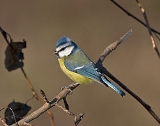
The Blue Tit, Cyanistes caeruleus, is a 10.5 to 12 cm (4.2 to 4.8 inches,) long passerine
Passerine

A passerine is a bird of the order Passeriformes, which includes more than half of all bird species. Sometimes known as perching birds or, less accurately, as songbirds, the passerines form one of the most diverse terrestrial vertebrate orders:...
 bird
Bird

Birds are wing, Bipedalismal, endothermic , vertebrate animals that lay egg . There are around 10,000 living species, making them the most numerous tetrapod vertebrates....
 in the tit
Titmouse

The tits, chickadees, and titmice comprise Paridae, a large family of small passerine birds which occur in the northern hemisphere and Africa....
 family
Family (biology)

In biological classification, family is a taxonomic rank. Exact details of formal nomenclature depend on the Nomenclature Codes which applies....
 Paridae. It is a widespread and common resident breeder throughout temperate and subarctic Europe
Europe

Europe is, conventionally, one of the world's seven continents. Comprising the westernmost peninsula of Eurasia, Europe is generally divided from Asia to its east by the water divide of the Ural Mountains, the Ural , the Caspian Sea, and by the Caucasus Mountains to the southeast....
 and western Asia
Asia

Asia is the world's largest and most populous continent. It covers 8.6% of the Earth's total surface area and, with over 4 billion people, it contains more than 60% of the world's current human population....
 in deciduous or mixed woodlands. It is a resident bird
Resident bird

A resident bird, in ornithology, is a bird that does not make seasonal migrations. Birds that do migrate are referred to as migratory birds.For some bird species, a favorable environment, or food supply allows the birds to stay as a resident species, until some non-typical weather, or food supply event causes a semi-permanent change....
, i.e., most birds do not migrate
Bird migration

Bird migration refers to the regular seasonal journeys undertaken by many species of birds. Bird movements include those made in response to changes in food availability, habitat or weather....
.

species was first described by Linnaeus
Carolus Linnaeus

Carl Linnaeus was a Sweden botanist, physician, and zoologist, who laid the foundations for the modern scheme of binomial nomenclature. He is known as the father of modern alpha taxonomy, and is also considered one of the fathers of modern ecology....
 in his Systema naturae in 1758 as Parus caeruleus.

Most authorities retain Cyanistes as a subgenus
Subgenus

In biology, a subgenus is a taxonomic rank directly below genus. See rank and rank .In ICZN, a subgeneric name can be used independently or included in a binomen, in parentheses, placed between the name of a biological genus and specific name: e.g....
 of Parus, but the British Ornithologists' Union
British Ornithologists' Union

The British Ornithologists' Union aims to encourage the study of birds in Great Britain, Europe and elsewhere, in order to understand their biology and to aid their Conservation ecology....
 treats Cyanistes as a distinct genus
Genus

A genus is a low-level taxonomic rank used in the classification of living and fossil organisms. The taxonomic ranks are domain , kingdom , phylum, class , order , family , genus, and species....
.


Discussion
Ask a question about 'Blue Tit'
Start a new discussion about 'Blue Tit'
Answer questions from other users
Full Discussion Forum


Encyclopedia


The Blue Tit, Cyanistes caeruleus, is a 10.5 to 12 cm (4.2 to 4.8 inches,) long passerine
Passerine

A passerine is a bird of the order Passeriformes, which includes more than half of all bird species. Sometimes known as perching birds or, less accurately, as songbirds, the passerines form one of the most diverse terrestrial vertebrate orders:...
 bird
Bird

Birds are wing, Bipedalismal, endothermic , vertebrate animals that lay egg . There are around 10,000 living species, making them the most numerous tetrapod vertebrates....
 in the tit
Titmouse

The tits, chickadees, and titmice comprise Paridae, a large family of small passerine birds which occur in the northern hemisphere and Africa....
 family
Family (biology)

In biological classification, family is a taxonomic rank. Exact details of formal nomenclature depend on the Nomenclature Codes which applies....
 Paridae. It is a widespread and common resident breeder throughout temperate and subarctic Europe
Europe

Europe is, conventionally, one of the world's seven continents. Comprising the westernmost peninsula of Eurasia, Europe is generally divided from Asia to its east by the water divide of the Ural Mountains, the Ural , the Caspian Sea, and by the Caucasus Mountains to the southeast....
 and western Asia
Asia

Asia is the world's largest and most populous continent. It covers 8.6% of the Earth's total surface area and, with over 4 billion people, it contains more than 60% of the world's current human population....
 in deciduous or mixed woodlands. It is a resident bird
Resident bird

A resident bird, in ornithology, is a bird that does not make seasonal migrations. Birds that do migrate are referred to as migratory birds.For some bird species, a favorable environment, or food supply allows the birds to stay as a resident species, until some non-typical weather, or food supply event causes a semi-permanent change....
, i.e., most birds do not migrate
Bird migration

Bird migration refers to the regular seasonal journeys undertaken by many species of birds. Bird movements include those made in response to changes in food availability, habitat or weather....
.

Taxonomy

This species was first described by Linnaeus
Carolus Linnaeus

Carl Linnaeus was a Sweden botanist, physician, and zoologist, who laid the foundations for the modern scheme of binomial nomenclature. He is known as the father of modern alpha taxonomy, and is also considered one of the fathers of modern ecology....
 in his Systema naturae in 1758 as Parus caeruleus.

Most authorities retain Cyanistes as a subgenus
Subgenus

In biology, a subgenus is a taxonomic rank directly below genus. See rank and rank .In ICZN, a subgeneric name can be used independently or included in a binomen, in parentheses, placed between the name of a biological genus and specific name: e.g....
 of Parus, but the British Ornithologists' Union
British Ornithologists' Union

The British Ornithologists' Union aims to encourage the study of birds in Great Britain, Europe and elsewhere, in order to understand their biology and to aid their Conservation ecology....
 treats Cyanistes as a distinct genus
Genus

A genus is a low-level taxonomic rank used in the classification of living and fossil organisms. The taxonomic ranks are domain , kingdom , phylum, class , order , family , genus, and species....
. This is supported by mtDNA cytochrome b
Cytochrome b

Cytochrome b/b6 is main subunit of transmembrane cytochrome bc1 complex and Cytochrome b6f complex complexes.In the mitochondrion of eukaryotes and in aerobic prokaryotes, cytochrome b is a component of respiratory chain complex III - also known as the bc1 complex or ubiquinol-cytochrome c reductase....
 sequence
DNA sequence

A DNA sequence or genetic sequence is a succession of letters representing the primary structure of a real or hypothetical DNA molecule or strand, with the capacity to carry information as described by the central dogma of molecular biology....
 analysis which suggests that Cyanistes in not only distinct, but not close to other titmice (Gill et al., 2005).

The two traditional subspecies found in the Canary Islands
Canary Islands

The Canary Islands are a Spain archipelago which, in turn, forms one of the Spanish Autonomous Communities and an Outermost Region of the European Union....
 (teneriffae) and northwest Africa
Africa

Africa is the world's second-largest and second most-populous continent, after Asia. At about 30.2 million km? including adjacent islands, it covers 6% of the Earth's total surface area and 20.4% of the total land area....
 from northern Morocco
Morocco

Morocco , officially the Kingdom of Morocco , is a country located in North Africa with a population of nearly 34 million and an area just under 447,000 km2....
 to northern Libya
Libya

Libya , officially the Great Socialist People's Libyan Arab Jamahiriya , is a country located in North Africa. Bordering the Mediterranean Sea to the north, Libya lies between Egypt to the east, Sudan to the southeast, Chad and Niger to the south, and Algeria and Tunisia to the west....
 (ultramarinus) are distinctive. The Canary Islands subspecies has a black cap, and the African form has a blue back. Research is underway to split these populations into distinct species, with a peculiar "leapfrog" distribution (Kvist et al., 2005; Kvist, 2006; Sangster, 2006):

  • Afrocanarian Blue Tit or Ultramarine Tit, Parus ultramarinus Bonaparte, 1841 (La Palma, Hierro, Fuerteventura, Lanzarote, NW Africa)
  • Canary Islands Blue Tit, Parus teneriffae Lesson
    René-Primevère Lesson

    Ren? Primev?re Lesson was a France surgery and natural history.Lesson was born at Rochefort, and at the age of sixteen he entered the Naval Medical School there....
    , 1831
    (Tenerife, La Gomera, Gran Canaria)


The former would contain three or four subspecies (palmensis, ombriosus and ultramarinus/degener), the latter the nominate P. t. teneriffae and the unnamed distinct form of Gran Canaria.

Pleske's Tit (Cyanistes × pleskei) is a not uncommonly found hybrid between this species and the Azure Tit
Azure Tit

The Azure Tit, Cyanistes cyanus, is a passerine bird in the titmouse family Paridae. It is a widespread and common resident breeder throughout Russia and central Asia....
 in western Russia.

Description

The azure blue crown and dark blue line passing through the eye and encircling the white cheeks to the chin give the Blue Tit a very distinctive appearance. The forehead and a bar on the wing are white. The nape, wings and tail are blue; the back is yellowish green; the under parts mostly sulphur-yellow with a dark line down the abdomen. The bill is black, the legs bluish grey, and the irides dark brown. Young Blue Tits are noticeably more yellow. This is a common and popular European garden bird, due to its perky acrobatic performances when feeding on nuts or suet. It swings beneath the holder, calling tee, tee, tee or a scolding churr.

The song period lasts almost all the year round, but is most often heard during February to June.

Behaviour

Blue and Great Tit
Great Tit

The Great Tit is a passerine bird in the titmouse family Paridae. It is a widespread and common species throughout Europe and Asia in any sort of woodland....
s form mixed winter flocks, and the former are perhaps the better gymnasts in the slender twigs. A Blue Tit will often ascend a trunk in short jerky hops, imitating a Treecreeper
Treecreeper

The treecreepers are a family of small passerine Avess, widespread in wooded regions of the Northern Hemisphere and sub-Saharan Africa. Their plumage is dull-coloured, and as their name implies, they climb over the surface of trees in search of food....
. As a rule the bird roosts in ivy
Ivy

Hedera is a genus of 15 species of climbing or ground-creeping evergreen woody plants in the family Araliaceae, native to the Macaronesia, western, central and southern Europe, northwestern Africa and across central-southern Asia east to Japan....
 or evergreen
Evergreen

In botany, an evergreen plant is a plant having leaf all year round. This contrasts with deciduous plants, which completely lose their foliage for part of the year....
s, but in hard weather will shelter in a hole. Blue tits are very agile and can hang from almost anywhere.

The Blue Tit has an average life expectancy
Life expectancy

Life expectancy is the average number of years of life remaining at a given age. It is the average expected lifespan of an individual. Life expectancy is heavily dependent on the criteria used to select the group....
 of 1.5 years

Diet

The Blue Tit is a valuable destroyer of pests, though it has not an entirely clean sheet as a beneficial species. It is fond of young buds of various trees, and may pull them to bits in the hope of finding insects. No species, however, destroys more coccids and aphid
Aphid

Aphids, also known as plant lice , are small plant-eating insects, and members of the Taxonomic rank Aphidoidea. Aphids are among the most destructive insect pests on cultivated plants in temperate regions....
s, the worst foes of many plants. It takes leaf miner grubs and green tortrix moths (Tortricidae
Tortricidae

Tortricidae is a family of moths in the order Lepidoptera. They are commonly known as tortrix moths. It is a large family with over 6,300 species described, and is the sole member of the superfamily Tortricoidea....
). Seeds are eaten, as with all this family.

Breeding

It will nest in any suitable hole in a tree, wall, or stump, or an artificial nest box, often competing with House Sparrow
House Sparrow

The House Sparrow is a member of the Old World sparrow family sparrow, considered by some to be a relative of the Weaver Finch Family. It occurs naturally in most of Europe and much of Asia....
s or Great Tits for the site. Few birds more readily accept the shelter of a nesting box; the same hole is returned to year after year, and when one pair dies another takes possession.

The bird is a close sitter, hissing and biting at an intruding finger. In the South West of England such behaviour has earned the Blue Tit the colloquial nick-name "Little Billy Biter". When protecting its eggs it raises its crest, but this is a sign of excitement rather than anger, for it is also elevated during nuptial display. The nesting material is usually moss, wool, hair and feathers, and the eggs are laid in April or May. The number in the clutch is often very large, but seven or eight are normal, and bigger clutches are usually laid by two or even more hens.

Learning

An interesting example of culturally transmitted learning in birds was the phenomenon dating from the 1960s of Blue Tits teaching one another how to open traditional British milk
Milk

Milk is an opaque white liquid produced by the mammary glands of female mammals . It provides the primary source of nutrition for newborn mammals before they are able to digestion other types of food....
 bottles with foil tops to get at the cream underneath. This behaviour has declined recently because of the trend toward buying low-fat (skimmed) milk, and the replacement of doorstep delivery by supermarket purchases of milk.

Conservation


Blue Tit populations often decrease considerably during harsh winters or after poor breeding seasons where the weather is cold and wet, particularly if this coincides with the emergence of the caterpillars on which the nestlings are fed.

External links

  • ARKive -
  • on the Internet Bird Collection
  • Blue Tit nest 2006 part , , , , , , , , , (10), at Google Video
  • at Google Video