

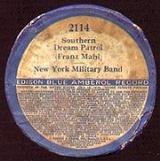
Blue Amberol Records

Encyclopedia
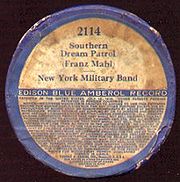
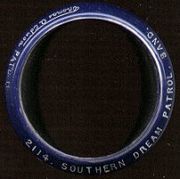
Phonograph cylinder
Phonograph cylinders were the earliest commercial medium for recording and reproducing sound. Commonly known simply as "records" in their era of greatest popularity , these cylinder shaped objects had an audio recording engraved on the outside surface which could be reproduced when the cylinder was...
manufactured by the Edison
Edison Records
Edison Records was one of the earliest record labels which pioneered recorded sound and was an important player in the early recording industry.- Early phonographs before commercial mass produced records :...
company in the U.S.
United States
The United States of America is a federal constitutional republic comprising fifty states and a federal district...
from 1912
1912 in music
-Events:*February 28 - In a concert in Copenhagen, Carl Nielsen conducts the premiere of his Symphony No. 3 and his Violin Concerto* March - Hart A. Wand published "Dallas Blues", a jazz standard and an early published blues song....
to 1929
1929 in music
-Events:*January 1 – Pianist and composer Abram Chasins makes his professional debut playing his own piano concerto with the Philadelphia Orchestra.*January 11 – Karol Szymanowski's Stabat Mater is premiered....
. They were issued as a replacement to the 4 minute black wax Amberol cylinder introduced in 1908 which in turn replaced the 2 minute wax cylinders that Edison had been producing. Blue Amberols run approximately four minutes and were made out of the "indestructible" plastic, celluloid, which was issued in the trademark blue color.
Edison wax Amberols
The four-minute "Amberol" cylinder made its début in 1908. Amberols were made of a brittle, black wax-like compound, but the wax was harder than the original 1902 black wax. The Amberol wax was also used on 2 minute "Standard" records starting in 1908 until the Blue Amberol appeared in 1912. The introduction of the Amberol started a resurgence of interest in cylinder records. Amberols crack somewhat easily and, similar to various ways of splitting brown wax cylinders, Amberols could break during playback. Amberols often shattered when they broke, unlike some kinds of two-minute cylinders that would crack into several pieces. Another problem was that the conical four-minute stylus wore the Amberols out somewhat quickly. Some Amberols mistracked or succumbed to inconsistent speed.Edison Blue Amberols
By 1912, the defects of the wax Amberol were evident. Edison, who did not want to pay royalties to Thomas B. Lambert for his celluloid cylinder, eventually bought the patent and changed production to celluloid (though with a plaster of paris core to reduce cost). The introduction of the "Blue Amberol" helped to bring cylinder sales up. The early issues of Blue Amberols are of higher audio fidelity than later issues. From January 1915 onward, the Edison Company, which had concentrated most of its research on improving the sound of their Diamond DiscEdison Disc Record
The Edison Disc, also known as a Diamond Disc record, was a type of audio disc record marketed by Edison Records from 1912 to 1929. They were known as Diamond disc because the reproducer fitted to the matching Edison disc player was fitted with a diamond stylus...
recordings (disc records
Gramophone record
A gramophone record, commonly known as a phonograph record , vinyl record , or colloquially, a record, is an analog sound storage medium consisting of a flat disc with an inscribed, modulated spiral groove...
), began to release cylinders which were acoustically dubbed from their Diamond Disc matrices. The dubbing technique used, acoustical-mechanical until December 1927 (when the first electrically recorded disc dubs began to appear), resulted in a somewhat hollow "dead" sound on theses cylinders compared to the original discs from which they were dubbed. Many such cylinders contain the sound of the disc machine being started or disc surface noise just at the beginning of the record and of it being stopped just before the end.
Beyond sacred and popular music, Edison issued variants on the basic Blue Amberol including the Concert Blue Amberols (classical and cultured music), operatic Blue Amberols, Royal Purple Amberols, the series which supplanted the Concert series. (At least one copy of each of the 77 Royal Purple Amberols issued survives today.) Special wax Amberols/Blue Amberols identified by letter A-H (rather than the more usual number) were given away with the 4 minute conversion kits for some earlier phonographs. Also there were instructional records to accompany the Edison School Phonograph, ICS language courses, telegraph-related Blue Ameberols, a 2-minute series of Blue Amberols for the Mexican market, and 6" (15 cm) long dictation instruction cylinders for the Ediphone that were essentially long Blue Amberols.
Technical
Edison Blue Amberols are made of celluloid over a molded plaster core. The celluloidCelluloid
Celluloid is the name of a class of compounds created from nitrocellulose and camphor, plus dyes and other agents. Generally regarded to be the first thermoplastic, it was first created as Parkesine in 1862 and as Xylonite in 1869, before being registered as Celluloid in 1870. Celluloid is...
surface are able to withstand hundreds of playings, with only a moderate increase in surface noise if played on well-maintained machines with a stylus
Stylus
A stylus is a writing utensil, or a small tool for some other form of marking or shaping, for example in pottery. The word is also used for a computer accessory . It usually refers to a narrow elongated staff, similar to a modern ballpoint pen. Many styli are heavily curved to be held more easily...
in good condition.
Blue Amberols have a maximum playing time of just over 4 minutes at 160 rpm (a maximum of 4'45" is possible). They can not be played on older machines set up to play the earlier standard of 2 minute cylinders, as the Amberols require a smaller stylus to track the groove and the worm-gear which moves the stylus over the surface of the cylinder must turn at a different rate. However, the Edison company sold kits with gears and reproducers which could be attached to older varieties of cylinder phonograph
Phonograph
The phonograph record player, or gramophone is a device introduced in 1877 that has had continued common use for reproducing sound recordings, although when first developed, the phonograph was used to both record and reproduce sounds...
s by those who wished to be able to play the new Blue Amberol records. The Edison company also marketed phonographs capable of playing both the older style 2-minute and the new 4-minute Blue Amberol records; with these machines the user needed to adjust a knob or lever (which changed gearing) and change the reproducer (which held different sizes of styli) when going from one type of record to another.
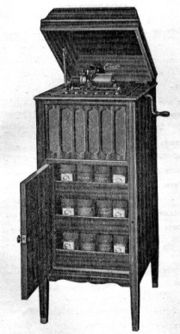
Internal horn Edison Phonographs designed to play 4-minute cylinders were called Amberolas. The earliest Amberola model, the 1909 Amberola IA, was equipped with selectable 2- and 4-minute gearing, and after initially being sent out fitted with an unmarked Model "L" reproducer with a flattened fishtail weight that was recalled almost immediately as being "unsatisfactory", was refitted with the Model "M" reproducer with flip-over 2- or 4-minute sapphire
Sapphire
Sapphire is a gemstone variety of the mineral corundum, an aluminium oxide , when it is a color other than red or dark pink; in which case the gem would instead be called a ruby, considered to be a different gemstone. Trace amounts of other elements such as iron, titanium, or chromium can give...
styli intended to play wax cylinders. There is at least one known example of an early Model M reproducer also fitted with a flattened fishtail weight.
Upon the introduction of Blue Amberols in 1913, the M reproducer was supplanted by the Diamond A reproducer which was capable of playing only celluloid cylinders. Outside horn Edison Phonographs were available with the Diamond B reproducer. Several other Amberola models less expensive than the IA (and later the 4-min only IB and III) were available, such as the V, VI, and X.
After the Edison factory fire of December 1914, the Amberola line was simplified in mechanical and cabinet design resulting in the Amberola 30, 50, and 75 (each serial number indicating the initial retail price of each player). These were equipped with the Diamond C reproducer. The 4-minute only external horn Opera (later renamed Concert) of 1911-1912, which shared the same mechanism as the IB and III, was initially fitted with the Model L reproducer (with sapphire stylus for wax Amberols), but with the introduction of Blue Amberols, shipped with the Diamond A reproducer.
Archival storage of cylinders
The "Amberol" plastic of the cylinders is molded around a core of plasterPlaster
Plaster is a building material used for coating walls and ceilings. Plaster starts as a dry powder similar to mortar or cement and like those materials it is mixed with water to form a paste which liberates heat and then hardens. Unlike mortar and cement, plaster remains quite soft after setting,...
. This plaster core has proved the greatest problem with long-term survival of Blue Amberol Records, as the plaster often tends to expand over the decades, especially if exposed to moisture or kept in humid conditions. The expanding plaster in less severe cases can make the inside of the record not fit properly on the phonograph mandrel (which can be fairly easily remedied by reaming the inner surface of the cylinder out), or can warp the cylinder out of round making it not play properly. In worse cases, the expanding plaster will crack or split the plastic playing surface, rendering the record unusable.
The Blue Amberol plastic is highly flammable since it is nitrocellulose
Nitrocellulose
Nitrocellulose is a highly flammable compound formed by nitrating cellulose through exposure to nitric acid or another powerful nitrating agent. When used as a propellant or low-order explosive, it is also known as guncotton...
. Being an organic plastic, celluloid is also capable of decomposition, although this phenomenon in Amberols is rare to nil. Not all Blue Amberols were made of celluloid. Some were made of blue Bakelite, and Bakelite cylinders do not have these problems.
External links
- Edison Blue Amberol cylinder recordings, from the Cylinder Preservation and Digitization ProjectCylinder Preservation and Digitization ProjectThe Cylinder Preservation and Digitization Project is a free digital collection maintained by the University of California, Santa Barbara Libraries with streaming and downloadable versions of over 10,000 phonograph cylinders manufactured between 1893 and the mid 1920s.- History :The project began...
at the University of California, Santa BarbaraUniversity of California, Santa BarbaraThe University of California, Santa Barbara, commonly known as UCSB or UC Santa Barbara, is a public research university and one of the 10 general campuses of the University of California system. The main campus is located on a site in Goleta, California, from Santa Barbara and northwest of Los...
Library.