
All Topics  
Edison Records

 
Edison Records

   Email Print
   Bookmark   Link


Edison Records


Edison Records was the first record label
Record label

In the music industry, a record label can be a brand and a trademark associated with the marketing of recorded sound and music videos. Most commonly, a record label is the company that manages such brands and trademarks, coordinates the Record producer, manufacturing, distribution , marketing and promotion, and enforcement of copyright protec...
, pioneering recorded sound and an important player in the early record industry.


as A. Edison invented the phonograph
Phonograph

The record player, phonograph or gramophone was the most common device for playing Sound recording and reproduction sound from the 1870s through the 1980s....
, the first device for recording and playing back sound, in 1877.

After inventing and patenting the phonograph, Edison and his laboratory turned their attention to the commercial development of (electric lighting), playing no further role in the development of the phonograph for a decade.

The earliest phonograph was something of a crude curiosity, although it was one that fascinated much of the public.


Discussion
Ask a question about 'Edison Records'
Start a new discussion about 'Edison Records'
Answer questions from other users
Full Discussion Forum


Encyclopedia


Edison Records was the first record label
Record label

In the music industry, a record label can be a brand and a trademark associated with the marketing of recorded sound and music videos. Most commonly, a record label is the company that manages such brands and trademarks, coordinates the Record producer, manufacturing, distribution , marketing and promotion, and enforcement of copyright protec...
, pioneering recorded sound and an important player in the early record industry.

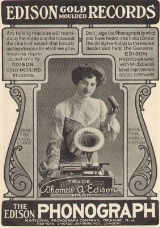
Edisonrecords1903ad

Early phonographs before commercial mass produced records

Thomas A. Edison invented the phonograph
Phonograph

The record player, phonograph or gramophone was the most common device for playing Sound recording and reproduction sound from the 1870s through the 1980s....
, the first device for recording and playing back sound, in 1877.

After inventing and patenting the phonograph, Edison and his laboratory turned their attention to the commercial development of (electric lighting), playing no further role in the development of the phonograph for a decade.

The earliest phonograph was something of a crude curiosity, although it was one that fascinated much of the public. Early machines were sold to entrepreneurs who made a living out of traveling around the country giving "phonograph concerts" and demonstrating the device for a fee at fairs.

"Talking dolls" and "Talking clocks" were manufactured using the early phonograph; these were expensive novelties.

The start of the commercial record industry

In 1887 Edison Labs turned their attention back to improving the phonograph and the phonograph cylinder
Phonograph cylinder

The earliest method of Sound recording was on phonograph cylinders. Commonly known simply as "records" in their era of greatest popularity , these cylinder shaped objects had an audio recording engraved on the outside surface which could be reproduced when the cylinder was played on a mechanical phonograph....
.

In 1888 the Edison company debuted the Perfected Phonograph, Edison produced wax cylinders 4 inches (10 cm) long, 2 inches in diameter, playing some 2 minutes of music or entertainment, which became the industry standard. Experimental music records were made around this time. The "brown wax" cylinder made its debut in March/April 1889. "Electric Light Quadrille" by Issler's Orchestra is an example of an 1889 brown wax cylinder (Superbatone #734--"The Real Sound of Ragtime").

Blank records were an important part of the business early on. Most phonographs had or could be fitted with attachments for the users to make their own recordings. One important early use, in line with the original term for a phonograph as a "talking machine", was in business for recording dictation. Attachments were added to facilitate starting, stopping, and skipping back the recording for dictation and playback by stenographers. The business phonograph eventually evolved into a separate device from the home entertainment phonograph. Edison Record's brand of business phonograph was called The Ediphone; see Phonograph cylinder
Phonograph cylinder

The earliest method of Sound recording was on phonograph cylinders. Commonly known simply as "records" in their era of greatest popularity , these cylinder shaped objects had an audio recording engraved on the outside surface which could be reproduced when the cylinder was played on a mechanical phonograph....
 and Dictaphone
Dictaphone

Dictaphone was an United States company, a producer of dictation machines?sound recording devices most commonly used to record Speech communication for later playback or to be typed into print....
.

Mass produced cylinders

A notable technological triumph of the Edison Laboratories was devising a method to mass produce pre-recorded phonograph cylinders in molds. This was done by using very slightly tapered cylinders and molding in a material that contracted as it set. To Edison's disappointment the commercial potential of this process was not realized for some years. Most of the regional Edison distributors were able to fill the small early market for recordings by mechanical duplication of a few dozen cylinders at a time. Molded cylinders did not become a significant force in the marketplace until the end of the 1890s, which was when molding was slow and was used only to create pantograph masters.

Mass producing cylinders at the Edison recording studio
Recording studio

A recording studio is a facility for Sound recording and reproduction. Ideally, the space is specially designed by an acoustics to achieve the desired acoustic properties ....
 in New Jersey
New Jersey

New Jersey is a state in the Mid-Atlantic States and Northeastern United States regions of the United States. It is bordered on the north by New York, on the east by the Hudson River and the Atlantic Ocean, on the southwest by Delaware, and on the west by Pennsylvania....
 largely ended the local Edison retailers early practice of producing recordings in small numbers for regional markets, and helped concentrate the USA recording industry in the New York City
New York City

The City of New York is the List of United States cities by population in the United States, while the New York metropolitan area ranks among the List of urban areas by population....
 - New Jersey area, already the headquarters of the nation's Tin Pan Alley
Tin Pan Alley

Tin Pan Alley is the name given to the collection of New York City-centered History of music publishings and songwriters who dominated the American popular music of the United States in the late 19th century and early 20th century....
 printed music industry.

In 1902, Edison Records introduced Edison Gold Molded Records, cylinder records of improved hard black wax, capable of being played hundreds of times before wearing out.

In 1908, Edison introduced a new line of cylinders (called "Amberols") playing 4 rather than 2 minutes of music on the same sized record, achieved by shrinking the grooves and spacing them twice as close together. New machines were sold to play these records, as were attachments for modifying existing Edison phonographs.

In November 1912, the new Blue Amberol Records
Blue Amberol Records

Blue Amberol Records was the trademarked name for phonograph cylinder manufactured by the Edison company in the United States from 1912 in music to 1929 in music....
, made out of a type of plastic
Plastic

Plastic is the general common term for a wide range of synthetic or semisynthetic organic chemistry solid materials suitable for the manufacture of industrial products....
 similar to celluloid
Celluloid

Celluloid is the name of a class of Chemical compound created from nitrocellulose and camphor, plus dyes and other agents. Generally regarded to be the first thermoplastic, it was first created as Parkesine in 1856 and as Xylonite in 1869 before being registered as Celluloid in 1870....
 invented by Edison labs, were introduced for public sale. The first release was number 1501, a performance of the Rossini
Gioacchino Rossini

Gioachino Antonio Rossini was a popular Italian composer who created 39 operas as well as sacred music and chamber music. His best known works include Il barbiere di Siviglia , La Cenerentola and Guillaume Tell ....
's overture to his opera Semiramide
Semiramide

Semiramide is an opera in two acts by Gioachino Rossini.The libretto was written by Gaetano Rossi, based on Voltaire's tragedy Semiramis, which in turn was based on the legend of Semiramis of Babylon ....
, performed by the American Standard Orchestra. The Blue Amberol records were much more durable than wax cylinders.

In 1913 artists' names began to be added to the records; previously, Edison's policy was to promote his cylinders based on the recognition of composers and the works recorded theron in lieu of the performers themselves.

Edison Records continued selling cylinders until they went out of business in 1929
1929 in music

Events*January 1 - Pianist and composer Abram Chasins makes his professional debut playing his own piano concerto with the Philadelphia Orchestra....
. However, from January 1915 onwards the first of the Blue Amberols, which were dubbed from Edison's Diamond Disc matrices, appeared on the market. By 1919, the last decade of production, these were simply dubs of their commercial disc records intended for customers who still used cylinder phonographs purchased years before.

Edison Records was eventually run by Thomas Edison's son, Charles Edison
Charles Edison

Charles Edison , son of Thomas Edison, was a businessman, Assistant and then United States Secretary of the Navy, and served as the List of Governors of New Jersey Governor of New Jersey of New Jersey....
.

Edisonrecordsleevelivingartist

Materials and process used to manufacture cylinder records

Cylinders that are mentioned from 1888 are sometimes called "yellow paraffin" cylinders, but these cylinders are not paraffin
Paraffin

In chemistry, paraffin is the common name for the alkane hydrocarbons with the general formula CnH2n+2. Paraffin wax refers to the solids with n=20–40....
. They could be a number of formulas tested by Jonas Aylsworth, Thomas Edison
Thomas Edison

Thomas Alva Edison was an American inventor and businessman who developed many devices that greatly influenced life around the world, including the phonograph and the long-lasting, practical electric light bulb....
’s chemist. Most of the surviving 1888 recordings would be formulated from a combination of 60% ceresin wax, 25% stearic acid
Stearic acid

Stearic acid or 18:0 is a saturated fatty acid. It is a waxy solid, and its chemical formula is C18H36O2....
, and 25% beeswax
Beeswax

Beeswax is a natural wax produced in the Beehive of honey bees of the genus Apis. Worker bees have eight wax-producing mirror glands on the inner sides of the sternites on abdominal segments 4 to 7....
. A record of this kind has a cigar-like smell, and is physically very soft when first molded. In a year's time, the record would harden quite considerably.

In late 1888, metallic soaps were tried. At first a lead stearate was used, but in the summer months, these records started to sweat and decompose. In 1889, Aylsworth developed an aluminum wax, using acetate of alumina and stearic acid with sodium hydroxide added as a saponifying agent. It was found these records were much more durable. Problems arose; however, there was no tempering agent and hot weather caused these records to decompose. Two problems contributed to this, stearic quality varied from different makers; Aylsworth purchased some from P&G and found it had too much olaic acid in it. The next cause of the problem is that all stearic acid takes on moisture without a tempering agent, and after many experiments it was found that Ceresine was ideal. To make the wax hard, sodium carbonate was added. Even so, a few batches of records still had some problems and became fogged. The fog problem arose from acetic acid left in the wax, this problem was solved when higher temperatures were used to make sure all the acetic acid was boiled out of the wax. As such, the records from 1889-1894 are a reddish brown color due to the long cooking time. By 1896, Edison started using hydrated alumina in place of acetate of alumina. The use of hydrated alumina (sheet aluminum dissolved in a mixture of sodium carbonate, sodium hydroxide, and distilled water) made better records, and the wax could be manufactured in a shorter period of time. Using the hydrated aluminum resulted in more desirable blanks, with fewer defects and shorter production time.

The Columbia Phonograph Company used Edison recording blanks until 1894. The North American Phonograph Company was dissolved in the fall of 1894, and Edison quit supplying blanks to Columbia, who had purchased 70,000 blanks from 1889-1894. Columbia was frantic to find a solution to make cylinder blanks in house, and the recipe for making Edison's wax was a well kept secret. Thomas McDonald started doing experiments with wax alloys with poor results: the records fogged or decomposed in the summer, just like the early Edison blanks. The Columbia company had a deadline to either supply recordings, or have their contracts cancelled and be sued for loss of records. Columbia resorted to attempt to steal secrets from Edison company by hiring old Edison Phonograph Works employees, such as Mr. Storms. Unfortunately for Columbia, the names of the components used by Edison were not labeled with ingredients but were instead indicated by letters (i.e. A, B, C, D...), keeping the identities of these components a secret. Paraffin
Paraffin

In chemistry, paraffin is the common name for the alkane hydrocarbons with the general formula CnH2n+2. Paraffin wax refers to the solids with n=20–40....
, Ceresine, and Ozokerite
Ozokerite

Ozokerite or ozocerite is a naturally-occurring odoriferous mineral wax or paraffin found in many localities....
 all look similar, making the tempering agent even more difficult to be identified by the wax mixer. Wax mixers were given instructions on how much of the lettered components to put in the mixture, and how to process it, but no idea as to what the ingredients actually were. It took over a year for Columbia to come up with the formula for cylinders. Columbia placed an ad in the Soap Makers' Journal for a practical man to work with metallic soaps. Adolph Melzer, a soap manufacturer from Evansville, Indiana took the job. Melzer came up with a formula comparable to Edison’s with the exception of the tempering agent (using paraffin instead of ceresine). By 1901 The Gold Molded (originally spelled Moulded) process was developed by Thomas Edison and Jonas Aylsworth (Edison’s Chemist) with input from Walter Miller, the Recording Manager of Edison Records. See Edison Papers Project National Phonograph Co. VS American Graphophone Co. Columbia Phonograph Co 1904.

At first, no method of mass production was available for cylinder records. Copies were made by having the artist play over and over or by hooking two machines together with rubber tubing (one with a master cylinder and the other a blank) or copying the sound mechanically. By the late 1890s, an improved mechanical duplicator, the pantograph
Pantograph

A pantograph is a Linkage connected in a special manner based on parallelograms so that the movement of one specified point is an amplified version of the movement of another point....
, was developed which used mechanical linkage. One mandrel
Mandrel

A mandrel is either an object used to shape machined work; a tool manufacturing that grips or clamps materials to be machined; or a tool component that can be used to grip other moving tool components....
 had a playback stylus and the other a recording one, while weights and springs were used to adjust the tension between the styli to control recording volume and tracking.

The Edison team had experimented with Vacuum Deposited Gold masters as early as 1888, and it has been reported that some brown wax records could be molded, though no evidence has been put forward to support this claim. The Edison Record, "Fisher Maiden," was an early record that was experimented with for the process. The 1888 experiments were not very successful due to the fact the grooves of the cylinders were square, and the sound waves were saw-tooth-shaped and deep. The records came out scratched and it was very time consuming. (See The Edison Papers Project, Record Experiments by Jonas Aylsworth 1888-1889)

The Gold Molded process involved taking a wax master and putting it in a vacuum chamber. The master record was put on a spinning mandrel, the pump sucked all the air out of a glass bell jar, and 2 pieces of gold leaf were hooked to an induction coil. The current was turned on, a magnet was spun around the outside to turn the mandrel, and the gold vaporized a very thin coating on the master. This master was put on a motor in a plating tank and copper was used to back the gold up. The master record was melted, then taken out of the mold to reveal a negative of the grooves in the metal. The master cylinder had to have wider feed as the grooves shrink in length through each process. The master mold is used to create "mothers" and these are then further processed to make working molds.

The Gold molded record used an aluminum-based wax, like the post-1896 Edison brown wax. However, caranuba wax was added, as well as pine tar and lampblack resulting in a black, shiny, durable record. The molds with mandrels placed in the center were heated and dipped in a tank of the molten wax. These were removed and trimmed while still hot, and put on a table from where the molds were put in lukewarm water. The water caused the records to shrink in diameter so that they could be removed. The records were then trimmed, dried and cleaned, then later put on warm mandrels for 2 hours where they shrank evenly.

In 1908, Edison introduced Blue Amberol Records
Blue Amberol Records

Blue Amberol Records was the trademarked name for phonograph cylinder manufactured by the Edison company in the United States from 1912 in music to 1929 in music....
 which had a playing time of just over 4 minutes. The process of making the finished record was the same as the Gold Molded records, however a harder wax compound was used. In 1912, celluloid was used in place of wax. The master was recorded and then the process of making the mold was the same as the Gold Molded process. What is different is that a steam jacketed mold with an air bladder in the center was used. Celluloid tubing was put in the mold and the end gate was closed. The rubber bladder expanded the celluloid to the side of the heated mold, and printed the negative record in positive on the celluloid. The bladder was then deflated, and cold air was used to shrink the tubing so the celluloid print could be removed. The printed tubing was put in a plaster filler. When the plaster was hard the cylinders were then baked in an oven, then the ribs made on the inside of the plaster with knives. The records were cleaned and then packaged. Much of this information may be found at the .

Edison disc records

In October 1912 the Edison Diamond Disc Record
Edison Disc Record

The Edison Disc also known as a Diamond Disc record, was a type of audio Gramophone record marketed by Edison Records from 1912 to 1929.Edison had previously concentrated on producing phonograph cylinders but decided to get into the disc market due to the increasing market share of disc sound recordings, especially the discs of companies su...
 was introduced. Edison Laboratories had been experimenting with disc records
Gramophone record

A gramophone record is an analog signal sound storage medium consisting of a flat disc with an inscribed modulated spiral groove usually starting near the periphery and ending near the centre of the disc....
 for some 3 years, as the general public seemed to prefer them to cylinders. The thick Edison Discs recorded the sound vertically in the groove rather than laterally, and could only be played to their full advantage on Edison Diamond Disc Phonographs. This combination produced audio fidelity superior to any other home record playing system of the time. However Edison Discs and phonographs were more expensive than the competitors. This together with the incompatibility of the Edison system with other discs and machines had an adverse effect on Edison's market share. Nonetheless, Edison Discs for a time became the third best selling brand in the United States, behind Victor
Victor Talking Machine Company

The Victor Talking Machine Company was an United States corporation, the leading American producer of phonographs and gramophone record and one of the leading phonograph companies in the world at the time....
 and Columbia Records
Columbia Records

Columbia Records is an American record label founded in 1888.Columbia is the oldest surviving brand name in pre-recorded sound, being the first record company to produce pre-recorded records as opposed to blank cylinders....
.
Edisondisclabelbunk
With World War I
World War I

World War I, or the First World War , was a global military conflict which involved the Great powers, organized into two opposing military alliances: the Allies of World War I and the Central Powers....
 various materials used in Edison Discs came in short supply, and many discs pressed during the war were made in part with such make-shift materials as could be acquired at the time. This resulted in problems with surface noise even on new records, and Edison's market share shrank.

Prior to the war Edison Records started a marketing campaign, hiring prominent singers and vaudeville
Vaudeville

Vaudeville was a genre of a variety show prevalent on the theatre in the United States and Canada from the early 1880s until the early 1930s. It developed from many sources, including the concert saloon, minstrel show, freak shows, dime museums, and literary burlesque....
 performers to perform along side and alternating with Edison records of their performances played on top-of-the-line "Laboratory Model" Edison Diamond Disc Phonographs. At various stages during the performances, all lights in the theater would be darkened and the audience challenged to guess if what they were hearing was live or recorded; accounts often said that much of the audience was astonished when the lights went back up to reveal only the Edison Phonograph on stage. According to a book published by the Edison company titled Composers and Artists whose Art is Re-Created by Edison's New Art (ca. 1920), the first such "comparison test" took place at Carnegie Hall
Carnegie Hall

Carnegie Hall is a concert venue in Midtown Manhattan in New York City located at 881 Seventh Avenue , occupying the east stretch of Seventh Avenue between West 56th Street and West 57th Street , two blocks south of Central Park....
 on April 28, 1916 with Marie Rappold
Marie Rappold

Marie Winterroth Rappold was an England-born American soprano who sang opera.Rappold was born in London to Germany parents. She moved to Brooklyn, New York at around the age of five, where she later studied with Oscar Saenger and sang with the Amberg German Opera Company....
 of the Metropolitan Opera
Metropolitan Opera

The Metropolitan Opera Association of New York City, founded in April 1880, is a major presenter of all types of opera including Grand Opera. Peter Gelb is the company's general manager and James Levine is music director....
 providing the live vocal performance.

In 1928 the Edison company began plans for making "needle cut" records; by which they meant standard lateral cut discs like the "78s" marketed by almost every other company of the time. The Edison "Needle Cut" records debuted the following year. The audio fidelity was often comparable to the best of other record companies of the time, but they sold poorly as Edison's market share had declined to the point where it was no longer one of the leading companies and Edison had few distributors compared to leaders like Victor
Victor Talking Machine Company

The Victor Talking Machine Company was an United States corporation, the leading American producer of phonographs and gramophone record and one of the leading phonograph companies in the world at the time....
, Columbia
Columbia Records

Columbia Records is an American record label founded in 1888.Columbia is the oldest surviving brand name in pre-recorded sound, being the first record company to produce pre-recorded records as opposed to blank cylinders....
, and Brunswick
Brunswick Records

Brunswick Records is a United States based record label. The label is currently distributed by Koch Entertainment....
.

Edison Records closed down in 1929. The record plant and many of the employees were transferred to manufacturing radio
Radio

Radio is the transmission of signals, by modulation of electromagnetic radiation with frequency below those of visible light.Electromagnetic radiation radio propagation by means of oscillating electromagnetic fields that pass through the air and the vacuum of space....
s. The masters for the Edison Records back catalogue were purchased by Henry Ford
Henry Ford

Henry Ford was the United States founder of the Ford Motor Company and father of modern assembly lines used in mass production. His introduction of the Model T History of the automobile revolutionized transportation and American industry....
, and became part of the collection of the Henry Ford Museum. They were recently deaccessioned by the museum and sent to the Edison Historic Site (National Park Service) in New Jersey. Edison then died in 1931. Some of the Edison catalogue is in the public domain
Public domain

File:PD-icon.svgThe public domain is a range of abstract materials?commonly referred to as intellectual property?which are not owned or controlled by anyone....
 and available for download at the following address at the Library of Congress
Library of Congress

The Library of Congress is the de facto national library of the United States and the research arm of the United States Congress. Located in three buildings in Washington, D.C., it is the largest library in the world by shelf space and holds the largest number of books....
 website.

See also

  • Edison Disc Record
    Edison Disc Record

    The Edison Disc also known as a Diamond Disc record, was a type of audio Gramophone record marketed by Edison Records from 1912 to 1929.Edison had previously concentrated on producing phonograph cylinders but decided to get into the disc market due to the increasing market share of disc sound recordings, especially the discs of companies su...
  • List of record labels
    List of record labels

    This is a list of notable record labels.Owing to the large number of entries, the list has been divided by the first letter of the label's name, with labels starting with a number added to this page:...


External links

  • on the National Recording Registry with descriptions, audio and transcripts
  • at the University of California, Santa Barbara
    University of California, Santa Barbara

    The University of California, Santa Barbara, commonly known as UCSB or UC Santa Barbara, is a public university research university and one of the 10 general campuses of the University of California system....
     Library with streaming and downloadable versions of over 5000 cylinders.