

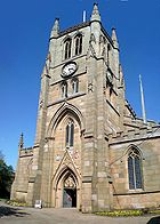
Blackburn Cathedral

Encyclopedia
Blackburn Cathedral, officially known as the Cathedral Church of Blackburn Saint Mary the Virgin, is a cathedral
situated in the heart of Blackburn town centre, in Lancashire
, England
. The cathedral site has been home to a church for over a thousand years and the first stone church was built on there in Norman
times.
in 1926 (taken from the Diocese of Manchester
) the impressive parish church of St Mary the Virgin was raised to cathedra
l status. The church, which was built in 1826 and designed by architect John Palmer
, now forms the cathedral's nave.
In the early 1930s, fundraising began to enlarge the cathedral so that the building complemented its newfound importance. By 1938, enough money had been raised and work began on enlarging the new cathedral. Although work was interrupted by the war
, it was resumed afterwards and continued through the 1950s and into the early 1960s. After the death of architect W.A. Forsyth in 1950, architect Laurence King joined the project and designed the distinctive lantern tower. The lantern tower, which consists of 56 different panes of coloured glass and an aluminium spire, was completed in 1967.
The cathedral was finally completed in 1977 and what had been built over the past decades was finally consecrated as Blackburn Cathedral.
The North transept contains eight misericords dating from the 15th century. It is not known at what time they arrived at the Cathedral, but they are believed to have originated at Whalley Abbey
. This could mean that they were removed to a builder's yard after the Dissolution
, but with the cathedral not being built until the 19th century, this allows for the possibility that they had lain unused for some 300 years.

Further work was carried out in 2000–1 to re-build the east end roofs and parapets and blend them into the existing structures. Upon completion of this work the cathedral was finally deemed to be finished after over 70 years of construction.
As well as this rebuilding a new piece of art was commissioned for the exterior of the building. The sculpture by Mark Jalland, entitled 'The Healing of The Nations' and measuring 35 by 26 feet, is an abstract steel and copper circular piece containing thousands of interwoven fibre optics that create ever-changing patterns of light at night. It is deemed by many to be one of the most innovative pieces of modern sculpture at any English cathedral.
The cathedral still forms an important part of the community. It is open to visitors and has a gift shop and café as well as hosting numerous events. Between 1 to 28 February 2011 the Cathedral exhibited the Quaker Tapestry
from Kendal.
Cathedral
A cathedral is a Christian church that contains the seat of a bishop...
situated in the heart of Blackburn town centre, in Lancashire
Lancashire
Lancashire is a non-metropolitan county of historic origin in the North West of England. It takes its name from the city of Lancaster, and is sometimes known as the County of Lancaster. Although Lancaster is still considered to be the county town, Lancashire County Council is based in Preston...
, England
England
England is a country that is part of the United Kingdom. It shares land borders with Scotland to the north and Wales to the west; the Irish Sea is to the north west, the Celtic Sea to the south west, with the North Sea to the east and the English Channel to the south separating it from continental...
. The cathedral site has been home to a church for over a thousand years and the first stone church was built on there in Norman
Norman dynasty
Norman dynasty is the usual designation for the family that were the Dukes of Normandy and the English monarchs which immediately followed the Norman conquest and lasted until the Plantagenet dynasty came to power in 1154. It included Rollo and his descendants, and from William the Conqueror and...
times.
History
With the creation of the Diocese of BlackburnDiocese of Blackburn
The Diocese of Blackburn is a Church of England diocese, covering much of Lancashire, created in 1926 from part of the Diocese of Manchester. The Diocese includes the towns of Blackburn, Blackpool, Burnley, and the cities of Lancaster, and Preston, as well as a large part of the Ribble Valley...
in 1926 (taken from the Diocese of Manchester
Anglican Diocese of Manchester
The Diocese of Manchester is a Church of England diocese in the Province of York, England. Based in the city of Manchester, the diocese covers much of the county of Greater Manchester and small areas of the counties of Lancashire and Cheshire.-History:...
) the impressive parish church of St Mary the Virgin was raised to cathedra
Cathedra
A cathedra or bishop's throne is the chair or throne of a bishop. It is a symbol of the bishop's teaching authority in the Catholic Church and the Orthodox Church, and has in some sense remained such in the Anglican Communion and in Lutheran churches...
l status. The church, which was built in 1826 and designed by architect John Palmer
John Palmer (architect)
John Palmer was an architect who practised in Manchester.-Some works:* Manchester Cathedral alterations * SS...
, now forms the cathedral's nave.
In the early 1930s, fundraising began to enlarge the cathedral so that the building complemented its newfound importance. By 1938, enough money had been raised and work began on enlarging the new cathedral. Although work was interrupted by the war
World War II
World War II, or the Second World War , was a global conflict lasting from 1939 to 1945, involving most of the world's nations—including all of the great powers—eventually forming two opposing military alliances: the Allies and the Axis...
, it was resumed afterwards and continued through the 1950s and into the early 1960s. After the death of architect W.A. Forsyth in 1950, architect Laurence King joined the project and designed the distinctive lantern tower. The lantern tower, which consists of 56 different panes of coloured glass and an aluminium spire, was completed in 1967.
The cathedral was finally completed in 1977 and what had been built over the past decades was finally consecrated as Blackburn Cathedral.
The North transept contains eight misericords dating from the 15th century. It is not known at what time they arrived at the Cathedral, but they are believed to have originated at Whalley Abbey
Whalley Abbey
Whalley Abbey is a former Cistercian abbey in Whalley, Lancashire, England. After the dissolution of the monasteries, the abbey was largely demolished and a country house was built on the site. In the 20th century the house was modified and it is now the Retreat and Conference House of the...
. This could mean that they were removed to a builder's yard after the Dissolution
Dissolution of the Monasteries
The Dissolution of the Monasteries, sometimes referred to as the Suppression of the Monasteries, was the set of administrative and legal processes between 1536 and 1541 by which Henry VIII disbanded monasteries, priories, convents and friaries in England, Wales and Ireland; appropriated their...
, but with the cathedral not being built until the 19th century, this allows for the possibility that they had lain unused for some 300 years.
Choir
At Blackburn cathedral there are 7 choirs — Boys, Girls, Childrens, Lantern Voices, YPC (Young Peoples' Choir), Men and Renaissance (Bach) Choir. On Sundays the Parish Communion is sung by the YPC and the Eucharist and Evensong by the Cathedral Choir (Boys and Men).Organ
Details of the organ from the National Pipe Organ RegisterOrganists
- 1828 - 1831 Joseph John Harris (later organist of Manchester CathedralManchester CathedralManchester Cathedral is a medieval church on Victoria Street in central Manchester and is the seat of the Bishop of Manchester. The cathedral's official name is The Cathedral and Collegiate Church of St Mary, St Denys and St George in Manchester...
) - 1832 R. Nimmo (temporary)
- 1832 - 1838 Henry SmartHenry SmartHenry Thomas Smart was an English organist and composer.Smart was born in London, a nephew of the conductor Sir George Smart. He studied first for the law, but soon gave this up for music...
- 1838 - 1840 John Bishop (formerly organist of St. Paul's Church, Cheltenham)
- 1840 - 1848 William Robinson
- 1848 - 1858 Joseph Rolley (from Church of St George, BoltonChurch of St George, BoltonThe Church of St George, Bolton, is a redundant church in Bolton, Greater Manchester, England . It is currently a craft centre and was designated a Grade II* listed building on April 26, 1974...
) - 1858 - 1863 Charles Greenwood
- 1863 - 1870 James H. Robinson
- 1870 - 1882 Thomas S. Hayward
- 1882 - 1888 Walter Handel Thorley
- 1888 - 1900 James H. Rooks
- 1900 - 1912 Christie Green (afterwards organist of Holy Trinity Church, CoventryHoly Trinity Church, CoventryHoly Trinity Church, Coventry is a parish church in the Church of England located in Coventry City Centre, West Midlands, England.Above the chancel arch is probably the most impressive Doom wall-painting now remaining in an English church.-History:...
) - 1912 - 1914 Richard Henry ColemanRichard Henry ColemanRichard Henry Coleman was an cathedral organist, who served at Peterborough Cathedral.-Background:Richard Henry Pinwill Coleman was born on 3 April 1888 in Dartmouth...
- 1914 - 1916 Charles Hylton StewartCharles Hylton StewartCharles Hylton Stewart was an English cathedral organist, who served in Rochester Cathedral and St. George's Chapel, Windsor Castle.-Background:...
- 1916 - 1939 Herman BrearleyHerman BrearleyHerman Brearley was an English cathedral organist, who served in Blackburn Cathedral.-Background:Herman Brearley was born in Batley, Yorkshire.He was a chorister and then assistant organist at Lichfield Cathedral....
- 1939 - 1964 Thomas Lucas DuerdenThomas Lucas DuerdenThomas Lucas Duerden was an English cathedral organist, who served in Blackburn Cathedral.-Background:Thomas Lucas Duerden was born in Blackburn in 1898.He served in the Royal Navy towards the end of World War I....
- 1964 - 1983 John BertalotJohn BertalotJohn Bertalot is an English organist, who served at Blackburn Cathedral.-Background:John Bertalot was born in Maidstone, Kent on 15 September 1931....
- 1983 - 1994 David Anthony CooperDavid Anthony CooperDavid Anthony Cooper was an English cathedral organist, who served in Blackburn Cathedral and Norwich Cathedral.-Background:David Anthony Cooper was born on 14 January 1949 in Derby....
- 1994 - 1998 Gordon Stewart
- 1998 - 2011 Richard Tanner (from All Saints' Church, NorthamptonAll Saints' Church, NorthamptonAll Saints' Church, Northampton situated in the centre of Northampton, is a Parish Church of the Church of England and Northampton's Civic Church....
) - 2011 - Samuel Hudson
Recent developments
In 1998, the lantern tower underwent restoration, being rebuilt in natural stone (the original 1960s tower was constructed in concrete) and the windows were replaced.Further work was carried out in 2000–1 to re-build the east end roofs and parapets and blend them into the existing structures. Upon completion of this work the cathedral was finally deemed to be finished after over 70 years of construction.
As well as this rebuilding a new piece of art was commissioned for the exterior of the building. The sculpture by Mark Jalland, entitled 'The Healing of The Nations' and measuring 35 by 26 feet, is an abstract steel and copper circular piece containing thousands of interwoven fibre optics that create ever-changing patterns of light at night. It is deemed by many to be one of the most innovative pieces of modern sculpture at any English cathedral.
The cathedral still forms an important part of the community. It is open to visitors and has a gift shop and café as well as hosting numerous events. Between 1 to 28 February 2011 the Cathedral exhibited the Quaker Tapestry
Quaker Tapestry
The Quaker Tapestry consists of 77 panels illustrating the history of Quakerism from the 17th century up to the present day. The idea of Quaker Anne Wynn-Wilson, the tapestry has a permanent home at the Friends Meeting House at Kendal, Cumbria, England....
from Kendal.