
Picea mariana (
Black Spruce) is a species of
spruceA spruce is a tree of the genus Picea , a genus of about 35 species of coniferous evergreen trees in the Family Pinaceae, found in the northern temperate and boreal regions of the earth. Spruces are large trees, from 20–60 m tall when mature, and can be distinguished by their whorled branches and...
native to northern
North AmericaNorth America is the northern continent of the Americas, situated in the Earth's northern hemisphere and in the western hemisphere. It is bordered on the north by the Arctic Ocean, on the east by the North Atlantic Ocean, on the southeast by the Caribbean Sea, and on the west by the North Pacific...
, from Newfoundland west to
AlaskaAlaska is the largest state of the United States of America by area; it is situated in the northwest extremity of the North American continent, with Canada to the east, the Arctic Ocean to the north, and the Pacific Ocean to the west and south, with Russia further west across the Bering Strait...
, and south to northern
New YorkNew York is a state in the Mid-Atlantic and Northeastern regions of the United States and is the nation's third most populous. The state is bordered by New Jersey and Pennsylvania to the south, and Connecticut, Massachusetts and Vermont to the east...
,
MinnesotaMinnesota is a state in the Midwestern region of the United States. The twelfth largest state by area in the U.S., it is the twenty-first most populous, with 5.2 million residents. Minnesota was carved out of the eastern half of the Minnesota Territory and admitted to the Union as the...
and central
British ColumbiaBritish Columbia is the westernmost of Canada's provinces and is famed for its natural beauty, as reflected in its Latin motto, Splendor sine occasu . In 1871, it became the sixth province of Canada.The capital of British Columbia is Victoria, the 15th largest metropolitan region in Canada...
. This area is also known as the
taigaTaiga is a biome characterized by coniferous forests. Covering most of inland Alaska, Canada, Sweden, Finland, inland Norway, Highland Scotland and Russia , as well as parts of the extreme northern continental United States , northern...
forest.
It is a slow-growing, small upright
evergreenIn botany, an evergreen plant is a plant having leaves all year round. This contrasts with deciduous plants, which completely lose their foliage for part of the year....
coniferousThe conifers, division Pinophyta, also known as division Coniferophyta or Coniferae, are one of 13 or 14 division level taxa within the Kingdom Plantae. Pinophytes are gymnosperms. They are cone-bearing seed plants with vascular tissue; all extant conifers are woody plants, the great majority...
treeA tree is a perennial woody plant. It is most often defined as a woody plant that has many secondary branches supported clear of the ground on a single main stem or trunk with clear apical dominance. A minimum height specification at maturity is cited by some authors, varying from 3 m to...
(rarely a
shrubA shrub or bush is a horticultural rather than strictly botanical category of woody plant, distinguished from a tree by its multiple stems and lower height, usually less than 5-6 m tall. A large number of plants can be either shrubs or trees, depending on the growing conditions they experience...
, having a straight trunk with little taper, a scruffy habit, and a narrow, pointed crown of short, compact, drooping branches with upturned tips.
Picea mariana (
Black Spruce) is a species of
spruceA spruce is a tree of the genus Picea , a genus of about 35 species of coniferous evergreen trees in the Family Pinaceae, found in the northern temperate and boreal regions of the earth. Spruces are large trees, from 20–60 m tall when mature, and can be distinguished by their whorled branches and...
native to northern
North AmericaNorth America is the northern continent of the Americas, situated in the Earth's northern hemisphere and in the western hemisphere. It is bordered on the north by the Arctic Ocean, on the east by the North Atlantic Ocean, on the southeast by the Caribbean Sea, and on the west by the North Pacific...
, from Newfoundland west to
AlaskaAlaska is the largest state of the United States of America by area; it is situated in the northwest extremity of the North American continent, with Canada to the east, the Arctic Ocean to the north, and the Pacific Ocean to the west and south, with Russia further west across the Bering Strait...
, and south to northern
New YorkNew York is a state in the Mid-Atlantic and Northeastern regions of the United States and is the nation's third most populous. The state is bordered by New Jersey and Pennsylvania to the south, and Connecticut, Massachusetts and Vermont to the east...
,
MinnesotaMinnesota is a state in the Midwestern region of the United States. The twelfth largest state by area in the U.S., it is the twenty-first most populous, with 5.2 million residents. Minnesota was carved out of the eastern half of the Minnesota Territory and admitted to the Union as the...
and central
British ColumbiaBritish Columbia is the westernmost of Canada's provinces and is famed for its natural beauty, as reflected in its Latin motto, Splendor sine occasu . In 1871, it became the sixth province of Canada.The capital of British Columbia is Victoria, the 15th largest metropolitan region in Canada...
. This area is also known as the
taigaTaiga is a biome characterized by coniferous forests. Covering most of inland Alaska, Canada, Sweden, Finland, inland Norway, Highland Scotland and Russia , as well as parts of the extreme northern continental United States , northern...
forest.
It is a slow-growing, small upright
evergreenIn botany, an evergreen plant is a plant having leaves all year round. This contrasts with deciduous plants, which completely lose their foliage for part of the year....
coniferousThe conifers, division Pinophyta, also known as division Coniferophyta or Coniferae, are one of 13 or 14 division level taxa within the Kingdom Plantae. Pinophytes are gymnosperms. They are cone-bearing seed plants with vascular tissue; all extant conifers are woody plants, the great majority...
treeA tree is a perennial woody plant. It is most often defined as a woody plant that has many secondary branches supported clear of the ground on a single main stem or trunk with clear apical dominance. A minimum height specification at maturity is cited by some authors, varying from 3 m to...
(rarely a
shrubA shrub or bush is a horticultural rather than strictly botanical category of woody plant, distinguished from a tree by its multiple stems and lower height, usually less than 5-6 m tall. A large number of plants can be either shrubs or trees, depending on the growing conditions they experience...
, having a straight trunk with little taper, a scruffy habit, and a narrow, pointed crown of short, compact, drooping branches with upturned tips. Through much of its range it averages 5–15 m tall with a trunk 15-50 cm diameter at maturity, though occasional specimens can reach 30 m tall and 60 cm diameter. The
barkBark is the outermost layers of stems and roots of woody plants. Plants with bark include trees, woody vines and shrubs. Bark refers to all the tissues outside of the vascular cambium and is a nontechnical term. It overlays the wood and consists of the inner bark and the outer bark. The inner...
is thin, scaly, and grayish brown. The
leavesIn botany, a leaf is an above-ground plant organ specialized for photosynthesis. For this purpose, a leaf is typically flat and thin. There is continued debate about whether the flatness of leaves evolved to expose the chloroplasts to more light or to increase the absorption of carbon dioxide. In...
are needle-like, 6-15 mm long, stiff, four-sided, dark bluish green on the upper sides, paler glaucous green below. The
conesA cone is an organ on plants in the division Pinophyta that contains the reproductive structures. The familiar woody cone is the female cone, which produces seeds. The male cones, which produce pollen, are usually herbaceous and much less conspicuous even at full maturity...
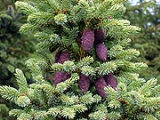
are the smallest of all of the spruces, 1.5-4 cm long and 1–2 cm broad, spindle-shaped to nearly round, dark purple ripening red-brown, produced in dense clusters in the upper crown, opening at maturity but persisting for several years.
Natural hybridization occurs regularly with the closely related
Picea rubens (Red Spruce), and very rarely with
Picea glauca (White Spruce).
It differs from
Picea glauca (White Spruce) in having shorter needles, smaller and rounder cones, and a preference for wetter lowland areas. From true
firFirs are a genus of between 48-55 species of evergreen conifers in the family Pinaceae. All are trees, reaching heights of 10-80 m tall and trunk diameters of 0.5-4 m when mature...
s, such as
Abies balsamea (
Balsam FirThe balsam fir is a North American fir, native to most of eastern and central Canada and the northeastern United States .-Growth & Morphology:It is a small to medium-size evergreen tree typically tall, rarely to tall, with a narrow conic...
), it differs in having pendulous cones, persistent woody leaf-bases, and four-angled needles, arranged all round the shoots.
Older taxonomic synonyms include
Abies mariana, Picea brevifolia, Picea nigra.
Ecology
Growth varies with site conditions. In swamp and
muskegMuskeg is an acidic soil type common in Arctic and boreal areas, although it is found in other northern climates as well. Muskeg is more-or-less synonymous with bogland but muskeg is the standard term in non-Atlantic Canada and Alaska . The term is of Cree origin, maskek meaning low lying marsh...
it shows progressively slower growth rates from the edges toward the centre. The roots are shallow and wide spreading with fallen trees are colloquially called "
drunken treesDrunken trees, tilted trees, or a drunken forest, is a stand of trees displaced from their normal vertical alignment.This most commonly occurs in northern subarctic taiga forests of Black Spruce under which discontinuous permafrost or ice wedges have melted,causing trees to tilt at various...
", and are often associated with thawing of
permafrostIn geology, permafrost or permafrost soil is soil at or below the freezing point of water for two or more years. Ice is not always present, as may be in the case of nonporous bedrock, but it frequently occurs and it may be in amounts exceeding the potential hydraulic saturation of the ground...
. In the northern part of its range,
ice prunedIce pruning is the natural process of selective vegetative pruning on the windward side of a plant, executed by the impact of ice and snow particles driven by wind. The process is sometimes termed snow pruning...
asymmetric Black Spruce are often seen, with diminished foliage on the windward side.
It grows in both lowland and upland sites. In the southern portion of range it is found primarily on wet organic soils, but farther north its abundance on uplands increases. In the Lake States it is most abundant in peat bogs and swamps, also on transitional sites between peatlands and uplands. In these areas it is rare on uplands, except in isolated areas of northern Minnesota and the Upper Peninsula of
MichiganMichigan is a Midwestern state of the United States of America. It was named after Lake Michigan, whose name is a French adaptation of the Ojibwe term mishigama, meaning "large water" or "large lake"....
.
Most stands are even-aged due to frequent fire intervals in
Black SprucePicea mariana is a species of spruce native to northern North America, from Newfoundland west to Alaska, and south to northern New York, Minnesota and central British Columbia...
forests. It commonly grows in pure stands on organic soils and in mixed stands on mineral soils. It is tolerant of nutrient-poor soils, and is commonly found on poorly drained acidic peatlands. It is considered a climax species over most of its range. However, some ecologists question whether Black Spruce forests truly attain climax because fires usually occur at 50-150 year intervals, while "stable" conditions may not be attained for several hundred years.
The frequent fire return interval perpetuates numerous successional communities. Throughout boreal North America,
Paper BirchBetula papyrifera is a species of birch native to northern North America.-Description:...
Betula papyrifera and
Quaking AspenAspen is a common name for trees of the Salicaceae family, most of those in a section, Populus sect. Populus, of the Populus genus. Some of the species in the section are:...
Populus tremuloides are successional hardwoods that frequently invade burns in Black Spruce. Black Spruce typically seeds in promptly after fire, and with the continued absence of fire, will eventually dominate the hardwoods.
It is a pioneer that invades the sedge mat in filled-lake bogs, though often preceded slightly by
Tamarack LarchTamarack Larch, or Tamarack, or Hackmatck, or American Larch is a species of larch native to northern North America and Canada, from eastern Yukon and Inuvik, Northwest Territories east to Newfoundland, and also south into the northeastern United States from Minnesota to Cranesville Swamp, West...
,
Larix laricina, with which it may in time form a stable forest cover in swamps. However, as the peat soil is gradually elevated by the accumulation of organic matter, and the fertility of the site improves, Balsam Fir and Eastern Arborvitae
Thuja occidentalis will eventually replace Black Spruce and Tamarack.
The larvae of the
Spruce BudwormSpruce budworms and relatives are a group of closely related insects in the genus Choristoneura. Most are serious pests of conifers. There are nearly a dozen Choristoneura species, subspecies, or forms, with a complexity of variation among populations found throughout much of the United States and...
mothA moth is an insect closely related to the butterfly, both being of the order Lepidoptera. The differences between butterflies and moths are more than just taxonomy. Sometimes the names "Rhopalocera" and "Heterocera" are used to formalize the popular distinction...
cause defoliation and if it occurs several years in a row will lead to death, though Black Spruce is less susceptible than White Spruce or Balsam Fir. Trees most at risk are those growing with Balsam Fir and White Spruce.
Uses and symbolism
Black Spruce is the Provincial tree of
NewfoundlandNewfoundland and Labrador is a province of Canada on the country's Atlantic coast in northeastern North America. This easternmost Canadian province comprises two main parts: the island of Newfoundland off the country's eastern coast, and Labrador on the mainland to the northwest of the island.A...
.
The
woodWood is an organic material; in the strict sense wood is produced as secondary xylem in the stems of trees . In a living tree it transfers water and nutrients to the leaves and other growing tissues, and has a support function, enabling woody plants to reach large sizes or to stand up for themselves...
is of low value due to the small size of the trees, but is used for pulp and paper making.