

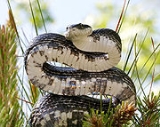
Black Rat Snake

Encyclopedia
The Western ratsnake — also called black rat snake, pilot black snake, or simply black snake — is a nonvenomous colubrid
species
found in North America
. No subspecies are currently recognized.
It is found in northeast United States, in particular New Jersey(northern), New York(eastern) and Vermont(southern).
and timber rattlesnakes. This association gave rise to the common name, pilot black snake, and the superstition that this nonvenomous species led the venomous ones to the den.
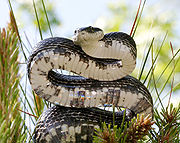 Adults can become quite large and are known to reach up to eight feet, being the largest snake found in Canada
. The record length is 101 inches (2.6 m), making it (officially) the longest snake in North America
. Unofficially, indigo snakes (Drymarchon couperi) are known to exceed them, and one wild caught pine snake (Pituophis melanoleucus
) with a portion of its tail missing measured 111 inches (2.8 m).
Juveniles are strongly patterned with brown blotches on a gray background (like miniature fox snakes). Darkening occurs rapidly as they grow. Adults are glossy black above with white lips, chin, and throat. Sometimes traces of the "obsolete" juvenile pattern are still discernible in the skin between the scales, especially when stretched after a heavy meal.
s). They are also capable of producing a foul smelling musk which they will release onto a predator if picked up. They spread the musk with their tail in hopes of deterring the threat.
, meaning it suffocates its prey, coiling around small animals and tightening its grip until they can no longer draw breath, before eating them. Though they do consume mice and rats, black rat snakes will also hunt other snakes, frogs, lizards, chipmunks, squirrels, juvenile rabbits, juvenile opossums, song birds, and bird eggs.
, into the female sex organ, cloaca
. The mating lasts anywhere from a few minutes to a few hours. After five weeks the female lays about 12 to 20 egg
s, which are 36–60 mm (1.4-2 in.) long by 20-26.5 mm (0.8-1.1 in.) wide. The eggs hatch
about 65 to 70 days later in late August to early October. The hatchlings are 28–41 cm (11-16 in.) in total length, and they look like miniature fox snakes.
In 2001 Burbrink suggested that this species be divided into three species based on geographic patterns of mitochondrial DNA diversity. He assigned new common names and resurrected old scientific names resulting in the following combinations: Eastern ratsnake (Elaphe alleghaniensis, now Pantherophis alleghaniensis), Central ratsnake (Elaphe spiloides, now Pantherophis spiloides), Western ratsnake (E. obsoleta, now P. obsoletus). However, these three species are not morphologically distinct and overlap in all examined morphological characters. More recent investigations have indicated that P. alleghaniensis and P. spiloides interbreed freely in Ontario.
In 2008 Collins and Taggart resurrected the genus Scotophis for Burbrink's three taxa, i.e., (Scotophis alleghaniensis), (Scotophis spiloides) and (Scotophis obsoletus) in response to the findings of Burbrink and Lawson, 2007. The justification for this nomenclatural change has been removed by more recent research.
Colubrid
A colubrid is a member of the snake family Colubridae. This broad classification of snakes includes about two-thirds of all snake species on earth. The earliest species of the snake family date back to the Oligocene epoch. With 304 genera and 1,938 species, Colubridae is the largest snake family...
species
Species
In biology, a species is one of the basic units of biological classification and a taxonomic rank. A species is often defined as a group of organisms capable of interbreeding and producing fertile offspring. While in many cases this definition is adequate, more precise or differing measures are...
found in North America
North America
North America is a continent wholly within the Northern Hemisphere and almost wholly within the Western Hemisphere. It is also considered a northern subcontinent of the Americas...
. No subspecies are currently recognized.
Geographic range
The black rat snake is found throughout the Eastern and Central United States. In Canada it is found in lower Ontario.It is found in northeast United States, in particular New Jersey(northern), New York(eastern) and Vermont(southern).
Preferred habitat
It prefers heavily wooded areas and is known for having excellent climbing ability, including the ability to climb the trunk of large mature trees without the aid of branches. The black rat snake is a competent swimmer but usually (not always) uses this ability only to travel to additional hunting territory. During winter it hibernates in dens, often with copperheadsAgkistrodon contortrix
Agkistrodon contortrix is a species of venomous snake found in North America, a member of the Crotalinae subfamily. The more common name for the species is "copperhead". The behavior of Agkistrodon contortrix may lead to accidental encounters with humans...
and timber rattlesnakes. This association gave rise to the common name, pilot black snake, and the superstition that this nonvenomous species led the venomous ones to the den.
Description
Canada
Canada is a North American country consisting of ten provinces and three territories. Located in the northern part of the continent, it extends from the Atlantic Ocean in the east to the Pacific Ocean in the west, and northward into the Arctic Ocean...
. The record length is 101 inches (2.6 m), making it (officially) the longest snake in North America
North America
North America is a continent wholly within the Northern Hemisphere and almost wholly within the Western Hemisphere. It is also considered a northern subcontinent of the Americas...
. Unofficially, indigo snakes (Drymarchon couperi) are known to exceed them, and one wild caught pine snake (Pituophis melanoleucus
Pituophis melanoleucus
Pituophis melanoleucus is a harmless colubrid species found in the United States. Three subspecies are currently recognized, including the nominate subspecies described here.-Description:...
) with a portion of its tail missing measured 111 inches (2.8 m).
Juveniles are strongly patterned with brown blotches on a gray background (like miniature fox snakes). Darkening occurs rapidly as they grow. Adults are glossy black above with white lips, chin, and throat. Sometimes traces of the "obsolete" juvenile pattern are still discernible in the skin between the scales, especially when stretched after a heavy meal.
Common names
Other common names include: Alleghany black snake, black chicken snake, black Coluber, black pilot snake, chicken snake, mountain black snake, mountain pilot snake, pilot, rat snake, rusty black snake, scaly black snake, cow snake, schwartze schlange, sleepy John, white-throated racer.Behavior
When startled, they may freeze and wrinkle themselves into a series of kinks. If they feel further threatened, they may flee quickly or vibrate their tails in dead leaves (a form of mimicry, which makes them sound like rattlesnakeRattlesnake
Rattlesnakes are a group of venomous snakes of the genera Crotalus and Sistrurus of the subfamily Crotalinae . There are 32 known species of rattlesnake, with between 65-70 subspecies, all native to the Americas, ranging from southern Alberta and southern British Columbia in Canada to Central...
s). They are also capable of producing a foul smelling musk which they will release onto a predator if picked up. They spread the musk with their tail in hopes of deterring the threat.
Feeding
This species is a constrictorConstriction
Constriction is a method used by various snake species to kill their prey. Although some species of venomous and mildly-venomous snakes do use constriction to subdue their prey, most snakes which use constriction lack venom. The snake initially strikes at its prey and holds on, pulling the prey...
, meaning it suffocates its prey, coiling around small animals and tightening its grip until they can no longer draw breath, before eating them. Though they do consume mice and rats, black rat snakes will also hunt other snakes, frogs, lizards, chipmunks, squirrels, juvenile rabbits, juvenile opossums, song birds, and bird eggs.
Reproduction
Mating takes place in late May and early June. The male snake wraps its tail around the female with their vents nearly touching. The male then everts one of its sex organs, a hemipenisHemipenis
A hemipenis is one of a pair of intromittent organs of male squamates .Hemipenes are usually held inverted, within the body, and are everted for reproduction via erectile tissue, much like that in the human penis. Only one is used at a time, and some evidence indicates males alternate use between...
, into the female sex organ, cloaca
Cloaca
In zoological anatomy, a cloaca is the posterior opening that serves as the only such opening for the intestinal, reproductive, and urinary tracts of certain animal species...
. The mating lasts anywhere from a few minutes to a few hours. After five weeks the female lays about 12 to 20 egg
Egg (biology)
An egg is an organic vessel in which an embryo first begins to develop. In most birds, reptiles, insects, molluscs, fish, and monotremes, an egg is the zygote, resulting from fertilization of the ovum, which is expelled from the body and permitted to develop outside the body until the developing...
s, which are 36–60 mm (1.4-2 in.) long by 20-26.5 mm (0.8-1.1 in.) wide. The eggs hatch
Egg (biology)
An egg is an organic vessel in which an embryo first begins to develop. In most birds, reptiles, insects, molluscs, fish, and monotremes, an egg is the zygote, resulting from fertilization of the ovum, which is expelled from the body and permitted to develop outside the body until the developing...
about 65 to 70 days later in late August to early October. The hatchlings are 28–41 cm (11-16 in.) in total length, and they look like miniature fox snakes.
Taxonomy
This species has previously been placed (and is still placed by many) in the genus Elaphe, as Elaphe obsoleta. However, Utiger et al. found that Elaphe as broadly construed is paraphyletic, and placed this species in the genus Pantherophis. In addition, because Pantherophis is masculine, the specific epithet becomes the masculine obsoletus. The split of Pantherophis from Elaphe has been further confirmed by additional phylogenetic studies.In 2001 Burbrink suggested that this species be divided into three species based on geographic patterns of mitochondrial DNA diversity. He assigned new common names and resurrected old scientific names resulting in the following combinations: Eastern ratsnake (Elaphe alleghaniensis, now Pantherophis alleghaniensis), Central ratsnake (Elaphe spiloides, now Pantherophis spiloides), Western ratsnake (E. obsoleta, now P. obsoletus). However, these three species are not morphologically distinct and overlap in all examined morphological characters. More recent investigations have indicated that P. alleghaniensis and P. spiloides interbreed freely in Ontario.
In 2008 Collins and Taggart resurrected the genus Scotophis for Burbrink's three taxa, i.e., (Scotophis alleghaniensis), (Scotophis spiloides) and (Scotophis obsoletus) in response to the findings of Burbrink and Lawson, 2007. The justification for this nomenclatural change has been removed by more recent research.
External links
- Pantherophis obsoletus at J. Craig Venter Institute. Accessed 25 October 2008
- Ratsnake - Elaphe obsoleta at HerpNet. Accessed 2 June 2008.
- E. obsoleta image at Picasa. Accessed 2 June 2008.
- Elaphe obsoleta populations in Southern Ontario Canada Accessed 17 October 2008.
- Black Rat Snake at Natural Resources Canada
- "Black Snakes": Identification and Ecology - University of Florida fact sheet
- Black Rat Snake (Elaphe obsoleta obsoleta), Natural Resources Canada
- Scientific and Standard English Names of Amphibians and Reptiles of North America North of Mexico, With Comments Regarding Confidence In Our Understanding. Edition 6.1