

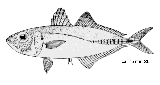
Bigeye scad

Encyclopedia
The bigeye scad is an oceanic fish that is found around the globe in tropical regions. Other common names include akule, chicharro, charrito ojón, purse-eye scad, coulirou, and goggle-eyed scad. Bigeye scads are fished commercially and are very important to aquaculture
.
Bigeye scads are blue-green or green on their backs and sides, with a white underside. They grow to about 15 inches (38 cm) long and feed on small invertebrates, fish larvae, and zooplankton
. They are a schooling fish, mostly nocturnal, and prefer clean, clear insular waters.
Aquaculture
Aquaculture, also known as aquafarming, is the farming of aquatic organisms such as fish, crustaceans, molluscs and aquatic plants. Aquaculture involves cultivating freshwater and saltwater populations under controlled conditions, and can be contrasted with commercial fishing, which is the...
.
Bigeye scads are blue-green or green on their backs and sides, with a white underside. They grow to about 15 inches (38 cm) long and feed on small invertebrates, fish larvae, and zooplankton
Zooplankton
Zooplankton are heterotrophic plankton. Plankton are organisms drifting in oceans, seas, and bodies of fresh water. The word "zooplankton" is derived from the Greek zoon , meaning "animal", and , meaning "wanderer" or "drifter"...
. They are a schooling fish, mostly nocturnal, and prefer clean, clear insular waters.
External links
- Fisheries Global Information System factsheet
- Australian Museum Fish Site species page
- Guam Department of Agriculture's Division of Aquatic & Wildlife Resources species page
- Bigeye scad stock video footage
- University of Rhode Island page with sound files of bigeye scads producing grating sounds with their teeth