Benzilic acid rearrangement

Encyclopedia
The benzilic acid rearrangement is the rearrangement reaction
of benzil
with potassium hydroxide
to benzilic acid. First performed by Justus Liebig in 1838 this reaction type is displayed by 1,2-diketones
in general. The reaction product is an α-hydroxy
-carboxylic acid
.
 Certain acyloin
s also rearrange in this fashion.
This diketone reaction is related to other rearrangements: the corresponding keto-aldehyde (one alkyl group replaced by hydrogen) rearranges in a Cannizzaro reaction
, the corresponding 1,2-diol reacts in a pinacol rearrangement
.
s. These rearrangements usually have migrating carbocation
s but this reaction is unusual because it involves a migrating carbanion
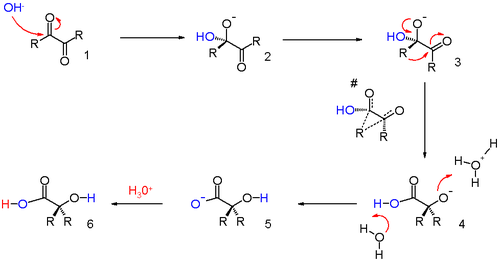
. The long established reaction mechanism
updated with in silico
data is outlined in scheme 2.
A hydroxide
anion attacks one of the ketone
groups in 1 in a nucleophilic addition
to the hydroxyl
anion 2. The next step requires a bond rotation to conformer 3 which places the migrating group R in position for attack on the second carbonyl group in a concerted
step with reversion of the hydroxyl group back to the carbonyl group. This sequence resembles a nucleophilic acyl substitution
. Calculations show that when R is methyl the charge build-up on this group in the transition state
can be as high as 0.22 and that the methyl group is positioned between the central carbon carbon at a separation of 209 pm.
 The carboxylic acid
in intermediate 4 is less basic than the hydroxyl anion and therefore proton transfer takes place to intermediate 5 which can be protonated in acidic workup to the final α-hydroxy
-carboxylic acid
6. Calculations show that an accurate description of the reaction sequence is possible with the participation of 4 water molecules taking responsibility for the stabilization of charge buildup. They also provide a shuttle for the efficient transfer of one proton in the formation of intermediate 5.
From a molecular orbital
point of view this rearrangement may at a first glance not obvious. Contrary to a carbocationic rearrangement as in the Wagner-Meerwein rearrangement
in which the empty carbocationic orbital interacts positively and symmetry allowed with the filled pi orbital HOMO
of the central C-C bond (situation A in scheme 3), a filled carbanionic orbital should not be able to escape a symmetry forbidden MO overlap with the LUMO
which is the empty antibonding
pi orbital having one node (situation B).
 In reality a 1,2-diketone LUMO is a 4 electron system without any nodes in the central C-C bond and a symmetry allowed transition is possible (Situation C). In other words the transition states of both a carbocationic rearrangement and the benzilic rearrangement obey the Woodward-Hoffmann rules
because the involves respectively 2 electrons and 6 electrons (n=0 and 1 in the 4n+2 Hückel's rule
).
s. In the so-called D-Homo Rearrangement of Steroids a cyclopentane ring expands to a cyclohexane ring with added base .
Rearrangement reaction
A rearrangement reaction is a broad class of organic reactions where the carbon skeleton of a molecule is rearranged to give a structural isomer of the original molecule. Often a substituent moves from one atom to another atom in the same molecule...
of benzil
Benzil
Benzil is the organic compound with the formula 2, generally abbreviated 2. This yellow solid is one of the most common diketones...
with potassium hydroxide
Potassium hydroxide
Potassium hydroxide is an inorganic compound with the formula KOH, commonly called caustic potash.Along with sodium hydroxide , this colorless solid is a prototypical strong base. It has many industrial and niche applications. Most applications exploit its reactivity toward acids and its corrosive...
to benzilic acid. First performed by Justus Liebig in 1838 this reaction type is displayed by 1,2-diketones
Ketone
In organic chemistry, a ketone is an organic compound with the structure RCR', where R and R' can be a variety of atoms and groups of atoms. It features a carbonyl group bonded to two other carbon atoms. Many ketones are known and many are of great importance in industry and in biology...
in general. The reaction product is an α-hydroxy
Hydroxyl
A hydroxyl is a chemical group containing an oxygen atom covalently bonded with a hydrogen atom. In inorganic chemistry, the hydroxyl group is known as the hydroxide ion, and scientists and reference works generally use these different terms though they refer to the same chemical structure in...
-carboxylic acid
Carboxylic acid
Carboxylic acids are organic acids characterized by the presence of at least one carboxyl group. The general formula of a carboxylic acid is R-COOH, where R is some monovalent functional group...
.
Acyloin
Acyloins are a class of organic compounds in organic chemistry sharing a common functional group consisting of a hydroxyl group placed on the α-position of a carbonyl group.- Nomenclature :Common types of ketols include:...
s also rearrange in this fashion.
This diketone reaction is related to other rearrangements: the corresponding keto-aldehyde (one alkyl group replaced by hydrogen) rearranges in a Cannizzaro reaction
Cannizzaro reaction
The Cannizzaro reaction, named after its discoverer Stanislao Cannizzaro, is a chemical reaction that involves the base-induced disproportionation of an aldehyde lacking a hydrogen atom in the alpha position...
, the corresponding 1,2-diol reacts in a pinacol rearrangement
Pinacol rearrangement
The pinacol rearrangement or pinacol-pinacolone rearrangement is a method for converting a 1,2-diol to a carbonyl compound in organic chemistry. This 1,2-rearrangement takes place under acidic conditions...
.
Reaction mechanism
The reaction is a representative of 1,2-rearrangement1,2-rearrangement
A 1,2-rearrangement or 1,2-migration or 1,2-shift or Whitmore 1,2-shift is an organic reaction where a substituent moves from one atom to another atom in a chemical compound. In a 1,2 shift the movement involves two adjacent atoms but moves over larger distances are possible...
s. These rearrangements usually have migrating carbocation
Carbocation
A carbocation is an ion with a positively-charged carbon atom. The charged carbon atom in a carbocation is a "sextet", i.e. it has only six electrons in its outer valence shell instead of the eight valence electrons that ensures maximum stability . Therefore carbocations are often reactive,...
s but this reaction is unusual because it involves a migrating carbanion
Carbanion
A carbanion is an anion in which carbon has an unshared pair of electrons and bears a negative charge usually with three substituents for a total of eight valence electrons. The carbanion exists in a trigonal pyramidal geometry. Formally a carbanion is the conjugate base of a carbon acid.where B...
. The long established reaction mechanism
Reaction mechanism
In chemistry, a reaction mechanism is the step by step sequence of elementary reactions by which overall chemical change occurs.Although only the net chemical change is directly observable for most chemical reactions, experiments can often be designed that suggest the possible sequence of steps in...
updated with in silico
In silico
In silico is an expression used to mean "performed on computer or via computer simulation." The phrase was coined in 1989 as an analogy to the Latin phrases in vivo and in vitro which are commonly used in biology and refer to experiments done in living organisms and outside of living organisms,...
data is outlined in scheme 2.
A hydroxide
Hydroxide
Hydroxide is a diatomic anion with chemical formula OH−. It consists of an oxygen and a hydrogen atom held together by a covalent bond, and carrying a negative electric charge. It is an important but usually minor constituent of water. It functions as a base, as a ligand, a nucleophile, and a...
anion attacks one of the ketone
Ketone
In organic chemistry, a ketone is an organic compound with the structure RCR', where R and R' can be a variety of atoms and groups of atoms. It features a carbonyl group bonded to two other carbon atoms. Many ketones are known and many are of great importance in industry and in biology...
groups in 1 in a nucleophilic addition
Nucleophilic addition
In organic chemistry, a nucleophilic addition reaction is an addition reaction where in a chemical compound a π bond is removed by the creation of two new covalent bonds by the addition of a nucleophile....
to the hydroxyl
Hydroxyl
A hydroxyl is a chemical group containing an oxygen atom covalently bonded with a hydrogen atom. In inorganic chemistry, the hydroxyl group is known as the hydroxide ion, and scientists and reference works generally use these different terms though they refer to the same chemical structure in...
anion 2. The next step requires a bond rotation to conformer 3 which places the migrating group R in position for attack on the second carbonyl group in a concerted
Concerted reaction
In chemistry, a concerted reaction is a chemical reaction in which all bond breaking and bond making occurs in a single step. Reactive intermediates or other unstable high energy intermediates are not involved. Concerted reaction rates tend not to depend on solvent polarity ruling out large buildup...
step with reversion of the hydroxyl group back to the carbonyl group. This sequence resembles a nucleophilic acyl substitution
Nucleophilic acyl substitution
Nucleophilic acyl substitution describes the substitution reaction involving nucleophiles and acyl compounds. Acyl compounds are carboxylic acid derivatives including esters, amides and acid halides...
. Calculations show that when R is methyl the charge build-up on this group in the transition state
Transition state
The transition state of a chemical reaction is a particular configuration along the reaction coordinate. It is defined as the state corresponding to the highest energy along this reaction coordinate. At this point, assuming a perfectly irreversible reaction, colliding reactant molecules will always...
can be as high as 0.22 and that the methyl group is positioned between the central carbon carbon at a separation of 209 pm.
Carboxylic acid
Carboxylic acids are organic acids characterized by the presence of at least one carboxyl group. The general formula of a carboxylic acid is R-COOH, where R is some monovalent functional group...
in intermediate 4 is less basic than the hydroxyl anion and therefore proton transfer takes place to intermediate 5 which can be protonated in acidic workup to the final α-hydroxy
Hydroxyl
A hydroxyl is a chemical group containing an oxygen atom covalently bonded with a hydrogen atom. In inorganic chemistry, the hydroxyl group is known as the hydroxide ion, and scientists and reference works generally use these different terms though they refer to the same chemical structure in...
-carboxylic acid
Carboxylic acid
Carboxylic acids are organic acids characterized by the presence of at least one carboxyl group. The general formula of a carboxylic acid is R-COOH, where R is some monovalent functional group...
6. Calculations show that an accurate description of the reaction sequence is possible with the participation of 4 water molecules taking responsibility for the stabilization of charge buildup. They also provide a shuttle for the efficient transfer of one proton in the formation of intermediate 5.
From a molecular orbital
Molecular orbital
In chemistry, a molecular orbital is a mathematical function describing the wave-like behavior of an electron in a molecule. This function can be used to calculate chemical and physical properties such as the probability of finding an electron in any specific region. The term "orbital" was first...
point of view this rearrangement may at a first glance not obvious. Contrary to a carbocationic rearrangement as in the Wagner-Meerwein rearrangement
Wagner-Meerwein rearrangement
A Wagner–Meerwein rearrangement is a class of carbocation 1,2-rearrangement reactions in which a hydrogen, alkyl or aryl group migrates from one carbon to a neighboring carbon.Several reviews have been published....
in which the empty carbocationic orbital interacts positively and symmetry allowed with the filled pi orbital HOMO
Homo
Homo may refer to:*the Greek prefix ὅμο-, meaning "the same"*the Latin for man, human being*Homo, the taxonomical genus including modern humans...
of the central C-C bond (situation A in scheme 3), a filled carbanionic orbital should not be able to escape a symmetry forbidden MO overlap with the LUMO
Lumo
Lumo is a 2007 documentary film about twenty-year-old Lumo Sinai, a woman who fell victim to "Africa's First World War." While returning home one day, Lumo and another woman were gang-raped by a group of soldiers fighting for control of the Democratic Republic of the Congo during the 1994 Rwandan...
which is the empty antibonding
Antibonding
Antibonding is a type of chemical bonding. An antibonding orbital is a form of molecular orbital that is located outside the region of two distinct nuclei...
pi orbital having one node (situation B).
Woodward-Hoffmann rules
The Woodward–Hoffmann rules devised by Robert Burns Woodward and Roald Hoffmann are a set of rules in organic chemistry predicting the stereochemistry of pericyclic reactions based on orbital symmetry. These include electrocyclic reactions, cycloadditions , sigmatropic reactions, and group transfer...
because the involves respectively 2 electrons and 6 electrons (n=0 and 1 in the 4n+2 Hückel's rule
Hückel's rule
In organic chemistry, Hückel's rule estimates whether a planar ring molecule will have aromatic properties. The quantum mechanical basis for its formulation was first worked out by physical chemist Erich Hückel in 1931...
).
Variations
A variation of this reaction occurs in certain steroidSteroid
A steroid is a type of organic compound that contains a characteristic arrangement of four cycloalkane rings that are joined to each other. Examples of steroids include the dietary fat cholesterol, the sex hormones estradiol and testosterone, and the anti-inflammatory drug dexamethasone.The core...
s. In the so-called D-Homo Rearrangement of Steroids a cyclopentane ring expands to a cyclohexane ring with added base .