


Antibonding

Encyclopedia
Chemical bond
A chemical bond is an attraction between atoms that allows the formation of chemical substances that contain two or more atoms. The bond is caused by the electromagnetic force attraction between opposite charges, either between electrons and nuclei, or as the result of a dipole attraction...
. An antibonding orbital is a form of molecular orbital
Molecular orbital
In chemistry, a molecular orbital is a mathematical function describing the wave-like behavior of an electron in a molecule. This function can be used to calculate chemical and physical properties such as the probability of finding an electron in any specific region. The term "orbital" was first...
(MO) that is located outside the region of two distinct nuclei
Atomic nucleus
The nucleus is the very dense region consisting of protons and neutrons at the center of an atom. It was discovered in 1911, as a result of Ernest Rutherford's interpretation of the famous 1909 Rutherford experiment performed by Hans Geiger and Ernest Marsden, under the direction of Rutherford. The...
. The overlap of the constituent atomic orbitals is said to be 'out of phase' and as such the electron
Electron
The electron is a subatomic particle with a negative elementary electric charge. It has no known components or substructure; in other words, it is generally thought to be an elementary particle. An electron has a mass that is approximately 1/1836 that of the proton...
s present in each antibonding orbital are repulsive and act to destabilize the molecule
Molecule
A molecule is an electrically neutral group of at least two atoms held together by covalent chemical bonds. Molecules are distinguished from ions by their electrical charge...
as a whole.
Explanation
Antibonding molecular orbitals (MOs) are normally higher in energy than bonding MOs. Bonding and antibonding orbitals form when atoms combine into molecules as a result of the Pauli Exclusion PrinciplePauli exclusion principle
The Pauli exclusion principle is the quantum mechanical principle that no two identical fermions may occupy the same quantum state simultaneously. A more rigorous statement is that the total wave function for two identical fermions is anti-symmetric with respect to exchange of the particles...
. Consider two hydrogen
Hydrogen
Hydrogen is the chemical element with atomic number 1. It is represented by the symbol H. With an average atomic weight of , hydrogen is the lightest and most abundant chemical element, constituting roughly 75% of the Universe's chemical elemental mass. Stars in the main sequence are mainly...
atoms that are initially far apart and are brought together. When they are far apart and isolated the atoms have identical energy level
Energy level
A quantum mechanical system or particle that is bound -- that is, confined spatially—can only take on certain discrete values of energy. This contrasts with classical particles, which can have any energy. These discrete values are called energy levels...
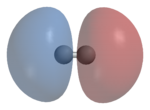
s. However as the spacing between the two atoms becomes smaller the electron wave functions begin to overlap. The Pauli principle dictates that no two electrons in an interacting system may have the same quantum state. Therefore, each energy level of the isolated atoms splits into two molecular orbitals belonging to the pair, one lower in energy than the original atomic level and one higher. For example, the ground state energy level, 1s, splits into two molecular orbitals. Since the lower orbital is lower in energy than the original atomic orbitals of the separate atoms, it is more stable, and promotes the bonding of the two H atoms into H2. This is the bonding orbital. The higher orbital is higher in energy than the original atomic orbitals and is less stable, and therefore opposes the bonding, this is the antibonding orbital. In a molecule such as H2, the two electrons normally occupy the bonding orbital since it is lower in energy, and therefore the molecule is more stable than the separate H atoms.
A molecular orbital becomes antibonding as there is actually less electron density
Electron density
Electron density is the measure of the probability of an electron being present at a specific location.In molecules, regions of electron density are usually found around the atom, and its bonds...
between the two nuclei than there would be if there was no bonding interaction at all. When an MO changes sign (from positive to negative) at a nodal plane between two atoms, it is said to be antibonding with respect to those atoms. Antibonding orbitals are often labelled with an asterisk
Asterisk
An asterisk is a typographical symbol or glyph. It is so called because it resembles a conventional image of a star. Computer scientists and mathematicians often pronounce it as star...
(*) on molecular orbital diagrams.
In homonuclear diatomic molecules, σ* (sigma star) antibonding orbitals have no nodal planes passing through the two nuclei, like sigma bonds, and π* (pi star) orbitals have one nodal plane passing through the two nuclei, like pi bonds.
In molecules with several atoms, such as benzene
Benzene
Benzene is an organic chemical compound. It is composed of 6 carbon atoms in a ring, with 1 hydrogen atom attached to each carbon atom, with the molecular formula C6H6....
, a particular MO may be bonding with respect to some adjacent pairs of atoms and antibonding with respect to other pairs. If the bonding interactions outnumber the antibonding interactions, the MO is said to be "bonding," while if the antibonding interactions outnumber the bonding interactions, the MO is said to be "antibonding". Since each carbon
Carbon
Carbon is the chemical element with symbol C and atomic number 6. As a member of group 14 on the periodic table, it is nonmetallic and tetravalent—making four electrons available to form covalent chemical bonds...
atom contributes only one electron to the π-system
Pi bond
In chemistry, pi bonds are covalent chemical bonds where two lobes of one involved atomic orbital overlap two lobes of the other involved atomic orbital...
of benzene, there are six π-electrons and therefore only the three lowest-energy MOs (the bonding ones) are filled.
Another particular feature of antibonding is that the antibonding orbital is more antibonding than the bonding orbital is bonding. This leads to the conclusion that the energy of both MOs are raised by the presence of nucleus-nucleus repulsion.
Antibonding orbitals are also important for explaining chemical reaction
Chemical reaction
A chemical reaction is a process that leads to the transformation of one set of chemical substances to another. Chemical reactions can be either spontaneous, requiring no input of energy, or non-spontaneous, typically following the input of some type of energy, such as heat, light or electricity...
s in terms of molecular orbital theory. Roald Hoffmann
Roald Hoffmann
Roald Hoffmann is an American theoretical chemist who won the 1981 Nobel Prize in Chemistry. He currently teaches at Cornell University in Ithaca, New York.-Escape from the Holocaust:...
and Kenichi Fukui
Kenichi Fukui
Kenichi Fukui was a Japanese chemist.Kenichi Fukui was co-recipient of the Nobel Prize in Chemistry in 1981 with Roald Hoffmann, for their independent investigations into the mechanisms of chemical reactions...
shared the 1981 Nobel Prize in Chemistry
Nobel Prize in Chemistry
The Nobel Prize in Chemistry is awarded annually by the Royal Swedish Academy of Sciences to scientists in the various fields of chemistry. It is one of the five Nobel Prizes established by the will of Alfred Nobel in 1895, awarded for outstanding contributions in chemistry, physics, literature,...
for their work and further development of qualitative MO explanations for chemical reactions.