
Home      Discussion      Topics      Dictionary      Almanac
Signup       Login
Beauveria bassiana

Beauveria bassiana

Overview
Beauveria bassiana is a fungus
Fungus
A fungus is any member of a large group of eukaryotic organisms that includes microorganisms such as yeasts and molds, as well as the more familiar mushrooms. The Fungi are classified as a kingdom that is separate from plants, animals and bacteria...

 that grows naturally in soils throughout the world and acts as a parasite on various insect
Insect
Insects are arthropods, having a hard exoskeleton, a three-part body , three pairs of jointed legs, compound eyes, and two antennae. They are the most diverse group of animals on the planet and include more than a million species that are already described. Insects represent more than half of all...

 species, causing white muscardine disease; it thus belongs to the entomopathogenic fungi. It is being used as a biological insecticide
Insecticide
An insecticide is a pesticide used against insects. They include ovicides and larvicides used against the eggs and larvae of insects respectively. Insecticides are used in agriculture, medicine, industry and the household. The use of insecticides is believed to be one of the major factors behind...

 to control a number of pests such as termite
Termite
The termites are a group of eusocial insects usually classified at the taxonomic rank of order Isoptera . Along with ants and some bees and wasps which are all placed in the separate order Hymenoptera, termites divide labour among gender lines, produce overlapping generations and take care of...

s, whitefly
Whitefly
The whiteflies, comprising only the family Aleyrodidae, are small hemipterans. More than 1550 species have been described. Whiteflies typically feed on the underside of plant leaves.-Agricultural threat:...

, different beetles and its use in the control of the malaria
Malaria
Malaria is a vector-borne infectious disease caused by a eukaryotic protist of the genus Plasmodium. It is widespread in tropical and subtropical regions, including parts of the Americas, Asia, and Africa. Each year, there are approximately 350–500 million cases of malaria, killing between one and...

-transmitting mosquito
Mosquito
Mosquito is a common insect in the family Culicidae...

s is under investigation.

The species is named after the Italian
Italy
Italy , officially the Italian Republic , is a country located on the Italian Peninsula in Southern Europe and on the two largest islands in the Mediterranean Sea, Sicily and Sardinia. Italy shares its northern, Alpine boundary with France, Switzerland, Austria and Slovenia...

 entomologist Agostino Bassi
Agostino Bassi
Agostino Bassi, sometimes called de Lodi, was an Lombard entomologist. He preceded Louis Pasteur in the discovery that microorganisms can be the cause of disease...

 who discovered it in 1835 as the cause of the muscardine disease of domesticated silkworms. It was formerly also known as Tritirachium shiotae.

Beauveria bassiana is the anamorph (asexually reproducing form) of Cordyceps
Cordyceps
Cordyceps is a genus of ascomycete fungi that includes about 400 described species. All Cordyceps species are endoparasitoids, mainly on insects and other arthropods ; a few are parasitic on other fungi. The best known species of the genus is Cordyceps sinensis, first recorded as yartsa gunbu in...

 bassiana
.
Discussion
Ask a question about 'Beauveria bassiana'
Start a new discussion about 'Beauveria bassiana'
Answer questions from other users
Full Discussion Forum
 
Encyclopedia
Beauveria bassiana is a fungus
Fungus
A fungus is any member of a large group of eukaryotic organisms that includes microorganisms such as yeasts and molds, as well as the more familiar mushrooms. The Fungi are classified as a kingdom that is separate from plants, animals and bacteria...

 that grows naturally in soils throughout the world and acts as a parasite on various insect
Insect
Insects are arthropods, having a hard exoskeleton, a three-part body , three pairs of jointed legs, compound eyes, and two antennae. They are the most diverse group of animals on the planet and include more than a million species that are already described. Insects represent more than half of all...

 species, causing white muscardine disease; it thus belongs to the entomopathogenic fungi. It is being used as a biological insecticide
Insecticide
An insecticide is a pesticide used against insects. They include ovicides and larvicides used against the eggs and larvae of insects respectively. Insecticides are used in agriculture, medicine, industry and the household. The use of insecticides is believed to be one of the major factors behind...

 to control a number of pests such as termite
Termite
The termites are a group of eusocial insects usually classified at the taxonomic rank of order Isoptera . Along with ants and some bees and wasps which are all placed in the separate order Hymenoptera, termites divide labour among gender lines, produce overlapping generations and take care of...

s, whitefly
Whitefly
The whiteflies, comprising only the family Aleyrodidae, are small hemipterans. More than 1550 species have been described. Whiteflies typically feed on the underside of plant leaves.-Agricultural threat:...

, different beetles and its use in the control of the malaria
Malaria
Malaria is a vector-borne infectious disease caused by a eukaryotic protist of the genus Plasmodium. It is widespread in tropical and subtropical regions, including parts of the Americas, Asia, and Africa. Each year, there are approximately 350–500 million cases of malaria, killing between one and...

-transmitting mosquito
Mosquito
Mosquito is a common insect in the family Culicidae...

s is under investigation.

Discovery and name


The species is named after the Italian
Italy
Italy , officially the Italian Republic , is a country located on the Italian Peninsula in Southern Europe and on the two largest islands in the Mediterranean Sea, Sicily and Sardinia. Italy shares its northern, Alpine boundary with France, Switzerland, Austria and Slovenia...

 entomologist Agostino Bassi
Agostino Bassi
Agostino Bassi, sometimes called de Lodi, was an Lombard entomologist. He preceded Louis Pasteur in the discovery that microorganisms can be the cause of disease...

 who discovered it in 1835 as the cause of the muscardine disease of domesticated silkworms. It was formerly also known as Tritirachium shiotae.

Relation to Cordyceps and other fungi


Beauveria bassiana is the anamorph (asexually reproducing form) of Cordyceps
Cordyceps
Cordyceps is a genus of ascomycete fungi that includes about 400 described species. All Cordyceps species are endoparasitoids, mainly on insects and other arthropods ; a few are parasitic on other fungi. The best known species of the genus is Cordyceps sinensis, first recorded as yartsa gunbu in...

 bassiana
. The latter teleomorph (the sexually reproducing form) has been collected only in eastern Asia.

The name B. bassiana has long been used to describe a complex of morphologically similar and closely related species. Rehner and Buckley have shown that B. bassiana consists of many distinct lineages that should be recognized as distinct phylogenetic species.

Morphology of the fungus


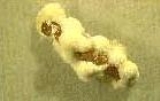
In culture, B. bassiana grows as a white mold
Mold
Molds include all species of microscopic fungi that grow in the form of multicellular filaments, called hyphae. In contrast, microscopic fungi that grow as single cells are called yeasts...

. On most common cultural media, it produces many dry, powdery conidia in distinctive white spore
Spore
In biology, a spore is a reproductive structure that is adapted for dispersal and surviving for extended periods of time in unfavorable conditions...

 balls. Each spore ball is composed of a cluster of conidiogenous cells. The conidiogenous cells of B. bassiana are short and ovoid, and terminate in a narrow apical extension called a rachis
Rachis
The rachis is the main axis of the inflorescence, or spike, of wheat and other cereals, to which the spikelets are attached. It is also the part of the axis that the pinnae are attached to in ferns, the main stem of a compound leaf , or the main axis in compound inflorescences in other...

. The rachis elongates after each conidium is produced, resulting in a long zig-zag extension. The conidia are single-celled, haploid, and hydrophobic.

White muscardine disease


The insect disease caused by the fungus is called white muscardine disease. When the microscopic spores of the fungus come into contact with the body of an insect host, they germinate, penetrate the cuticle
Cuticle
A cuticle , or cuticula, is any of a variety of tough but flexible, non-mineral outer coverings of an organism, or parts of an organism, that provide protection. Cuticles are non-homologous, differing in their origin, structure and chemical composition.-Human anatomy:In human anatomy, cuticle ...

, and grow inside, killing the insect within a matter of days. Afterwards a white mold emerges from the cadaver and produces new spores. A typical isolate of B. bassiana can attack a broad range of insects; various isolates differ in their host range. The factors responsible for host susceptibility are not known.

Beauveria bassiana parasitizing the Colorado potato beetle
Colorado potato beetle
The Colorado potato beetle - also known as the Colorado beetle, ten-striped spearman, the ten-lined potato beetle, potato bug - is an important pest of potato crops...

 has been reported to be, in turn, the host of a mycoparasitic fungus Syspastospora parasitica
Syspastospora parasitica
Syspastospora parasitica is a mycoparasitic fungus. It attacks other fungi, particularly species of Beauveria and Isaria . It parasitizes the mycelium of its host by means of specialized contact cells, and produces dark brown, long-necked perithecia.-References:*Markova, G. 1991...

. This organism also attacks related insect-pathogenic species of the Clavicipitaceae
Clavicipitaceae
Clavicipitaceae is a family of fungi within the order Hypocreales. It consists of 43 genera, and 321 species.-Phylogeny:Molecular phylogenetic analysis of multigene DNA sequence data indicates that the taxon, Clavicipitaceae, is paraphyletic, and consists of three well-defined clades, at least one...

.

Use in biological control of insects


Beauveria bassiana can be used as a biological insecticide
Insecticide
An insecticide is a pesticide used against insects. They include ovicides and larvicides used against the eggs and larvae of insects respectively. Insecticides are used in agriculture, medicine, industry and the household. The use of insecticides is believed to be one of the major factors behind...

 to control a number of pests such as termite
Termite
The termites are a group of eusocial insects usually classified at the taxonomic rank of order Isoptera . Along with ants and some bees and wasps which are all placed in the separate order Hymenoptera, termites divide labour among gender lines, produce overlapping generations and take care of...

s, whitefly
Whitefly
The whiteflies, comprising only the family Aleyrodidae, are small hemipterans. More than 1550 species have been described. Whiteflies typically feed on the underside of plant leaves.-Agricultural threat:...

, and many other insects. Its use in the control of the malaria
Malaria
Malaria is a vector-borne infectious disease caused by a eukaryotic protist of the genus Plasmodium. It is widespread in tropical and subtropical regions, including parts of the Americas, Asia, and Africa. Each year, there are approximately 350–500 million cases of malaria, killing between one and...

-transmitting mosquito
Mosquito
Mosquito is a common insect in the family Culicidae...

s is under investigation. As an insecticide, the spores are sprayed on affected crops as an emulsified suspension or wettable powder or applied to mosquito net
Mosquito net
A mosquito net offers protection against mosquitos, flies, and other insects, and thus against diseases such as malaria. Its fine, see-through, mesh construction stops many insects from biting and disturbing the person using the net...

s as a malaria control agent.

Beauveria bassiana parasitizes a very wide range of arthropod hosts, and so should be considered a nonselective biological insecticide. It should not be applied to flowers visited by pollinating insects .

Known targets include :
  • Aphids
  • Whiteflies
  • Bugs
  • Mealybugs
  • Psyllids
  • Lygus bugs
  • Chinch bug
  • Grasshoppers
  • Thrips
    Thrips
    Thrips are tiny, slender insects with fringed wings . Other common names for thrips include thunderflies, thunderbugs, storm flies, and corn lice...

  • Termites
  • Fire ants
  • Flies
  • Fungal gnats
  • Shoreflies
  • Beetles
  • Coffee borer beetle
    Coffee borer beetle
    The coffee berry borer, Hypothenemus hampei, is a small beetle native to Africa. It is recognised as the most harmful pest to coffee crops worldwide. The insect affects over seventy countries, mainly in Latin America...

  • Colorado potato beetle
  • Mexican bean beetle
  • Japanese beetle
  • Boll weevil
  • Cereal leaf beetle
  • Bark beetles
  • Black vine weevil
    Black vine weevil
    The black vine weevil, Otiorhynchus sulcatus, is native to Europe, but common in North America as well. This weevil is a pest of many garden plants, causing the most damage on evergreen trees and shrubs....

  • Strawberry root weevil
  • Caterpillars
  • European corn borer
  • Codling moth
  • Douglas fir tussock moth
  • Silkworm
  • Mites


The fungus rarely infects humans or other animals, so it is generally considered safe as an insecticide. However, at least one case of human infection by B. bassiana has been reported in a person with a suppressed immune system. Additionally, like any powder, the spores may exacerbate breathing difficulties. Wagner and Lewis reported the ability of B. bassiana to grow as an endophyte
Endophyte
An endophyte is an endosymbiont, often a bacterium or fungus, that lives within a plant for at least part of its life without causing apparent disease. Endophytes are ubiquitous and have been found in all the species of plants studied to date; however, most of these endophyte/plant relationships...

 in corn.

See also


  • Metarhizium
    Metarhizium
    Metarhizium is a genus of entomopathogenic fungi in the Clavicipitaceae family. With the advent of genetic profiling, it has now become possible to place these fungi in proper taxa. Most turn out to be the asexual forms of fungi in the phylum Ascomycota.Nine distinct species have now been...

     
    spp. which cause "green muscardine" disease
  • Biological insecticides