
All Topics  
Thrips

 
Thrips

   Email Print
   Bookmark   Link


Thrips


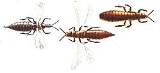
Thrips (Order Thysanoptera) are tiny, slender insect
Insect

Insects are the biggest class of arthropods and the only ones with wings. They are the most diverse group of animals on the planet. They are most diverse at the equator and their diversity declines toward the poles....
s with fringed wings (thus the scientific name, from the Greek
Greek language

Greek is an Indo-European languages native to the southern Balkan peninsula, the language of the Greek people. It forms an independent branch within Indo-European....
 thysanos (fringe) + pteron (wing)). Other common names for thrips include thunderflies, thunderbugs, storm flies, and corn lice. Thrips species feed on a large variety of sources both plant and animal by puncturing them and sucking up the contents.


Discussion
Ask a question about 'Thrips'
Start a new discussion about 'Thrips'
Answer questions from other users
Full Discussion Forum


Recent Posts


Encyclopedia


Thrips (Order Thysanoptera) are tiny, slender insect
Insect

Insects are the biggest class of arthropods and the only ones with wings. They are the most diverse group of animals on the planet. They are most diverse at the equator and their diversity declines toward the poles....
s with fringed wings (thus the scientific name, from the Greek
Greek language

Greek is an Indo-European languages native to the southern Balkan peninsula, the language of the Greek people. It forms an independent branch within Indo-European....
 thysanos (fringe) + pteron (wing)). Other common names for thrips include thunderflies, thunderbugs, storm flies, and corn lice. Thrips species feed on a large variety of sources both plant and animal by puncturing them and sucking up the contents. A large number of thrips species are considered pests, because they feed on plants with commercial value. Some species of thrips feed on other insects or mite
Mite

Mites, along with ticks, belong to the subclass Acarina and the class Arachnida. Mites are among the most diverse and successful of all the invertebrate groups....
s and are considered beneficial, while some feed on fungal spores or pollen. So far around 5,000 species have been described. Thrips are generally tiny (1 mm
Millimetre

The millimetre is a Units of measurement of length in the metric system, equal to one thousandth of a metre, which is the current International System of Units SI base unit of length....
 long or less) and are not good flyers, although they can be carried long distances by the wind. In the right conditions, many species can explode in population and swarm everywhere, making them an irritation to humans.

Like the words sheep
Sheep

#REDIRECT Domestic sheep...
 or moose
Moose

File:Alces alces NA.svgThe moose or elk , , is the largest Extant taxon species in the deer family . Moose are distinguished by the palmate antlers of the males; other members of the family have antlers with a "twig-like" configuration....
, the word thrips is used for both the singular and plural forms
Grammatical number

In linguistics, grammatical number is a grammatical category of nouns, pronouns, and adjective and verb agreement that expresses count distinctions ....
. So while there may be many thrips there can also be a solitary thrips. The word thrips is from Greek, meaning wood louse.

Morphology and Classification


Characteristics

They are small hemimetabolic insects with a distinctive cigar-shaped bauplan: elongate with transversely constricted bodies. They range in size from half a millimeter to fourteen millimeters in length for the larger predatory thrips, but most thrips are approximately a millimeter in length. Flight-capable groups will bear two similar pairs of wings with the ciliated fringe from which the order derives its name. Their legs usually end in two tarsal
Tarsus

Tarsus may refer to:*Tarsus , the skeletal region between the tibia and fibula and the metatarsus*Tarsus *The final segment of an arthropod leg...
 segments with an bladder-like structure known as an arolium at the pretarsus. This structure can be everted by means of hemolymph pressure, enabling the insect to walk on vertical surfaces.

The asymmetrical thrips mouthparts are also unique to the group. Unlike the Hemiptera
Hemiptera

Hemiptera is an order of insects, comprising around 80,000 species of cicadas, aphids, planthoppers, leafhoppers, shield bugs, and others. They range in size from 1 mm to around 15 cm, and share a common arrangement of sucking mouthparts ....
, the right mandible is vestigial, and in some species completely absent. The left mandible may be relatively larger, and is used to pierce the cell wall of tissues . Some species may then inject digestive enzymes as the maxillary stylets and hypopharynx are inserted into the opening to drain cellular fluids. This process leaves a distinctive silvery or bronze scarring on the surface of the stems or leaves where the thrips feed .

The Thysanoptera are divided into two suborders: the Terebrantia, and the Tubulifera. These two suborders can be distinguished by morphological, behavioral, and developmental characteristics. The Tubulifera can be identified by their characteristic tube-shaped apical abdominal segment, egg-laying atop the surface of leaves, and three "pupal" stages. Females of the eight families of the Terebrantia all possess the eponymous saw-like ovipositor on the anteapical abdominal segment, lay eggs singly within plant tissue, and have two "pupal" stages.

Evolution and systematics

The Thysanoptera were first described in 1744 as a genus
Genus

A genus is a low-level taxonomic rank used in the classification of living and fossil organisms. The taxonomic ranks are domain , kingdom , phylum, class , order , family , genus, and species....
 Physapus by De Greer, and then renamed Thrips by Linnaeus in 1758. In 1836 Haliday promoted the genus to the taxonomic rank
Taxonomic rank

Taxonomic rank, taxonomic category, rank, or category is an abstract term used in the scientific classification, or taxonomy, of organisms....
 of order
Order (biology)

In Biological classification used in biology, the order is a taxonomic rank between class and family . The superorder is a rank between class and order....
, renaming them Thysanoptera.

The earliest fossils of thrips date back to Permian
Permian

The PermianThe term "Permian" was introduced into geology in 1841 by Sir Roderick Murchison, president of the Geological Society of London, who identified typical strata in extensive Russian explorations undertaken with Edouard de Verneuil; Murchison asserted in 1841 that he named his "Permian system" after the ancient kingdom...
 (Permothrips longipennis Martynov, 1935). By the Early Cretaceous
Early Cretaceous

The Early Cretaceous or the Lower Cretaceous , is the earlier of the two major divisions of the Cretaceous Period . It began about 146 million years ago....
 true thrips became much more abundant. The extant family
Family (biology)

In biological classification, family is a taxonomic rank. Exact details of formal nomenclature depend on the Nomenclature Codes which applies....
 Merothripidae most resemble these ancestral Thysanoptera, and are probably basal to the order.

The following families are currently (2006) recognized:

  • Suborder Terebrantia
  • Adiheterothripidae Shumsher, 1946 (11 genera)
  • Aeolothripidae
    Aeolothripidae

    The Aeolothripidae are a family of thrips. They are particularly common in the holarctic region, although several occur in the drier parts of the subtropics, including dozens in Australia....
     Uzel, 1895 (29 genera) - banded thrips and broad-winged thrips
  • Fauriellidae Priesner, 1949 (4 genera)
  • †Hemithripidae Bagnall, 1923 (1 fossil genus, Hemithrips with 15 species)
  • Heterothripidae Bagnall, 1912 (7 genera)
  • † Jezzinothripidae zur Strassen, 1973 (included by some authors in Merothripidae)
  • †Karataothripidae Sharov, 1972 (1 fossil species, Karataothrips jurassicus)
  • Melanthripidae Bagnall, 1913 (6 genera)
  • Merothripidae Hood, 1914 (5 genera) - large-legged thrips
  • † Scudderothripidae zur Strassen, 1973 (included by some authors in Stenurothripidae)
  • Thripidae
    Thripidae

    The Thripidae are the most speciose family of thrips, with over 290 genera representing just over two thousand species . They can be distinguished from other thrips by a saw-like ovipositor curving downwards, narrow wings with two veins, and antennae of six to ten antennomeres with stiletto-like forked sense cones on antennal segments III and...
     Stevens, 1829 (292 genera in four subfamilies) - common thrips
  • † Triassothripidae Grimaldi & Shmakov, 2004 (2 fossil genera)
  • Uzelothripidae Hood, 1952 (1 species, Uzelothrips scabrosus)


  • Suborder Tubulifera
  • Phlaeothripidae
    Phlaeothripidae

    Phlaeothripidae is a family of thrips with hundreds of genera. They are the only family of the suborder Tubulifera, and are themselves ordered into two subfamilies, the Idolothripinae with 80 genera, and the Phlaeothripinae with almost 400....
     (447 genera in two subfamilies)

Ecology


Natural History

Thrips are believed to have descended from a mycetophilic ancestor during the Mesozoic, and many groups still feed upon and inadvertently redistribute fungal spores, but most research has focused on those species feeding on or in association with economically significant crops. Some thrips are predatory, but the majority are phytophagous insects feeding on pollen and the chloroplasts harvested from the outer layer of plant epidermal and mesophyll cells . These species are small cryptophilic organisms that prefer to feed within the tightly packed apical buds of new growth. Feeding usually occurs along the main vein or ribs of leaves and petals.

Flower-feeding thrips may be responsible for pollination while feeding, but their most obvious contribution to their ecosystem remains the damage they can cause during feeding. This impact may fall across a broad selection of prey items, as there is considerable breadth in host affinity across the order, and even within a species there remains varying degrees of fidelity to a described host . Family Thripidae
Thripidae

The Thripidae are the most speciose family of thrips, with over 290 genera representing just over two thousand species . They can be distinguished from other thrips by a saw-like ovipositor curving downwards, narrow wings with two veins, and antennae of six to ten antennomeres with stiletto-like forked sense cones on antennal segments III and...
 is particularly notorious for members with broad host ranges, and the majority of pest thrips come from this family .

While poorly documented, chemical communication is believed to be important to the group. Anal secretions are produced in the hindgut, and released along the posterior setae as predator deterrents.

To survive the winter temperatures most thrips species over-winter as either adults or as pupa
Pupa

A pupa is the life stage of some insects undergoing transformation. The pupal stage is found only in Holometabolism insects, those that undergo a complete metamorphosis, going through four life stages; embryo, larva, pupa and imago....
e under ground litter. A typical flower thrips generation time will be from 7 to 22 days depending on the temperature. The eggs are about 0.2 mm long and reniform (kidney
Kidney

The kidneys are Organ that have numerous biological roles. Their primary role is to maintain the homeostasis balance of bodily fluids by filtering and secreting Metabolomics#Metabolitess and minerals from the blood and excreting them, along with water , as urine....
 shaped), and may take on average 3 days to hatch. Thrips have 2 larval stages then go through a prepupal and a pupae stage, with the adults taking 1 to 4 days to reach sexual maturity. In the two suborders, the females of the suborder Terebrantia are equipped with an ovipositor which they use to cut slits into plant tissue into which they insert their eggs, one per slit, while females of the suborder Tubulifera lack an ovipositor and lay their eggs singly or in small groups on the outside surface of plants.

All described genera of thrips are haplodiploid organisms capable of parthenogenesis
Parthenogenesis

Parthenogenesis is an asexual form of reproduction found in females where growth and development of embryos or seeds occurs without fertilization by a male....
, with some favoring arrhenotoky
Arrhenotoky

Arrhenotoky or arrhenotokous parthenogenesis is a form of parthenogenesis in which unfertilised ovums develop into haploid males.This form is observed in some marine invertebrates, beetles, scorpiones, mites, bees, etc....
 and others displaying thelytoky
Thelytoky

Thelytoky comes from the Greek language thely, meaning "female", and tok, meaning "birth". Thelytokous parthenogenesis is a type of parthenogenesis in which females are produced from unfertilized eggs....
, although it remains possible that the sex-determining bacterial endosymbiont
Endosymbiont

An endosymbiont is any organism that lives within the body or cells of another organism, i.e. forming an endosymbiosis . Examples are nitrogen-fixing bacterium which live in root nodules on legume roots, single-celled algae inside reef-building corals, and bacterial endosymbionts that provide essential nutrients to about 10%?15% of in...
 Wolbachia
Wolbachia

Wolbachia is a genus of inherited bacterium which infects arthropod species, including a high proportion of insects. It is one of the world's most common parasitic microbes and is potentially the most common reproductive parasite in the biosphere....
 may also play a role in defining sex-ratios for some populations of thrips . Several normally bisexual species have become established in the United States with only members of a single sex present.

Human Impact

Ponticulothrips Diospyrosi
Many thrips are pests of commercial crops due to the damage caused by feeding on developing flowers or vegetables which causes discoloration, deformities, and reduced marketability of the crop. Thrips may also serve as vectors for plant diseases, such as Tospoviruses. Over 20 plant infecting viruses are known to be transmitted by thrips. These enveloped viruses are considered among some of the most damaging of emerging plant pathogens around the world. Virus members include the tomato spotted wilt virus and the Impatiens necrotic spot viruses. The western flower thrips, Frankliniella occidentalis
Frankliniella occidentalis

The western flower thrips is an important pest insect in agriculture. This species of thrips is native to North America but has spread to other continents including Europe, Australia, and South America via transport of infested plant material....
, has a worldwide distribution and is considered the primary vector of plant diseases caused by Tospoviruses.

Flower feeding thrips are routinely attracted to bright floral colors (esp. white, blue, or yellow), and will land and attempt to feed. It is common for some species (e.g., Frankliniella tritici and Limothrips cerealium) to "bite" humans under such circumstances, though no species feed on blood; such biting does not result in any known disease transmission but skin irritations are known to occur.

Management

Due to their small size, cryptophilic behavior, and high rate of reproduction, thrips are difficult to control using classical biological control
Biological pest control

Biological control of pests in agriculture is a method of pest control that relies on predation, parasitism, herbivory, or other natural mechanisms....
. All predators must be small and slender enough to penetrate the crevices that thrips hide in while feeding, and then prey extensively on eggs and larvae. Only two families of parasitoid
Parasitoid

A parasitoid is an organism that spends a significant portion of its biological life cycle attached to or within a single host organism which it ultimately kills in the process....
 hymenoptera
Hymenoptera

Hymenoptera is one of the larger order s of insects, comprising the sawfly, wasps, bees, and ants. The name refers to the membranous wings of the insects, and is derived from the Ancient Greek language wikt:???? : membrane and wikt:pte??? : wing....
 are known to parasitize eggs and larvae, the Eulophidae
Eulophidae

Eulophidae is a large family of hymenopteran insects, with over 4,300 described species in some 300 genera . The family as presently defined also includes the genus Elasmus, which was previously treated as a separate family, "Elasmidae", and is now treated as a subfamily of Eulophidae....
 and the Trichogrammatidae
Trichogrammatidae

The family Trichogrammatidae are tiny wasps in the Chalcidoidea that include some of the smallest of all insects, with most species having adults less than 1 mm in length....
. Other biocontrol agents of adults and larvae include aphid wasps, anthocorid bugs
Anthocoridae

The Anthocoridae are a family of Hemipteras, commonly called minute pirate bugs or flower bugs....
 of genus Orius
Orius (bug)

The genus Orius consists of predator Hemiptera in the family Anthocoridae . Adults are 2-5 mm long and feed mostly on Tetranychus urticae and thrips....
, and Phytoseiid
Phytoseiidae

Phytoseiidae is a family of mites which feed on thrips and other mite species. They are often used as a biological control agent for managing mite pests....
 mites. For this reason, many growers are occasionally forced to make limited use of pesticides to control thrips populations in the field and in greenhouses.

Thysanoptera Thripidae Sp

External links


on the UF
University of Florida

The University of Florida is a Public university land-grant university, sea grant colleges, Space grant colleges major research university located on a campus in Gainesville, Florida, in the United States....
 / IFAS
Institute of Food and Agricultural Sciences

The University of Florida?s Institute of Food and Agricultural Sciences is a federal-state-county partnership dedicated to developing knowledge in agriculture, human and natural resources, and the life sciences, and enhancing and sustaining the quality of human life by making that information accessible....
 Featured Creatures Web site

  • (Phlaeothripidae)
  • (Thripidae)
  • (Thripidae)
  • (Thripidae)
  • (Thripidae)