

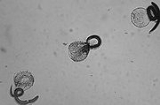
Baylisascaris

Encyclopedia
Baylisascaris is a genus
of roundworms that infest more than fifty animal species
.
and become active within a month. They can remain viable in the environment for years, withstanding heat and cold. According to University of California, Davis, and the Santa Barbara County Public Health Department, animals become infested either by:
e hatch in the intestine
and invade the intestinal wall. If they are in their definitive host they develop for several weeks, then enter the intestinal lumen, mature, mate, and produce eggs, which are carried out in the fecal stream. If the larvae are in a paratenic
host, they break into the bloodstream and enter various organs, particularly the central nervous system.
A great deal of damage occurs wherever the larva tries to make a home. In response to the attack, the body attempts to destroy it by walling it off or killing it. The larva moves rapidly to escape, seeking out the liver, eyes, spinal cord or brain. Occasionally they can be found in the heart, lungs, and other organs. Eventually the larva dies and is reabsorbed by the body. In very small species such as mice, it might take only one or two larvae in the brain to be fatal. If the larva does not cause significant damage in vital organs then the victim will show no signs of disease. On the other hand, if it causes behavioral changes by destroying parts of the brain, the host becomes easier prey, bringing the larva into the intestine of a new host.
Baylisascaris species include:
Baylisascaris procyonis
Baylisascaris procyonis
, the raccoon parasite, is related to the canine roundworm Toxocara canis
. It is found in the intestines of raccoon
s in North America, Japan and Germany. It infests 68 to 82% of some raccoon populations, according to the House Rabbit Society. This parasite can be extremely harmful or deadly to humans.
Baylisascaris columnaris is not as prevalent as B. procyonis.
Baylisascaris are highly resistant to decontamination procedures because of their dense cell walls and sticky surface. They can survive hot or freezing weather and certain chemicals, remaining viable for several years. Rats are a known vector, and rat droppings may deposit the eggs into the carpets and interiors of homes.
Bleach can prevent the eggs from sticking, but will not ensure destruction. According to Parasitism in Companion Animals by Olympic Veterinary Hospital, hand washing is an important countermeasure against ingestion, and decontamination of other surfaces is accomplished by thoroughly flaming with a propane torch or treating with lye
. According to Bolek, other forms of high heat such as boiling water or steam will accomplish the same result. Children are more likely to be infected than adults because of their tendency to pica
, particularly geophagy
(eating dirt).
Genus
In biology, a genus is a low-level taxonomic rank used in the biological classification of living and fossil organisms, which is an example of definition by genus and differentia...
of roundworms that infest more than fifty animal species
Species
In biology, a species is one of the basic units of biological classification and a taxonomic rank. A species is often defined as a group of organisms capable of interbreeding and producing fertile offspring. While in many cases this definition is adequate, more precise or differing measures are...
.
Life cycle
Baylisascaris eggs are passed in fecesFeces
Feces, faeces, or fæces is a waste product from an animal's digestive tract expelled through the anus or cloaca during defecation.-Etymology:...
and become active within a month. They can remain viable in the environment for years, withstanding heat and cold. According to University of California, Davis, and the Santa Barbara County Public Health Department, animals become infested either by:
- Swallowing the eggs, or
- Eating another animal infested with Baylisascaris.
Disease progression
After an animal swallows the eggs, the microscopic larvaLarva
A larva is a distinct juvenile form many animals undergo before metamorphosis into adults. Animals with indirect development such as insects, amphibians, or cnidarians typically have a larval phase of their life cycle...
e hatch in the intestine
Intestine
In human anatomy, the intestine is the segment of the alimentary canal extending from the pyloric sphincter of the stomach to the anus and, in humans and other mammals, consists of two segments, the small intestine and the large intestine...
and invade the intestinal wall. If they are in their definitive host they develop for several weeks, then enter the intestinal lumen, mature, mate, and produce eggs, which are carried out in the fecal stream. If the larvae are in a paratenic
Paratenic
In parasitology, the term paratenic describes a host which is not needed for the development of the parasite, but nonetheless serves to maintain the life cycle of the parasite. Alaria americana may serve as an example: the so-called mesocercarial stages of this parasite reside in tadpoles, which...
host, they break into the bloodstream and enter various organs, particularly the central nervous system.
A great deal of damage occurs wherever the larva tries to make a home. In response to the attack, the body attempts to destroy it by walling it off or killing it. The larva moves rapidly to escape, seeking out the liver, eyes, spinal cord or brain. Occasionally they can be found in the heart, lungs, and other organs. Eventually the larva dies and is reabsorbed by the body. In very small species such as mice, it might take only one or two larvae in the brain to be fatal. If the larva does not cause significant damage in vital organs then the victim will show no signs of disease. On the other hand, if it causes behavioral changes by destroying parts of the brain, the host becomes easier prey, bringing the larva into the intestine of a new host.
Clinical signs in humans
- Skin irritations from larvae migrating within the skin.
- Respiratory discomfort, liver enlargement, and fever due to reaction to larvae migration.
- Eye and brain tissue damage due to the random migration of the larvae.
- Nausea, a lethargic feeling, incoordination and loss of eyesight.
- Severe neurological signs including imbalance, circling and abnormal behavior, caused by extensive tissue damage due to larval migration through the brain, eventually seizures and coma.
Treatment
While worming can rid the intestine of adult Baylisascaris, no treatment has been shown to alleviate illness caused by migrating larvae. Despite lack of larvicidal effects, albendazole (20–40 mg/kg/d for 1–4 weeks) has been used to treat many cases.Baylisascaris species
Each Baylisascaris species has a host species that it uses to reproduce. The eggs appear in the host species' feces. They can then be ingested by, and infest, a variety of other animals (including humans) that serve as paratenic hosts.Baylisascaris species include:
- Baylisascaris procyonisBaylisascaris procyonisBaylisascaris procyonis is a roundworm nematode, found ubiquitously in raccoons, its larvae migrating in the intermediate hosts causing visceral larva migrans . Baylisascariasis as the zoonotic infection of humans is rare, though extremely dangerous due to the ability of the parasite's larvae to...
(of raccoonRaccoonProcyon is a genus of nocturnal mammals, comprising three species commonly known as raccoons, in the family Procyonidae. The most familiar species, the common raccoon , is often known simply as "the" raccoon, as the two other raccoon species in the genus are native only to the tropics and are...
s) - Baylisascaris melis (of European badgers)
- Baylisascaris transfuga (of bearBearBears are mammals of the family Ursidae. Bears are classified as caniforms, or doglike carnivorans, with the pinnipeds being their closest living relatives. Although there are only eight living species of bear, they are widespread, appearing in a wide variety of habitats throughout the Northern...
s) - Baylisascaris columnaris (of skunkSkunkSkunks are mammals best known for their ability to secrete a liquid with a strong, foul odor. General appearance varies from species to species, from black-and-white to brown or cream colored. Skunks belong to the family Mephitidae and to the order Carnivora...
s) and American badgerAmerican BadgerThe American badger is a North American badger, somewhat similar in appearance to the European badger. It is found in the western and central United States, northern Mexico and central Canada, as well as in certain areas of southwestern British Columbia.Their habitat is typified by open...
s) - Baylisascaris devosi (of fishers)Fisher (animal)The fisher is a medium-size mammal native to North America. It is a member of the mustelid family, commonly referred to as the weasel family. The fisher is closely related to but larger than the American Marten...
and martenMartenThe martens constitute the genus Martes within the subfamily Mustelinae, in family Mustelidae.-Description:Martens are slender, agile animals, adapted to living in taigas, and are found in coniferous and northern deciduous forests across the northern hemisphere. They have bushy tails, and large...
s) - Baylisascaris laevis (of marmotMarmotThe marmots are a genus, Marmota, of squirrels. There are 14 species in this genus.Marmots are generally large ground squirrels. Those most often referred to as marmots tend to live in mountainous areas such as the Alps, northern Apennines, Eurasian steppes, Carpathians, Tatras, and Pyrenees in...
s)
Baylisascaris procyonisBaylisascaris procyonisBaylisascaris procyonis is a roundworm nematode, found ubiquitously in raccoons, its larvae migrating in the intermediate hosts causing visceral larva migrans . Baylisascariasis as the zoonotic infection of humans is rare, though extremely dangerous due to the ability of the parasite's larvae to...
Baylisascaris procyonisBaylisascaris procyonis
Baylisascaris procyonis is a roundworm nematode, found ubiquitously in raccoons, its larvae migrating in the intermediate hosts causing visceral larva migrans . Baylisascariasis as the zoonotic infection of humans is rare, though extremely dangerous due to the ability of the parasite's larvae to...
, the raccoon parasite, is related to the canine roundworm Toxocara canis
Toxocariasis
-History of discovery:Werner described a parasitic nematode in dogs in 1782 which he named Ascaris canis. Johnston determined that what Werner had described was actually a member of the genus Toxocara established by Stiles in 1905. Fữlleborn speculated that T canis larvae might cause granulomatous...
. It is found in the intestines of raccoon
Raccoon
Procyon is a genus of nocturnal mammals, comprising three species commonly known as raccoons, in the family Procyonidae. The most familiar species, the common raccoon , is often known simply as "the" raccoon, as the two other raccoon species in the genus are native only to the tropics and are...
s in North America, Japan and Germany. It infests 68 to 82% of some raccoon populations, according to the House Rabbit Society. This parasite can be extremely harmful or deadly to humans.
Baylisascaris columnaris
Skunks carry Baylisascaris columnaris, a similar species to B. procyonis. Many pet skunks have died from this parasite. According to several skunk experts and Information on Parasites in Skunks by Matt Bolek, Diagnostic Parasitologist, many baby skunks from skunk farms have B. columnaris present in their bodies. The exact proportion of new skunks that are infested is unknown. Since the worms are often at too early a stage in development to begin shedding eggs into the feces, a fecal test may not detect the parasite, and the pet should be pre-emptively treated with wormers (See Pet skunk).Baylisascaris columnaris is not as prevalent as B. procyonis.
Disease prevention
Careful decontamination procedures need to be performed after contact with animal feces. Baylisascaris eggs can enter the digestive tract of a person who, for instance, removes dung from his property and then eats without thoroughly washing his hands.Baylisascaris are highly resistant to decontamination procedures because of their dense cell walls and sticky surface. They can survive hot or freezing weather and certain chemicals, remaining viable for several years. Rats are a known vector, and rat droppings may deposit the eggs into the carpets and interiors of homes.
Bleach can prevent the eggs from sticking, but will not ensure destruction. According to Parasitism in Companion Animals by Olympic Veterinary Hospital, hand washing is an important countermeasure against ingestion, and decontamination of other surfaces is accomplished by thoroughly flaming with a propane torch or treating with lye
Lye
Lye is a corrosive alkaline substance, commonly sodium hydroxide or historically potassium hydroxide . Previously, lye was among the many different alkalis leached from hardwood ashes...
. According to Bolek, other forms of high heat such as boiling water or steam will accomplish the same result. Children are more likely to be infected than adults because of their tendency to pica
Pica (disorder)
Pica is characterized by an appetite for substances largely non-nutritive . For these actions to be considered pica, they must persist for more than one month at an age where eating such objects is considered developmentally inappropriate...
, particularly geophagy
Geophagy
Geophagy is the practice of eating earthy or soil-like substances such as clay, and chalk. It exists in animals in the wild and also in humans, most often in rural or preindustrial societies among children and pregnant women...
(eating dirt).
External links
- Old Rabbit Paralysis Part III: Baylisascaris Procyonis House Rabbit Society
- Baylisascaris procyonis in Dogs, D. D. Bowman, Department of Microbiology & Immunology, College of Veterinary Medicine, Cornell University, Mar. 11, 2000.
- Information on Parasites in Skunks by Matt Bolek, Diagnostic Parasitologist (link via InternetArchive, as original page no longer valid).
- University of California, Davis, and the Santa Barbara County Public Health Department.
- Parasitism in Companion Animals by Olympic Veterinary Hospital.
- Raccoon Roundworm by University of Northern British Columbia.
- Deadly Dung, University of Wisconsin Board of Regents.
- Baylisascaris procyonis: An Emerging Helminthic Zoonosis, Centers for Disease Control.