

Battle of the Vistula River

Encyclopedia
The Battle of the Vistula River, also known as the Battle of Warsaw, was a Russian
victory against the German Empire
on the Eastern Front
during the First World War
.
was being driven from Galicia in the Battle of Galicia, the German industrial area of Upper Silesia, left undefended by German troops, was threatened with a Russian offensive into the heart of Germany. In order to counter the Russian preparations, as well as to support the shattered Austro-Hungarian Armies, Erich von Falkenhayn
, the German commander in chief, ordered the bulk of the German VIII. Army from Eastern Prussia
to be transferred into the area of Cracow for an offensive against the Russian centre around Warsaw
. The newly-formed German IX. Army, commanded by Paul von Hindenburg
, consisted of the XVII., XX., XI., Guard Reserve and Landwehr Corps, as well as a mixed Landwehr Division from Silesia and the Saxon 8th Cavalry Division. In early October, the Army was reinforced by the 35. Reserve Division from East Prussia. Thus, Hindenburg had at his disposal 12 Infantry and one Cavalry Divisions. The battle opened on 28 September by the Ninth Army
and was joined by 30 September by the Austro-Hungarian First Army.
The next day, his group was destroyed by the much superior enemy. The Central Powers captured 7,000 prisoners, only a few Russians managed to escape. The German troops lost only 571 men (Austrian casualties are not known).
, commander of the Russian Northwest Front, brought up significant reinforcement against the Ninth Army. At this time, Hindenburg learned of a planned Russian offensive into Silesia
from a captured Russian soldier. However, Hindenburg continued to push the offensive against Warsaw. The Germans were unfamiliar with the land and unable to bring sufficient reinforcements to the Ninth Army, therefore allowing Ruzsky to concentrate his front against Hindenburg. On 17 October, Hindenburg ordered a retreat, and by the 31st the battle was over.
, former commander of the XVII. Corps. Ten days later, Hindenburg made another attempt at Warsaw culminating in the Battle of Łódź. Superior numbers on the Eastern Front had given the Russian army the advantage in the fall of 1914.
Russian Empire
The Russian Empire was a state that existed from 1721 until the Russian Revolution of 1917. It was the successor to the Tsardom of Russia and the predecessor of the Soviet Union...
victory against the German Empire
German Empire
The German Empire refers to Germany during the "Second Reich" period from the unification of Germany and proclamation of Wilhelm I as German Emperor on 18 January 1871, to 1918, when it became a federal republic after defeat in World War I and the abdication of the Emperor, Wilhelm II.The German...
on the Eastern Front
Eastern Front (World War I)
The Eastern Front was a theatre of war during World War I in Central and, primarily, Eastern Europe. The term is in contrast to the Western Front. Despite the geographical separation, the events in the two theatres strongly influenced each other...
during the First World War
World War I
World War I , which was predominantly called the World War or the Great War from its occurrence until 1939, and the First World War or World War I thereafter, was a major war centred in Europe that began on 28 July 1914 and lasted until 11 November 1918...
.
Background
When the Austro-Hungarian ArmyAustro-Hungarian Army
The Austro-Hungarian Army was the ground force of the Austro-Hungarian Dual Monarchy from 1867 to 1918. It was composed of three parts: the joint army , the Austrian Landwehr , and the Hungarian Honvédség .In the wake of fighting between the...
was being driven from Galicia in the Battle of Galicia, the German industrial area of Upper Silesia, left undefended by German troops, was threatened with a Russian offensive into the heart of Germany. In order to counter the Russian preparations, as well as to support the shattered Austro-Hungarian Armies, Erich von Falkenhayn
Erich von Falkenhayn
Erich von Falkenhayn was a German soldier and Chief of the General Staff during World War I. He became a military writer after World War I.-Early life:...
, the German commander in chief, ordered the bulk of the German VIII. Army from Eastern Prussia
Prussia
Prussia was a German kingdom and historic state originating out of the Duchy of Prussia and the Margraviate of Brandenburg. For centuries, the House of Hohenzollern ruled Prussia, successfully expanding its size by way of an unusually well-organized and effective army. Prussia shaped the history...
to be transferred into the area of Cracow for an offensive against the Russian centre around Warsaw
Warsaw
Warsaw is the capital and largest city of Poland. It is located on the Vistula River, roughly from the Baltic Sea and from the Carpathian Mountains. Its population in 2010 was estimated at 1,716,855 residents with a greater metropolitan area of 2,631,902 residents, making Warsaw the 10th most...
. The newly-formed German IX. Army, commanded by Paul von Hindenburg
Paul von Hindenburg
Paul Ludwig Hans Anton von Beneckendorff und von Hindenburg , known universally as Paul von Hindenburg was a Prussian-German field marshal, statesman, and politician, and served as the second President of Germany from 1925 to 1934....
, consisted of the XVII., XX., XI., Guard Reserve and Landwehr Corps, as well as a mixed Landwehr Division from Silesia and the Saxon 8th Cavalry Division. In early October, the Army was reinforced by the 35. Reserve Division from East Prussia. Thus, Hindenburg had at his disposal 12 Infantry and one Cavalry Divisions. The battle opened on 28 September by the Ninth Army
German Ninth Army
The 9th Army was a World War II field army.The 9th Army was activated on May 15, 1940 with General Johannes Blaskowitz in command.-1940:The 9th Army first saw service along the Siegfried Line when it was involved in the invasion of France...
and was joined by 30 September by the Austro-Hungarian First Army.
Engagement of Opatów-Klimontów
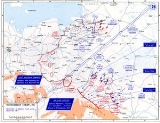
To guard the northward crossing of their 4th and 9th Armies over the Vistula, the Russian command deployed the 75. Reserve Division (IV. Army) at Radom, as well as the group General Delsalle, consisting of the Guard Rifle Brigade, 2nd Rifle Brigade and 80. Reserve Division, at Opatów-Klimontów. Both groups were screened by the Cavalry divisions of the Corps Nowikow. As Hindenburg suspected two to three corps in the area, he concentrated the German XI., Guard and Austro-Hungarian I. Corps against Delsalle's group. On 3 October, the 3rd and 7th Austrian Cavalry Divisions engaged the Guard cavalry Brigade, supported by Infantry from the 80. Reserve Division, at Klimontów, but were defeated and forced back. Thus, Hindenburg had no idea of how weak the forces opposing him were in reality. In response to the Austro-German threat, the Russians were ordered to retreat on their own. While Nowikow's cavalry obeyed the order, General Delsalle believed that he would be able to hold his position.The next day, his group was destroyed by the much superior enemy. The Central Powers captured 7,000 prisoners, only a few Russians managed to escape. The German troops lost only 571 men (Austrian casualties are not known).
Battle
Hindenburg reached the Vistula River by 9 October and was only 19 km (11.8 mi) away from Warsaw; here, the German offensive began to falter. General Nikolai RuzskyNikolai Ruzsky
Nikolai Vladimirovich Ruzsky , was a Russian general of World War I.Career=His military career prior to the outbreak of World War I in August 1914 took him to both the Russo-Turkish War and the Russo-Japanese War, where he was Chief of Staff to the Second Manchurian Army. In between he served as...
, commander of the Russian Northwest Front, brought up significant reinforcement against the Ninth Army. At this time, Hindenburg learned of a planned Russian offensive into Silesia
Silesia
Silesia is a historical region of Central Europe located mostly in Poland, with smaller parts also in the Czech Republic, and Germany.Silesia is rich in mineral and natural resources, and includes several important industrial areas. Silesia's largest city and historical capital is Wrocław...
from a captured Russian soldier. However, Hindenburg continued to push the offensive against Warsaw. The Germans were unfamiliar with the land and unable to bring sufficient reinforcements to the Ninth Army, therefore allowing Ruzsky to concentrate his front against Hindenburg. On 17 October, Hindenburg ordered a retreat, and by the 31st the battle was over.
Results
On 1 November, the Ninth Army was back where it had begun, with the loss of 21,350 soldiers, while the First Army had lost 50,000 soldiers. The Russians had lost 15,000 dead and 50,000 wounded. This was the first of a series of attempts by the Germans to capture Warsaw. After the battle, Colonel General Hindenburg was appointed commander of the whole Eastern front. The IX. Army was taken over by General August von MackensenAugust von Mackensen
Anton Ludwig August von Mackensen , born August Mackensen, was a German soldier and field marshal. He commanded with success during the First World War and became one of the German Empire's most prominent military leaders. After the Armistice, Mackensen was interned for a year...
, former commander of the XVII. Corps. Ten days later, Hindenburg made another attempt at Warsaw culminating in the Battle of Łódź. Superior numbers on the Eastern Front had given the Russian army the advantage in the fall of 1914.
Russian forces
Russian South-Western front. Commander-in-chief – Nikolai Ivanov- 2nd Army. Commander - Scheidemann
- I. Corps
- II. Corps
- IV. Corps
- XXIII. Corps
- I. Siberian Corps
- II. Siberian Corps
- XXVII. Corps
- 4th Army. Commander - Alexei EvertAlexei EvertAlexei Evert was a Russian Imperial General in World War I, notable for his role as commander of the Russian Western Army Group in the Brusilov Offensive....
- Grenadier Corps
- III. Caucasian Corps
- XVI. Corps
- Cavalry Corps Nowikow
- 9th Army. Commander - Leschitzky
- Guard Corps
- XVIII. Corps
- XIV. Corps
- 5th Army. Commander - Pavel PlehvePavel PlehvePavel von Plehve , a German officer, served exclusively in the Russian Army during World War I.- Military career :After graduation from officers cavalry school Plehve served in uhlan regiment. In 1877 he graduated from the General Staff Academy...
- XVII. Corps
- XXV. Corps
- V. Corps
Austro-German Forces
- 9th Army. Commander - Paul von HindenburgPaul von HindenburgPaul Ludwig Hans Anton von Beneckendorff und von Hindenburg , known universally as Paul von Hindenburg was a Prussian-German field marshal, statesman, and politician, and served as the second President of Germany from 1925 to 1934....
- XVII. Corps
- XX. Corps
- Guard Reserve Corps
- XI. Corps
- Landwehr Corps Woyrsh
- Cavalry Corps Frommel
- 1st Army. Commander - Viktor Dankl
- I. Corps
- V. Corps
- X. Corps