
All Topics  
Battle of Valcour Island

 
Battle of Valcour Island

   Email Print
   Bookmark   Link


Battle of Valcour Island


The naval Battle of Valcour Island, also known as the Battle of Valcour Bay, took place on October 11, 1776, on Lake Champlain
Lake Champlain

Lake Champlain is a natural, freshwater lake in North America, located mainly within the borders of the United States but partially situated across the Canada ? United States border in the Canadian province of Quebec....
 in a narrow strait between the New York
New York

The State of New York is a U.S. state in the Mid-Atlantic States and Northeastern United States regions of the United States and is the nation's List of U.S....
 mainland and Valcour Island
Valcour Island

Valcour Island is an island in Lake Champlain in Clinton County, New York, USA. The island is mostly in the Peru, New York and partly in the Plattsburgh , New York, southeast of the Plattsburgh , New York....
 during the American Revolutionary War
American Revolutionary War

The American Revolutionary War , also known as the American War of Independence, began as a war between the Kingdom of Great Britain and Thirteen Colonies on the North America, and ended in a global war between several European great powers....
. It is generally regarded as the first naval battle
Naval battle

A naval battle is a battle fought using ships or other waterborne vessels. Most naval battles have occurred at sea, but a few have taken place on lakes or rivers....
 fought by the United States Navy
United States Navy

The United States Navy is the navy of the United States Armed Forces. It is one of the seven uniformed services of the United States. The U.S. Navy currently has approximately 331,682 personnel on active duty as of 31 December 2008 and 124,000 in the United States Navy Reserve....
. Although most of the ships in the American fleet under the command of Benedict Arnold
Benedict Arnold

Benedict Arnold V was a General officer during the American Revolutionary War who originally fought for the American Continental Army, but switched sides to the British Empire....
 were captured or destroyed, the American defense of Lake Champlain delayed by one year the British
Kingdom of Great Britain

The Kingdom of Great Britain, also known as the United Kingdom of Great Britain, was a country in North-West Europe, in existence from 1707 to 1801....
 attempt to divide the colonies in half by gaining control of the upper Hudson River
Hudson River

The Hudson River, called Muh-he-kun-ne-tuk , the Great Mohegan by the Iroquois, or as the Lenape Native Americans called it in Unami, Muhheakantuck, is a river that flows from north to south through eastern New York....
 Valley.

The Continental Army
Continental Army

The American Continental Army was an army formed after the outbreak of the American Revolutionary War by the colonies that became the United States. Established by a resolution of the Continental Congress on June 15, 1775, the army was created to coordinate the military efforts of the Thirteen Colonies in their struggle against the rule of Kingdom...
, which had retreated from Quebec
Province of Quebec (1763-1791)

The Province of Quebec was a colony in North America created by Kingdom of Great Britain after the Seven Years' War. Great Britain acquired Canada, New France by the Treaty of Paris when King Louis XV of France of France and his advisors chose to keep the territory of Guadeloupe for its valuable sugar crops instead of New France....
 to Fort Ticonderoga
Fort Ticonderoga

Fort Ticonderoga is a large eighteenth-century fort built at a narrows at the south end of Lake Champlain where a short traverse gives access to the north end of Lake George in the state of New York....
 and Fort Crown Point
Fort Crown Point

His Majesty's Fort of Crown Point or more simply Crown Point was a Kingdom of Great Britain fort built in 1759 on Lake Champlain to secure the region against the French....
 in June 1776, spent the summer of 1776 fortifying those forts, and building additional ships to augment its small fleet already on the lake.


Discussion
Ask a question about 'Battle of Valcour Island'
Start a new discussion about 'Battle of Valcour Island'
Answer questions from other users
Full Discussion Forum


Recent Posts


Encyclopedia


The naval Battle of Valcour Island, also known as the Battle of Valcour Bay, took place on October 11, 1776, on Lake Champlain
Lake Champlain

Lake Champlain is a natural, freshwater lake in North America, located mainly within the borders of the United States but partially situated across the Canada ? United States border in the Canadian province of Quebec....
 in a narrow strait between the New York
New York

The State of New York is a U.S. state in the Mid-Atlantic States and Northeastern United States regions of the United States and is the nation's List of U.S....
 mainland and Valcour Island
Valcour Island

Valcour Island is an island in Lake Champlain in Clinton County, New York, USA. The island is mostly in the Peru, New York and partly in the Plattsburgh , New York, southeast of the Plattsburgh , New York....
 during the American Revolutionary War
American Revolutionary War

The American Revolutionary War , also known as the American War of Independence, began as a war between the Kingdom of Great Britain and Thirteen Colonies on the North America, and ended in a global war between several European great powers....
. It is generally regarded as the first naval battle
Naval battle

A naval battle is a battle fought using ships or other waterborne vessels. Most naval battles have occurred at sea, but a few have taken place on lakes or rivers....
 fought by the United States Navy
United States Navy

The United States Navy is the navy of the United States Armed Forces. It is one of the seven uniformed services of the United States. The U.S. Navy currently has approximately 331,682 personnel on active duty as of 31 December 2008 and 124,000 in the United States Navy Reserve....
. Although most of the ships in the American fleet under the command of Benedict Arnold
Benedict Arnold

Benedict Arnold V was a General officer during the American Revolutionary War who originally fought for the American Continental Army, but switched sides to the British Empire....
 were captured or destroyed, the American defense of Lake Champlain delayed by one year the British
Kingdom of Great Britain

The Kingdom of Great Britain, also known as the United Kingdom of Great Britain, was a country in North-West Europe, in existence from 1707 to 1801....
 attempt to divide the colonies in half by gaining control of the upper Hudson River
Hudson River

The Hudson River, called Muh-he-kun-ne-tuk , the Great Mohegan by the Iroquois, or as the Lenape Native Americans called it in Unami, Muhheakantuck, is a river that flows from north to south through eastern New York....
 Valley.

The Continental Army
Continental Army

The American Continental Army was an army formed after the outbreak of the American Revolutionary War by the colonies that became the United States. Established by a resolution of the Continental Congress on June 15, 1775, the army was created to coordinate the military efforts of the Thirteen Colonies in their struggle against the rule of Kingdom...
, which had retreated from Quebec
Province of Quebec (1763-1791)

The Province of Quebec was a colony in North America created by Kingdom of Great Britain after the Seven Years' War. Great Britain acquired Canada, New France by the Treaty of Paris when King Louis XV of France of France and his advisors chose to keep the territory of Guadeloupe for its valuable sugar crops instead of New France....
 to Fort Ticonderoga
Fort Ticonderoga

Fort Ticonderoga is a large eighteenth-century fort built at a narrows at the south end of Lake Champlain where a short traverse gives access to the north end of Lake George in the state of New York....
 and Fort Crown Point
Fort Crown Point

His Majesty's Fort of Crown Point or more simply Crown Point was a Kingdom of Great Britain fort built in 1759 on Lake Champlain to secure the region against the French....
 in June 1776, spent the summer of 1776 fortifying those forts, and building additional ships to augment its small fleet already on the lake. The British, who had a 9,000 man army at Fort Saint-Jean
Fort Saint-Jean (Quebec)

Fort Saint-Jean is a fortification in Quebec, built from 1666 to 1775. It is one of the oldest permanent military facilities in North America....
, needed to build a fleet to carry it, as the American retreat had taken or destroyed most of the ships on the lake. By early October, the British fleet, which significantly outgunned the American fleet, was ready for launch.

After being drawn to Arnold's carefully-chosen battle position on October 11, the battle was engaged. Many of the American ships were damaged or destroyed in the battle that day, which ended with the fleets still facing each other. That night, Arnold, in a bold move, snuck the American fleet past the British one, and began a retreat toward Crown Point and Ticonderoga. Unfavorable weather hampered the American retreat, and some of the fleet was captured, or grounded and burned, before it reached Crown Point. More of the fleet was destroyed when Arnold decided he could not hold Crown Point, and retreated back to Ticonderoga.

The British forces included four officers who went on to become admirals in the Royal Navy
Royal Navy

The Royal Navy of the United Kingdom is the oldest of the British Armed Forces . From the mid-18th century until well into the 20th century, it was the most powerful navy in the world, playing a key part in establishing the British Empire as the dominant world power from 1815 until the early 1940s....
: Thomas Pringle
Thomas Pringle (admiral)

Thomas Pringle was an Admiral in the Royal Navy. Pringle was born in New London, Connecticut in 1736. He became a Commondore in 1776 just before the Battle of Valcour Island....
, James Dacres
James Richard Dacres (1749–1810)

James Richard Dacres was an officer of the Royal Navy who saw service during the Seven Years' War, the American Revolutionary War and the French Revolutionary War and Napoleonic Wars....
, Edward Pellew
Edward Pellew, 1st Viscount Exmouth

Admiral Edward Pellew, 1st Viscount Exmouth, Order of the Bath was a United Kingdom naval officer. He fought during the American War of Independence, the French Revolutionary Wars, and the Napoleonic wars Wars....
 and John Schank
John Schank

Admiral John Schank, , was a member of the British Royal Navy until his death. He was the son of Alexander Schank of Castlerigg, Fife, Scotland....
. Valcour Bay
Valcour Bay

Valcour Bay is a strait between Valcour Island and the west side of Lake Champlain, four miles south of Plattsburgh, New York. It was the site of the Battle of Valcour Island during the American Revolutionary War....
, the site of the battle, is now a National Historic Landmark
National Historic Landmark

A National Historic Landmark is a building, :wiktionary:site, structure, object, or district, that is officially recognized by the Federal government of the United States for its historical significance....
, as is the USS Philadelphia
USS Philadelphia (1776)

Continental gunboat Philadelphia is the only surviving gunboat built and manned by American Forces during the Revolutionary War. Part of a hastily constructed fleet, she is one of 15 small craft with which Benedict Arnold fought 29 British vessels off Valcour Island in Lake Champlain in October 1776....
, which sank shortly after the October 11 battle, and was raised in 1935.

Strategic importance of Lake Champlain

Following the failed American invasion of Canada
Invasion of Canada (1775)

The Invasion of Canada in 1775 was the first major military initiative by colonial separatist forces during the American Revolutionary War. One expedition left Fort Ticonderoga under Richard Montgomery, besieged and captured Fort Saint-Jean , and very nearly captured British General Guy Carleton, 1st Baron Dorchester when taking Montreal....
 in 1775, the British launched a counteroffensive intended to gain control of the Hudson River
Hudson River

The Hudson River, called Muh-he-kun-ne-tuk , the Great Mohegan by the Iroquois, or as the Lenape Native Americans called it in Unami, Muhheakantuck, is a river that flows from north to south through eastern New York....
 Valley, which extends southward not far from Lake Champlain. Control of the upper Hudson would have enabled the British to link their Canadian forces with those in British-occupied New York City, dividing the American colonies of New England from those in the South and Mid-Atlantic and potentially quashing the revolution. Lake Champlain is connected to Lake George
Lake George (New York)

Lake George, nicknamed the Queen of American Lakes, is a long, narrow lake at the southeast base of the Adirondack Mountains, northern New York, United States The lake extends about 32.2 miles on a north-south axis and varies from 1 to 3 miles in width....
, which has its southern end near the Hudson River.

Access to the river's source was protected by the American strongholds of Fort Crown Point
Fort Crown Point

His Majesty's Fort of Crown Point or more simply Crown Point was a Kingdom of Great Britain fort built in 1759 on Lake Champlain to secure the region against the French....
 and Fort Ticonderoga
Fort Ticonderoga

Fort Ticonderoga is a large eighteenth-century fort built at a narrows at the south end of Lake Champlain where a short traverse gives access to the north end of Lake George in the state of New York....
, and elimination of these defenses required the transportation of troops and supplies from the British-controlled St. Lawrence Valley 90 miles (150 km) to the north. Roads were either impassable or nonexistent, making water transport over Lake Champlain the only viable option. The only ships on the lake following the American retreat from Quebec were a small fleet of lightly armed ships that Benedict Arnold had assembled following the capture of Fort Ticonderoga
Capture of Fort Ticonderoga

On May 10, 1775, Fort Ticonderoga was captured by a small force of American Patriot s led by Ethan Allen and Colonel Benedict Arnold. They surprised and captured, without significant injury or incident, the small Kingdom of Great Britain garrison at Fort Ticonderoga, and looted the personal belongings of the garrison and its hangers-on....
 in May 1775. This fleet, even if it had been in British hands, was inadequate to the needs of transporting the British forces down the lake to Fort Ticonderoga.

Shipbuilding

During the American army's retreat from Quebec, they were very careful to deny the British any ships that might prove useful on Lake Champlain. When Arnold and his forces, which made up the rear of the army, abandoned Fort Saint-Jean
Fort Saint-Jean (Quebec)

Fort Saint-Jean is a fortification in Quebec, built from 1666 to 1775. It is one of the oldest permanent military facilities in North America....
, they burned or sank all the boats they could not use, and set fire to the sawmill and the fort. These tactics effectively denied the British any hope of immediately moving onto the lake.

The two sides therefore set about building fleets; the British at Saint-Jean
Saint-Jean-sur-Richelieu, Quebec

Saint-Jean-sur-Richelieu is a city in the province of Quebec, Canada about southeast of Montreal. It is situated on the west bank of the Richelieu River at the northernmost navigable point of Lake Champlain....
 in Quebec
Province of Quebec (1763-1791)

The Province of Quebec was a colony in North America created by Kingdom of Great Britain after the Seven Years' War. Great Britain acquired Canada, New France by the Treaty of Paris when King Louis XV of France of France and his advisors chose to keep the territory of Guadeloupe for its valuable sugar crops instead of New France....
 and the Americans at the other end of the lake in Skenesborough
Whitehall (village), New York

Whitehall is a village located in the Whitehall , New York in Washington County, New York, United States. It is part of the Glens Falls, New York Glens Falls metropolitan area....
. The British commander, General Guy Carleton
Guy Carleton, 1st Baron Dorchester

Guy Carleton, 1st Baron Dorchester, Order of the Bath , known between 1776 and 1786 as Sir Guy Carleton, was an Ireland-Great Britain soldier who twice served as Governor of the Province of Quebec , from 1768–1778 , and from 1785–1795....
, had, in planning Quebec's defenses in 1775, anticipated the problem of shipping on Lake Champlain, and had requested the provisioning of prefabricated ships. By the time Carleton's army reached St. John, ten such ships had arrived. Those ships and more were assembled by skilled shipwrights on the upper Richelieu River
Richelieu River

The Richelieu River is a river in Quebec, Canada. It flows from Lake Champlain about 171 km north, ending into the St. Lawrence River at Sorel....
, as was HMS , a 180-ton warship they disassembled and rebuilt on the lake. All told, the British fleet (25 armed vessels) had more firepower than the Americans' 15 vessels, with more than 80 guns outweighing the 74 smaller American guns. Two of Carleton's ships, the Inflexible and the Thunderer, carried enough firepower (Thunderer carried six 24-pound guns, six 12-pound guns, and two howitzers, while Inflexible carried 18 12-pounders) to threaten the entirety of Arnold's fleet by themselves.

Forces assembled

Benedict Arnold's flagship during his patrols of the Lake was the Royal Savage, a two-masted schooner
Schooner

A schooner is a type of sailing ship characterized by the use of fore-and-aft rig sails on two or more mast s. Schooners were first used by the Netherlands in the 16th or 17th century, and further developed in North America from the early 18th century onwards....
 carrying 12 guns, commanded by Captain David Hawley. When it came time for the battle, he transferred to the Congress, a row galley. Arnold's fleet included Revenge
USS Revenge (1776)

The first USS Revenge was a schooner in the Continental Navy. Revenge was built in the summer of 1776 by Colonel Jeduthan Baldwin at Fort Ticonderoga, New York....
 and Liberty
USS Liberty (1775)

The first U.S. Navy Liberty was a schooner built at Skenesboro Named Liberty to honor the patriot cause, it sailed via Fort Ticonderoga and Crown Point toward St....
, also two-masted schooners carrying 8 guns, as well as the Enterprise
USS Enterprise (1775)

Enterprise was a Continental Navy sloop-of-war that served in Lake Champlain during the American Revolutionary War. She is the first of a long and prestigious line of United States Navy ships to bear the name USS Enterprise....
, a sloop
Sloop

A sloop is a sailboat with a fore-and-aft rig and a single mast farther forward than the mast of a cutter . A sloop's fore-triangle is smaller than a cutter's, and a sloop usually bends only one headsail, though this distinction is not definitive....
 (12 guns), and 8 gunboats (each with three guns): New Haven
USS New Haven (1776)

The first USS New Haven was a gondola built in 1776 on Lake Champlain, Capt. Mansfield in command, under General Benedict Arnold, who actually resided in the ship's namesake city for a time....
, , Boston
USS Boston

Seven ships of the United States Navy have borne the name Boston, in honor of the city of Boston, Massachusetts.* The , was a gondola launched in 1776 and was burned to avoid capture by the British on 13 October 1776....
, Spitfire
USS Spitfire (1776 gunboat)

The USS Spitfire was an American gunboat that operated in 1776 on Lake Champlain. She was part of Benedict Arnold's small, hastily-built fleet of ships whose purpose was to counter any British invasion forces passing through the lake from Canada....
, Philadelphia
USS Philadelphia (1776)

Continental gunboat Philadelphia is the only surviving gunboat built and manned by American Forces during the Revolutionary War. Part of a hastily constructed fleet, she is one of 15 small craft with which Benedict Arnold fought 29 British vessels off Valcour Island in Lake Champlain in October 1776....
, Connecticut, Jersey, New York, the cutter
Cutter

When used in a nautical sense, a cutter is:# a small single-masted vessel, fore-and-aft rigged, with two or more headsails, a bowsprit, and a mast set further back than in a sloop...
 Lee, and the galley Trumbull
USS Trumbull (1776)

The second Trumbull ? one of the 13 frigates authorized by the Continental Congress on 13 December 1775 ? was probably laid down in March or April 1776 at Chatham, Connecticut, by John Cotton and was launched on 5 September 1776....
.

Facing them were the ships of the Royal Navy
Royal Navy

The Royal Navy of the United Kingdom is the oldest of the British Armed Forces . From the mid-18th century until well into the 20th century, it was the most powerful navy in the world, playing a key part in establishing the British Empire as the dominant world power from 1815 until the early 1940s....
 constructed in Quebec under the direction of Captain Charles Douglas: The flagship Inflexible (18 guns), the schooner
Schooner

A schooner is a type of sailing ship characterized by the use of fore-and-aft rig sails on two or more mast s. Schooners were first used by the Netherlands in the 16th or 17th century, and further developed in North America from the early 18th century onwards....
s Maria (14 guns), Carleton (12 guns), Loyal Convert (called in some histories the Royal Convert or Loyal Consort) (6 guns), the 14-gun two-masted ketch
Ketch

A ketch is a sailing craft with two Mast : a main mast, and a shorter mizzen mast abaft of the main mast, but forward of the rudder. Both masts are rigged mainly Fore-and-aft rig....
-radeau Thunderer (very roughly, a raft that has been rigged as a ketch), as well as about 20 single-masted gunboats each armed with two cannons.

Arnold patrols the lake

Ships from Arnold's fleet patrolled the waters of Lake Champlain throughout the summer, as the British were busy building their fleet at Fort Saint-Jean. At one point he cruised part of the fleet to the far northern end of the lake, within twenty miles of Saint-Jean, and formed a battle line. A British outpost that was well out of range fired a few shots at the line, without effect. On September 30, expecting the British to sail soon, he retreated to the shelter of Valcour Island
Valcour Island

Valcour Island is an island in Lake Champlain in Clinton County, New York, USA. The island is mostly in the Peru, New York and partly in the Plattsburgh , New York, southeast of the Plattsburgh , New York....
.

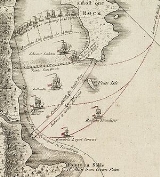
Arnold, whose business interests before the war had included sailing ships to Europe and the West Indies, carefully chose the site at which to meet the British fleet. He wanted to force the British to attack his inferior forces in a narrow, rocky body of water between the western shore of Lake Champlain and Valcour Island, where the British fleet would have difficulty bringing its superior firepower to bear, and where the inferior seamanship of his unskilled sailors would have a minimal effect. Some of Arnold's captains wanted to fight in open waters, where they might be able to retreat to the shelter of Fort Crown Point, but Arnold argued that the purpose of the fleet was not to preserve itself, but to delay the British advance on Crown Point and Ticonderoga.

Battle


On October 9, Carleton's fleet, commanded by Captain Thomas Pringle
Thomas Pringle (admiral)

Thomas Pringle was an Admiral in the Royal Navy. Pringle was born in New London, Connecticut in 1736. He became a Commondore in 1776 just before the Battle of Valcour Island....
, which included 50 unarmed support vessels, sailed onto Lake Champlain. Moving cautiously, it advanced up the lake to the south, searching for signs of Arnold's fleet. On the night of October 10, the fleet anchored about 15 miles to the north of Arnold's position, still unaware of his location. The next day, they continued to sail south, assisted by favorable winds. After they passed the northern tip of Valcour Island, Arnold sent out Congress and Royal Savage to draw the attention of the British. Following an exchange of fire that was more like a challenge than a threat, Arnold attempted to withdraw the two ships into his crescent-shaped firing line. Unfortunately, the Royal Savage was unable to fight the headwinds, and ran aground on the southern tip of Valcour Island. Some of the British gunboats swarmed toward her, as Captain Hawley and his men hastily abandoned ship. British men from the Loyal Convert boarded her, capturing 20 men in the process, but were then forced to abandon her under heavy fire from the Americans. Many of Arnold's papers were lost due to the destruction of the Royal Savage, which was later burned by the British.

The British gunboats and the Carleton then maneuvered within range of the American line; Thunderer and Maria were unable to make headway against the winds, and did not participate in the battle, while Inflexible eventually came up far enough the strait to participate in the action. Around 12:30, the battle began in earnest, with both sides firing broadsides and cannonades at each other. The action continued all afternoon. Revenge was heavily hit; Philadelphia was also heavily hit and eventually sank around 6:30 p.m. Carleton, whose guns wreaked havoc against the smaller American gunboats, became a focus of attention. A lucky shot eventually snapped the line holding her broadside in position; eight men were killed and another eight wounded, and she was seriously damaged, before she could be towed out of range of the American line. The young Edward Pellew
Edward Pellew, 1st Viscount Exmouth

Admiral Edward Pellew, 1st Viscount Exmouth, Order of the Bath was a United Kingdom naval officer. He fought during the American War of Independence, the French Revolutionary Wars, and the Napoleonic wars Wars....
, serving as a midshipman aboard Carleton, distinguished himself by ably commanding the vessel to safety when its senior officers, including its captain, Lieutenant James Dacres
James Richard Dacres (1749–1810)

James Richard Dacres was an officer of the Royal Navy who saw service during the Seven Years' War, the American Revolutionary War and the French Revolutionary War and Napoleonic Wars....
, were injured. Another lucky shot hit a British gunboat's magazine, exploding the entire vessel.

Toward sunset the Inflexible finally reached the action. Her big guns silenced much of Arnold's fleet. The British also began landing Indians on both Valcour Island and the lakeshore, in order to deny the Americans the possibility of retreat to land. As darkness fell, the American fleet retreated, and the British called off the attack, in part because some boats had run out of ammunition. Lieutenant James Hadden, commanding one of the British gunboats noted that "little more than 1/3 of the British Fleet" saw much action that day.

Retreat

The battle had clearly gone against the Americans when the sun set on October 11. Most of the American ships were damaged or sinking, and the crews reported around 60 casualties. The British reported around 40 casualties on their ships. Aware that he could not defeat the British fleet, Arnold decided to try reaching the cover of Fort Crown Point, about away. Arnold managed to sneak his fleet past the British fleet during the fortunately foggy night, reaching Schuyler Island
Schuyler Island

Schuyler Island, Schuyler[']s Island, or Whitney Island, is an island in Lake Champlain, between Port Kent, New York and Willsboro Bay, opposite Burlington, Vermont....
, about up the lake, by morning. Carleton, upset that the American fleet had escaped him, immediately sent the fleet around Valcour Island to locate it. As they weren't there, he regrouped the fleet and sent out scouts to find Arnold.

The American fleet's progress was slowed by adverse winds and leaking of the damaged boats. At Schuyler's, Providence, New York and New Jersey were sunk or burned, and crude repairs were effected to other vessels. The Lee was also abandoned on the New York shore, and the ship was eventually taken by the British. Around 2 PM, the fleet set off again, trying to make headway against biting winds, rain, and sleet. By the following morning, they were still more than from Crown Point, and the British fleet's masts were visible on the horizon. When the wind finally changed, the British had its advantage first, and began to close, opening fire on Congress and Washington, which were in the rear of the American fleet. Arnold first decided to attempt grounding the slower gunboats at Split Rock, short of Crown Point. The Washington, however, was too badly damaged and too slow to make it, and she was forced to surrender; 110 men were taken prisoner.

Arnold then boldly led the remaining ships through the British fleet and into Buttonmold Bay, where the waters were too shallow for the larger British vessels. There most of the small boats in the fleet were grounded, stripped, and set afire, with flags still flying. Arnold was the last to land, and personally torched Congress, his flagship. The surviving ships crews, numbering about 200, then made their way the remaining distance to Crown Point, narrowly escaping an Indian ambush. There they found the Trumbull, New York, Enterprise, and Revenge, which had escaped the British fleet, as well as Liberty, which, while not in the battle, had arrived with supplies for the fort from Ticonderoga.

Aftermath

Arnold, convinced that Crown Point was no longer viable as a point of defense against the large British force, destroyed and abandoned the fort, moving the forces stationed there to Ticonderoga. General Carleton, rather than ship his prisoners back to Quebec, returned them to Ticonderoga under a flag of truce. On their arrival, they were so effusive in their praise of Carleton that they were sent home to prevent desertion.

The British, with control of the lake, landed troops and occupied Crown Point the next day. They remained for two weeks, pushing scouting parties to within three miles of Ticonderoga. But the season was late, and his supply line would be difficult to manage in winter, so Carleton decided to withdraw to winter quarters. Baron Riedesel, commanding the Hessians in Carleton's army, noted that, "If we could have begun our expedition four weeks earlier, I am satisfied that everything could have ended this year."

Captain Pringle was criticized by some of his peers due to the American fleet's escape. The captains of Maria, Inflexible, and Loyal Convert, wrote a letter criticizing Pringle's failure to properly blockade the channel, and for not being more aggressive in his direction of the battle. The letter did not apparently cause any problems for Pringle; he (and John Schank
John Schank

Admiral John Schank, , was a member of the British Royal Navy until his death. He was the son of Alexander Schank of Castlerigg, Fife, Scotland....
, captain of the Inflexible) went on to become admirals, as did midshipman Pellew and Lieutenant Dacres.

On December 31, one year after the Battle of Quebec, a mass was held in celebration of the British success, and Carleton threw a grand ball. Carleton was knighted
Order of the Bath

The Most Honourable Order of the Bath is a United Kingdom order of chivalry founded by George I of Great Britain on 18 May 1725. The name derives from the medieval ceremony for creating a knight, which involved bathing as one of its elements....
 by King George III for his success at Valcour Bay.

Commemoration

The site of the battle, Valcour Bay
Valcour Bay

Valcour Bay is a strait between Valcour Island and the west side of Lake Champlain, four miles south of Plattsburgh, New York. It was the site of the Battle of Valcour Island during the American Revolutionary War....
, was declared a National Historic Landmark
National Historic Landmark

A National Historic Landmark is a building, :wiktionary:site, structure, object, or district, that is officially recognized by the Federal government of the United States for its historical significance....
 on January 1, 1961, and added to the National Register of Historic Places
National Register of Historic Places

The National Register of Historic Places is the United States government official list of districts, sites, buildings, structures, and objects deemed worthy of preservation....
 on October 15, 1966. The Philadelphia
USS Philadelphia (1776)

Continental gunboat Philadelphia is the only surviving gunboat built and manned by American Forces during the Revolutionary War. Part of a hastily constructed fleet, she is one of 15 small craft with which Benedict Arnold fought 29 British vessels off Valcour Island in Lake Champlain in October 1776....
, which sank shortly after the battle ended on October 11, was raised in 1935 and is on display at the Smithsonian Institution
Smithsonian Institution

The Smithsonian Institution is an educational and research institute and associated museum complex, administered and funded by the government of the United States and by funds from its Financial endowment, contributions, and profits from its shops and its magazine....
 in Washington, D.C. It received the same designations.

Citations


External links

  • from the National Park Service


  • of the
  • including pictures of underwater Revolutionary War artifacts