
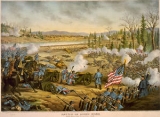
The
Battle of Stones River or
Second Battle of Murfreesboro (in the
SouthThe Southern United States—commonly referred to as the American South, Dixie, or simply the South—constitutes a large distinctive area in the southeastern and south-central United States...
, simply the
Battle of Murfreesboro), was fought from December 31, 1862, to January 2, 1863, in
Middle TennesseeMiddle Tennessee is a distinct portion of the state of Tennessee, delineated according to state law as the 41 counties in the Middle Grand Division of Tennessee....
, as the culmination of the
Stones River Campaign in the
Western TheaterThis article presents an overview of major military and naval operations in the Western Theater of the American Civil War.-Theater of operations:...
of the
American Civil WarThe American Civil War was a civil war fought in the United States of America. In response to the election of Abraham Lincoln as President of the United States, 11 southern slave states declared their secession from the United States and formed the Confederate States of America ; the other 25...
. Of the major battles of the Civil War, Stones River had the highest percentage of casualties on both sides. Although the battle itself was inconclusive, the
Union ArmyThe Union Army was the land force that fought for the Union during the American Civil War. It was also known as the Federal Army, the U.S. Army, the Northern Army and the National Army...
's repulse of two
ConfederateThe Confederate States Army was the army of the Confederate States of America while the Confederacy existed during the American Civil War. On February 8, 1861, delegates from the seven Deep South states which had already declared their secession from the United States of America adopted the...
attacks and the subsequent Confederate withdrawal were a much-needed boost to Union morale after the defeat at the
Battle of FredericksburgThe Battle of Fredericksburg was fought December 11–15, 1862, in and around Fredericksburg, Virginia, between General Robert E. Lee's Confederate Army of Northern Virginia and the Union Army of the Potomac, commanded by Maj. Gen. Ambrose E. Burnside...
, and it dashed Confederate aspirations for control of
Middle TennesseeMiddle Tennessee is a distinct portion of the state of Tennessee, delineated according to state law as the 41 counties in the Middle Grand Division of Tennessee....
.
Union
Maj. Gen.In the United States Army, United States Marine Corps, and United States Air Force, major general is a two-star general-officer rank, with the pay grade of O-8. Major general ranks above brigadier general and below lieutenant general...
William S. Rosecrans's
Army of the CumberlandThe Army of the Cumberland was one of the principal Union armies in the Western Theater during the American Civil War. It was originally known as the Army of the Ohio.-History:...
marched from
Nashville, TennesseeNashville is the capital of the U.S. state of Tennessee and the county seat of Davidson County. It is located on the Cumberland River in Davidson County, in the north-central part of the state. The city is a center for the health care, publishing, banking and transportation industries, and is home...
, on December 26, 1862, to challenge General
Braxton BraggBraxton Bragg was a career United States Army officer, and then a general in the Confederate States Army—a principal commander in the Western Theater of the American Civil War and later the military adviser to Confederate President Jefferson Davis.Bragg, a native of North Carolina, was...
's
Army of TennesseeThe Army of Tennessee was the principal Confederate army operating between the Appalachian Mountains and the Mississippi River during the American Civil War. It was formed in late 1862 and fought until the end of the war in 1865, participating in most of the significant battles in the Western Theater...
at
MurfreesboroMurfreesboro is a city in and the county seat of Rutherford County, Tennessee, United States. The population was 108,755 according to the United States Census Bureau's 2010 U.S. Census, up from 68,816 residents certified during the 2000 census. The center of population of Tennessee is located in...
. On December 31, each army commander planned to attack his opponent's right flank, but Bragg struck first. A massive assault by the corps of Maj. Gen.
William J. HardeeWilliam Joseph Hardee was a career U.S. Army officer, serving during the Second Seminole War and fighting in the Mexican-American War...
, followed by that of
Leonidas PolkLeonidas Polk was a Confederate general in the American Civil War who was once a planter in Maury County, Tennessee, and a second cousin of President James K. Polk...
, overran the wing commanded by Maj. Gen.
Alexander M. McCookAlexander McDowell McCook was a career United States Army officer and a Union general in the American Civil War.-Early life:...
. A stout defense by the division of Brig. Gen.
Philip SheridanPhilip Henry Sheridan was a career United States Army officer and a Union general in the American Civil War. His career was noted for his rapid rise to major general and his close association with Lt. Gen. Ulysses S...
in the right center of the line prevented a total collapse and the Union assumed a tight defensive position backing up to the Nashville Turnpike. Repeated Confederate attacks were repulsed from this concentrated line, most notably in the cedar "Round Forest" salient against the brigade of Col. William B. Hazen. Bragg attempted to continue the assault with the corps of Maj. Gen.
John C. BreckinridgeJohn Cabell Breckinridge was an American lawyer and politician. He served as a U.S. Representative and U.S. Senator from Kentucky and was the 14th Vice President of the United States , to date the youngest vice president in U.S...
, but the troops were slow in arriving and their multiple piecemeal attacks failed.
Fighting resumed on January 2, 1863, when Bragg ordered Breckinridge to assault the well-fortified Union position on a hill to the east of the Stones River. Faced with overwhelming artillery, the Confederates were repulsed with heavy losses. Aware that Rosecrans was receiving reinforcements, Bragg chose to withdraw his army on January 3 to
Tullahoma, Tennessee-Demographics:As of the census of 2010, there were 18,655 people, 7,717 households, and 5,161 families residing in the city. The racial makeup of the city was 88.1% White, 7.0% African American, 0.2% Native American, 1.2% Asian, 1.1% from other races, and 2.5% from two or more races...
.
Background and opposing forces
After the
Battle of PerryvilleThe Battle of Perryville, also known as the Battle of Chaplin Hills, was fought on October 8, 1862, in the Chaplin Hills west of Perryville, Kentucky, as the culmination of the Confederate Heartland Offensive during the American Civil War. Confederate Gen. Braxton Bragg's Army of Mississippi won a...
on October 8, 1862, Confederate Gen.
Braxton BraggBraxton Bragg was a career United States Army officer, and then a general in the Confederate States Army—a principal commander in the Western Theater of the American Civil War and later the military adviser to Confederate President Jefferson Davis.Bragg, a native of North Carolina, was...
's
Army of MississippiThere were three organizations known as the Army of Mississippi in the Confederate States Army during the American Civil War. -Army of Mississippi :This army, at times known by the names Army of the West or Army of the...
abandoned its invasion of
KentuckyThe Commonwealth of Kentucky is a state located in the East Central United States of America. As classified by the United States Census Bureau, Kentucky is a Southern state, more specifically in the East South Central region. Kentucky is one of four U.S. states constituted as a commonwealth...
and withdrew to
Harrodsburg, KentuckyHarrodsburg is a city in and the county seat of Mercer County, Kentucky, United States. The population was 8,014 at the 2000 census. It is the oldest city in Kentucky.-History:...
, where it was joined by Maj. Gen.
Kirby SmithEdmund Kirby Smith was a career United States Army officer and educator. He served as a general in the Confederate States Army during the American Civil War, notable for his command of the Trans-Mississippi Department of the Confederacy after the fall of Vicksburg.After the conflict ended Smith...
's army of 10,000 on October 10. Although Bragg's newly combined force was up to 38,000 veteran troops, he made no effort to regain the initiative.
Maj. Gen.In the United States Army, United States Marine Corps, and United States Air Force, major general is a two-star general-officer rank, with the pay grade of O-8. Major general ranks above brigadier general and below lieutenant general...
Don Carlos BuellDon Carlos Buell was a career United States Army officer who fought in the Seminole War, the Mexican-American War, and the American Civil War. Buell led Union armies in two great Civil War battles—Shiloh and Perryville. The nation was angry at his failure to defeat the outnumbered...
, the Union commander at Perryville, was equally passive and refused to attack Bragg.
| Key Confederate commanders |
|
| Key Union commanders |
|
Frustrated with his prospects in Kentucky and low on supplies, Bragg withdrew through the
Cumberland GapCumberland Gap is a pass through the Cumberland Mountains region of the Appalachian Mountains, also known as the Cumberland Water Gap, at the juncture of the U.S. states of Tennessee, Kentucky, and Virginia...
, passed through
KnoxvilleFounded in 1786, Knoxville is the third-largest city in the U.S. state of Tennessee, U.S.A., behind Memphis and Nashville, and is the county seat of Knox County. It is the largest city in East Tennessee, and the second-largest city in the Appalachia region...
and
ChattanoogaChattanooga is the fourth-largest city in the US state of Tennessee , with a population of 169,887. It is the seat of Hamilton County...
, turned northwest, and eventually stopped in
Murfreesboro, TennesseeMurfreesboro is a city in and the county seat of Rutherford County, Tennessee, United States. The population was 108,755 according to the United States Census Bureau's 2010 U.S. Census, up from 68,816 residents certified during the 2000 census. The center of population of Tennessee is located in...
. His army, joined with Smith's
Army of KentuckyThe Army of Kentucky was a Confederate army during the American Civil War.The designation "Army of Kentucky" was given August 25, 1862 to the field army Kirby Smith led into eastern Kentucky during the Confederate Heartland Offensive...
and together renamed the
Army of TennesseeThe Army of Tennessee was the principal Confederate army operating between the Appalachian Mountains and the Mississippi River during the American Civil War. It was formed in late 1862 and fought until the end of the war in 1865, participating in most of the significant battles in the Western Theater...
as of November 20, took up a defensive position northwest of the city along the West Fork of the
Stones RiverThe Stones River is a major stream of the eastern portion of Tennessee's Nashville Basin region.-Geography and hydrography:The Stones River is composed of three major forks: the West, Middle, and East forks. The West Fork, long, rises in southernmost Rutherford County near the Bedford County...
. During a visit by
Confederate PresidentThe President of the Confederate States of America was the Head of State and Head of Government of the Confederate States of America, which was formed from the states which declared their secession from the United States, thus precipitating the American Civil War. The only person to hold the...
Jefferson DavisJefferson Finis Davis , also known as Jeff Davis, was an American statesman and leader of the Confederacy during the American Civil War, serving as President for its entire history. He was born in Kentucky to Samuel and Jane Davis...
on December 16, Bragg was ordered to send the infantry division of Maj. Gen.
Carter L. StevensonCarter Littlepage Stevenson, Jr. was a career military officer, serving in the United States Army in several antebellum wars and then in the Confederate States Army as a general in the Western Theater of the American Civil War.-Early life and career:Stevenson was born to a prominent family in...
to
MississippiMississippi is a U.S. state located in the Southern United States. Jackson is the state capital and largest city. The name of the state derives from the Mississippi River, which flows along its western boundary, whose name comes from the Ojibwe word misi-ziibi...
to assist in the defense of
VicksburgVicksburg is a city in Warren County, Mississippi, United States. It is the only city in Warren County. It is located northwest of New Orleans on the Mississippi and Yazoo rivers, and due west of Jackson, the state capital. In 1900, 14,834 people lived in Vicksburg; in 1910, 20,814; in 1920,...
. The loss of Stevenson's 7,500 men would be sorely felt in the coming battle. Bragg reorganized his army, and Kirby Smith left for
East TennesseeEast Tennessee is a name given to approximately the eastern third of the U.S. state of Tennessee, one of the three Grand Divisions of Tennessee defined in state law. East Tennessee consists of 33 counties, 30 located within the Eastern Time Zone and three counties in the Central Time Zone, namely...
.
Bragg commanded two corps, under Maj. Gen.
William J. HardeeWilliam Joseph Hardee was a career U.S. Army officer, serving during the Second Seminole War and fighting in the Mexican-American War...
(divisions of Maj. Gens.
John C. BreckinridgeJohn Cabell Breckinridge was an American lawyer and politician. He served as a U.S. Representative and U.S. Senator from Kentucky and was the 14th Vice President of the United States , to date the youngest vice president in U.S...
, Patrick R. Cleburne, and
John P. McCownJohn Porter McCown was a career officer in the United States Army, fighting in the Mexican–American War and in the Seminole Wars. He also served as a general in the Confederate Army during the American Civil War....
) and Maj. Gen.
Leonidas PolkLeonidas Polk was a Confederate general in the American Civil War who was once a planter in Maury County, Tennessee, and a second cousin of President James K. Polk...
(divisions of Maj. Gens.
Benjamin F. CheathamBenjamin Franklin Cheatham , known also as Frank, was a Tennessee aristocrat, California gold miner, and a General in the Confederate States Army during the American Civil War, serving in many battles of the Western Theater.-Early years:Cheatham was born in Nashville, Tennessee on a plantation...
and
Jones M. WithersJones Mitchell Withers was a United States Army officer who fought during the Mexican–American War and later served as a Confederate major general during the American Civil War...
, and a cavalry command under Brig. Gen.
Joseph WheelerJoseph Wheeler was an American military commander and politician. He has the rare distinction of serving as a general during war time for two opposing forces: first as a noted cavalry general in the Confederate States Army in the 1860s during the American Civil War, and later as a general in the...
. Bragg had to deal with a command problem that became typical for him during the war—a virtual revolt of his senior generals, who petitioned Jefferson Davis to relieve him (in favor of Gen.
Joseph E. JohnstonJoseph Eggleston Johnston was a career U.S. Army officer, serving with distinction in the Mexican-American War and Seminole Wars, and was also one of the most senior general officers in the Confederate States Army during the American Civil War...
, the commander of all armies in the Western Theater). Davis refused to relieve either Bragg or the rebellious generals.
On the Union side,
PresidentThe President of the United States of America is the head of state and head of government of the United States. The president leads the executive branch of the federal government and is the commander-in-chief of the United States Armed Forces....
Abraham LincolnAbraham Lincoln was the 16th President of the United States, serving from March 1861 until his assassination in April 1865. He successfully led his country through a great constitutional, military and moral crisis – the American Civil War – preserving the Union, while ending slavery, and...
had become frustrated with Buell's passivity and replaced him with Maj. Gen. William S. Rosecrans, victor of the recent battles of
IukaThe Battle of Iuka was fought on September 19, 1862, in Iuka, Mississippi, during the American Civil War. In the opening battle of the Iuka-Corinth Campaign, Union Maj. Gen. William S. Rosecrans stopped the advance of the army of Confederate Maj. Gen. Sterling Price.Maj. Gen. Ulysses S...
and
CorinthThe Second Battle of Corinth was fought October 3–4, 1862, in Corinth, Mississippi. For the second time in the Iuka-Corinth Campaign, Union Maj. Gen. William S...
. Rosecrans moved his XIV Corps (which was soon after designated the
Army of the CumberlandThe Army of the Cumberland was one of the principal Union armies in the Western Theater during the American Civil War. It was originally known as the Army of the Ohio.-History:...
) to
Nashville, TennesseeNashville is the capital of the U.S. state of Tennessee and the county seat of Davidson County. It is located on the Cumberland River in Davidson County, in the north-central part of the state. The city is a center for the health care, publishing, banking and transportation industries, and is home...
, and was warned by
WashingtonWashington, D.C., formally the District of Columbia and commonly referred to as Washington, "the District", or simply D.C., is the capital of the United States. On July 16, 1790, the United States Congress approved the creation of a permanent national capital as permitted by the U.S. Constitution....
that he too would be replaced if he did not move aggressively against Bragg and occupy eastern Tennessee. However, Rosecrans took ample time to reorganize and train his forces (particularly his cavalry) and resupply his army. He did not begin his march in pursuit of Bragg until December 26.
While Rosecrans was preparing in Nashville, Bragg ordered
Col.Colonel , abbreviated Col or COL, is a military rank of a senior commissioned officer. It or a corresponding rank exists in most armies and in many air forces; the naval equivalent rank is generally "Captain". It is also used in some police forces and other paramilitary rank structures...
John Hunt MorganJohn Hunt Morgan was a Confederate general and cavalry officer in the American Civil War.Morgan is best known for Morgan's Raid when, in 1863, he and his men rode over 1,000 miles covering a region from Tennessee, up through Kentucky, into Indiana and on to southern Ohio...
to move north with his cavalry and operate along Rosecrans's lines of communications, to prevent him from foraging for supplies north of Nashville. The
Battle of HartsvilleThe Battle of Hartsville was fought on December 7, 1862, in northern Tennessee at the opening of the Stones River Campaign the American Civil War.-Background:...
, at a crossing point on the
Cumberland RiverThe Cumberland River is a waterway in the Southern United States. It is long. It starts in Harlan County in far southeastern Kentucky between Pine and Cumberland mountains, flows through southern Kentucky, crosses into northern Tennessee, and then curves back up into western Kentucky before...
about 40 miles (64 km) upstream from Nashville (north of Murfreesboro) was an incident in Morgan's raid to the north, before Rosecrans had the bulk of his infantry forces on the move. The relatively small battle that followed Morgan's surprise attack was an embarrassing Union defeat, resulting in many captured Union supplies and soldiers. The Union also engaged in a strategic cavalry raid. On December 26, the day Rosecrans marched from Nashville, a small force under Brig. Gen.
Samuel P. CarterSamuel Perry "Powhatan" Carter was a United States naval officer who served in the Union Army as a brevet major general during the American Civil War and became a rear admiral in the postbellum United States Navy. He was the first and thusfar only United States officer to have been commissioned...
raided the upper Tennessee Valley from
Manchester, KentuckyAs of the census of 2000, there were 1,738 people, 778 households, and 455 families residing in the city. The population density was 1,148.4 people per square mile . There were 844 housing units at an average density of 557.7 per square mile...
. Until January 5, Carter's men destroyed railroad bridges and fought a few skirmishes, including a serious one on December 28 at Perkins's Mill (also known as Elk Fort). But none of the cavalry raids, Confederate or Union, had any significant effect on the Stones River Campaign.
The Army of the Cumberland marched southeast the day after
ChristmasChristmas or Christmas Day is an annual holiday generally celebrated on December 25 by billions of people around the world. It is a Christian feast that commemorates the birth of Jesus Christ, liturgically closing the Advent season and initiating the season of Christmastide, which lasts twelve days...
in three columns, or "wings", towards Murfreesboro, and they were effectively harassed by Wheeler's Confederate cavalry along the way, which delayed their movements. Although Rosecrans had reported his army to have 81,729 effectives in Nashville, his force on the march was barely more than half of that since he needed to protect his base and supply lines from the harassment of the Confederate cavalry. The left wing of 14,500 men under Maj. Gen. Thomas L. Crittenden (divisions of Brig. Gens.
Thomas J. WoodThomas John Wood was a career United States Army officer and a Union general during the American Civil War.-Early life and career:...
,
John M. PalmerJohn McAuley Palmer , was an Illinois resident, an American Civil War General who fought for the Union, the 15th Governor of Illinois, and presidential candidate of the National Democratic Party in the 1896 election on a platform to defend the gold standard, free trade, and limited...
, and
Horatio P. Van CleveHoratio Phillips Van Cleve was a general in the Union Army during the American Civil War.-Early life:...
) took a route that was parallel to the
Nashville and Chattanooga RailroadThe Nashville, Chattanooga and St. Louis Railway was a railway company operating in the southern United States in Kentucky, Tennessee, Alabama and Georgia...
, passing through
La VergneLa Vergne is a city in Rutherford County, Tennessee, United States. The population was 18,687 at the 2000 census. La Vergne lies within the Nashville Metropolitan Statistical Area.-Geography:...
and south of
SmyrnaSmyrna is a town in Rutherford County, Tennessee, United States. Smyrna's population was 25,569 people at the 2000 census. The Census estimate of the 2009 population is 39,142.-Geography:Smyrna is located at ....
. The right wing of 16,000 men under Maj. Gen.
Alexander M. McCookAlexander McDowell McCook was a career United States Army officer and a Union general in the American Civil War.-Early life:...
(divisions of Brig. Gens.
Jefferson C. DavisJefferson Columbus Davis was an officer in the United States Army who served in the Mexican-American War, the Civil War, and the Modoc War. He was the first commander of the Department of Alaska, from 1868 to 1870...
,
Richard W. JohnsonRichard W. Johnson was an American soldier, born in Kentucky.-Early career:He graduated at West Point in 1849 and up to the time of the Civil War was employed chiefly on frontier service. In 1861 he was commissioned colonel in the 3rd Kentucky Cavalry and soon afterward became a brigadier general...
, and Philip H. Sheridan) marched south along the Nolensville Turnpike to
NolensvilleNolensville is a town in Williamson County, Tennessee, United States. The population was 3,099 at the 2000 census.-Geography:Nolensville is located at ....
, south to
TriuneTriune is an unincorporated community in eastern Williamson County, Tennessee, United States, approximately halfway between Franklin and Murfreesboro. The community is located along the Wilson Branch of the Harpeth River and at the intersection of Tennessee State Route 96 and the concurrency of U.S...
, and then eastward to Murfreesboro. The center wing of 13,500 men under Maj. Gen.
George Henry ThomasGeorge Henry Thomas was a career United States Army officer and a Union General during the American Civil War, one of the principal commanders in the Western Theater....
(divisions of Maj. Gen. Lovell H. Rousseau and Brig. Gens.
James S. NegleyJames Scott Negley was an American Civil War General, farmer, railroader, and U.S. Representative from the state of Pennsylvania. He played a key role in the Union victory at the Battle of Murfreesboro.-Early life:...
,
Speed S. FrySpeed Smith Fry was a lawyer, judge, and a United States Army officer during the Mexican-American War and American Civil War.-Early life:...
, and Robert B. Mitchell) moved south along the Wilson Turnpike and the Franklin Turnpike, parallel to the Nashville and Decatur Railroad, then eastward through Nolensville and along the same route used by Crittenden south of the Nashville and Chattanooga. Union cavalry under Brig. Gen.
David S. StanleyDavid Sloane Stanley was a Union Army officer during the American Civil War and a recipient of America's highest military decoration, the Medal of Honor, for his actions at the Battle of Franklin.-Early life:...
(a single cavalry division under Col. John Kennett) preceded each of the three columns. The separation of the wings was designed to conduct a
turning movementIn military tactics, a turning movement involves an attacker's forces reaching the rear of a defender's forces, separating the defender from their principal defensive positions and placing them in a pocket...
against Hardee at Triune, but when the Federal march began, Bragg moved Hardee back to Murfreesboro to avoid a confrontation.
Murfreesboro and plans for battle
Murfreesboro was a small town in the Stones River Valley, a former state capital named for a
colonelIn the United States Army, Air Force, and Marine Corps, colonel is a senior field grade military officer rank just above the rank of lieutenant colonel and just below the rank of brigadier general...
in the
American Revolutionary WarThe American Revolutionary War , the American War of Independence, or simply the Revolutionary War, began as a war between the Kingdom of Great Britain and thirteen British colonies in North America, and ended in a global war between several European great powers.The war was the result of the...
,
Hardy MurfreeHardy Murfree was a Lieutenant Colonel from North Carolina during the American Revolutionary War.Murfree was born at Murfree's Landing, North Carolina, later renamed Murfreesboro, where he lived for most of his adult life. His parents were William Murfree and Mary Moore...
. All through the war it was a center for strong Confederate sentiment, and Bragg and his men were warmly welcomed and entertained during the month of December. It was located in a rich agricultural region from which Bragg planned to provision his army and a position that he intended to use to block a potential Federal advance on Chattanooga. Hardee noted afterward that "The field of battle offered no particular advantages for defense." Despite this, Bragg was reluctant to move farther south, say to the arguably more defensible
Duck RiverThe Duck River, long, is the longest river located entirely within the U.S. state of Tennessee. Free flowing for most of its length, the Duck River is home to over 50 species of freshwater mussels and 151 species of fish, making it one of the most biologically diverse rivers in North America.The...
Valley, or farther north, to Stewart's Creek, where Rosecrans thought Bragg would defend. Sensitive to the political requirements that almost no Tennessee ground be yielded to Federal control, he chose the relatively flat area northwest of the politically influential city, straddling the Stones River. Portions of the area, particularly near the intersection of the Nashville Pike and the Nashville and Chattanooga Railroad, were characterized by small but dense cedar forests, in places more impenetrable to infantry than the
Wilderness of SpotsylvaniaThe Battle of the Wilderness, fought May 5–7, 1864, was the first battle of Lt. Gen. Ulysses S. Grant's 1864 Virginia Overland Campaign against Gen. Robert E. Lee and the Confederate Army of Northern Virginia. Both armies suffered heavy casualties, a harbinger of a bloody war of attrition by...
in
VirginiaThe Commonwealth of Virginia , is a U.S. state on the Atlantic Coast of the Southern United States. Virginia is nicknamed the "Old Dominion" and sometimes the "Mother of Presidents" after the eight U.S. presidents born there...
. Short limestone outcroppings, separated by narrow cracks as if rows of teeth, impeded the movement of wagons and artillery. Hardee's Corps was initially placed in Triune, about 20 miles (32 km) to the west, Polk's on the west bank of the river, and a detached division from Hardee's Corps under Maj. Gen.
John C. BreckinridgeJohn Cabell Breckinridge was an American lawyer and politician. He served as a U.S. Representative and U.S. Senator from Kentucky and was the 14th Vice President of the United States , to date the youngest vice president in U.S...
on the low hills east of the river. None of the troops were ordered to construct field fortifications.
By the time Rosecrans had arrived in Murfreesboro on the evening of December 29, the Army of Tennessee had been encamped in the area for a month. By nightfall, two thirds of Rosecrans's army was in position along the Nashville Turnpike, and by the next day Rosecrans's army numbered about 41,000 and Bragg's 35,000. The odds were closer than those figures would indicate. Bragg had the advantage of the detached, but cooperating, cavalry commands under Forrest and Morgan, who raided deeply behind Union lines while Wheeler's cavalry slowed the Union forces with hit-and-run skirmishes. (Part of Rosecrans's reluctance to move from Nashville was the inexperience of his cavalry forces in comparison to their Confederate counterparts.) On December 29, Wheeler and 2,500 of his men rode completely around the Union army, destroying supply wagons and capturing reserve ammunition in Rosecrans's trains. They captured four wagon trains and 1,000 Union prisoners.
On December 30, the Union force moved into line two miles (three km) northwest of Murfreesboro. The two armies were in parallel lines, about four miles (six km) long, oriented from southwest to northeast. Bragg's left
flankIn military tactics, a flanking maneuver, also called a flank attack, is an attack on the sides of an opposing force. If a flanking maneuver succeeds, the opposing force would be surrounded from two or more directions, which significantly reduces the maneuverability of the outflanked force and its...
was weak at the start, and Rosecrans could have attacked there when he arrived and wheeled left, around the flank and directly into the town of Murfreesboro, but he did not know the full disposition of Bragg's forces because of the skillful screening of the Confederate cavalry during the Union march. In a manner similar to the previous year's
First Battle of Bull RunFirst Battle of Bull Run, also known as First Manassas , was fought on July 21, 1861, in Prince William County, Virginia, near the City of Manassas...
, both commanders devised similar plans for the following day: envelop the enemy's right, get into his rear, and cut him off from his base. Since both plans were the same, the victory would probably go to the side that was able to attack first. Rosecrans ordered his men to be ready to attack after breakfast, but Bragg ordered an attack at dawn.
Bragg's forces were situated with
Leonidas PolkLeonidas Polk was a Confederate general in the American Civil War who was once a planter in Maury County, Tennessee, and a second cousin of President James K. Polk...
's corps on the west side of the river,
William J. HardeeWilliam Joseph Hardee was a career U.S. Army officer, serving during the Second Seminole War and fighting in the Mexican-American War...
's men on the east. He had expected Rosecrans to attack on December 30, but when that attack did not come, his plan was to drive Hardee's corps and the cavalry under Brig. Gen.
John A. WhartonJohn Austin Wharton was a lawyer, plantation owner, and Confederate general during the American Civil War. He is considered one of the Confederacy's best tactical cavalry commanders.-Early life:...
deep into the Union rear. He began moving the bulk of Hardee's corps across the river to his left flank in preparation for the next morning's attack. This left Breckinridge's division in reserve on the east side of the river on the high ground.
Rosecrans planned to have Crittenden cross the river and attack the heights east of the river, which would be an excellent artillery platform from which to bombard the entire Confederate line. Crittenden—facing Breckinridge on the Union left—failed to notify McCook (on the Union right) of these troop movements. McCook, anticipating that the next day would start with a major attack by Crittenden, planted numerous campfires in his area, hoping to deceive the Confederates as to his strength on that flank, and to disguise the fact that his flank was not anchored on an obstacle (the nearby Overall Creek). Thomas, in the center, was ordered to make a limited attack and act as the pivot for Crittenden's wheel.
The armies bivouacked only 700 yards (640.1 m) from each other, and their bands started a musical battle that became a non-lethal preview of the next day's events. Northern musicians played
Yankee Doodle and
Hail, Columbia and they were answered by
Dixie and
The Bonnie Blue Flag. Finally, one band started playing
Home Sweet Home and the others joined in. Thousands of Northern and Southern soldiers sang the sentimental song together across the lines.
December 31
At dawn on December 31, about 6 a.m., Confederate
William J. HardeeWilliam Joseph Hardee was a career U.S. Army officer, serving during the Second Seminole War and fighting in the Mexican-American War...
struck first, attacking the Union's right flank with the division of Maj. Gen.
John P. McCownJohn Porter McCown was a career officer in the United States Army, fighting in the Mexican–American War and in the Seminole Wars. He also served as a general in the Confederate Army during the American Civil War....
, before many in Union Brig. Gen.
Richard W. JohnsonRichard W. Johnson was an American soldier, born in Kentucky.-Early career:He graduated at West Point in 1849 and up to the time of the Civil War was employed chiefly on frontier service. In 1861 he was commissioned colonel in the 3rd Kentucky Cavalry and soon afterward became a brigadier general...
's division had finished their breakfast. (This was the third major battle, after
Fort DonelsonThe Battle of Fort Donelson was fought from February 11 to February 16, 1862, in the Western Theater of the American Civil War. The capture of the fort by Union forces opened the Cumberland River as an avenue for the invasion of the South. The success elevated Brig. Gen. Ulysses S...
and
ShilohThe Battle of Shiloh, also known as the Battle of Pittsburg Landing, was a major battle in the Western Theater of the American Civil War, fought April 6–7, 1862, in southwestern Tennessee. A Union army under Maj. Gen. Ulysses S. Grant had moved via the Tennessee River deep into Tennessee and...
, in which an early morning attack caught a Union army by surprise.) The 10,000 Confederates who massed on their left attacked in one massive wave. McCook's deceptive campfires and the relative inexperience of McCown caused his division to drift away to the left, which left a gap in the front, but the gap was filled seamlessly by the division coming up from his rear, under Maj. Gen.
Patrick R. CleburnePatrick Ronayne Cleburne was an Irish American soldier, best known for his service in the Confederate States Army during the American Civil War, where he rose to the rank of major general....
. These two divisions swept all resistance aside. Several artillery batteries were captured without having time to fire a shot. Johnson's division, on the right, suffered over 50% casualties. His neighboring Union division to the left, under Brig. Gen.
Jefferson C. DavisJefferson Columbus Davis was an officer in the United States Army who served in the Mexican-American War, the Civil War, and the Modoc War. He was the first commander of the Department of Alaska, from 1868 to 1870...
, was able to hold only briefly.
Although meeting stiff resistance, Hardee drove the Union troops back three miles (5 km) to the railroad and the Nashville Pike by 10 a.m., where Johnson was able to rally them. Rosecrans canceled Crittenden's attack on the Confederate right, which had begun with Brig. Gen.
Horatio P. Van CleveHoratio Phillips Van Cleve was a general in the Union Army during the American Civil War.-Early life:...
's division crossing the river at 7 a.m., and instead rushed reinforcements to his own right flank. He had been slow to recognize the threat, assuming incorrectly that McCook would be capable of turning back Hardee's assault. As Rosecrans raced across the battlefield directing units, seeming ubiquitous to his men, his uniform was covered with blood from his friend and chief of staff, Col. Julius Garesché, beheaded by a cannonball while riding alongside.
The second Confederate wave was by the Polk's corps, consisting the divisions of Maj. Gens.
Jones M. WithersJones Mitchell Withers was a United States Army officer who fought during the Mexican–American War and later served as a Confederate major general during the American Civil War...
and
Benjamin F. CheathamBenjamin Franklin Cheatham , known also as Frank, was a Tennessee aristocrat, California gold miner, and a General in the Confederate States Army during the American Civil War, serving in many battles of the Western Theater.-Early years:Cheatham was born in Nashville, Tennessee on a plantation...
. What saved the Union from total destruction that morning was the foresight of Maj. Gen.
Philip SheridanPhilip Henry Sheridan was a career United States Army officer and a Union general in the American Civil War. His career was noted for his rapid rise to major general and his close association with Lt. Gen. Ulysses S...
(McCook's wing), who anticipated an early attack and had the troops of his division up and ready in the center of the right half of the line by 4 a.m. Withers hit Sheridan's right flank first (and Davis's left) but was repulsed in three separate charges. Then Cheatham, with his reserve division, hit Sheridan's front as Cleburne struck his flank. Cheatham's assault was sluggish and piecemeal; observers claimed he had been drinking heavily and was unable to command his units effectively. While Sheridan's men slowed the enemy advance, they did it at heavy cost to themselves; all three of Sheridan's brigade commanders were killed that day, and more than one third of his men were casualties in four hours of fighting in a cedar forest surrounded on three sides that became known as "The Slaughter Pen". By 10 a.m., many of the Confederate objectives had been achieved. They had captured 28 guns and over 3,000 Union soldiers.

Two Confederate blunders aided Rosecrans. Breckinridge, on the east side of the river, did not realize that Crittenden's early morning attack had been withdrawn. He refused to send two brigades as reinforcements across the river to aid the main attack on the left. When Bragg ordered him to attack to his front—so that
some use could be made of his corps—Breckinridge moved forward and was embarrassed to find out that there were no Union troops opposing him. At about that time, Bragg received a false report that a strong Union force was moving south along the Lebanon Turnpike in his direction. He canceled his orders that Breckinridge send reinforcements across the river, which diluted the effectiveness of the main attack.
By 11 a.m., Sheridan's ammunition ran low, and his division pulled back, which opened a gap that Hardee exploited. The Union troops regrouped and held the Nashville Pike, supported by reinforcements and massed artillery. Repeated attacks on the left flank of the Union line were repulsed by Col. William B. Hazen's brigade in a rocky, 4 acres (16,187.4 m²) wooded area named "Round Forest" by the locals; it became known as "Hell's Half-Acre". Brig. Gen. Milo S. Hascall sent the 3rd Kentucky to the Round Forest as reinforcements. When he was informed that the 3rd's regimental commander was dead, he decided to take personal command of the defensive position. He declared that it had to be held, "even if it cost the last man we had." Hazen's brigade was the only part of the original Union line to hold. The Union line was stabilized by the strong leadership of Rosecrans and by the rallying of the divisions under Johnson and Davis. The new line was roughly perpendicular to the original line, in a small half oval with its back to the river.
Bragg planned to attack the Union left, a portion of the oval line facing southeast, manned by Hazen's brigade. The only troops available for such an assault were Breckinridge's, and Bragg ordered him to cross the river, but Breckinridge moved slowly. By 4 p.m., Breckinridge's first two brigades assaulted Hazen in piecemeal attacks and suffered heavy repulses. Two more brigades arrived, and they were sent in, reinforced by other elements of Polk's corps. The attack failed a second time. Thomas responded with a limited counterattack that cleared his front. By 4:30 p.m., the battle was finished.
Bragg's plan had had a fundamental flaw: although his objective was to cut Rosecrans's line of communication (the Nashville Pike), his attack drove the Union defenders to concentrate at that point. Bragg's biographer, Grady McWhiney, observed:
That night Rosecrans held a
council of warA council of war is a term in military science that describes a meeting held to decide on a course of action, usually in the midst of a battle. Under normal circumstances, decisions are made by a commanding officer, optionally communicated and coordinated by staff officers, and then implemented by...
to decide what to do. Some of his generals felt that the Union army had been defeated and recommended a retreat before they were entirely cut off. Rosecrans opposed this view and was strongly supported by Thomas and Crittenden. Thomas has been quoted by different sources in the council meeting as saying either "This army does not retreat" or "There's no better place to die." The decision was made to stand and fight, and as the Union line was reinforced, the morale of the soldiers rose.
On the Confederate side, Bragg was certain that he had won a victory. Although he had suffered 9,000 casualties, he was convinced that the large number of captured Union soldiers meant that Rosecrans had lost considerably more. The Confederate army began digging in, facing the Union line. Bragg sent a telegram to
RichmondRichmond is the capital of the Commonwealth of Virginia, in the United States. It is an independent city and not part of any county. Richmond is the center of the Richmond Metropolitan Statistical Area and the Greater Richmond area...
before he went to bed: "The enemy has yielded his strong position and is falling back. We occupy [the] whole field and shall follow him. ... God has granted us a happy New Year."
January 1–3
At 3 a.m. on January 1, 1863, Rosecrans revived his original plan and ordered Van Cleve's division (commanded by Col. Samuel Beatty following Van Cleve's wounding the previous day) to cross the river and occupy the heights there, protecting two river crossing sites and providing a good platform for artillery. But the day was relatively quiet as both armies observed
New Year's DayNew Year's Day is observed on January 1, the first day of the year on the modern Gregorian calendar as well as the Julian calendar used in ancient Rome...
by resting and tending to their wounded. Polk launched two probes of the Union line, one against Thomas, the other against Sheridan, to little effect.
In the rear, Wheeler's cavalry continued to harass the Union line of communication on the turnpike back to Nashville. Convoys of wounded had to travel under heavy escort to be protected from the cavalry, and Wheeler interpreted these movements as preparations for a retreat, and he reported such to Bragg. Buoyed by his sense that he had won the battle, Bragg was content to wait for Rosecrans to retreat.
At 4 p.m. on January 2, Bragg directed Breckinridge's troops to attack Beatty's division, which was occupying the hill on the east side of the river. Breckinridge initially protested that the assault would be suicidal but eventually agreed and attacked with determination. The Union troops were pushed back across McFadden Ford, but the Confederate charge ran into heavy fire from massed Union artillery across the river, commanded by Crittenden's artillery chief, Capt. John Mendenhall. Mendenhall deployed his guns perfectly—45 arrayed hub-to-hub on the ridge overlooking McFadden's Ford (with 12 more guns about a mile to the southwest, which could provide enfilading fire), completely commanding the opposite bank and heights beyond—and saved the day for Rosecrans. The Confederate attack stalled, having suffered over 1,800 casualties in less than an hour. A Union division under the command of
James S. NegleyJames Scott Negley was an American Civil War General, farmer, railroader, and U.S. Representative from the state of Pennsylvania. He played a key role in the Union victory at the Battle of Murfreesboro.-Early life:...
(Thomas's wing) led a counterattack at 4:45 p.m., and the Confederate troops retreated. Breckinridge was devastated by the disaster. He lost nearly one third of his Kentucky troops (Hanson's Brigade, also known as the
Orphan BrigadeThe Orphan Brigade was the nickname of the First Kentucky Brigade, a group of military units recruited from the Commonwealth of Kentucky to fight for the Confederate States of America during the American Civil War. The brigade was the largest Confederate unit to be recruited from Kentucky during...
because it could not return to Union-occupied Kentucky). As he rode among the survivors, he cried out repeatedly, "My poor Orphans! My poor Orphans."
On the morning of January 3, a large supply train and reinforced infantry brigade reached Rosecrans. Wheeler's cavalry attempted to capture the ammunition train that followed it but was repulsed. Late that evening, Thomas attacked the center of the Confederate line with two regiments in reaction to constant enemy sharpshooting against troops in his division under Lovell H. Rousseau. Thomas drove the Confederates from their entrenchments, taking about 30 prisoners. (Despite this action, the main battle is generally accepted to have ended on January 2.)
Bragg knew that Rosecrans was not likely to retreat and would continue to receive reinforcements—the Confederates had only about 20,000 men ready to resume a battle and intelligence reports convinced Bragg that Rosecrans would soon have 70,000—and he knew that the miserable weather of freezing rain could raise the river enough to split his army. Beginning at 10 p.m. on January 3, he withdrew through Murfreesboro and began a retreat to
Tullahoma, Tennessee-Demographics:As of the census of 2010, there were 18,655 people, 7,717 households, and 5,161 families residing in the city. The racial makeup of the city was 88.1% White, 7.0% African American, 0.2% Native American, 1.2% Asian, 1.1% from other races, and 2.5% from two or more races...
, 36 miles (58 km) to the south. Rosecrans occupied Murfreesboro on January 5, but made no attempt to pursue Bragg. Rosecrans was quoted after the battle as saying, "Bragg's a good dog, but Hold Fast's a better."
Aftermath
Total casualties in the battle were 24,645: 12,906 on the Union side and 11,739 for the Confederates. Considering that only about 76,400 men were engaged, this was the highest percentage of killed and wounded of any major battle in the Civil War, higher in absolute numbers than the infamous bloodbaths at
ShilohThe Battle of Shiloh, also known as the Battle of Pittsburg Landing, was a major battle in the Western Theater of the American Civil War, fought April 6–7, 1862, in southwestern Tennessee. A Union army under Maj. Gen. Ulysses S. Grant had moved via the Tennessee River deep into Tennessee and...
and
AntietamThe Battle of Antietam , fought on September 17, 1862, near Sharpsburg, Maryland, and Antietam Creek, as part of the Maryland Campaign, was the first major battle in the American Civil War to take place on Northern soil. It was the bloodiest single-day battle in American history, with about 23,000...
earlier that year. Four brigadier generals were killed or mortally wounded: Confederate James E. Rains and Roger W. Hanson; Union
Edward N. KirkEdward Needles Kirk was a Quaker school teacher, attorney, and then a brigadier general in the Union Army during the American Civil War.-Early life and career:...
and
Joshua W. SillJoshua Woodrow Sill , was a career officer in the United States Army and brigadier general during the American Civil War. He was killed at the Battle of Stones River in Tennessee. Fort Sill, Oklahoma, was later named in his honor.-Early life and background:Sill was born in Chillicothe, Ohio...
.
The battle was tactically inconclusive, although Rosecrans claimed a victory since Bragg withdrew first from the battlefield. Bragg received almost universal scorn from his Confederate military colleagues; only the support of
Joseph E. JohnstonJoseph Eggleston Johnston was a career U.S. Army officer, serving with distinction in the Mexican-American War and Seminole Wars, and was also one of the most senior general officers in the Confederate States Army during the American Civil War...
and President
Jefferson DavisJefferson Finis Davis , also known as Jeff Davis, was an American statesman and leader of the Confederacy during the American Civil War, serving as President for its entire history. He was born in Kentucky to Samuel and Jane Davis...
's inability to find a suitable replacement saved his command. But a case can also be made that Stones River was in fact a strategic Union victory. The battle was very important to Union morale, as evidenced by
Abraham LincolnAbraham Lincoln was the 16th President of the United States, serving from March 1861 until his assassination in April 1865. He successfully led his country through a great constitutional, military and moral crisis – the American Civil War – preserving the Union, while ending slavery, and...
's letter to General Rosecrans: "You gave us a hard-earned victory, which had there been a defeat instead, the nation could scarcely have lived over." The Confederate threat to Kentucky and Middle Tennessee had been nullified, and Nashville was secure as a major Union supply base for the rest of the war.
Rosecrans spent five and a half months reinforcing Murfreesboro. The massive earthenworks "Fort Rosecrans" was built there and served as a supply depot for the remainder of the war. The next major operation, the
Tullahoma CampaignThe Tullahoma Campaign or Middle Tennessee Campaign was fought between June 24 and July 3, 1863, during the American Civil War. The Union Army of the Cumberland, commanded by Maj. Gen. William S...
, did not come until June, when Rosecrans finally moved his army against Bragg.
Part of the site of the Battle of Stones River and Fort Rosecrans is now
Stones River National BattlefieldStones River National Battlefield, a park along the Stones River in Rutherford County, Tennessee, three miles northwest of Murfreesboro and twenty-eight miles southeast of...
. It contains the nation's oldest intact Civil War monument, erected by William Hazen's brigade at Hell's Half Acre. The 600 acre (2.4 km²) National Battlefield includes Stones River National Cemetery, established in 1865, with more than 6,000 Union graves.
Further reading
- Davis, William C.
William C. Davis is a professor of history at Virginia Tech University. An expert on the American Civil War, Davis has twice been nominated for a Pulitzer Prize. He has written more than forty books on the American Civil War and other aspects of Southern history. He was twice nominated for a...
The Battlefields of the Civil War. London: Salamander Books, 1990. ISBN 1-84065-105-9.
- Hascall, Milo S.
Milo Smith Hascall was an American soldier, banker, and real estate executive who served as a general in the Union Army during the American Civil War.-Early life and career:...
Personal recollections and experiences concerning the Battle of Stones River. Goshen, IN: Times Publishing Co., 1889. .
- Hazen, William B. A Narrative of Military Service. Huntington, WV: Blue Acorn Press, 1993. ISBN 978-0-9628866-7-6. First published 1885 by Ticknor and Co.
- McDonough, James Lee. Stones River: Bloody Winter In Tennessee. Knoxville: University of Tennessee Press, 1980. ISBN 0-87049-373-6.
- Rosecrans, William S. Official Report from the Battle of Stones River, February 12, 1863.
- Watkins, Sam
Samuel “Sam” Rush Watkins was a noted Confederate soldier during the American Civil War. He is known today for his memoir Company Aytch: Or, a Side Show of the Big Show, often heralded as one of the best primary sources about the common soldier's Civil War experience.Watkins was born on June 26,...
. Co. Aytch Maury Grays, First Tennessee Regiment or, A Side Show of the Big Show. Cumberland Presbyterian Publishing House, 1882. .
- Worsham, Dr. William J. Old Nineteenth Tennessee Regiment, C.S.A. June, 1861 – April, l865. Knoxville, TN: Paragon Printing, 1902.
External links