

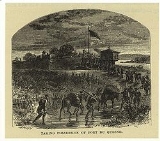
Battle of Fort Duquesne

Encyclopedia
The Battle of Fort Duquesne was a British
assault on the eponymous French
fort (later the site of Pittsburgh) that was repulsed with heavy losses on 14 September 1758, during the French and Indian War
.
The attack on Fort Duquesne was part of a large-scale British expedition
with 6,000 troops led by General John Forbes to drive the French out of the contested Ohio Country
(the upper Ohio River Valley) and clear the way for an invasion of Canada. Forbes ordered Major
James Grant
of the 1st Highland Regiment to reconnoiter
the area with 850 men. When Grant proceeded to attack the French position, his force was outmanouevred, surrounded, and largely destroyed by the French and their native allies led by François-Marie Le Marchand de Lignery
. Major Grant was taken prisoner and the British survivors retreated fitfully to Fort Ligonier.
After repulsing this advance party
the French, deserted by some of their native allies and vastly outnumbered by the approaching Forbes, blew up their magazines and burnt Fort Duquesne. In November the French withdrew from the Ohio Valley and British colonists erected Fort Pitt
on the site.
. Forbes, very ill, did not keep up with the advance of his army, but entrusted it to his second in command, Lt. Col. Henry Bouquet
, a Swiss officer commanding a battalion of the Royal American Regiment. Bouquet sanctioned a reconnaissance of Fort Duquesne by Major James Grant of Ballindalloch
, acting commander of the 77th Regiment of Foot (Montgomerie's Highlanders)
.
The next morning, Grant divided his force into several parts. A company of the 77th, under a Capt. McDonald, approached the fort with drums beating and pipes playing as a decoy. A force of 400 men lay in wait to ambush the enemy when they went out to attack McDonald, and several hundred more under the Virginian Maj. Andrew Lewis
were concealed near the force's baggage train in the hope of surprising an enemy attack there.
The French and Indian force was in fact much larger than anticipated, and moved swiftly. They overwhelmed McDonald's decoy force and overran the party that had been meant to ambush them. Lewis's force left its ambush positions and went to the aid of the rest of the force but the French and Indians had by then gained a point of high ground above them and forced them to retire. The Indians used the forest to their advantage; "concealed by a thick foliage, their heavy and destructive fire could not be returned with any effect". In the one-sided battle in the woods, the British and American force suffered 342 casualties, of whom 232 were from the 77th Regiment, including Grant, who was taken prisoner. Out of the eight officers in Andrew Lewis’s Virginian contingent, 5 were killed, 1 was wounded and Lewis himself was captured. Nevertheless, most of Grant's force escaped to rejoin the main army under Forbes and Bouquet. The Franco-Indian force suffered only 8 killed and 8 wounded.
A plaque on the Allegheny County Courthouse, erected in 1901 commemorates the site of the battle, and the hill where the battle was fought is today called Grant Street, in Pittsburgh.
after the British prime minister William Pitt
, who had ordered the capture of that strategic location.
Kingdom of Great Britain
The former Kingdom of Great Britain, sometimes described as the 'United Kingdom of Great Britain', That the Two Kingdoms of Scotland and England, shall upon the 1st May next ensuing the date hereof, and forever after, be United into One Kingdom by the Name of GREAT BRITAIN. was a sovereign...
assault on the eponymous French
Kingdom of France
The Kingdom of France was one of the most powerful states to exist in Europe during the second millennium.It originated from the Western portion of the Frankish empire, and consolidated significant power and influence over the next thousand years. Louis XIV, also known as the Sun King, developed a...
fort (later the site of Pittsburgh) that was repulsed with heavy losses on 14 September 1758, during the French and Indian War
French and Indian War
The French and Indian War is the common American name for the war between Great Britain and France in North America from 1754 to 1763. In 1756, the war erupted into the world-wide conflict known as the Seven Years' War and thus came to be regarded as the North American theater of that war...
.
The attack on Fort Duquesne was part of a large-scale British expedition
Forbes Expedition
The Forbes Expedition was a British military expedition led by Brigadier-General John Forbes in 1758, during the French and Indian War. Its objective was the capture of Fort Duquesne, a French fort constructed at the confluence of the Allegheny and Monongahela Rivers in 1754.The expedition...
with 6,000 troops led by General John Forbes to drive the French out of the contested Ohio Country
Ohio Country
The Ohio Country was the name used in the 18th century for the regions of North America west of the Appalachian Mountains and in the region of the upper Ohio River south of Lake Erie...
(the upper Ohio River Valley) and clear the way for an invasion of Canada. Forbes ordered Major
Major
Major is a rank of commissioned officer, with corresponding ranks existing in almost every military in the world.When used unhyphenated, in conjunction with no other indicator of rank, the term refers to the rank just senior to that of an Army captain and just below the rank of lieutenant colonel. ...
James Grant
James Grant (general)
James Grant, Laird of Ballindalloch was a major general in the British Army during the American War of Independence. He served as Governor of East Florida from 1763 to 1771.-Early career:...
of the 1st Highland Regiment to reconnoiter
Reconnaissance
Reconnaissance is the military term for exploring beyond the area occupied by friendly forces to gain information about enemy forces or features of the environment....
the area with 850 men. When Grant proceeded to attack the French position, his force was outmanouevred, surrounded, and largely destroyed by the French and their native allies led by François-Marie Le Marchand de Lignery
François-Marie Le Marchand de Lignery
François-Marie Le Marchand de Lignery was a colonial military leader in the French province of Canada. Active in the defense of New France during the Seven Years' War , he died of wounds sustained in the 1759 Battle of La Belle-Famille.-Life:Born into a military family François-Marie Le Marchand...
. Major Grant was taken prisoner and the British survivors retreated fitfully to Fort Ligonier.
After repulsing this advance party
Vanguard (military tactics)
The vanguard is the leading part of an advancing military formation. It has a number of functions, including seeking out the enemy and securing ground in advance of the main force.- Medieval origins :...
the French, deserted by some of their native allies and vastly outnumbered by the approaching Forbes, blew up their magazines and burnt Fort Duquesne. In November the French withdrew from the Ohio Valley and British colonists erected Fort Pitt
Fort Pitt (Pennsylvania)
Fort Pitt was a fort built at the location of Pittsburgh, Allegheny County, Pennsylvania.-French and Indian War:The fort was built from 1759 to 1761 during the French and Indian War , next to the site of former Fort Duquesne, at the confluence the Allegheny River and the Monongahela River...
on the site.
British forces
Forbes commanded between 6,000 and 8,000 men, including a contingent of Virginians led by George WashingtonGeorge Washington
George Washington was the dominant military and political leader of the new United States of America from 1775 to 1799. He led the American victory over Great Britain in the American Revolutionary War as commander-in-chief of the Continental Army from 1775 to 1783, and presided over the writing of...
. Forbes, very ill, did not keep up with the advance of his army, but entrusted it to his second in command, Lt. Col. Henry Bouquet
Henry Bouquet
Henry Bouquet was a prominent British Army officer in the French and Indian War and Pontiac's War. Bouquet is best known for his victory over Native Americans at the Battle of Bushy Run, lifting the siege of Fort Pitt during Pontiac's War.-Early life:Bouquet was born into a moderately wealthy...
, a Swiss officer commanding a battalion of the Royal American Regiment. Bouquet sanctioned a reconnaissance of Fort Duquesne by Major James Grant of Ballindalloch
James Grant (general)
James Grant, Laird of Ballindalloch was a major general in the British Army during the American War of Independence. He served as Governor of East Florida from 1763 to 1771.-Early career:...
, acting commander of the 77th Regiment of Foot (Montgomerie's Highlanders)
77th Regiment of Foot (Montgomerie's Highlanders)
The 77th Regiment of Foot was a Highland Scots Regiment raised under Major Archibald Montgomerie, son of the Earl of Eglinton. It was originally raised as the "First Highland Battalion" in 1757, around Stirling, Scotland, with thirteen companies...
.
Battle
On September 11, 1758, Grant led over 800 men to scout the environs of Fort Duquesne ahead of Forbes' main column. Bouquet believed the fort to be held by 500 French and 300 Indians, a force too strong to be attacked by Grant's detachment. Grant, who arrived in the vicinity of the fort on September 13, believed there were only 200 enemy within, and sent a small party of 50 men forward to scout. These saw no enemy outside the fort; they burned a storehouse and returned to Grant's main position, two miles (3 km) from the fort.The next morning, Grant divided his force into several parts. A company of the 77th, under a Capt. McDonald, approached the fort with drums beating and pipes playing as a decoy. A force of 400 men lay in wait to ambush the enemy when they went out to attack McDonald, and several hundred more under the Virginian Maj. Andrew Lewis
Andrew Lewis (soldier)
Andrew Lewis was an American pioneer, surveyor, and soldier from Virginia. He served as a colonel of militia during the French and Indian War, and as a brigadier general in the American Revolutionary War...
were concealed near the force's baggage train in the hope of surprising an enemy attack there.
The French and Indian force was in fact much larger than anticipated, and moved swiftly. They overwhelmed McDonald's decoy force and overran the party that had been meant to ambush them. Lewis's force left its ambush positions and went to the aid of the rest of the force but the French and Indians had by then gained a point of high ground above them and forced them to retire. The Indians used the forest to their advantage; "concealed by a thick foliage, their heavy and destructive fire could not be returned with any effect". In the one-sided battle in the woods, the British and American force suffered 342 casualties, of whom 232 were from the 77th Regiment, including Grant, who was taken prisoner. Out of the eight officers in Andrew Lewis’s Virginian contingent, 5 were killed, 1 was wounded and Lewis himself was captured. Nevertheless, most of Grant's force escaped to rejoin the main army under Forbes and Bouquet. The Franco-Indian force suffered only 8 killed and 8 wounded.
A plaque on the Allegheny County Courthouse, erected in 1901 commemorates the site of the battle, and the hill where the battle was fought is today called Grant Street, in Pittsburgh.
French retreat
Though the French had beaten off the initial British attack, Lignery understood that his force of about 600 could not hold Fort Duquesne against the main British force of more than ten times that number. The French continued to occupy Fort Duquesne until November 26, when the garrison set fire to the fort and left under the cover of darkness. As the British marched up to the smoldering remains, they were confronted with an appalling sight. The Indians had decapitated many of the dead Highlanders and impaled their heads on the sharp stakes on top of the fort walls, with their kilts displayed below. The British and Americans rebuilt Fort Duquesne, naming it Fort PittFort Pitt (Pennsylvania)
Fort Pitt was a fort built at the location of Pittsburgh, Allegheny County, Pennsylvania.-French and Indian War:The fort was built from 1759 to 1761 during the French and Indian War , next to the site of former Fort Duquesne, at the confluence the Allegheny River and the Monongahela River...
after the British prime minister William Pitt
William Pitt, 1st Earl of Chatham
William Pitt, 1st Earl of Chatham PC was a British Whig statesman who led Britain during the Seven Years' War...
, who had ordered the capture of that strategic location.
Primary sources
- The Papers of Henry Bouquet : Volume II The Forbes Expedition ed. by Donald Kent et al. (1951)
- Writings of General John Cabot Forbes Relating to his Service in North America (1938)
- The Papers of George Washington, Colonial Series, volume 5 October 1757-September 1758 ed by W. W. Abbott et al. (1988)