


Bascule (horse)

Encyclopedia
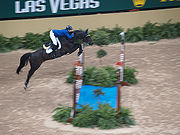
Importances of Bascule
A horse with bascule is one with a "round" jump, while a horse with poor bascule may jump "flat" with his head in the air and his spine relatively straight. A hollowed back over the fence tends to prevent the animal from lifting his forearms very high, thus preventing the necessary tucking motion of his front legs to jump clear.Most naturally talented jumpers have good bascule. However, there are several very athletic horses that can jump great heights with considerably poor bascule due to sheer power.
Some bascule is an important trait for all jumping horses, as it is more mechanically efficient for clearing high obstacles. Good bascule is desirable in show jumping
Show jumping
Show jumping, also known as "stadium jumping," "open jumping," or "jumpers," is a member of a family of English riding equestrian events that also includes dressage, eventing, hunters, and equitation. Jumping classes commonly are seen at horse shows throughout the world, including the Olympics...
, but is essential in the show hunter
Show hunter
The show hunter is a type of show horse that is judged on its movement, manners, and way of going, particularly while jumping fences. The horses are shown in hunt seat style tack, and are often of Warmblood or Thoroughbred type, though a hunter-style pony is also seen in youth classes...
s, being one of the main qualities that a judge looks for in the horse.
Less of a bascule is desirable in other disciplines, such as eventing
Eventing
Eventing is an equestrian event comprising dressage, cross-country, and show jumping. This event has its roots in a comprehensive cavalry test requiring mastery of several types of riding...
, when the added roundness would result in the jump taking a longer time (adding valuable seconds to the clock). Additionally, some cross-country jumps are best jumped flat, to ensure an appropriate landing. For example, drops are best jumped with little bascule, so that the landing is made as short as possible, putting less stress on the horse's legs and the rider's balance. In sports such as steeplechase
Steeplechase (horse racing)
The steeplechase is a form of horse racing and derives its name from early races in which orientation of the course was by reference to a church steeple, jumping fences and ditches and generally traversing the many intervening obstacles in the countryside...
, bascule is not desirable, because of the added time it takes to jump the fence. Therefore, the horses are encouraged to jump flatter and "out of stride." Furthermore, the extra energy required for a horse to bascule over a hurdle in steeplechasing would be wasted.
A "flat" jump is often desirable in hunt seat equitation. A jump with a great deal of bascule is challenging to ride, and is said to "pop the rider out of the tack." In a competition where the appearance of ease is critical, a flat jump can benefit the rider.
Training for Bascule
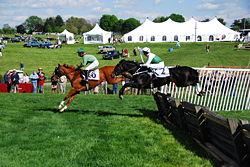
Certain jumps tend to favor good bascule, most notably the ascending oxer. Other jumps, such as steeplechase fences which are meant to be brushed through, favor a flat jump. In the case of the steeplechase
Steeplechase (horse racing)
The steeplechase is a form of horse racing and derives its name from early races in which orientation of the course was by reference to a church steeple, jumping fences and ditches and generally traversing the many intervening obstacles in the countryside...
fence, it is detrimental for the horse to have a powerful, round jump, because it consumes time and energy.
Additionally, the ability to bascule over a fence is a matter of flexibility in the horse. In some cases, a more relaxed atmosphere or improved conditioning may help the horse to flex his spine better.
In general, training cannot compensate for a lack of natural bascule in a horse.