
Home      Discussion      Topics      Dictionary      Almanac
Signup       Login
Show hunter

Show hunter

Overview

Discussion
Ask a question about 'Show hunter'
Start a new discussion about 'Show hunter'
Answer questions from other users
Full Discussion Forum
 
Unanswered Questions
Encyclopedia

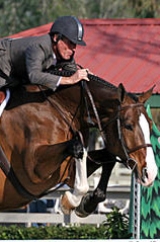
The show hunter is a type of show horse that is judged on its movement, manners, and way of going, particularly while jumping fences. The horses are shown in hunt seat
Hunt seat
Hunt seat is terminology used in the United States and Canada to refer to a style of forward seat riding commonly found at American horse shows. Along with Dressage, it is one of the two classic forms of English riding. The Hunt seat is based on the tradition of fox hunting...

 style tack, and are often of Warmblood
Warmblood
Warmbloods are a group of middle-weight horse types and breeds, primarily originating in Europe, registered with organizations that are characterized by open studbook policy, studbook selection, and the aim of breeding for equestrian sport...

 or Thoroughbred
Thoroughbred
The Thoroughbred is a horse breed best known for its use in horse racing. Although the word thoroughbred is sometimes used to refer to any breed of purebred horse, it technically refers only to the Thoroughbred breed...

 type, though a hunter-style pony
Pony
A pony is a small horse . Depending on context, a pony may be a horse that is under an approximate or exact height at the withers, or a small horse with a specific conformation and temperament. There are many different breeds...

 is also seen in youth classes. In the United States
United States
The United States of America is a federal constitutional republic comprising fifty states and a federal district...

, show hunters are primarily exhibited over fences, with a few additional classes offered for horses shown in-hand or on the flat. In the United Kingdom
United Kingdom
The United Kingdom of Great Britain and Northern IrelandIn the United Kingdom and Dependencies, other languages have been officially recognised as legitimate autochthonous languages under the European Charter for Regional or Minority Languages...

, competition over fences is called "Working Hunter," and the term "Show Hunter" describes classes held on the flat.

Movement and frame


The show hunter has long and low movement, meaning the horse should have a long, sweeping stride that covers maximum ground per minimum effort. There is not much flexion of the horse's joints as it moves; ideally the majority of the movement occurs from the horse's shoulder and hip. The action of the field hunter is efficient: the horse does not waste energy bending its legs any more than it has to. This relates back to the hunt field, where the horse had to work for several hours on end, often galloping, and inefficient movement would tire the horse more quickly.

The show hunter moves smoothly and freely, pointing its toes as it floats over the ground. It should not have excessive knee action, nor should its strides be short and choppy, both of which would make its movement less efficient. The horse should be forward, so it could jump if needed, but no faster than necessary.

The horse must always be in a balanced frame. This, too, relates back to the hunt field, where a horse had to be balanced in order to cope with the changing terrain, sometimes sudden change of direction, and surprising fences. The frame of the show hunter differs from that of dressage
Dressage
Dressage is a competitive equestrian sport, defined by the International Equestrian Federation as "the highest expression of horse training." Competitions are held at all levels from amateur to the World Equestrian Games...

 horses, eventers
Eventing
Eventing is an equestrian event comprising dressage, cross-country, and show jumping. This event has its roots in a comprehensive cavalry test requiring mastery of several types of riding...

, and show jumpers
Show jumping
Show jumping, also known as "stadium jumping," "open jumping," or "jumpers," is a member of a family of English riding equestrian events that also includes dressage, eventing, hunters, and equitation. Jumping classes commonly are seen at horse shows throughout the world, including the Olympics...

, as it travels in a long and low frame, with its head moderately extended. Its frame is more "stretched out" than horses competing in dressage, eventing, or show jumping, but the horse should not be on its forehand. The riders of show hunters often ride on a slightly looser rein than seen elsewhere to facilitate this type of movement, and the horse carries its head just in front of the vertical.

Although the horse is in a long and low frame, it should still be able to collect its stride when asked. The horse must also be proficient at lengthening its canter
Canter
The canter is a controlled, three-beat gait performed by a horse. It is a natural gait possessed by all horses, faster than most horses' trot but slower than the gallop, and is used by all riders. The speed of the canter varies between 16-27 km/h , depending on the length of the stride of the horse...

 stride while still maintaining its tempo and rhythm.

The walk of the show hunter is free and ground-covering; the trot should be balanced and flowing. The canter should be moderately collected. The horse should have a long galloping stride (12 feet is the expected length), but it should still be balanced and rhythmic.

Jumping form


A good show hunter must possess an excellent jumping form. The forearm should be parallel or higher with the ground, and the knees and lower legs should be even. The horse should not be lazy with its lower legs, but should tuck them under its forearm as it clears the fence, clearly bending its fetlocks and knees. The horse should not throw its body or legs to one side, but should stay perfectly straight over the fence. A good show hunter should show a great bascule
Bascule (horse)
Bascule is the natural round arc a horse's body takes as it goes over a jump. The horse should rise up through its back, stretching its neck forward and down, when it reaches the peak of his jump. Ideally, the withers are the highest point over the fence. This is often described as the horse...

, or roundness over a jump. This is often described as the horse taking the shape of a dolphin jumping out of the water, with the horse's back up, and its head reaching forward and down over the fence.

Attitude


A show hunter is not only judged on movement, but also on temperament and manners. Thus, the show hunter should always be relaxed and calm, yet attentive to its rider. It should be responsive to invisible signals and look relatively easy to ride.

Turn-out


Show hunters are well groomed for show
Horse grooming
Horse grooming is hygienic care given to a horse, or a process by which the horse's physical appearance is enhanced for horse shows or other types of competition.-Reasons for grooming:...

, clean with a shiny coat. They carry a bit more weight than an eventing
Eventing
Eventing is an equestrian event comprising dressage, cross-country, and show jumping. This event has its roots in a comprehensive cavalry test requiring mastery of several types of riding...

 horse or racehorse. The horse is bathed before the competition, with special attention paid to white markings
Horse markings
Markings on horses usually are distinctive white areas on an otherwise dark base coat color. Most horses have some markings, and they help to identify the horse as a unique individual. Markings are present at birth and do not change over the course of the horse's life...

. The hooves are polished before the horse enters the show ring.

The horse's head is trimmed, focusing on the whiskers around the muzzle, the hair of the ears, the bridle path
Bridle path (horse)
The bridle path is a shaved or clipped section of the mane, beginning behind the ears of a horse at the poll, delineating the area where the crownpiece of the bridle lies...

, and lower jaw. The legs are also trimmed, removing all fetlock
Fetlock
Fetlock is the common name for the metacarpophalangeal and metatarsophalangeal joints of horses, large animals, and sometimes dogs. It is formed by the junction of the third metacarpal or metatarsal bones proximad and the proximal phalanx distad...

 hair and feathering
Feathering
Feathering is a technique used in computer graphics software to smooth or blur the edges of a feature. The term is inherited from a technique of fine retouching using fine feathers.-Paintbrush feathering:...

, and trimming the pastern
Pastern
The pastern is a part of the leg of a horse between the fetlock and the top of the hoof. It incorporates the long pastern bone and the short pastern bone , which are held together by two sets of paired ligaments to form the pastern joint...

s and coronet. In the winter, show hunters are often given a full clip, removing all the body hair, to give them a neater appearance in the show ring. The mane
Mane (horse)
The mane is the hair that grows from the top of the neck of a horse or other equine, reaching from the poll to the withers, and includes the forelock or foretop. It is thicker and coarser than the rest of the horse's coat, and naturally grows to roughly cover the neck...

 and forelock are braided, usually using yarn matching the color of the mane.

Tails are not pulled at the dock
Rump (animal)
The rump or croup, in the external morphology of an animal, is the portion of the posterior dorsum that is posterior to the loins and anterior to the tail. Anatomically, the rump corresponds to the sacrum....

, so that it may be braided, and the bottom of the tail is left natural in US competition, not trimmed. The tail is braided from the top down to the end of the tail bone, with the rest of the tail left loose.

The course


The course of fences a show hunter must jump is usually made up of 8-12 obstacles of natural type material. The fences are not brightly-colored as in show jumping
Show jumping
Show jumping, also known as "stadium jumping," "open jumping," or "jumpers," is a member of a family of English riding equestrian events that also includes dressage, eventing, hunters, and equitation. Jumping classes commonly are seen at horse shows throughout the world, including the Olympics...

, instead they are mostly brown, green, white, beige, and other natural colors. They do not exceed 4'3" in height. The course may include verticals, oxers, gates, and fences with "natural" fillers, like brush or flowers. Open water jumps and liverpools, common obstacles in show jumping arena, are not used in a show hunter course. Although combination fences may be seen, they are usually only two elements, and have easier distances between them than those found in show jumping. Banks and ditches are not found on the show hunter course, nor are any major changes in terrain, and often the horses jump on level footing in an enclosed arena.

The distance between fences is usually a set number of strides, with each stride 12 feet in length. Unlike a show jumper, the show hunter does not need to go to extreme lengths to collect or extend its stride to meet the distances correctly. The horse must put a certain amount of strides between each set of fences if they are in a line. If the horse and rider don't do this, points will be taken off the overall score.

The show hunter should maintain a good pace throughout the course of fences, but keep an even rhythm, neither speeding up nor slowing down. The horse is judged on its smoothness around the course, its movement, jumping form, and whether it reaches each "spot", or the distance of takeoff in front of a jump, correctly. A poor spot would put the horse too close or too far back from the jump, so that it would either have to stretch and make a great effort over the fence, or have to jump more "up and down" rather than over the fence. A poor spot interrupts the rhythm of a course, and increases the likelihood that a horse will rub or drop a rail.

A good ride over fences will look easy, with the horse jumping from the correct takeoff spot, easily fitting the strides in between the jumps (as opposed to having to really stretch out or collect its stride), and cleanly making the flying changes required. Refusals, knocked rails, or rubs over fences incur a severe drop (faults) in the rider's score.

The show hunter vs. the field hunter


Although the qualities of the show hunter are based on those of the field hunter
Field hunter
A field hunter, or a fox hunter, is a type of horse used in the hunt field for fox hunting. It may be of any breed, but should possess stamina, a level head, and bravery. The horse should have a safe jump, so as not to get caught on any of the solid obstacles found in the hunt field...

, the modern show horse is slightly different from its more rugged counterpart in the field. The field hunter must be tougher and more durable, with great stamina, to cope with the difficulties of a long day of hunting. The field hunter must also be extremely brave, as it often has to jump solid objects, and other natural obstacles such as stone walls, ditches, banks, and hedges, and must occasionally go through water. In some countries, fences may be made of barbed wire. Unlike the show hunter, the field hunter must travel over varied terrain. In some ways, a good field hunter is more closely related to a good eventer
Eventing
Eventing is an equestrian event comprising dressage, cross-country, and show jumping. This event has its roots in a comprehensive cavalry test requiring mastery of several types of riding...

, rather than a show hunter, as the cross-country phase of eventing includes ditches, banks, water, brush, and varied terrain.

Classes and Divisions


Show hunter competition at a horse show consists of multiple classes of different types grouped into divisions, usually based on the experience or age of the rider or horse, or the height of the animal. In all classes except equitation, the horse is judged on performance and soundness, and usually also on conformation, suitability and manners.

Types of classes

  • Flat - Sometimes also called "hunter under saddle" or "hack" classes. These are group classes where all the competitors entered are judged in the ring at the same time. Required gaits
    Horse gait
    Horse gaits are the various ways in which a horse can move, either naturally or as a result of specialized training by humans.-Classification:...

     are the walk, trot, and canter. Some classes will also occasionally ask for a counter canter or a hand gallop. At the end of the class the competitors line up in the middle of the ring and awards are given.

  • Hunter- Sometimes called "hunter over fences" or "working hunter" classes. Horses in hunter classes are shown one at a time over a course of jumps. The horse and rider are generally expected to enter the ring at the trot and make a large circle for about a third or one half of the ring before cantering to the course of 8-12 obstacles. After the course has been completed, they are also expected to complete another circle of similar size at the trot before leaving the arena.

  • Equitation
    Equitation
    Equitation is the art or practice of horse riding or horsemanship.More specifically, equitation may refer to a rider's position while mounted, and encompass a rider's ability to ride correctly and with effective aids. In horse show competition, the rider, rather than the horse is evaluated...

     - The rider is judged on riding ability and form, and though the performance of the horse is not specifically judged, it is nonetheless considered to reflect the rider's ability. Both flat and over fences classes are offered.

  • "Handy" classes - A hunter class that combines elements of flat and over-fences classes, often with elements reminiscent of field hunting. For example; in addition to jumping a course, the rider may be asked to open and close a gate or to dismount and lead the horse over a small fence.

  • Model, or in-hand classes - The horse is judged on conformation
    Equine conformation
    Equine conformation evaluates the degree of correctness of a horse's bone structure, musculature, and its body proportions in relation to each other. Undesirable conformation can limit the ability to perform a specific task. Although there are several universal "faults," a horse's conformation is...

     and movement
    Horse gait
    Horse gaits are the various ways in which a horse can move, either naturally or as a result of specialized training by humans.-Classification:...

     suitable for that of a hunter. Horses are only led in these classes, not ridden, and the horse is presented for judging without a saddle.

Divisions

  • Pony - Classes for horses not exceeding . There is usually 3 divisions for ponies - small (ponies less than 12.2 hands), medium (ponies between 12.2 and 13.2 hands), and large (ponies between 13.3 and 14.2 hands). The courses for each division differ by the height of the obstacles and distance between obstacles, which is based on the pony's average stride size.

  • Adult Amateur - This is a division for Adults (18 years and over) who are not professionals, which means that they do not participate in any professional activities surrounding their riding.

  • Junior and Children - This is a division for riders who are under 18.

  • Regular - This division is open to any horse.

  • Green - This is a division for inexperienced, usually young horses in their first or second year of competition in classes where national specifications require horses to jump fences at 3'6" or higher. In smaller local or regional shows that do not seek approval of the USEF
    United States Equestrian Federation
    The United States Equestrian Federation is the national governing body for most equestrian sports in the United States. It began on January 20, 1917 as the Association of American Horse Shows, later changed in 1933 to the American Horse Shows Association...

    , qualifications may be more lenient.