


Azolla event

Encyclopedia
Eocene
The Eocene Epoch, lasting from about 56 to 34 million years ago , is a major division of the geologic timescale and the second epoch of the Paleogene Period in the Cenozoic Era. The Eocene spans the time from the end of the Palaeocene Epoch to the beginning of the Oligocene Epoch. The start of the...
period, around , when blooms of the freshwater fern
Fern
A fern is any one of a group of about 12,000 species of plants belonging to the botanical group known as Pteridophyta. Unlike mosses, they have xylem and phloem . They have stems, leaves, and roots like other vascular plants...
Azolla are thought to have happened in the Arctic Ocean
Arctic Ocean
The Arctic Ocean, located in the Northern Hemisphere and mostly in the Arctic north polar region, is the smallest and shallowest of the world's five major oceanic divisions...
. As they sank to the stagnant sea floor, they were incorporated into the sediment; the resulting draw down of carbon dioxide
Carbon dioxide
Carbon dioxide is a naturally occurring chemical compound composed of two oxygen atoms covalently bonded to a single carbon atom...
has been speculated to have helped transform the planet from a "greenhouse Earth" state, hot enough for turtles and palm trees to prosper at the poles, to the icehouse Earth it has been since.
Geological evidence of the event
Plankton
Plankton are any drifting organisms that inhabit the pelagic zone of oceans, seas, or bodies of fresh water. That is, plankton are defined by their ecological niche rather than phylogenetic or taxonomic classification...
ic organisms, usual to marine sediments, switch with millimetre-thick laminations comprising fossil
Fossil
Fossils are the preserved remains or traces of animals , plants, and other organisms from the remote past...
ised Azolla matter. This organic matter can also be detected in the form of a gamma radiation spike
Gamma ray logging
Gamma ray logging is a method of measuring naturally occurring gamma radiation to characterize the rock or sediment in a borehole. It is sometimes used in mineral exploration and water-well drilling, but most commonly for formation evaluation in oil and gas well drilling . Different types of...
, that has been noted throughout the Arctic basin, making the event a useful aid in lining up cores drilled at different locations. Palynological controls and calibration with the high-resolution geomagnetic reversal
Geomagnetic reversal
A geomagnetic reversal is a change in the Earth's magnetic field such that the positions of magnetic north and magnetic south are interchanged. The Earth's field has alternated between periods of normal polarity, in which the direction of the field was the same as the present direction, and reverse...
record allows the duration of the event to be estimated at 800,000 years. The event coincides precisely with a catastrophic decline in carbon dioxide
Carbon dioxide
Carbon dioxide is a naturally occurring chemical compound composed of two oxygen atoms covalently bonded to a single carbon atom...
levels, which fell from 3500 ppm
Parts-per notation
In science and engineering, the parts-per notation is a set of pseudo units to describe small values of miscellaneous dimensionless quantities, e.g. mole fraction or mass fraction. Since these fractions are quantity-per-quantity measures, they are pure numbers with no associated units of measurement...
in the early Eocene
Eocene
The Eocene Epoch, lasting from about 56 to 34 million years ago , is a major division of the geologic timescale and the second epoch of the Paleogene Period in the Cenozoic Era. The Eocene spans the time from the end of the Palaeocene Epoch to the beginning of the Oligocene Epoch. The start of the...
to 650 ppm during this event.
Azolla
Azolla has been deemed a "super-plant" as it can draw down as much as a tonne of nitrogen per acre per year (0.25 kg/m²/yr); this is matched by 6 tonnes per acre of carbon drawdown (1.5 kg/m²/yr). Its ability to use atmospheric nitrogen for growth means that the main limit to its growth is usually the availability of phosphorus: carbon, nitrogen and sulphur being three of the key elements of proteins, and phosphorus being required for DNA, RNA and in energy metabolism. The plant can grow at great speed in favourable conditions – modest warmth and 20 hours of sunlight, both of which were in evidence at the poles during the early Eocene – and can double its biomass over two to three days in such a climate.Conditions encouraging the event
Continental drift
Continental drift is the movement of the Earth's continents relative to each other. The hypothesis that continents 'drift' was first put forward by Abraham Ortelius in 1596 and was fully developed by Alfred Wegener in 1912...
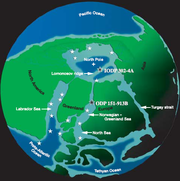
was such that the Arctic sea was almost entirely cut off from the wider oceans. This meant that mixing — provided today by deep water currents such as the Gulf Stream — did not occur, leading to a stratified water column resembling today's Black Sea
Black Sea
The Black Sea is bounded by Europe, Anatolia and the Caucasus and is ultimately connected to the Atlantic Ocean via the Mediterranean and the Aegean seas and various straits. The Bosphorus strait connects it to the Sea of Marmara, and the strait of the Dardanelles connects that sea to the Aegean...
.
High temperatures and winds led to high evaporation, increasing the density of the ocean, and — through an increase in rainfall — high discharge from rivers which fed the basin. This low-density freshwater formed a nepheloid layer
Nepheloid layer
Nepheloid layer or nepheloid zone is a layer of water in the deep ocean basin, above the ocean floor, that contains significant amounts of suspended sediment. It is from 200 to 1000 m thick. The name comes from Greek: nephos, "cloud". The particles in the layer may come from the upper ocean...
, floating on the surface of the dense sea.
Even a few centimetres of fresh water would be enough to allow the colonization of Azolla; further, this river water would be rich in minerals such as phosphorus, which it would accumulate from mud and rocks it interacted with as it crossed the continents. To further aid the growth of the plant, concentrations of carbon (in the form of carbon dioxide) and accessible nitrogen in the atmosphere are known to have been high at this time.
Blooms alone are not enough to have any geological impact; to permanently draw down CO2 and cause climate change, the carbon must be sequestered, by the plants being buried and eventually fossilised. The anoxic bottom of the Arctic basin, a result of the stratified water column, permitted just this: the anoxic environment inhibits the activity of decomposing organisms and allows the plants to sit unrotted until they are buried by sediment and incorporated into the fossil record.
Global effects
With 800,000 years of Azolla bloom episodes and a 4,000,000 km² basin to cover, even by very conservative estimates more than enough carbon could be sequestered by plant burial to account for the observed 80% drop in CO2 by this one phenomenon alone. This drop initiated the switch from a greenhouse to the current icehouse EarthGreenhouse and Icehouse Earth
For the past millions of years, the earth has been fluctuating between two different states of dominant climate: Greenhouse and Icehouse. These two climate sets are complete opposites from each other and is on a continuing, uneven cycle between the two...
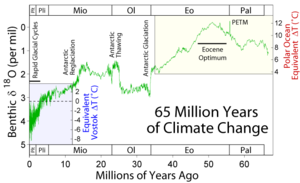
; the Arctic cooled from an average sea-surface temperature of 13 °C to today's −9 °C, and the rest of the globe underwent a similar change. For perhaps the first time in its history, the planet had ice caps at both of its poles. A geologically rapid decrease in temperature between 49 and , around the Azolla event, is evident: dropstones — which are taken as evidence for the presence of glaciers — are common in Arctic sediments thereafter. This is set against a backdrop of gradual, long-term cooling: It is not until that evidence for widespread polar freezing is common.
Alternative explanations
While a verdant Arctic Ocean is a viable working model, sceptical scientists point out that it would be possible for Azolla colonies in deltas or freshwater lagoons to be swept into the Arctic Ocean by strong currents, removing the necessity for a freshwater layer.Economic considerations
Much of the current interest in oil exploration in the Arctic regions is directed towards the Azolla deposits. The burial of large amounts of organic material provides the source rockSource rock
In petroleum geology, source rock refers to rocks from which hydrocarbons have been generated or are capable of being generated. They form one of the necessary elements of a working petroleum system. They are organic-rich sediments that may have been deposited in a variety of environments including...
for oil, so given the right thermal history, the preserved Azolla blooms might have been converted to oil or gas. This means that much money is available for the study of this event — a centre has been set up in the Netherlands devoted to Azolla.