

Azhdarchidae

Encyclopedia
Azhdarchidae is a family
of pterosaur
s known primarily from the late Cretaceous
Period, though an isolated vertebrae apparently from an azhdarchid is known from the early Cretaceous as well (late Berriasian
age, about 140Ma ago). Azhdarchids included some of the largest known flying animals of all time. Originally considered a sub-family of Pteranodon
tidae, Nesov (1984) named the azhdarchinae to include the pterosaurs Azhdarcho
, Quetzalcoatlus
, and "Titanopteryx" (now known as Arambourgiania
).
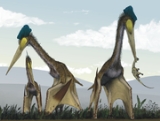
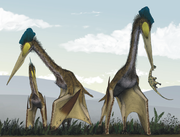 Azhdarchids are characterized by their long legs and extremely long necks, made up of elongated neck vertebrae which are round in cross section. Most species of azhdarchids are still known mainly from their distinctive neck bones and not much else. The few azhdarchids that are known from reasonably good skeletons include Zhejiangopterus
and Quetzalcoatlus
. Azhdarchids are also distinguished by their relatively large heads and long, spear-like jaws. It had been suggested azhdarchids were skimmers, but further research has cast doubt on this idea, demonstrating that azhdarchids lacked the necessary adaptations for a skim-feeding lifestyle, and that they may have led a more terrestrial existence similar to modern stork
s.
due to their long, toothless beaks. Others have suggested they were more closely related to the toothy Ctenochasmatids
(which include filter-feeders like Ctenochasma
and Pterodaustro
). Currently it is widely agreed that azhdarchids were closely related to pterosaurs such as Tupuxuara
and Tapejara.
Family (biology)
In biological classification, family is* a taxonomic rank. Other well-known ranks are life, domain, kingdom, phylum, class, order, genus, and species, with family fitting between order and genus. As for the other well-known ranks, there is the option of an immediately lower rank, indicated by the...
of pterosaur
Pterosaur
Pterosaurs were flying reptiles of the clade or order Pterosauria. They existed from the late Triassic to the end of the Cretaceous Period . Pterosaurs are the earliest vertebrates known to have evolved powered flight...
s known primarily from the late Cretaceous
Cretaceous
The Cretaceous , derived from the Latin "creta" , usually abbreviated K for its German translation Kreide , is a geologic period and system from circa to million years ago. In the geologic timescale, the Cretaceous follows the Jurassic period and is followed by the Paleogene period of the...
Period, though an isolated vertebrae apparently from an azhdarchid is known from the early Cretaceous as well (late Berriasian
Berriasian
In the geological timescale, the Berriasian is an age or stage of the Early or Lower Creteceous. It is the oldest or lowest subdivision in the entire Cretaceous. It spanned between 145.5 ± 4.0 Ma and 140.2 ± 3.0 Ma...
age, about 140Ma ago). Azhdarchids included some of the largest known flying animals of all time. Originally considered a sub-family of Pteranodon
Pteranodon
Pteranodon , from the Late Cretaceous geological period of North America in present day Kansas, Alabama, Nebraska, Wyoming, and South Dakota, was one of the largest pterosaur genera and had a maximum wingspan of over...
tidae, Nesov (1984) named the azhdarchinae to include the pterosaurs Azhdarcho
Azhdarcho
Azhdarcho is a genus of pterodactyloid pterosaur from the late Cretaceous Period of the Bissekty Formation of Uzbekistan. It is known from fragmentary remains including the distinctive, elongated neck vertebrae that characterizes members of the family Azhdarchidae, which also includes such giant...
, Quetzalcoatlus
Quetzalcoatlus
Quetzalcoatlus was a pterodactyloid pterosaur known from the Late Cretaceous of North America , and one of the largest known flying animals of all time. It was a member of the Azhdarchidae, a family of advanced toothless pterosaurs with unusually long, stiffened necks...
, and "Titanopteryx" (now known as Arambourgiania
Arambourgiania
Arambourgiania is a pterosaur from the Late Cretaceous of Jordan. It was one of the largest members of this group.In the early forties, a railway worker during repairs on the Amman-Damascus railroad near Russeifa found a two feet long fossil bone...
).
Description
Zhejiangopterus
Zhejiangopterus is a genus of azhdarchid pterosaur known from one species, which lived in China during the late Cretaceous Period.The genus was named in 1994 by Chinese paleontologists Cai Zhengquan and Wei Feng. The type species is Zhejiangopterus linhaiensis. The genus name refers to Zhejiang...
and Quetzalcoatlus
Quetzalcoatlus
Quetzalcoatlus was a pterodactyloid pterosaur known from the Late Cretaceous of North America , and one of the largest known flying animals of all time. It was a member of the Azhdarchidae, a family of advanced toothless pterosaurs with unusually long, stiffened necks...
. Azhdarchids are also distinguished by their relatively large heads and long, spear-like jaws. It had been suggested azhdarchids were skimmers, but further research has cast doubt on this idea, demonstrating that azhdarchids lacked the necessary adaptations for a skim-feeding lifestyle, and that they may have led a more terrestrial existence similar to modern stork
Stork
Storks are large, long-legged, long-necked wading birds with long, stout bills. They belong to the family Ciconiidae. They are the only family in the biological order Ciconiiformes, which was once much larger and held a number of families....
s.
Systematics
Azhdarchids were originally classified as close relatives of PteranodonPteranodon
Pteranodon , from the Late Cretaceous geological period of North America in present day Kansas, Alabama, Nebraska, Wyoming, and South Dakota, was one of the largest pterosaur genera and had a maximum wingspan of over...
due to their long, toothless beaks. Others have suggested they were more closely related to the toothy Ctenochasmatids
Ctenochasmatidae
Ctenochasmatidae is a group of pterosaurs within the suborder Pterodactyloidea.-Classification:Listing of subfamilies and genera after Unwin 2006 unless otherwise noted.* Family Ctenochasmatidae** Elanodactylus** Gegepterus...
(which include filter-feeders like Ctenochasma
Ctenochasma
Ctenochasma is a genus of Late Jurassic pterosaur belonging to the suborder pterodactyloidea. Three species are currently recognized: C. roemeri , C. taqueti, and C. elegans...
and Pterodaustro
Pterodaustro
Pterodaustro is a genus of Cretaceous pterodactyloid pterosaur from South America, which lived 105 million years ago.-Naming:The genus was named in 1969 by José Bonaparte as an as yet undescribed nomen nudum. The first description followed in 1970, making the name valid, the type species being...
). Currently it is widely agreed that azhdarchids were closely related to pterosaurs such as Tupuxuara
Tupuxuara
Tupuxuara is a genus of large, crested, toothless pterodactyloid pterosaur.The genus was in 1988 named and described by Alexander Kellner and Diogenes de Almeida Campos. The type species is Tupuxuara longicristatus. The genus name refers to a familiar spirit from the mythology of the Tupi...
and Tapejara.
Taxonomy
Classification after Unwin 2006, except where noted.- Family Azhdarchidae
- AlanqaAlanqaAlanqa is a genus of pterosaur from the Late Cretaceous Kem Kem Beds of southeastern Morocco....
- AralazhdarchoAralazhdarchoAralazhdarcho is a genus of azhdarchid pterosaur from the Santonian-early Campanian Late Cretaceous Bostobe Svita of Kazakhstan.The genus was named in 2007 by Alexander Averianov. Already in 2004 the holotype had been described. The type species is Aralazhdarcho bostobensis. The genus name is...
- ArambourgianiaArambourgianiaArambourgiania is a pterosaur from the Late Cretaceous of Jordan. It was one of the largest members of this group.In the early forties, a railway worker during repairs on the Amman-Damascus railroad near Russeifa found a two feet long fossil bone...
- AzhdarchoAzhdarchoAzhdarcho is a genus of pterodactyloid pterosaur from the late Cretaceous Period of the Bissekty Formation of Uzbekistan. It is known from fragmentary remains including the distinctive, elongated neck vertebrae that characterizes members of the family Azhdarchidae, which also includes such giant...
- BakonydracoBakonydracoBakonydraco is a genus of azhdarchid pterosaur of the Santonian-age Upper Cretaceous Csehbánya Formation of the Bakony Mountains, Iharkút, Veszprém, western Hungary....
- HatzegopteryxHatzegopteryxHatzegopteryx is a genus of azhdarchid pterosaur, known from incomplete remains found in Transylvania. The skull fragments, left humerus, and other fossilized remains indicate it was among the largest pterosaurs. The skeleton of Hatzegopteryx has been considered identical to the known remains of...
- MontanazhdarchoMontanazhdarchoMontanazhdarcho is a genus of azhdarchid pterosaur from the late Cretaceous Period of North America, known from only one species, M. minor....
- PhosphatodracoPhosphatodracoPhosphatodraco is a genus of azhdarchid pterodactyloid pterosaur from a late Maastrichtian-age Upper Cretaceous portion of the Oulad Abdoun Phosphatic Basin, Grand Doui, near Khouribga, central Morocco.Phosphatodraco is based on holotype OCP DEK/GE 111, found in...
- QuetzalcoatlusQuetzalcoatlusQuetzalcoatlus was a pterodactyloid pterosaur known from the Late Cretaceous of North America , and one of the largest known flying animals of all time. It was a member of the Azhdarchidae, a family of advanced toothless pterosaurs with unusually long, stiffened necks...
- VolgadracoVolgadracoVolgadraco is a genus of azhdarchid pterodactyloid pterosaur from the Upper Cretaceous of European Russia. It is known from lower beak and postcranial fragments from the early Campanian-age Rybushka Formation of Saratov, Russia...
- ZhejiangopterusZhejiangopterusZhejiangopterus is a genus of azhdarchid pterosaur known from one species, which lived in China during the late Cretaceous Period.The genus was named in 1994 by Chinese paleontologists Cai Zhengquan and Wei Feng. The type species is Zhejiangopterus linhaiensis. The genus name refers to Zhejiang...
- Possible valid azhdarchid genera
- BennettazhiaBennettazhiaBennettazhia is a genus of pterosaur .In 1928 Charles Gilmore named a new species of Pteranodon: P. oregonensis. A humerus , two fused dorsal vertebrae and the broken-off end of some joint bone had been unearthed from the Lower Cretaceous beds of the Hudspeth Formation in Wheeler County, in the...
- BogoluboviaBogoluboviaBogolubovia is a genus of pterosaur from the Upper Cretaceous Rybushka Formation of Petrovsk, Saratov Oblast, Russia. It is named for Nikolai Nikolaevich Bogolubov, the palaeontologist who discovered the remains in 1914. It has in 1991 been assigned to the Azhdarchidae. Wellnhofer however,...
- DoratorhynchusDoratorhynchusDoratorhynchus is a generic replacement name for Pterodactylus validus, in 1875 suggested by Harry Govier Seeley. Today it is considered a nomen vanum....
- EoazhdarchoEoazhdarchoEoazhdarcho is a genus of azhdarchoid pterodactyloid pterosaur named in 2005 by Chinese paleontologists Lü Junchang and Ji Qiang. The type species is Eoazhdarcho liaoxiensis. The genus name combines a Greek eos, "dawn" with the name of the genus Azhdarcho, with the implication it was an early...
- "Ornithocheirus" bunzeli
- Bennettazhia
- Alanqa