
All Topics  
Axial compressor

 
Axial Compressor

   Email Print
   Bookmark   Link


Axial compressor


Axial compressors are rotating, aerofoil based compressors
Gas compressor

A gas compressor is a mechanical device that increases the pressure of a gas by reducing its volume.Compressors are similar to pumps: both increase the pressure on a fluid and both can transport the fluid through a pipe ....
 in which the working fluid principally flows parallel to the axis of rotation. This is in contrast with other rotating compresors such as centrifugal, axi-centrifugal and mixed-flow compressors where the air may enter axially but will have a significant radial component on exit.

Axial flow compressors produce a continuous flow of compressed gas, and have the benefits of high efficiencies and large mass flow capacity, particularly in relation to their cross-section.


Discussion
Ask a question about 'Axial compressor'
Start a new discussion about 'Axial compressor'
Answer questions from other users
Full Discussion Forum


Encyclopedia


Axial Compressor
Axial compressors are rotating, aerofoil based compressors
Gas compressor

A gas compressor is a mechanical device that increases the pressure of a gas by reducing its volume.Compressors are similar to pumps: both increase the pressure on a fluid and both can transport the fluid through a pipe ....
 in which the working fluid principally flows parallel to the axis of rotation. This is in contrast with other rotating compresors such as centrifugal, axi-centrifugal and mixed-flow compressors where the air may enter axially but will have a significant radial component on exit.

Axial flow compressors produce a continuous flow of compressed gas, and have the benefits of high efficiencies and large mass flow capacity, particularly in relation to their cross-section. They do, however, require several rows of aerofoils to achieve large pressure rises making them complex and expensive relative to other designs (e.g. centrifugal compressor
Centrifugal compressor

Centrifugal compressor, are a special class of radial-flow work-absorbing turbomachinery that includes pumps, fans, blowers and compressors....
).

Axial compressors are widely used in gas turbines, such as jet engine
Jet engine

A jet engine is a reaction engine that discharges a fast moving jet of fluid to generate thrust in accordance with Isaac Newton Newton's laws of motion....
s, high speed ship engines, and small scale power stations. They are also used in industrial applications such as large volume air separation plants, blast furnace air, fluid catalytic cracking air, and propane dehydrogenation. Axial compressors, known as supercharger
Supercharger

A supercharger is an air Gas compressor used for forced induction of an internal combustion engine. The greater mass flow-rate provides more oxygen to support combustion than would be available in a naturally-aspirated engine, which allows more fuel to be provided and more work to be done per cycle, increasing the power output of the engine...
s, have also been used to boost the power of automotive reciprocating engines by compressing the intake air, though these are very rare. A good example of an axial supercharger is the aftermarket Latham type built between 1955-65 which were used on hot rods and aircooled Volkwagens at that time, but these didn't catch on.

Description

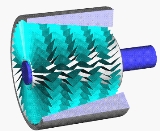
Axial compressors consist of rotating and stationary components. A shaft drives a central drum, retained by bearings, which has a number of annular aerofoil rows attached. These rotate between a similar number of stationary aerofoil rows attached to a stationary tubular casing. The rows alternate between the rotating aerofoils (rotors) and stationary aerofoils (stators), with the rotors imparting energy into the fluid, and the stators converting the increased rotational kinetic energy into static pressure through diffusion. A pair of rotating and stationary aerofoils is called a stage. The cross-sectional area between rotor drum and casing is reduced in the flow direction to maintain axial velocity as the fluid is compressed.
Axial Flow Compressor

Design


The increase in pressure produced by a single stage is limited by the relative velocity between the rotor and the fluid, and the turning and diffusion capabilities of the aerofoils. A typical stage in a commercial compressor will produce a pressure increase of between 15% and 60% (pressure ratios of 1.15-1.6) at design conditions with a polytropic efficiency in the region of 90-95%. To achieve different pressure ratios, axial compressors are designed with different numbers of stages and rotational speeds.

Higher stage pressure ratios are also possible if the relative velocity between fluid and rotors is supersonic, however this is achieved at the expense of efficiency and operability. Such compressors, with stage pressure ratios of over 2, are only used where minimising the compressor size, weight or complexity is critical, such as in military jets.

The aerofoil profiles are optimised and matched for specific velocities and turning. Although compressors can be run at other conditions with different flows, speeds, or pressure ratios, this can result in an efficiency penalty or even a partial or complete breakdown in flow (known as compressor stall
Compressor stall

A compressor stall is a situation of abnormal airflow resulting from a Stall of the airfoil within the compressor. Stall is found in dynamic Gas compressor, particularly axial compressors, as used in jet engines and turbocharger reciprocating engines....
 and pressure surge respectively). Thus, a practical limit on the number of stages, and the overall pressure ratio, comes from the interaction of the different stages when required to work away from the design conditions. These “off-design” conditions can be mitigated to a certain extent by providing some flexibility in the compressor. This is achieved normally through the use of adjustable stators or with valves that can bleed fluid from the main flow between stages (inter-stage bleed).

Modern jet engines use a series of compressors, running at different speeds; to supply air at around 40:1 pressure ratio for combustion with sufficient flexibility for all flight conditions.

Development


Early axial compressors offered poor efficiency, so poor that in the early 1920s a number of papers claimed that a practical jet engine would be impossible to construct. Things changed dramatically after A. A. Griffith
Alan Arnold Griffith

Alan Arnold Griffith was an English people engineer, who, among many other contributions, is best known for his work on stress and fracture in metals that is now known as metal fatigue, as well as being one of the first to develop a strong theoretical basis for the jet engine....
 published a seminal paper in 1926, noting that the reason for the poor performance was that existing compressors used flat blades and were essentially "flying stalled". He showed that the use of airfoil
Airfoil

An airfoil or aerofoil is the shape of a wing or blade or sail as seen in cross-section.An airfoil-shaped body moved through a fluid produces a force perpendicular to the motion called lift ....
s instead of the flat blades would dramatically increase efficiency, to the point where a practical jet engine was a real possibility. He concluded the paper with a basic diagram of such an engine, which included a second turbine that was used to power a propeller.

Although Griffith was well known due to his earlier work on metal fatigue
Metal Fatigue

Metal Fatigue , is a futuristic science fiction, real-time strategy computer game developed by Zono, Inc and published by Psygnosis and TalonSoft ....
 and stress
Stress (physics)

In continuum mechanics, stress is a measure of the average amount of force exerted per unit area. It is a measure of the intensity of the total internal forces acting within a body across imaginary internal surfaces, as a reaction to external applied forces and body forces....
 measurement, little work appears to have started as a direct result of his paper. The only obvious effort was a test-bed compressor built by Griffith's colleague at the Royal Aircraft Establishment
Royal Aircraft Establishment

The Royal Aircraft Establishment England, was a British research establishment latterly under the Ministry of Defence .The first site was at Farnborough Airfield in Hampshire to which was added a second site RAE Bedford in 1946....
, Haine Constant. Other early jet efforts, notably those of Frank Whittle
Frank Whittle

Air Commodore Sir Frank Whittle, Order of Merit , Order of the British Empire, Companion of the Order of the Bath, Fellow of the Royal Society, Hon Royal Aeronautical Society was an England Royal Air Force officer ....
 and Hans von Ohain
Hans von Ohain

Hans Joachim Pabst von Ohain was one of the inventors of jet engine.The engineers, Frank Whittle in the United Kingdom and Hans von Ohain in Germany, developed the concept independently during the late 1930s, although credit for the first turbojet is given to Whittle,...
, were based on the more robust and better understood centrifugal compressor
Centrifugal compressor

Centrifugal compressor, are a special class of radial-flow work-absorbing turbomachinery that includes pumps, fans, blowers and compressors....
 which was widely used in supercharger
Supercharger

A supercharger is an air Gas compressor used for forced induction of an internal combustion engine. The greater mass flow-rate provides more oxygen to support combustion than would be available in a naturally-aspirated engine, which allows more fuel to be provided and more work to be done per cycle, increasing the power output of the engine...
s. Griffith had seen Whittle's work in 1929 and dismissed it, noting an error in the math and going on to claim that the frontal size of the engine would make it useless on a high-speed aircraft.

Real work on axial-flow engines started in the late 1930s, in several efforts that all started at about the same time. In England, Haine Constant reached an agreement with the steam turbine company Metropolitan Vickers (Metrovick) in 1937, starting their turboprop
Turboprop

A turboprop engine is a type of aircraft engine that uses a gas turbine to drive a propeller. The gas turbine is designed specifically for this application, with almost all of its output being used to drive the propeller....
 effort based on the Griffith design in 1938. In 1940, after the successful run of Whittle's centrifugal-flow design, their effort was re-designed as a pure jet, the Metrovick F.2
Metrovick F.2

The Metropolitan-Vickers F.2 was an early turbojet engine and the first British design to be based on an axial compressor. It was considered too unreliable for use during the war, and never entered production....
. In Germany, von Ohain had produced several working centrifugal engines, some of which had flown including the world's first jet aircraft (He 178
Heinkel He 178

The Heinkel He 178 was the world's first aircraft to fly under turbojet power, and the first practical jet plane, the pioneering example of this type of aircraft....
), but development efforts had moved on to Junkers (Jumo 004) and BMW
BMW

, is an independent German automotive industry founded in 1916. It also produces BMW Motorrad, is the owner of the MINI brand and is the parent company of Rolls-Royce Motor Cars....
 (BMW 003
BMW 003

The BMW 003 was an early axial-flow turbojet engine produced by BMW in Germany during World War II. It and the Junkers Jumo 004 were the only German turbojet engines to reach production during World War II....
), which used axial-flow designs in the world's first jet fighter (Messerschmitt Me 262
Messerschmitt Me 262

The Messerschmitt Me 262 Schwalbe was the world's first operational Jet engine fighter aircraft. It was produced in World War II and saw action starting in 1944 as a multi-role fighter/bomber/reconnaissance/interceptor warplane for the Luftwaffe....
) and jet bomber (Arado Ar 234
Arado Ar 234

The Arado Flugzeugwerke Ar 234 was the world's first operational jet engine bomber, built by the Germany Arado company in the closing stages of World War II....
). In the United States, both Lockheed
Lockheed Corporation

The Lockheed Corporation was an United States aerospace company founded in 1912 which merged with Martin Marietta in 1995 in aviation to form Lockheed Martin....
 and General Electric
General Electric

The General Electric Company, or GE is a multinational corporation United States technology and Service s conglomerate incorporated in the State of New York....
 were awarded contracts in 1941 to develop axial-flow engines, the former a pure jet, the latter a turboprop. Northrop also started their own project to develop a turboprop, which the US Navy eventually contracted in 1943. Westinghouse also entered the race in 1942, their project proving to be the only successful one of the US efforts, later becoming the J30
Westinghouse J30

The Westinghouse J30 was a turbojet engine developed by Westinghouse Electric Corporation. It was the firstAmerican-designed turbojet to run, and only the second Axial compressor turbojet to run outside of Germany....
.

By the 1950s every major engine development had moved on to the axial-flow type. As Griffith had originally noted in 1929, the large frontal size of the centrifugal compressor caused it to have higher drag than the narrower axial-flow type. Additionally the axial-flow design could improve its compression ratio
Compression ratio

The compression ratio of an internal-combustion engine or external combustion engine is a value that represents the ratio of the volume of its combustion chamber; from its largest capacity to its smallest capacity....
 simply by adding additional stages and making the engine slightly longer. In the centrifugal-flow design the compressor itself had to be larger in diameter, which was much more difficult to "fit" properly on the aircraft. On the other hand, centrifugal-flow designs remained much less complex (the major reason they "won" in the race to flying examples) and therefore have a role in places where size and streamlining are not so important. For this reason they remain a major solution for helicopter engines, where the compressor lies flat and can be built to any needed size without upsetting the streamlining to any great degree.

Axial-flow jet engines

In the jet engine application, the compressor faces a wide variety of operating conditions. On the ground at takeoff the inlet pressure is high, inlet speed zero, and the compressor spun at a variety of speeds as the power is applied. Once in flight the inlet pressure drops, but the inlet speed increases (due to the forward motion of the aircraft) to recover some of this pressure, and the compressor tends to run at a single speed for long periods of time.

There is simply no "perfect" compressor for this wide range of operating conditions. Fixed geometry compressors, like those used on early jet engines, are limited to a design pressure ratio of about 4 or 5:1. As with any heat engine
Heat engine

A heat engine is a physical or theoretical device that converts thermal energy to mechanical output. The mechanical output is called Mechanical work, and the thermal energy input is called heat....
, fuel efficiency
Fuel efficiency

Fuel efficiency, in its basic sense, is the same as thermal efficiency, meaning the efficiency of a process that converts chemical potential energy contained in a carrier fuel into kinetic energy or Mechanical work....
 is strongly related to the compression ratio
Compression ratio

The compression ratio of an internal-combustion engine or external combustion engine is a value that represents the ratio of the volume of its combustion chamber; from its largest capacity to its smallest capacity....
, so there is very strong financial need to improve the compressor stages beyond these sorts of ratios.

Additionally the compressor may stall
Compressor stall

A compressor stall is a situation of abnormal airflow resulting from a Stall of the airfoil within the compressor. Stall is found in dynamic Gas compressor, particularly axial compressors, as used in jet engines and turbocharger reciprocating engines....
 if the inlet conditions change abruptly, a common problem on early engines. In some cases, if the stall occurs near the front of the engine, all of the stages from that point on will stop compressing the air. In this situation the energy required to run the compressor drops suddenly, and the remaining hot air in the rear of the engine allows the turbine to speed up the whole engine dramatically. This condition, known as surging, was a major problem on early engines and often led to the turbine or compressor breaking and shedding blades.

For all of these reasons, axial compressors on modern jet engines are considerably more complex than those on earlier designs.

Spools

All compressors have a sweet spot
Sweet spot

A sweet spot is a place, often numerical as opposed to physical, where a combination of factors suggest a particularly suitable solution.In the context of a racquet, bat or similar sporting instrument, sweet spot is often believed to be the same as the center of percussion....
 relating rotational speed and pressure, with higher compressions requiring higher speeds. Early engines were designed for simplicity, and used a single large compressor spinning at a single speed. Later designs added a second turbine and divided the compressor into "low pressure" and "high pressure" sections, the latter spinning faster. This two-spool design resulted in increased efficiency. Even more can be squeezed out by adding a third spool, but in practice this has proven to be too complex to make it generally worthwhile as there is a trade off between higher fuel efficiency and the higher maintenance involved pushing up total cost of ownership compared to a two spool design. That said, there are several three-spool engines in use, perhaps the most famous being the Rolls-Royce RB.211, used on a wide variety of commercial aircraft.

Bleed air, variable stators

As an aircraft changes speed or altitude, the pressure of the air at the inlet to the compressor will vary. In order to "tune" the compressor for these changing conditions, designs starting in the 1950s would "bleed" air out of the middle of the compressor in order to avoid trying to compress too much air in the final stages. This was also used to help start the engine, allowing it to be spun up without compressing much air by bleeding off as much as possible. Bleed systems were already commonly used anyway, to provide airflow into the turbine
Turbine

A turbine is a rotary engine that extracts energy from a fluid flow. Claude Burdin coined the term from the Latin turbo, or vortex, during an 1828 engineering competition....
 stage where it was used to cool the turbine blades, as well as provide pressurized air for the air conditioning
Air conditioning

An air conditioner is an appliance, system, or Mechanism designed to extract heat from an area via a refrigeration cycle. In construction, a complete system of heating, Ventilation , and air conditioning is referred to as "HVAC." Its purpose, in a building or an automobile, is to provide comfort during either hot or cold...
 systems inside the aircraft.

A more advanced design, the variable stator, used blades that can be individually rotated around their axis, as opposed to the power axis of the engine. For startup they are rotated to "open", reducing compression, and then are rotated back into the airflow as the external conditions require. The General Electric J79
General Electric J79

The General Electric J79 is an axial-flow compressor turbojet engine built for use in a variety of fighter aircraft and bomber aircraft. Produced by GE Aviation and under license by other companies worldwide, it was one of the first US-designed engines to outperform designs from the United Kingdom, which had previously led in the jet field....
 was the first major example of a variable stator design, and today it is a common feature of most military engines.

Closing the variable stators progressively, as compressor speed falls, reduces the slope of the surge (or stall) line on the operating characteristic (or map), improving the surge margin of the installed unit. By incorporating variable stators in the first five stages, General Electric Aircraft Engines has developed a ten-stage axial compressor capable of operating at a 23:1 design pressure ratio.

Bypass

For jet engine applications, the "whole idea" of the engine is to move air to provide thrust. In most cases, the engine produces more power
Power (physics)

In physics, power is the rate at which mechanical work is performed or energy is transmitted, or the amount of energy required or expended for a given unit of time....
 to move air than its mechanical design actually allows. Namely, the inlet into the compressor is simply too small to move the amount of air that the engine could, in theory, heat and use. A number of engine designs had experimented with using some of the turbine power to drive a secondary "fan" for added air flow, starting with the Metrovick F.3, which placed a fan at the rear of a late-model F.2 engine. A much more practical solution was created by Rolls-Royce in their early 1950s Conway
Rolls-Royce Conway

The Rolls-Royce RB.80 Conway was the first turbofan in the world to enter service. Development started at Rolls-Royce Limited in the 1940s, but it was used only briefly in the late 1950s and early 1960s before other turbofan designs were introduced that replaced it....
 engine, which enlarged the first compressor stage to be larger than the engine itself. This allowed the compressor to blow cold air past the interior of the engine, somewhat similar to a propeller. This technique allows the engine to be designed to produce the amount of energy needed, and any air that cannot be blown through the engine due to its size is simply blown around it. Since that air is not compressed to any large degree, it is being moved without using up much energy from the turbine, allowing a smaller core to provide the same mass flow, and thrust, as a much larger "pure jet" engine. This engine is called a "turbofan
Turbofan

A turbofan is a type of aircraft engine consisting of a ducted fan which is powered by a gas turbine. Part of the airstream from the ducted fan passes through the gas turbine core, providing oxygen to burn fuel to create power....
."

This technique also has the added benefit of mixing the cold bypass air with the hot engine exhaust, greatly lowering the exhaust temperature. Since the sound of a jet engine is strongly related to the exhaust temperature, bypass also dramatically reduces the sound of the engine. Early jetliners from the 1960s were famous for their "screaming" sound, whereas modern engines of greatly higher power generally give off a much less annoying "whoosh" or even buzzing.

Mitigating this savings is the fact that drag
Drag (physics)

The term drag is widely used in Physics and Engineering and is central to the field of fluid dynamics. "Drag" refers to forces that oppose the motion of a solid object through a fluid ....
 increases exponentially at high speeds, so while the engine is able to operate far more efficiently, this typically translates into a smaller real-world effect. For instance, the latest Boeing 737
Boeing 737

The Boeing 737 is a short to medium range, single aisle, narrow-body aircraft jet airliner. Originally developed as a shorter, lower cost twin engine airliner derived from Boeing's Boeing 707 and Boeing 727, the 737 has nine variants, from the early -100 to the most recent and largest, the -900....
's with high-bypass CFM56 engines operates at an overall efficiency about 30% better than the earlier models. Military turbofans, on the other hand, especially those used on combat aircraft, tend to have so low a bypass-ratio
Bypass ratio

The term bypass ratio relates to the design of turbofan engines, commonly used in aviation. It is defined as the ratio between the mass flow rate of air drawn in by the fan but bypassing the engine core to the mass flow rate passing through the engine core....
 that they are sometimes referred to as "leaky turbojets."

Turbine cooling

The limiting factor in jet engine design is not the compressor, but the temperature at the turbine. It is fairly easy to build an engine that can provide enough compressed air that when burnt will melt the turbine; this was a major cause of failure in early German engines which were hampered by the availability of high temperature metals. Improvements in air cooling and materials have dramatically improved the temperature performance of turbines, allowing the compression ratio of jet engines to increase dramatically. Early test engines offered perhaps 3:1 and production engines like the Jumo 004 were about 4:1, about the same as contemporary piston engines. Improvements started immediately and have not stopped; the latest Rolls-Royce Trent
Rolls-Royce Trent

Rolls Royce Trent is a family of Turbofan#High-bypass_turbofan_engines turbofan engines manufactured by Rolls-Royce plc. All are developments of the Rolls-Royce RB211 with thrust ratings of ....
 operates at about 40:1, far in excess of any piston engine.

Since compression ratio is strongly related to fuel economy, this eightfold increase in compression ratio results in an increase in fuel economy for any given amount of power, which is the reason there is strong pressure in the airline industry to use only the latest designs.

Design notes


Energy exchange between rotor and fluid

The relative motion of the blades relative to the fluid adds velocity or pressure or both to the fluid as it passes through the rotor. The fluid velocity is increased through the rotor, and the stator converts kinetic energy to pressure energy. Some diffusion also occurs in the rotor in most practical designs.

The increase in velocity of the fluid is primarily in the tangential direction (swirl
Swirl

Swirl may refer to:* Swirl , an Australian indie rock band* Swirl , a national multi-ethnic organization working to challenge society's notions of race ...
) and the stator removes this angular momentum.

The pressure rise results in a stagnation temperature
Stagnation temperature

Stagnation temperature is the temperature at a stagnation point in a fluid flow. At a stagnation point the speed of the fluid is zero and all of the kinetic energy has been converted to internal energy and is added to the local Enthalpy....
 rise. For a given geometry the temperature rise depends on the square of the tangential Mach number
Mach number

Mach number is the speed of an object moving through air, or any fluid substance, divided by the speed of sound as it is in that substance. It is commonly used to represent an object's speed, when it is travelling at the speed of sound....
 of the rotor row. Current turbofan
Turbofan

A turbofan is a type of aircraft engine consisting of a ducted fan which is powered by a gas turbine. Part of the airstream from the ducted fan passes through the gas turbine core, providing oxygen to burn fuel to create power....
 engines have fans that operate at Mach 1.7 or more, and require significant containment and noise suppression structures to reduce blade loss damage and noise.

Velocity diagrams

The blade rows are designed at the first level using velocity diagrams. A velocity diagram shows the relative velocities of the blade rows and the fluid.

The axial flow through the compressor is kept as close as possible to Mach 1 to maximize the thrust for a given compressor size. The tangential Mach number determines the attainable pressure rise.

The blade rows turn the flow through an angle ß; larger turning allows a higher temperature ratio, but requires higher solidity.

Modern blades rows have low aspect ratios and high solidity.

Compressor maps
A map shows the performance of a compressor and allows determination of optimal operating conditions. It shows the mass flow along the horizontal axis, typically as a percentage of the design mass flow rate, or in actual units. The pressure rise is indicated on the vertical axis as a ratio between inlet and exit stagnation pressures.

A surge or stall line identifies the boundary to the left of which the compressor performance rapidly degrades and identifies the maximum pressure ratio that can be achieved for a given mass flow. Contours of efficiency are drawn as well as performance lines for operation at particular rotational speeds.

Compression stability
Operating efficiency is highest close to the stall line. If the downstream pressure is increased beyond the maximum possible the compressor will stall and become unstable.

Typically the instability will be at the Helmholtz frequency
Helmholtz resonance

Helmholtz resonance is the phenomenon of air resonance in a cavity. The name comes from a device created in the 1850s by Hermann von Helmholtz to show the height of the various tones....
 of the system, taking the downstream plenum into account.

External links