
All Topics  
Austrian schilling

 
Austrian Schilling

   Email Print
   Bookmark   Link


Austrian schilling


The Schilling was the currency
Currency

A currency is a Medium of exchange, facilitating the trade of goods and/or Service s. It is coins and paper bills used as money. It is one form of money, where money is anything that serves as a medium of exchange, a store of value, and a standard of value....
 of Austria
Austria

Austria , officially the Republic of Austria , is a landlocked country in Central Europe. It borders both Germany and the Czech Republic to the north, Slovakia and Hungary to the east, Slovenia and Italy to the south, and Switzerland and Liechtenstein to the west....
 between 1924 and 1938 and again between 1945 and 1999, and the circulating currency until 2002. The euro
Euro

The euro is the official currency of 16 out of 27 European Union member state of the European Union . The states, known collectively as the Eurozone are: Austria, Belgium, Cyprus, Finland, France, Germany, Greece, Republic of Ireland, Italy, Luxembourg, Malta, the Netherlands, Portugal, Slovakia, Slovenia, and Spain....
 was introduced at a fixed parity of €1 = 13.7603 Schilling to replace it. The Schilling was divided into 100 Groschen
Groschen

Groschen was the name for a coin used in various German language-speaking states as well as some non-German-speaking countries of Central Europe , the Danubian principalities....
.

Schilling was established by the Schilling Act (Schillingrechnungsgesetz) of December 20, 1924 at a rate of 1 Schilling to 10,000 Austro-Hungarian Kronen
Austro-Hungarian krone

The Krone or korona was the official currency of the Austria-Hungary from 1892 until the dissolution of the empire in 1918. The subunit was one hundredth of the main unit, and it was called Heller in the Austrian and fill?r in the Hungarian part of the Empire....
 and issued on 1 March 1925.


Discussion
Ask a question about 'Austrian schilling'
Start a new discussion about 'Austrian schilling'
Answer questions from other users
Full Discussion Forum


Recent Posts


Encyclopedia


The Schilling was the currency
Currency

A currency is a Medium of exchange, facilitating the trade of goods and/or Service s. It is coins and paper bills used as money. It is one form of money, where money is anything that serves as a medium of exchange, a store of value, and a standard of value....
 of Austria
Austria

Austria , officially the Republic of Austria , is a landlocked country in Central Europe. It borders both Germany and the Czech Republic to the north, Slovakia and Hungary to the east, Slovenia and Italy to the south, and Switzerland and Liechtenstein to the west....
 between 1924 and 1938 and again between 1945 and 1999, and the circulating currency until 2002. The euro
Euro

The euro is the official currency of 16 out of 27 European Union member state of the European Union . The states, known collectively as the Eurozone are: Austria, Belgium, Cyprus, Finland, France, Germany, Greece, Republic of Ireland, Italy, Luxembourg, Malta, the Netherlands, Portugal, Slovakia, Slovenia, and Spain....
 was introduced at a fixed parity of €1 = 13.7603 Schilling to replace it. The Schilling was divided into 100 Groschen
Groschen

Groschen was the name for a coin used in various German language-speaking states as well as some non-German-speaking countries of Central Europe , the Danubian principalities....
.

History


First Schilling

The Schilling was established by the Schilling Act (Schillingrechnungsgesetz) of December 20, 1924 at a rate of 1 Schilling to 10,000 Austro-Hungarian Kronen
Austro-Hungarian krone

The Krone or korona was the official currency of the Austria-Hungary from 1892 until the dissolution of the empire in 1918. The subunit was one hundredth of the main unit, and it was called Heller in the Austrian and fill?r in the Hungarian part of the Empire....
 and issued on 1 March 1925. The Schilling was abolished in the wake of the Anschluss
Anschluss

The ' , also known as the ', was the 1938 unification of Austria into Gro?deutschland by Nazi Germany.Austria was merged into Nazi Germany on 12 March 1938....
 (1938), when it was exchanged at a rate of 1 German Reichsmark
German reichsmark

The Reichsmark was the currency in Germany from 1924 until June 20, 1948. The Reichsmark was subdivided into 100 Reichspfennig....
 to 1.5 Schilling.

Second Schilling

The Schilling was reintroduced after World War II
World War II

World War II, or the Second World War , was a global military conflict which involved a Participants in World War II, including all of the great powers, organised into two opposing military alliances: the Allies of World War II and the Axis powers....
 on November 30, 1945 by the Allied Military, who issued paper money (dated 1944) in denominations of 50 Groschen up to 100 Schilling. The exchange rate to the Reichsmark was 1:1, limited to 150 Schilling per person. The Nationalbank also began issuing Schilling notes in 1945 and the first coins were issued in 1946.

With a second "Schilling" law in November 1947, new banknotes were introduced. The earlier notes could be exchanged for new notes at par for the first 150 Schilling and at a rate of 1 new Schilling for 3 old Schilling thereafter. Coins were not affected by this reform. The currency stabilised in the 1950s, with the Schilling being tied to the U.S. dollar at a rate of $1 = 26 Schilling. Following the breakdown of the Bretton Woods system
Bretton Woods system

The Bretton Woods system of money management established the rules for commerce and finance relations among the world's major developed country in the mid 20th century....
 in 1971, the Schilling was initially tied to a basket of currencies and then, in July 1976, the Schilling was coupled to the Deutsche Mark
German mark

The Deutsche Mark or German mark was the official currency of West Germany and, from 1990 until the adoption of the euro, all of unified Germany....
.

Although the euro
Euro

The euro is the official currency of 16 out of 27 European Union member state of the European Union . The states, known collectively as the Eurozone are: Austria, Belgium, Cyprus, Finland, France, Germany, Greece, Republic of Ireland, Italy, Luxembourg, Malta, the Netherlands, Portugal, Slovakia, Slovenia, and Spain....
 became the official currency of Austria in 1999, euro coins
Euro coins

There are eight coins of the euro, ranging in value from one cent to two euros . The coins first came into use in 2002. The coins have a common Obverse and reverse, portraying a map of Europe, but each country in the Eurozone has its own design on the Obverse and reverse which means that each coin has a variety of different designs in circ...
 and notes were not introduced until 2002. Old Schilling denominated coins and notes were phased out from circulation because of the introduction of the euro
Introduction of the euro

The introduction of the euro took place principally between 31 December 1998, when the exchange rates between the euro and legacy currencies in the Eurozone became fixed, and early 2002, when euro notes and coins were introduced and the legacy currencies withdrawn....
 by 28 February of that year. Schilling banknotes and coins which were valid at the time of the introduction of the euro will remain exchangeable for euros at any branch of the Austrian National Bank (Oesterreichische Nationalbank) indefinitely.

Coins


First Schilling

In 1925, bronze 1 and 2 Groschen, cupro-nickel 10 Groschen and silver ½ and 1 Schilling coins were introduced, followed by cupro-nickel 5 Groschen in 1931. In 1934, cupro-nickel 50 Groschen and 1 Schilling were introduced, together with silver 5 Schilling. Coins were issued until 1938.

Second Schilling


Between 1947 and 1952, coins in denominations of 1, 2, 5, 10, 20 and 50 Groschen, 1, 2 and 5 Schilling were introduced. The 1, 2 and 50 Groschen, 1, 2 and 5 Schilling were struck in aluminium, as was the second type of 10 Groschen coin. The 5 Groschen and first type of 10 Groschen were in zinc, with the 20 Groschen struck in aluminium-bronze. The 1 Groschen was only struck in 1947, whilst the 20 Groschen and 2 Schilling coins were suspended from production in 1954 and 1952, respectively. In 1957, silver 10 Schilling coins were introduced, followed, in 1959, by aluminium-bronze 50 Groschen and 1 Schilling, and, in 1960, by silver 5 Schilling coins. Thus, the 5 Schilling coins went from an aluminium composition to a silver one, a highly unusual event made possible by the substantial improvement of the Austrian economy in the 1950s. Cupro-nickel replaced silver in the 5 and 10 Schilling coins in 1969 and 1974, respectively. An aluminium-bronze 20 Schilling coin was introduced in 1980.

At the time of the changeover to the euro, coin
Coin

A coin is a piece of hard material, usually metal or a metallic material, usually in the shape of a Disk , and most often issued by a government....
s in circulation were the following. Coins under 10 Groschen were rarely seen in circulation during the final years of validity.
Last Circulating Coins
Image Value € equiv. Technical parameters Description Date of
Diameter Mass Composition Edge Obverse Reverse first minting issue
1 Groschen 0.07 cent 17 mm 1.8 g 100% zinc
Zinc

Zinc is a metallic chemical element with the symbol Zn and atomic number 30. It is a first-row transition metal of the group 12 element of the periodic table....
Smooth State title, coat of arms
Coat of arms of Austria

File:2003 Austria 20 Euro The Post-War Period front.jpgThe current coat of arms of Austria, albeit without the broken chains, has been in use by the Austria since 1919....
Value, year of minting 1947 5 April 1948
Austria Coin 1972 2g Rs
2 Groschen 0.15 cent 18 mm 0.9 g 98.5% aluminium
Aluminium

Aluminium or aluminum is a silvery white and ductile member of the boron group of chemical elements. It has the symbol Al; its atomic number is 13....

1.5% magnesium
Magnesium

Magnesium is a chemical element with the symbol Mg, atomic number 12, atomic weight 24.3050 and common oxidation number +2.Magnesium, an alkaline earth metal, is the ninth most abundance of the chemical elements in the universe by mass....
Coat of arms
Coat of arms of Austria

File:2003 Austria 20 Euro The Post-War Period front.jpgThe current coat of arms of Austria, albeit without the broken chains, has been in use by the Austria since 1919....
State title, value, year of minting 1950 15 July 1950
5 Groschen 0.36 cent 19 mm 2.5 g 100% zinc
Zinc

Zinc is a metallic chemical element with the symbol Zn and atomic number 30. It is a first-row transition metal of the group 12 element of the periodic table....
Notched State title, coat of arms
Coat of arms of Austria

File:2003 Austria 20 Euro The Post-War Period front.jpgThe current coat of arms of Austria, albeit without the broken chains, has been in use by the Austria since 1919....
Value, year of minting 1948 17 June 1948
Austria 05
10 Groschen 0.73 cent 20 mm 1.1 g 98.5% aluminium
Aluminium

Aluminium or aluminum is a silvery white and ductile member of the boron group of chemical elements. It has the symbol Al; its atomic number is 13....

1.5% magnesium
Magnesium

Magnesium is a chemical element with the symbol Mg, atomic number 12, atomic weight 24.3050 and common oxidation number +2.Magnesium, an alkaline earth metal, is the ninth most abundance of the chemical elements in the universe by mass....
Smooth Coat of arms
Coat of arms of Austria

File:2003 Austria 20 Euro The Post-War Period front.jpgThe current coat of arms of Austria, albeit without the broken chains, has been in use by the Austria since 1919....
Value, year of minting 1951 27 November 1951
Austria 02
50 Groschen 3.63 cent 19.5 mm 3 g 91.5% copper
Copper

Copper is a chemical element with the symbol Cu and atomic number 29.It is a ductile metal with very high thermal and electrical conductivity....

8.5% aluminium
Aluminium

Aluminium or aluminum is a silvery white and ductile member of the boron group of chemical elements. It has the symbol Al; its atomic number is 13....
Serrated Shield, state title Value, year of minting 1959 1 October 1959
Austria 06
S 1 7.27 cent 22.5 mm 4.2 g Smooth State title, value, year of minting Edelweiss flowers, value 1959 1 September 1959
Austria 07
S 5 36.34 cent 23.5 mm 4.8 g Cupronickel
Cupronickel

Cupronickel or Coppernickel is an alloy of copper, nickel and strengthening impurities, such as iron and manganese. Cupronickel does not corrosion in seawater, because its electrode potential is adjusted to be neutral with regard to seawater....
1
75% copper
Copper

Copper is a chemical element with the symbol Cu and atomic number 29.It is a ductile metal with very high thermal and electrical conductivity....

25% nickel
Nickel

Nickel is a chemical element, with the chemical symbol Ni and atomic number 28. It is a silvery-white lustrous metal with a slight golden tinge....
Smooth State title, horse rider Shield, value, year of minting 1968 15 January 1969
Austria 08
S 10 72.67 cent 26 mm 6.2 g Serrated State title, coat of arms
Coat of arms of Austria

File:2003 Austria 20 Euro The Post-War Period front.jpgThe current coat of arms of Austria, albeit without the broken chains, has been in use by the Austria since 1919....
Woman, value, year of minting 1974 17 April 1974
S 20 1.45 27.7 mm 8 g Aluminium bronze
Aluminium bronze

Aluminium bronze is a type of bronze in which aluminium is the main alloying metal added to copper. A variety of aluminium bronzes of differing compositions have found industrial use, with most ranging from 5% to 11% aluminium by weight, the remaining mass being copper; other alloying agents such as iron, nickel, manganese, and silicon are...

92% copper
Copper

Copper is a chemical element with the symbol Cu and atomic number 29.It is a ductile metal with very high thermal and electrical conductivity....

6% aluminium
Aluminium

Aluminium or aluminum is a silvery white and ductile member of the boron group of chemical elements. It has the symbol Al; its atomic number is 13....

2% nickel
Nickel

Nickel is a chemical element, with the chemical symbol Ni and atomic number 28. It is a silvery-white lustrous metal with a slight golden tinge....
Smoothly with 19 points/Smooth 2 State title, the nine Austrian provinces
States of Austria

Austria is a federation made up of nine State , known in German language as L?nder . Since Land is also the German word for "country", the term Bundesl?nder is often used instead to avoid ambiguity....
Value, year of minting 1980 10 December 1980
S 20 State title, value, shield, year of minting Various commemorative subject
Commemorative coins of Austria

This is the list of commemorative coins of Austria in schilling, minted by M?nze ?sterreich....
1982 
S 50 3.63 26.5 mm
Core: 18.5 mm
8.15 g Ring: Aluminium bronze
Aluminium bronze

Aluminium bronze is a type of bronze in which aluminium is the main alloying metal added to copper. A variety of aluminium bronzes of differing compositions have found industrial use, with most ranging from 5% to 11% aluminium by weight, the remaining mass being copper; other alloying agents such as iron, nickel, manganese, and silicon are...
 (as S 20)
Center: Magnimat 7
Smooth State title, value encircled by the coats-of-arms of the states of Austria
States of Austria

Austria is a federation made up of nine State , known in German language as L?nder . Since Land is also the German word for "country", the term Bundesl?nder is often used instead to avoid ambiguity....
Various commemorative subject
Commemorative coins of Austria

This is the list of commemorative coins of Austria in schilling, minted by M?nze ?sterreich....
1996 
  1. 10 Schilling has pure nickel core
  2. Smoothly with 19 points until 1992. In 1993, all previous 20 Schilling coins were reissued with smooth edges.


Banknotes


First Schilling

In 1925, notes were introduced by the Austrian National Bank in denominations of 5, 10, 20, 100 and 1000 Schillinge (note the different spelling of the plural on this first series of notes). 50 Schilling notes were added in 1929.

Second Schilling

Carl Ritter Von Ghega Money
In 1945, the Allies
Allies of World War II

The Allies of World War II were the countries officially opposed to the Axis powers of World War II during the World War II. Within the ranks of the Allies powers, the British Empire, the Soviet Union, and the United States of America were known as "The Big Three"....
 introduced notes (dated 1944) in denominations of 50 Groschen, 1, 2, 5, 10, 20, 25, 50, 100 and 1000 Schilling. The National Bank also introduced notes in 1945, in denominations of 5, 10, 20, 50, 100 and 1000 Schilling. With the banknote reform of 1947, new notes were issued in denominations of 10, 20, 100 and 1000 Schilling, with 50 Schilling notes reintroduced in 1951, followed by 500 Schilling in 1953. In 1957, the 10 Schilling note was replaced by a coin. However, although 20 Schilling coins were issued from 1980, the 20 Schilling note continued to be produced, with 5000 Schilling notes added in 1988.

1983 Series
Image Front Image Back Value € equiv. Dimensions Description Date of
Obverse Reverse printing issue
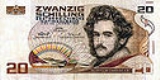
S 20 1.45 123 × 61.5 mm Moritz Daffinger Albertina (Vienna) 1 October 1986 19 October 1988
S 50 3.63 130 × 65 mm Sigmund Freud
Sigmund Freud

Sigmund Freud , born Sigismund Schlomo Freud , was an Austrian psychiatrist who founded the psychoanalysis of psychology. Freud is best known for his theories of the unconscious mind and the defense mechanism of Psychological repression and for creating the clinical practice of psychoanalysis for curing psychopathology through dialogue...
Josephinum (Alsergrund
Alsergrund

Alsergrund is the ninth district of Vienna, Austria . It is located just north of the first, central district, Innere Stadt. Alsergrund was incorporated in 1862, with seven suburbs....
, Vienna
Vienna

Vienna is the Capital of Republic of Austria and also one of the nine states of Austria. Vienna is Austria's primary city, with a population of about 1.7 million...
)
2 January 1986 19 October 1987
S 100 7.27 137 × 68.5 mm Eugen von Böhm-Bawerk
Eugen von Böhm-Bawerk

Eugen Ritter von B?hm-Bawerk was an Austrian Empire economist who made important contributions to the development of Austrian School. Trained in the University of Vienna as a lawyer where he read Carl Menger's Principles of Economics. Though he never studied under Menger, he quickly became an adherent of his theories....
Akademie der Wissenschaften 2 January 1984 14 October 1985
S 500 36.34 144 × 72 mm Otto Wagner
Otto Wagner

Otto Koloman Wagner was an Austrian architect.Wagner was born in Penzing , a suburb of Vienna. He studied in Berlin and Vienna. In 1864, he started designing his first buildings in the historicist style....
Post Office Savings Bank, Vienna 1 July 1985 1986
S 1000 72.67 152 × 76 mm Erwin Schrödinger
Erwin Schrödinger

Erwin Rudolf Josef Alexander Schr?dinger was an Austrian theoretical physicist who achieved fame for his contributions to quantum mechanics, especially the Schr?dinger equation, for which he received the Nobel Prize in 1933....
University of Vienna

The University of Vienna is a public university located in Vienna, Austria. Having opened in 1365, it is one of the oldest universities in Europe....
3 January 1983 1983
S 5000 363.36 160 × 78 mm Wolfgang Amadeus Mozart
Wolfgang Amadeus Mozart

Wolfgang Amadeus Mozart Mozart showed prodigious ability from his earliest childhood in Salzburg. Already competent on keyboard and violin, he composed from the age of five and performed before European royalty; at seventeen he was engaged as a court musician in Salzburg, but grew restless and traveled in search of a better position, always...
Wiener Staatsoper 4 January 1988 17 October 1989
1997 Series
Image Front Image Back Value € equiv. Dimensions Description Date of
Obverse Reverse printing issue
S 500 36.34 147 × 72 mm Rosa Mayreder Rosa Mayreder 1 January 1997 20 October 1997
S 1000 72.67 154 × 72 mm Karl Landsteiner
Karl Landsteiner

Karl Landsteiner , was an Austrian biologist and physician. He is noted for his development in 1901 of the modern system of classification of Blood type from his identification of the presence of agglutinins in the blood, and in 1930 he received the Nobel Prize in Physiology or Medicine....
Karl Landsteiner
Karl Landsteiner

Karl Landsteiner , was an Austrian biologist and physician. He is noted for his development in 1901 of the modern system of classification of Blood type from his identification of the presence of agglutinins in the blood, and in 1930 he received the Nobel Prize in Physiology or Medicine....
1 January 1997 20 October 1997


See also

  • Austrian euro coins
    Austrian euro coins

    Austrian euro coins have a unique design for each denomination, with a common theme for each of the three series of coins. The minor coins feature Austrian flowers, the middle coins examples of architecture from Austria's capital, Vienna, and the two major coins famous Austrians....
  • Economy of Austria
    Economy of Austria

    The Economic system of the Republic of Austria may be characterised as a social market economy similar in structure with that of Germany....
  • shilling
    Shilling

    The shilling is a unit of currency used in current and former Commonwealth of Nations countries, and continued to be used in countries that left the commonwealth, such as Republic of Ireland and Tanzania....
  • Edwin Grienauer
    Edwin Grienauer

    Edwin Grienauer was an Austrian Sculpture and medalist. He was born and died in Vienna....


External links