


Atoms for Peace

Encyclopedia
Dwight D. Eisenhower
Dwight David "Ike" Eisenhower was the 34th President of the United States, from 1953 until 1961. He was a five-star general in the United States Army...
to the UN General Assembly in New York City on December 8, 1953.
The United States then launched an "Atoms for Peace" program that supplied equipment and information to schools, hospitals, and research institutions within the U.S. and throughout the world. The first nuclear reactors in Iran
Iran
Iran , officially the Islamic Republic of Iran , is a country in Southern and Western Asia. The name "Iran" has been in use natively since the Sassanian era and came into use internationally in 1935, before which the country was known to the Western world as Persia...
and Pakistan
Pakistan
Pakistan , officially the Islamic Republic of Pakistan is a sovereign state in South Asia. It has a coastline along the Arabian Sea and the Gulf of Oman in the south and is bordered by Afghanistan and Iran in the west, India in the east and China in the far northeast. In the north, Tajikistan...
were built under the program by American Machine and Foundry.
Philosophy of Atoms for Peace
The speech was possibly a tipping point for international focus on peaceful uses of atomic energy, even during the early stages of the Cold WarCold War
The Cold War was the continuing state from roughly 1946 to 1991 of political conflict, military tension, proxy wars, and economic competition between the Communist World—primarily the Soviet Union and its satellite states and allies—and the powers of the Western world, primarily the United States...
. It could be argued that Eisenhower, with some influence from Albert Einstein
Albert Einstein
Albert Einstein was a German-born theoretical physicist who developed the theory of general relativity, effecting a revolution in physics. For this achievement, Einstein is often regarded as the father of modern physics and one of the most prolific intellects in human history...
, was attempting to convey a spirit of comfort to a terrified world that the horror of Hiroshima
Hiroshima
is the capital of Hiroshima Prefecture, and the largest city in the Chūgoku region of western Honshu, the largest island of Japan. It became best known as the first city in history to be destroyed by a nuclear weapon when the United States Army Air Forces dropped an atomic bomb on it at 8:15 A.M...
and Nagasaki would not be experienced again.
It presents an ostensible antithesis to brinkmanship
Brinkmanship
Brinkmanship is the practice of pushing dangerous events to the verge of disaster in order to achieve the most advantageous outcome...
, the international intrigue that subsequently kept the world at the edge of war.
However recent historians have tended to see the speech as a cold war maneuver directed primarily at U.S. allies in Europe. Eisenhower wanted to make sure that the European allies would go along with the shift in NATO strategy from an emphasis on conventional weapons to the cheaper nuclear weapons. Western Europeans wanted reassurance that the U.S. did not intend to provoke a nuclear war in Europe, and the speech was designed primarily to create that sense of reassurance. Eisenhower later said that he knew the Soviets would reject the specific proposal he offered in the speech.
Eisenhower's invoking of "...those same great concepts of universal peace and human dignity which are so clearly etched in..." the UN Charter, placed new emphasis upon the US's grave responsibility
Moral responsibility
Moral responsibility usually refers to the idea that a person has moral obligations in certain situations. Disobeying moral obligations, then, becomes grounds for justified punishment. Deciding what justifies punishment, if anything, is a principle concern of ethics.People who have moral...
for its nuclear actions— past, present and future. In a large way, this address laid down the rules of engagement for the new kind of warfare, the cold war
Cold War
The Cold War was the continuing state from roughly 1946 to 1991 of political conflict, military tension, proxy wars, and economic competition between the Communist World—primarily the Soviet Union and its satellite states and allies—and the powers of the Western world, primarily the United States...
.
Two quotations from the speech follow:
- "It is with the book of history, and not with isolated pages, that the United States will ever wish to be identified. My country wants to be constructive, not destructive. It wants agreement, not wars, among nations. It wants itself to live in freedom, and in the confidence that the people of every other nation enjoy equally the right of choosing their own way of life."
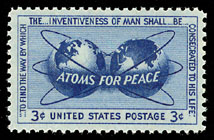
- "To the making of these fateful decisions, the United States pledges before you--and therefore before the world--its determination to help solve the fearful atomic dilemma--to devote its entire heart and mind to find the way by which the miraculous inventiveness of man shall not be dedicated to his death, but consecrated to his life."
See also
- International Atomic Energy AgencyInternational Atomic Energy AgencyThe International Atomic Energy Agency is an international organization that seeks to promote the peaceful use of nuclear energy, and to inhibit its use for any military purpose, including nuclear weapons. The IAEA was established as an autonomous organization on 29 July 1957...
(IAEA) - Atoms for Peace AwardAtoms for Peace AwardThe Atoms for Peace Award was established in 1955 through a grant of $1,000,000 by the Ford Motor Company Fund. An independent nonprofit corporation was set up to administer the award for the development or application of peaceful nuclear technology. It was created in response to U.S. President...
- Atoms for Peace GalaxyNGC 7252NGC 7252 is a peculiar galaxy resulting from an interaction between two galaxies that started a billion years ago. It is located 220 million light years away in the constellation Aquarius...
- Nuclear proliferationNuclear proliferationNuclear proliferation is a term now used to describe the spread of nuclear weapons, fissile material, and weapons-applicable nuclear technology and information, to nations which are not recognized as "Nuclear Weapon States" by the Treaty on the Nonproliferation of Nuclear Weapons, also known as the...
- GammatorGammatorA Gammator was a gamma irradiator made by the Radiation Machinery Corporation during the U.S. Atoms for Peace project of the 1950s and 1960s. The gammator was distributed by the "Atomic Energy Commission to schools, hospitals, and private firms to promote nuclear understanding." Around 120-140...
- Shippingport ReactorShippingport ReactorThe Shippingport Atomic Power Station, "the world’s first full-scale atomic electric power plant devoted exclusively to peacetime uses," was located near the present-day Beaver Valley Nuclear Generating Station on the Ohio River in Beaver...
- Nuclear power plantNuclear power plantA nuclear power plant is a thermal power station in which the heat source is one or more nuclear reactors. As in a conventional thermal power station the heat is used to generate steam which drives a steam turbine connected to a generator which produces electricity.Nuclear power plants are usually...
- Operation PlowshareOperation PlowshareProject Plowshare was the overall United States term for the development of techniques to use nuclear explosives for peaceful construction purposes...
External links
- Documents regarding President Eisenhower's Atoms for Peace speech, Dwight D. Eisenhower Presidential Library
-
 Full transcript and original recording
 - Original annotated draft of speech
- Guide to materials pertaining to the Atoms for Peace speech at the Eisenhower Presidential Library
- Annotated bibliography for Atoms for Peace from the Alsos Digital Library for Nuclear Issues