


Anthony Hope

Encyclopedia
Sir Anthony Hope Hawkins, better known as Anthony Hope (9 February 1863 – 8 July 1933), was an English novelist and playwright. Although he was a prolific writer, especially of adventure novels, he is remembered best for only two books: The Prisoner of Zenda
(1894) and its sequel Rupert of Hentzau
(1898). These works, "minor classics" of English literature
, are set in the contemporaneous fictional country of Ruritania
and spawned the genre known as Ruritanian romance
. Zenda has inspired many adaptations, most notably the 1937 Hollywood movie
of the same name.
, then on the edge of London, where his father, the Reverend Edward Connerford Hawkins, was headmaster of St John's Foundational School for the Sons of Poor Clergy (which soon moved to Leatherhead
in Surrey and is now St John's School). Hope's mother, Jane Isabella Grahame, was an aunt of Kenneth Grahame
, the author of Wind in the Willows. Hope was educated by his father and then attended Marlborough College
, where he was editor of The Marlburian. He won a scholarship to Balliol College at Oxford University in 1881. Before graduating in 1886, he played football for his college, took a first-class degree in Classics, and was one of the rare Liberal
presidents of the Oxford Union
, becoming known as a good speaker. His contemporaries included Cosmo Gordon Lang, later Archbishop of Canterbury
; A.E.W. Mason, author of The Four Feathers
; Arthur Quiller-Couch
, a literary critic; Gilbert Murray
, a classical scholar and intellectual; Sir Michael Sadler
, an historian and educationalist; and J. A. Spender, editor of the Westminster Gazette
.
in 1887. He had time to write, as his working day was not overly full during these first years, and he lived with his widowed father, then vicar of St Bride's Church
, Fleet Street
. Hope's short pieces appeared in periodicals, but for his first book he was forced to resort to a vanity press
. A Man of Mark (1890) is notable primarily for its similarities to Zenda: it is set in an imaginary country, Aureataland, and features political upheaval and humour. More novels and short stories
followed, including Father Stafford in 1891 and the mildly successful Mr Witt's Widow in 1892. He stood as a Liberal
candidate for the Southern Division of South Bucks
in the election of 1892
but was not elected. In 1893 he wrote three novels (Sport Royal, A Change of Air and Half-a-Hero) and a series of sketch
es that first appeared in the Westminster Gazette
and were collected in 1894 as The Dolly Dialogues, illustrated by Arthur Rackham
. Dolly was his first major literary success. A.E.W. Mason deemed these conversations "so truly set in the London of their day
that the social historian would be unwise to neglect them" and said they were written with "delicate wit [and] a shade of sadness."
The idea for Hope's tale of political intrigue, The Prisoner of Zenda, being the history of three months in the life of an English gentleman, came to him at the close of 1893 as he was walking in London. Hope finished the first draft in a month, and the book was in print by April. The story is set in the fictional European kingdom of 'Ruritania', a term which has come to mean 'the novelist's and dramatist's locale for court romances in a modern setting.' Zenda achieved instant success, and its witty protagonist, the debonair Rudolf Rassendyll, became a well-known literary creation. The novel was praised by Mason, the literary critic Andrew Lang
, and Robert Louis Stevenson
. The popularity of Zenda convinced Hope to give up the "brilliant legal career [that] seemed to lie ahead of him" to become a full-time writer, but he "never again achieved such complete artistic success as in this one book." Also in 1894, Hope produced The God in the Car, a political story.
The sequel to Zenda, Rupert of Hentzau, begun in 1895 and serialised in the Pall Mall Magazine
, did not appear between hard covers until 1898. A prequel entitled The Heart of Princess Osra
, a collection of short stories set about 150 years before Zenda, appeared in 1896. Hope also co-wrote, with Edward Rose, the first stage adaptation of Zenda, which appeared on the London stage
that year. Hope alone wrote the dramatic adaptation of Rupert of Hentzau in 1899.
 In 1898, he wrote Simon Dale, an historical novel involving the actress and courtesan Nell Gwyn
. Marie Tempest
appeared in the dramatisation, called English Nell. One of Hope's plays, The Adventure of Lady Ursula, was produced in 1898. This was followed by his novel The King's Mirror (1899), which Hope considered one of his best works. In 1900, he published Quisanté, and he was elected chairman of the committee of the Society of Authors
. He wrote Tristram of Blent in 1901 and Double Harness in 1904, followed by A Servant of the Public in 1905, about the love of acting. In 1906, he produced Sophy of Kravonia, a novel in a similar vein to Zenda which was serialised in the Windsor Magazine
; Roger Lancelyn Green is especially damning of this effort. In 1910, he wrote Second String, followed by Mrs Maxon Protests the next year.
In addition, Hope wrote or co-wrote many plays and some political non-fiction during the First World War, some under the auspices of the Ministry of Information. Later publications included Beaumaroy Home from the Wars, in 1919, and Lucinda in 1920. Lancelyn Green asserts that Hope was "a first-class amateur but only a second-class professional writer.
Hope married Elizabeth Somerville (1885/6–1946) in 1903, and they had two sons and a daughter. He was knighted
in 1918 for his contribution to propaganda efforts during World War I
. He published an autobiographical book
, Memories and Notes, in 1927. Hope died of throat cancer at the age of 70 at his country home, Heath Farm at Walton-on-the-Hill
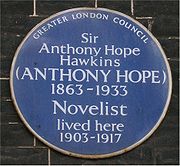
in Surrey. There is a blue plaque
on his house in Bedford Square
, London.
The Prisoner of Zenda
The Prisoner of Zenda is an adventure novel by Anthony Hope, published in 1894. The king of the fictional country of Ruritania is drugged on the eve of his coronation and thus unable to attend his own coronation. Political forces are such that in order for the king to retain his crown his...
(1894) and its sequel Rupert of Hentzau
Rupert of Hentzau
Rupert of Hentzau is a sequel by Anthony Hope to The Prisoner of Zenda, written in 1895, but not published until 1898.-Plot summary:...
(1898). These works, "minor classics" of English literature
English literature
English literature is the literature written in the English language, including literature composed in English by writers not necessarily from England; for example, Robert Burns was Scottish, James Joyce was Irish, Joseph Conrad was Polish, Dylan Thomas was Welsh, Edgar Allan Poe was American, J....
, are set in the contemporaneous fictional country of Ruritania
Ruritania
Ruritania is a fictional country in central Europe which forms the setting for three books by Anthony Hope: The Prisoner of Zenda , The Heart of Princess Osra , and Rupert of Hentzau...
and spawned the genre known as Ruritanian romance
Ruritanian Romance
A Ruritanian Romance is a story set in a fictional country, usually in Central or Eastern Europe, such as the Ruritania that gave the genre its name...
. Zenda has inspired many adaptations, most notably the 1937 Hollywood movie
The Prisoner of Zenda (1937 film)
The Prisoner of Zenda is a 1937 black-and-white adventure film based on the Anthony Hope 1894 novel of the same name and the 1896 play. Of the many film adaptations, this is considered by many to be the definitive version....
of the same name.
Youth
Hope was born in ClaptonLower Clapton
Lower Clapton is a district within the London Borough of Hackney.It is immediately adjacent to central Hackney - bounded, roughly, by the western side of Hackney Downs , the Lea Valley , Clifden Road and the Lea Bridge Road...
, then on the edge of London, where his father, the Reverend Edward Connerford Hawkins, was headmaster of St John's Foundational School for the Sons of Poor Clergy (which soon moved to Leatherhead
Leatherhead
Leatherhead is a town in the County of Surrey, England, on the River Mole, part of Mole Valley district. It is thought to be of Saxon origin...
in Surrey and is now St John's School). Hope's mother, Jane Isabella Grahame, was an aunt of Kenneth Grahame
Kenneth Grahame
Kenneth Grahame was a Scottish writer, most famous for The Wind in the Willows , one of the classics of children's literature. He also wrote The Reluctant Dragon; both books were later adapted into Disney films....
, the author of Wind in the Willows. Hope was educated by his father and then attended Marlborough College
Marlborough College
Marlborough College is a British co-educational independent school for day and boarding pupils, located in Marlborough, Wiltshire.Founded in 1843 for the education of the sons of Church of England clergy, the school now accepts both boys and girls of all beliefs. Currently there are just over 800...
, where he was editor of The Marlburian. He won a scholarship to Balliol College at Oxford University in 1881. Before graduating in 1886, he played football for his college, took a first-class degree in Classics, and was one of the rare Liberal
Liberal Party (UK)
The Liberal Party was one of the two major political parties of the United Kingdom during the 19th and early 20th centuries. It was a third party of negligible importance throughout the latter half of the 20th Century, before merging with the Social Democratic Party in 1988 to form the present day...
presidents of the Oxford Union
Oxford Union
The Oxford Union Society, commonly referred to simply as the Oxford Union, is a debating society in the city of Oxford, Britain, whose membership is drawn primarily but not exclusively from the University of Oxford...
, becoming known as a good speaker. His contemporaries included Cosmo Gordon Lang, later Archbishop of Canterbury
Archbishop of Canterbury
The Archbishop of Canterbury is the senior bishop and principal leader of the Church of England, the symbolic head of the worldwide Anglican Communion, and the diocesan bishop of the Diocese of Canterbury. In his role as head of the Anglican Communion, the archbishop leads the third largest group...
; A.E.W. Mason, author of The Four Feathers
The Four Feathers
The Four Feathers is a 1902 adventure novel by British writer A.E.W. Mason that has inspired many films of the same title.-Plot summary:...
; Arthur Quiller-Couch
Arthur Quiller-Couch
Sir Arthur Thomas Quiller-Couch was a Cornish writer, who published under the pen name of Q. He is primarily remembered for the monumental Oxford Book Of English Verse 1250–1900 , and for his literary criticism...
, a literary critic; Gilbert Murray
Gilbert Murray
George Gilbert Aimé Murray, OM was an Australian born British classical scholar and public intellectual, with connections in many spheres. He was an outstanding scholar of the language and culture of Ancient Greece, perhaps the leading authority in the first half of the twentieth century...
, a classical scholar and intellectual; Sir Michael Sadler
Michael Ernest Sadler
Sir Michael Ernest Sadler KCSI was a British historian, educationalist and university administrator. He worked at the universities of Manchester and Leeds. He was a champion of the public school system.-Early life and education:...
, an historian and educationalist; and J. A. Spender, editor of the Westminster Gazette
Westminster Gazette
The Westminster Gazette was an influential Liberal newspaper based in London. It was known for publishing sketches and short stories, including early works by Raymond Chandler, Anthony Hope and Saki, and travel writing by Rupert Brooke. One of its editors was caricaturist and political cartoonist...
.
Early career and Zenda
Hope trained as a lawyer and barrister, being called to the Bar by the Middle TempleMiddle Temple
The Honourable Society of the Middle Temple, commonly known as Middle Temple, is one of the four Inns of Court exclusively entitled to call their members to the English Bar as barristers; the others being the Inner Temple, Gray's Inn and Lincoln's Inn...
in 1887. He had time to write, as his working day was not overly full during these first years, and he lived with his widowed father, then vicar of St Bride's Church
St Bride's Church
St Bride's Church is a church in the City of London, England. The building's most recent incarnation was designed by Sir Christopher Wren in 1672 on Fleet Street in the City of London, though Wren's original building was largely gutted by fire during the London Blitz in 1940. Due to its location on...
, Fleet Street
Fleet Street
Fleet Street is a street in central London, United Kingdom, named after the River Fleet, a stream that now flows underground. It was the home of the British press until the 1980s...
. Hope's short pieces appeared in periodicals, but for his first book he was forced to resort to a vanity press
Vanity press
A vanity press or vanity publisher is a term describing a publishing house that publishes books at the author's expense. Publisher Johnathon Clifford claims to have coined the term in 1959. However, the term appears in mainstream U.S...
. A Man of Mark (1890) is notable primarily for its similarities to Zenda: it is set in an imaginary country, Aureataland, and features political upheaval and humour. More novels and short stories
Short Stories
Short Stories may refer to:*A plural for Short story*Short Stories , an American pulp magazine published from 1890-1959*Short Stories, a 1954 collection by O. E...
followed, including Father Stafford in 1891 and the mildly successful Mr Witt's Widow in 1892. He stood as a Liberal
Liberal Party (UK)
The Liberal Party was one of the two major political parties of the United Kingdom during the 19th and early 20th centuries. It was a third party of negligible importance throughout the latter half of the 20th Century, before merging with the Social Democratic Party in 1988 to form the present day...
candidate for the Southern Division of South Bucks
Wycombe (UK Parliament constituency)
Wycombe is a parliamentary constituency represented in the House of Commons of the Parliament of the United Kingdom. It currently elects one Member of Parliament by the first-past-the-post system of elections....
in the election of 1892
United Kingdom general election, 1892
The 1892 United Kingdom general election was held from 4 July to 26 July 1892. It saw the Conservatives, led by Lord Salisbury, win the greatest number of seats, but not enough for an overall majority as William Ewart Gladstone's Liberals won many more seats than in the 1886 general election...
but was not elected. In 1893 he wrote three novels (Sport Royal, A Change of Air and Half-a-Hero) and a series of sketch
Sketch story
A sketch story, or sketch, is a piece of writing that is generally shorter than a short story, and contains very little, if any, plot. The term was most popularly-used in the late nineteenth century. As a literary work, it is also often referred to simply as the sketch.-Style:A sketch is mainly...
es that first appeared in the Westminster Gazette
Westminster Gazette
The Westminster Gazette was an influential Liberal newspaper based in London. It was known for publishing sketches and short stories, including early works by Raymond Chandler, Anthony Hope and Saki, and travel writing by Rupert Brooke. One of its editors was caricaturist and political cartoonist...
and were collected in 1894 as The Dolly Dialogues, illustrated by Arthur Rackham
Arthur Rackham
Arthur Rackham was an English book illustrator.-Biography:Rackham was born in London as one of 12 children. At the age of 18, he worked as a clerk at the Westminster Fire Office and began studying part-time at the Lambeth School of Art.In 1892 he left his job and started working for The...
. Dolly was his first major literary success. A.E.W. Mason deemed these conversations "so truly set in the London of their day
Victorian era
The Victorian era of British history was the period of Queen Victoria's reign from 20 June 1837 until her death on 22 January 1901. It was a long period of peace, prosperity, refined sensibilities and national self-confidence...
that the social historian would be unwise to neglect them" and said they were written with "delicate wit [and] a shade of sadness."
The idea for Hope's tale of political intrigue, The Prisoner of Zenda, being the history of three months in the life of an English gentleman, came to him at the close of 1893 as he was walking in London. Hope finished the first draft in a month, and the book was in print by April. The story is set in the fictional European kingdom of 'Ruritania', a term which has come to mean 'the novelist's and dramatist's locale for court romances in a modern setting.' Zenda achieved instant success, and its witty protagonist, the debonair Rudolf Rassendyll, became a well-known literary creation. The novel was praised by Mason, the literary critic Andrew Lang
Andrew Lang
Andrew Lang was a Scots poet, novelist, literary critic, and contributor to the field of anthropology. He is best known as a collector of folk and fairy tales. The Andrew Lang lectures at the University of St Andrews are named after him.- Biography :Lang was born in Selkirk...
, and Robert Louis Stevenson
Robert Louis Stevenson
Robert Louis Balfour Stevenson was a Scottish novelist, poet, essayist and travel writer. His best-known books include Treasure Island, Kidnapped, and Strange Case of Dr Jekyll and Mr Hyde....
. The popularity of Zenda convinced Hope to give up the "brilliant legal career [that] seemed to lie ahead of him" to become a full-time writer, but he "never again achieved such complete artistic success as in this one book." Also in 1894, Hope produced The God in the Car, a political story.
The sequel to Zenda, Rupert of Hentzau, begun in 1895 and serialised in the Pall Mall Magazine
The Pall Mall Magazine
The Pall Mall Magazine was a monthly British literary magazine published between 1893 and 1914. Started by William Waldorf Astor as an offshoot of the Pall Mall Gazette, the magazine included poetry, short stories, serialized fiction, and general commentaries, along with extensive artwork...
, did not appear between hard covers until 1898. A prequel entitled The Heart of Princess Osra
The Heart of Princess Osra
The Heart of Princess Osra is part of Anthony Hope's trilogy of novels set in the fictional country of Ruritania and which spawned the genre of Ruritanian romance...
, a collection of short stories set about 150 years before Zenda, appeared in 1896. Hope also co-wrote, with Edward Rose, the first stage adaptation of Zenda, which appeared on the London stage
West End theatre
West End theatre is a popular term for mainstream professional theatre staged in the large theatres of London's 'Theatreland', the West End. Along with New York's Broadway theatre, West End theatre is usually considered to represent the highest level of commercial theatre in the English speaking...
that year. Hope alone wrote the dramatic adaptation of Rupert of Hentzau in 1899.
Later years
Hope wrote 32 volumes of fiction over the course of his lifetime, and he had a large popular following. In 1896 he published The Chronicles of Count Antonio, followed in 1897 by a tale of adventure set on a Greek island, entitled Phroso. He went on a publicity tour of the United States in late 1897, during which he impressed a New York Times reporter as being somewhat like Rudolf Rassendyll: a well-dressed Englishman with a hearty laugh, a soldierly attitude, a dry sense of humour, "quiet, easy manners" and an air of shrewdness.Nell Gwyn
Eleanor "Nell" Gwyn was a long-time mistress of King Charles II of England. Called "pretty, witty Nell" by Samuel Pepys, she has been regarded as a living embodiment of the spirit of Restoration England and has come to be considered a folk heroine, with a story echoing the rags-to-royalty tale of...
. Marie Tempest
Marie Tempest
Dame Marie Tempest DBE was an English singer and actress known as the "queen of her profession".Tempest became the most famous soprano in late Victorian light opera and Edwardian musical comedies. Later, she became a leading comic actress and toured widely in North America and elsewhere...
appeared in the dramatisation, called English Nell. One of Hope's plays, The Adventure of Lady Ursula, was produced in 1898. This was followed by his novel The King's Mirror (1899), which Hope considered one of his best works. In 1900, he published Quisanté, and he was elected chairman of the committee of the Society of Authors
Society of Authors
The Society of Authors is a trade union for professional writers that was founded in 1884 to protect the rights of writers and fight to retain those rights .It has counted amongst its members and presidents numerous notable writers and poets including Tennyson The Society of Authors (UK) is a...
. He wrote Tristram of Blent in 1901 and Double Harness in 1904, followed by A Servant of the Public in 1905, about the love of acting. In 1906, he produced Sophy of Kravonia, a novel in a similar vein to Zenda which was serialised in the Windsor Magazine
Windsor Magazine
The Windsor Magazine was a monthly illustrated publication produced by Ward Lock & Co from January 1895 to September 1939 .The title page described it as "An Illustrated Monthly for Men and Women"....
; Roger Lancelyn Green is especially damning of this effort. In 1910, he wrote Second String, followed by Mrs Maxon Protests the next year.
In addition, Hope wrote or co-wrote many plays and some political non-fiction during the First World War, some under the auspices of the Ministry of Information. Later publications included Beaumaroy Home from the Wars, in 1919, and Lucinda in 1920. Lancelyn Green asserts that Hope was "a first-class amateur but only a second-class professional writer.
Hope married Elizabeth Somerville (1885/6–1946) in 1903, and they had two sons and a daughter. He was knighted
Knight Bachelor
The rank of Knight Bachelor is a part of the British honours system. It is the most basic rank of a man who has been knighted by the monarch but not as a member of one of the organised Orders of Chivalry...
in 1918 for his contribution to propaganda efforts during World War I
World War I
World War I , which was predominantly called the World War or the Great War from its occurrence until 1939, and the First World War or World War I thereafter, was a major war centred in Europe that began on 28 July 1914 and lasted until 11 November 1918...
. He published an autobiographical book
Autobiography
An autobiography is a book about the life of a person, written by that person.-Origin of the term:...
, Memories and Notes, in 1927. Hope died of throat cancer at the age of 70 at his country home, Heath Farm at Walton-on-the-Hill
Walton-on-the-Hill
Walton-on-the-Hill, Surrey, is a village in England, situated midway between Reigate and Epsom, just inside the M25 orbital motorway around London. It is situated close to the larger village of Tadworth. Other neighbouring villages include: Kingswood, Burgh Heath, Headley and Box Hill...
in Surrey. There is a blue plaque
Blue plaque
A blue plaque is a permanent sign installed in a public place to commemorate a link between that location and a famous person or event, serving as a historical marker....
on his house in Bedford Square
Bedford Square
Bedford Square is a square in the Bloomsbury district of the Borough of Camden in London, England.Built between 1775 and 1783 as an upper middle class residential area, the sqare has had many distinguished residents, including Lord Eldon, one of Britain's longest serving and most celebrated Lord...
, London.