
All Topics  
Ancient Hawaii

 
Ancient Hawaii

   Email Print
   Bookmark   Link


Ancient Hawaii


Ancient Hawaii refers to the period of Hawaii
Hawaii

File:Pahoehoe and Aa flows at Hawaii.jpgThe State of Hawaii is a U.S. state in the United States, located on an archipelago in the central Pacific Ocean southwest of the continental United States, southeast of Japan, and northeast of Australia....
an history preceding the unification of the Kingdom of Hawai'i
Kingdom of Hawaii

The Kingdom of Hawaii was established during the years 1795 to 1810 with the subjugation of the smaller independent chiefdoms of Oahu, Maui, Molokai, Lanai, Kauai and Niihau by the chiefdom of Hawaii into one unified government....
 by Kamehameha the Great in 1810. Included in this period was the first contact made by Captain James Cook in 1778.

iian history is inextricably tied into a larger Polynesia
Polynesia

Polynesia is a subregion of Oceania, comprising a large grouping of over 1,000 islands scattered over the central and southern Pacific Ocean....
n phenomenon. Hawaii is the apex of the Polynesian Triangle
Polynesian Triangle

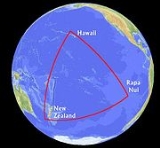
The Polynesian Triangle is a region of the Pacific Ocean anchored by three island groups: Hawaii, Easter Island and New Zealand.The many island cultures within this vast triangle speak Polynesian languages, which are classified by linguists as part of the Malayo-Polynesian languages subgroup....
, a region of the Pacific Ocean
Pacific Ocean

The Pacific Ocean is the largest of the Earth's oceanic divisions. Its name is derived from the Latin name Mare Pacificum, "peaceful sea", bestowed upon it by the Portugal explorer Ferdinand Magellan....
 anchored by three island groups: Hawaii, Rapa Nui (Easter Island
Easter Island

Easter Island is a Polynesian island in the southeastern Pacific Ocean, at the southeastern most point of the Polynesian triangle. The island is a special territory of Chile....
), and Aotearoa (New Zealand
New Zealand

New Zealand is an island country in the south-western Pacific Ocean comprising two main landmasses , and numerous Islands of New Zealand, most notably Stewart Island/Rakiura and the Chatham Islands....
).


Discussion
Ask a question about 'Ancient Hawaii'
Start a new discussion about 'Ancient Hawaii'
Answer questions from other users
Full Discussion Forum


Recent Posts


Encyclopedia


Ancient Hawaii refers to the period of Hawaii
Hawaii

File:Pahoehoe and Aa flows at Hawaii.jpgThe State of Hawaii is a U.S. state in the United States, located on an archipelago in the central Pacific Ocean southwest of the continental United States, southeast of Japan, and northeast of Australia....
an history preceding the unification of the Kingdom of Hawai'i
Kingdom of Hawaii

The Kingdom of Hawaii was established during the years 1795 to 1810 with the subjugation of the smaller independent chiefdoms of Oahu, Maui, Molokai, Lanai, Kauai and Niihau by the chiefdom of Hawaii into one unified government....
 by Kamehameha the Great in 1810. Included in this period was the first contact made by Captain James Cook in 1778.

Polynesian Triangle

Hawaiian history is inextricably tied into a larger Polynesia
Polynesia

Polynesia is a subregion of Oceania, comprising a large grouping of over 1,000 islands scattered over the central and southern Pacific Ocean....
n phenomenon. Hawaii is the apex of the Polynesian Triangle
Polynesian Triangle

The Polynesian Triangle is a region of the Pacific Ocean anchored by three island groups: Hawaii, Easter Island and New Zealand.The many island cultures within this vast triangle speak Polynesian languages, which are classified by linguists as part of the Malayo-Polynesian languages subgroup....
, a region of the Pacific Ocean
Pacific Ocean

The Pacific Ocean is the largest of the Earth's oceanic divisions. Its name is derived from the Latin name Mare Pacificum, "peaceful sea", bestowed upon it by the Portugal explorer Ferdinand Magellan....
 anchored by three island groups: Hawaii, Rapa Nui (Easter Island
Easter Island

Easter Island is a Polynesian island in the southeastern Pacific Ocean, at the southeastern most point of the Polynesian triangle. The island is a special territory of Chile....
), and Aotearoa (New Zealand
New Zealand

New Zealand is an island country in the south-western Pacific Ocean comprising two main landmasses , and numerous Islands of New Zealand, most notably Stewart Island/Rakiura and the Chatham Islands....
). The many island cultures within the Polynesian Triangle share similar languages derived from a proto-Malayo-Polynesian language
Malayo-Polynesian languages

The Malayo-Polynesian languages are a subgroup of the Austronesian languages, with approximately 351 million speakers. These are widely dispersed throughout the island nations of Southeast Asia and the Pacific Ocean, with a smaller number in continental Asia....
 used in Southeast Asia
Southeast Asia

Southeast Asia or Southeastern Asia is a subregion of Asia, consisting of the countries that are geographically south of China, east of India and north of Australia....
 5,000 years ago. Polynesians also share cultural traditions, such as religion, social organization, myths, and material culture. Anthropologists believe that all Polynesians have descended from a South Pacific proto-culture created by an Austronesian (Malayo-Polynesian) people that had migrated from Southeast Asia
Southeast Asia

Southeast Asia or Southeastern Asia is a subregion of Asia, consisting of the countries that are geographically south of China, east of India and north of Australia....
.
Polynesiantraiangle
The seven[this list contains eight] main Polynesian cultures are:

  • Aotearoa
    Maori

    The Maori are the indigenous people Polynesian people of Aotearoa . The group probably arrived in south-western Polynesia in several waves at some time before 1300....
  • Hawaii
    Hawaii

    File:Pahoehoe and Aa flows at Hawaii.jpgThe State of Hawaii is a U.S. state in the United States, located on an archipelago in the central Pacific Ocean southwest of the continental United States, southeast of Japan, and northeast of Australia....
  • Rapa Nui
    Easter Island

    Easter Island is a Polynesian island in the southeastern Pacific Ocean, at the southeastern most point of the Polynesian triangle. The island is a special territory of Chile....
  • Marquesas
  • Samoa
    Samoa

    Samoa , officially the Independent State of Samoa , is a country governing the western part of the Samoan Islands archipelago in the South Pacific Ocean....
  • Tahiti
    Tahiti

    O Tahiti is the largest island in the Windward Islands group of French Polynesia, located in the archipelago of Society Islands in the southern Pacific Ocean....
  • Tokelau
    Tokelau

    Tokelau is a territory of New Zealand that consists of three tropical coral atolls in the South Pacific Ocean. The United Nations United Nations General Assembly designated Tokelau a United Nations list of Non-Self-Governing Territories....
  • Tonga
    Tonga

    The Kingdom of Tonga in the south Pacific Ocean comprises an archipelago of 171 islands, 48 of them inhabited, stretching over a distance of about 800 kilometres in a north-south line....


Voyage to the Hawaiian islands


Priests Traveling Across Kealakekua Bay for First Contact Rituals
Polynesian seafarers were skilled ocean navigators and astronomers
Astronomy

Astronomy is the science of Astronomical object and Phenomenon that originate outside the Earth's atmosphere . It is concerned with the evolution, physics, chemistry, meteorology, and motion of celestial objects, as well as the physical cosmology....
. At a time when Western boats rarely went out of sight of land, they often traveled long distances.

The early settlement history of Hawaii is still not completely resolved. Some believe that the first Polynesians arrived in Hawaii in the 3rd century from the Marquesas and were followed by Tahiti
Tahiti

O Tahiti is the largest island in the Windward Islands group of French Polynesia, located in the archipelago of Society Islands in the southern Pacific Ocean....
an settlers in AD 1300 who conquered the original inhabitants. Others believe that there was only a single, extended period of settlement. Patrick Kirch, in his 2001 Hawaiki, argues for an extended period of contact but not necessarily for a Tahitian invasion:

There is substantial archaeological as well as paleoecological evidence confirming Hawaiian settlement no later than 800 AD, and quite possibly as early as AD 300–500 (Kirch 1985; Athens 1997). The immediate source of the colonizing population in Hawai'i is likely to have been the Southern Marquesas, but continued contact between Hawai'i and islands in the core region is indicated by linguistic evidence (lexical borrowings from the Tahitic subgroup), abundant oral traditions (Cachola-Abad 1993), botanical indications, uniquely shared mtDNA sequences in populations of the Pacific Rat (Matisoo-Smith et al. 1998), and possibly some archaeological style changes as well. However, long-distance voyaging between Hawai'i and the central Eastern Polynesian core became less frequent after about AD 1200, and was little more than a memory encoded in Hawaiian oral traditions by the time of European contact.


The only evidence for a Tahitian conquest of the islands are the legends of Hawaiiloa
Hawaiiloa

Hawaiiloa is the hero of an ancient Hawaiian legend about the settling of the Hawaiian Islands. After having accidentally stumbled upon the islands, he returned to his homeland which he called Ka aina kai melemele a Kane, "the land of the yellow sea of Kane"....
 and the navigator-priest Paao
Pa'ao

Paao is either a figure from a Hawaiian Hawaiian mythology or a historical character. He is said to have been a high priest from Kahiki ? later identified with Tahiti ? who introduced certain customs, such as human sacrifice, to Hawaii....
, who is said to have made a voyage between Hawaii and the island of "Kahiki" (Tahiti) and introduced many new customs. Some Hawaiians believe that there was a real historical Pa'ao
Pa'ao

Paao is either a figure from a Hawaiian Hawaiian mythology or a historical character. He is said to have been a high priest from Kahiki ? later identified with Tahiti ? who introduced certain customs, such as human sacrifice, to Hawaii....
. Early historians, such as Fornander and Beckwith, also subscribed to this Tahitian invasion theory, but later historians, such as Kirch, simply do not mention it.

King Kalakaua in his book, The Legends and Myths of Hawaii, claims that Pa?ao was from Samoa. The religion he brought, the Kahuna religion was from Samoa. Paao was instrumental in bringing the High Chief Pili
Pili-kaaiea

In Hawaiian mythology, Pili-kaaiea was the 1st Alii Aimoku of Hawaii Island. He was sovereign king or tribal chief,He was called a 'grandchild' of Lana-ka-wai on the Ulu line, but born and brought up in Kahiki....
 from Samoa to rule the island of Hawaii. Pili
Pili

Pili may refer to:Common names:* Pilus is a cellular organelle* Pili, a Philippine Tree that is a source of the Pili nut* Pili is a Hawaiian grass used to thatch structures...
 is a well known entity in Samoan mythology. His descendents were one of the highest ranked families in Samoa even to this day. According to the genealogy laid out by King Kalakaua, King Kamehameha was also a descendant of Pili. The big island of Savaii in the Samoan archipeligo was known as Hawaiki in ancient times.

Some writers believe that there were other settlers in Hawai'i, peoples who were forced back into remote valleys by newer arrivals. They claim that stories about menehune
Menehune

In Hawaiian mythology, the Menehune [pronounced meh-neh-HOO-neh] are said to be a people, sometimes described as dwarfs in size, who live in the deep forests and hidden valleys of the Hawaiian islands, far from the eyes of normal humans....
, little people who built heiaus and fishponds, prove the existence of ancient peoples who settled the islands before the Hawaiians. Luomala, in her 1951 essay on the menehune, argues that these stories, like stories of "dog people" with tails living in deep forests, are folklore and not to be construed as evidence of an earlier race. Archaeologists have found no evidence suggesting earlier settlements and menehune legends are simply not mentioned or discussed in current archaeological literature.

However, there is one puzzling artifact on the island of Kauai
Kauai

Kauai or Kauai is the oldest of the main Hawaiian Islands. With an area of , it is the fourth largest of the main islands in the Hawaiian archipelago and the List of islands of the United States by area....
, one that has never been satisfactorily explained. Running alongside the Waimea River is an ancient aqueduct known as the "Menehune ditch." This channel once brought water from the Waimea River to irrigate taro
Taro

Taro , more rarely kalo , gabi in The Philippines and dalo in Fiji is a tropical plant grown primarily as a root vegetable for its edible corm, and secondarily as a leaf vegetable....
 fields. The rocks were shaped into rectangular bricks and carefully fitted together — a method of stonework requiring immense labor, and not typical of Hawaiian rockwork. This ditch is currently believed to have been constructed before Captain Cook's first visit.

Settlement

The colonists brought along with them clothing, plants and livestock and established settlements along the coasts and larger valleys. Upon their arrival, the settlers grew kalo (taro), maia (banana), niu (coconut), ulu (breadfruit), and raised pua'a (pork), moa (chicken), and 'ilio (dog), although these meats were eaten less often than fruits, vegetables, and seafood. Popular condiments included pa'akai (salt), ground kukui nut, limu (seaweed), and ko (sugarcane) which was used as both a sweet and a medicine. In addition to the foods they brought, the settlers also acquired 'uala (sweet potato
Sweet potato

The 'sweet potato' is a dicotyledonous plant which belongs to the family Convolvulaceae. Amongst the approximately 50 genera and more than 1000 species of this family, only I....
), which has yet to be adequately explained as the plant originates in South America
South America

South America is the southern continent of the Americas, situated entirely in the Western Hemisphere and mostly in the Southern Hemisphere, with a relatively small portion in the Northern Hemisphere....
. A few researchers have argued that the presence of the sweet potato in the ancient Hawaiian diet is evidence of pre-Columbian trans-oceanic contact
Pre-Columbian trans-oceanic contact

Pre-Columbian trans-oceanic contact describes alleged interactions between the indigenous peoples of the Americas and peoples of other continents ? Africa, Asia, Europe, or Oceania ? pre-Columbian the Voyages of Christopher Columbus#First voyage of Christopher Columbus in 1492....
 with the Americas, while most have dismissed the idea.

As soon as they arrived, the new settlers built hale (homes) and heiau (temples). Archaeologists currently believe that the first settlements were on the southern end of the Big Island of Hawai'i and that they quickly extended northwards, along the seacoasts and the easily accessible river valleys. As the population increased, settlements were made further inland.

Village

A traditional village of ancient Hawaii included several structures. Listed in order of importance:

  • Heiau, temple to the gods. They were built on high-rising stone terraces and adorned with wood and stone carved idols. A source of great mana or divine power, the heiau was restricted to alii, the king and kahuna, or priests.


  • Hale alii, the house of the chief. It was used as a residence for the high chief and meeting house of the lesser chiefs. It was always built on a raised stone foundation to represent high social standing. Kahili, or feather standards, were placed outside to signify royalty. Women and children were banned from entering.


  • Hale pahu, the house of the sacred hula instruments. It held the pahu drums. It was treated as a religious space as hula was a religious activity in honor of the goddess Laka.


  • Hale papaa, the house of royal storage. It was built to store royal implements including fabrics, prized nets and lines, clubs, spears and other weapons.


  • Hale ulana, the house of the weaver. It was the house where craftswomen would gather each day to manufacture the village baskets, fans, mats and other implements from dried pandanus leaves called lauhala.


  • Hale mua, the men's eating house. It was considered a sacred place because it was used to carve stone idols of aumakua or ancestral gods. Men and women could not eat with each other for fear that men were vulnerable while eating to have their mana, or divine spirit, stolen by women. Women ate at their own separate eating house called the hale aina.the design was made for the men to enter end exit quickly


  • Hale waa, the house of the canoe. It was built along the beaches as a shelter for their fishing vessels. Hawaiians also stored koa logs used to craft the canoe
    Canoe

    A canoe is a small narrow boat, typically human-powered, though it may also be powered by sails or small electric or gas motors. Canoes usually are pointed at both bow and stern and are normally open on top, but can be covered....
    s.


  • Hale lawaia, the house of fishing. It was built along the beaches as a shelter for their fishing nets and lines. Nets and lines were made by a tough rope fashioned from woven coconut
    Coconut

    The Coconut Palm is a member of the Family Arecaceae . It is the only species in the genus Cocos, and is a large palm, growing to 30 m tall, with pinnate leaf 4-6 m long, pinnae 60-90 cm long; old leaves break away cleanly leaving the trunk smooth....
     husks. Fish hooks were made of human, pig or dog bone. Implements found in the hale lawaia were some of the most prized possessions of the entire village.


  • Hale noho, the living house. It was built as sleeping and living quarters for the Hawaiian family unit.


  • Imu, the communal earth oven. Dug in the ground, it was used to cook the entire village's food including puaa or pork. Only men cooked using the imu.


Caste system


Ancient Hawaii was a caste society
Caste

Castes are hereditary systems of wikt:occupation, endogamy, culture, social class, and political power, the assignment of individuals to places in the social hierarchy is determined by social group and culture....
 much like Hindus in India. People were born into specific social classes; social mobility was not unknown, but it was extremely rare. The main classes were:

  • Alii. This class consisted of the high and lesser chiefs of the realms. They governed with divine power called mana. Could be equated with Kshatriyas in India who had the same role in the society.


  • Kahuna. Priests conducted religious ceremonies, at the heiau and elsewhere. Professionals included master carpenters and boatbuilders, chanters, dancers, genealogists, and physicians and healers. Much like Brahmins in hindu society.


  • Makaainana. Commoners farmed, fished, and exercised the simpler crafts. They labored not only for themselves and their families, but to support the chiefs and kahuna. Much like vaishyas in Hinduism.


  • Kaua. They are believed to have been war captives, or the descendents of war captives. Marriage between higher castes and the kauwa was strictly forbidden. The kauwa worked for the chiefs and were often used as human sacrifices at the luakini
    Luakini

    In ancient Hawai'i, a luakini temple, or luakini heiau, was a Native Hawaiian sacred place where human and animal blood sacrifices were offered....
     heiau
    . (They were not the only sacrifices; law-breakers of all castes or defeated political opponents were also acceptable as victims.). Much like shudras in Hinduism.


Land tenure

The great chiefs owned all the land in the areas which they controlled. They allocated control of portions of the land to their kinsmen and retainers, who then apportioned land to the commoners. On the death of one chief and the accession of another, lands were re-apportioned -- some of the previous "owners" would lose their lands, and others would gain them. Lands were also re-apportioned when one chief defeated another, and re-distributed the conquered lands as rewards to his warriors.

In practice, commoners had some security against capricious re-possession of their houses and farms. They were usually left in place, to pay tribute and supply labor to a new chief, under the supervision of a new konohiki, or overseer.

This system of land tenure is similar to the feudal system
Feudalism

Feudalism, a term first used in the early modern period , in its most classic sense refers to a Middle Ages European political system composed of a set of reciprocal law and military obligations among the warrior nobility, revolving around the three key concepts of lords, vassals, and fiefs....
 prevalent in Europe during the Middle Ages
Middle Ages

File:Karl 1 mit papst gelasius gregor1 sacramentar v karl d kahlen.jpgThe Middle Ages of European history are a period in history which lasted for roughly a millennium, commonly dated from the fall of the Roman Empire in the 5th century to the beginning of the Early Modern Period in the 16th century, marked by the division of Western Christi...
.

The main landholding unit in Hawai'i was the ahupua'a, a triangular slice of land running from the mountains in the center of an island down to the seashore. An island would be cut like a pie into a number of ahupua'a, usually defined by river valleys. Most ahupua'a contained all the resources necessary for life: a seashore for fishing and perhaps gathering on the reef, a river for drinking, bathing, and irrigation, forested uplands for timber and wild foods. All inhabitants of the ahupua'a shared the right to fish in the commonly-held waters, or gather in the uplands. Outsiders could fish or gather only with the permission of the residents. Some ahupua'a were larger than others and were sub-divided into smaller units. Some were incomplete. A fishing village on a rocky shore might form an ahupua'a rich in fish and lacking in everything else. These villagers had to barter fish for taro and sweet potato.

Most villages were built close to the shore, for easy access to fishing grounds. However, as the Hawaiian population increased over the centuries, inland villages sprang up as well. Like the fishing villages, they had to barter for the foods they could not get for themselves.

Every ahupua'a owed taxes, in the form of produce, crafts, and labor, to the chiefs who "owned" the land. These demands could be onerous. Ancient Hawaiian tales speak of the chiefs as ravenous land sharks, who devoured the work of the commoners.

Kapu system

Religion
Religion

A religion is an organized approach to human spirituality which usually encompasses a set of myth, symbols, beliefs and practices, often with a supernatural or transcendence quality, that give meaning to the practitioner's experiences of life through reference to a higher power or truth....
 held ancient Hawaiian society together, affecting habits, lifestyles, work methods, social policy and law. The legal system was based on religious kapu, or taboo
Taboo

A taboo is a strong social prohibition against words, objects, actions, or discussions that are considered undesirable or offensive by a group, culture, society, or community....
s. There was a correct way to live, to worship, and even to eat. Examples of kapu included the provision that men and women could not eat together. Fishing was limited to specified seasons of the year. The shadow of the alii must not be touched as it was stealing his mana. Violating kapu even by accident was punishable by death.

Kapu was derived from traditions and beliefs from Hawaiian worship of gods, demigods and ancestral mana. The forces of nature were personified as the main gods of Ku
Ku (mythology)

In Hawaiian mythology Ku or Ku-ka-ili-moku is one of the four great gods along with Kanaloa, Kane, and Lono.He was the husband of the goddess Hina....
 (God of War), Kane
Kane Milohai

In Hawaiian mythology, Kane Milohai is the father of Kamohoalii, Pele , Kapo , Namaka and Hi'iaka by Haumea . He created the sky, earth and upper heaven and gave Kumu-Honua the garden....
 (God of Light and Life), and Lono
Lono

In Hawaiian mythology, Lono is a fertility and music god who descended to Earth on a rainbow to marry Laka. In agricultural and planting traditions, Lono was identified with rain and food plants....
 (God of Harvest and Rebirth). Famous lesser gods include Pele
Pele (mythology)

In Hawaiian mythology, Pele is the goddess of fire, lightning, dance, volcanoes and violence. She is a daughter of Haumea and Kane Milohai, and her home is believed to be the fire pit, Halema`uma`u crater, at the summit caldera of Kilauea, one of the Earth's most and continuously active volcanoes; but her domain encompasses all volcanic a...
 (Goddess of Fire) and her sister Hiiaka
Hi'iaka

In Hawaiian mythology, Hiiaka is a daughter of Haumea and Kane. She was the patron goddess of Hawaii and the Hula dancers, and lived in a sacred grove where she spent her days dancing with the forest spirits....
 (Goddess of Water). In a famous creation story, the demigod Maui
Maui (Hawaiian mythology)

In Hawaiian mythology, Maui is a culture hero who appears in several different genealogies. In the Ulu line he is the son of Akalana and his wife Hinakawea ....
 fished the islands of Hawaii from the sea after a little mistake he made on a fishing trip. From Haleakala
Haleakala

Haleakala , or the East Maui Volcano, is a massive shield volcano that forms more than 75% of the Hawaiian Islands of Maui....
, Maui ensnared the sun in another story, forcing him to slow down so there was equal periods of darkness and light each day.

Chiefs

The four biggest islands, Hawaii proper, Maui, Kauai and Oahu were generally ruled by their own Alii ?aimoku, high chiefs (also called king, local king). Under them, subordinate district alii controlled their petty fiefs.

All these dynasties were interrelated. They all regarded native Hawaiian people (and possibly all humans) as descendants of legendary parents, Wakea
Wakea

In Hawaiian mythology, Wakea is the eldest son of Kahiko , and lives in Olalowaia. Wakea is the ancestor of the aristocracy, the ali?i. The priests and common people come from his brothers....
 (symbolizing the air) and his wife Papa (symbolizing the earth). Their legend is similar to other creation myths, such as Adam and Eve.

During the late 18th century, the kingdom of the island of Hawaii
Hawaii (island)

The Island of Hawaii, also called the Big Island or Hawaii Island , is a volcano island in the U.S. Hawaii in the North Pacific Ocean....
 is known to have fragmented into several independent chiefdoms. Internecine warfare between them became common. There apparently was no longer an alii ?aimoku controlling the island.

In the beginning of 19th century, high chiefs of major islands were considered the "twenty-and-something" alii ?aimoku to hold their positions, according to count of monarchs in each realm based on Hawaiian legends. One century averagely contains three to five biological generations. Even allowing for successions of siblings and such, any experiential dynastical research generally allows less than ten successive monarchs in one century on average. Concluded from this, the Alii ?Aimoku dynasties were then (around 1800 CE) three to six centuries old. The Tahitian invasion of the Hawaiian islands, reportedly extinguishing all the previous population, is believed to have taken place in the 13th century CE. Alii ?Aimoku lordships were presumably established rather soon after the invasion.

The preceding generations, according to lineal counts in legends, some 30 generations from mythical Wakea to the first Alii ?Aimoku rulers, thus presumably lived elsewhere than in Hawaiian islands.

Subsistence economy

Ancient Hawaiian economy became complex over time. People began to specialize in specific skills. Generations of families became committed to certain careers: roof thatchers, house builders, stone grinders, bird catchers who would make the feather cloaks of the alii, canoe builders. Soon, entire islands began to specialize in certain skilled trades. Oahu
Oahu

'Oahu' or 'Oahu' , known as Gathering_place#Island_of_O.7B.7Bokina.7D.7Dahu_as_The_Gathering_Place, is the third largest of the Hawaiian Islands and most populous of the islands in the State of Hawaii....
 became the chief kapa (tapa bark cloth) manufacturer. Maui
Maui

The island of Maui is the second-largest of the Hawaiian Islands at 727.2 square miles and is the List of islands of the United States by area....
 became the chief canoe manufacturer. The island of Hawaii
Hawaii (island)

The Island of Hawaii, also called the Big Island or Hawaii Island , is a volcano island in the U.S. Hawaii in the North Pacific Ocean....
 exchanged bales of dried fish.

First contact

The discovery of the Hawaiian islands by the Europeans marked the official end of the ancient Hawaii period and beginning of Hawaii's modern era. In 1778, British Captain James Cook
James Cook

Captain James Cook Royal Society Royal Navy was an English explorer, navigator and cartographer, ultimately rising to the rank of Captain in the Royal Navy....
 landed first on Kauai
Kauai

Kauai or Kauai is the oldest of the main Hawaiian Islands. With an area of , it is the fourth largest of the main islands in the Hawaiian archipelago and the List of islands of the United States by area....
, then sailed southwards to observe and explore the other islands in the chain.

When he first arrived, some of the natives believed Cook was their god Lono
Lono

In Hawaiian mythology, Lono is a fertility and music god who descended to Earth on a rainbow to marry Laka. In agricultural and planting traditions, Lono was identified with rain and food plants....
. Cook's mast and sails coincidentally resembled the emblem (a mast and sheet of white tapa) that symbolized Lono in their religious rituals; the ships arrived during the Makahiki
Makahiki

The Makahiki season was the Hawaiian New Year, in honor of the god Lono. It was a holiday covering four consecutive lunar months . Religious ceremonies happened during this period....
 season dedicated to Lono.

Captain Cook was eventually killed during a violent confrontation between natives and British sailors. Cook's body was left behind on the beach by his retreating sailors. The British demanded that his body be returned, but the Hawaiians had already offered the body as a sacrifice at the heiau (temple). The flesh had then been stripped from the bones and the bones prepared for burial. The Hawaiian historian Kamakau says that the Hawaiians returned only some of the bones.

See also

  • Maori
    Maori

    The Maori are the indigenous people Polynesian people of Aotearoa . The group probably arrived in south-western Polynesia in several waves at some time before 1300....
  • Mary Kawena Pukui
    Mary Kawena Pukui

    Mary Abigail Kawenaulaokalaniahiiakaikapoliopelekawahineaihonua Wiggin Pukui , known as Kawena, was a Hawaiian scholar, dancer, composer, and educator....
    , scholar of ancient Hawaiian culture
  • Polynesian culture
    Polynesian culture

    Polynesian culture refers to the indigenous peoples culture of the Polynesian languages-speaking peoples of Polynesia and the Polynesian outliers....
  • List of Ali?i ?Aimoku of Hawai?i
    Alii Aimoku of Hawaii

    Alii Aimoku of the Big Island* Pili-kaaiea, 1st Alii Aimoku of Hawaii 1125-1155* Kukohou, 2nd Alii Aimoku of Hawaii 1155-1185* Kaniuhu, 3rd Alii Aimoku of Hawaii 1185-1215...
  • List of Ali?i ?Aimoku of Kaua?i
    Alii Aimoku of Kauai

    The Alii Aimoku of Kauai was the sovereign king/queen regnant or alii of the island of Kaua'i. Niihau was a territory of the Kingdom of Kauai....
  • List of Ali?i ?Aimoku of O?ahu
    Alii Aimoku of Oahu

    The Alii Aimoku was the sovereign king or queen of one of the four main Hawaiian Islands. The monarchs of island Oahu, like those of the other Hawaiian islands, claim descent from Wakea....
  • List of Ali?i ?Aimoku of Maui
  • List of Ali?i ?Aimoku of Moloka?i
    Alii Aimoku of Molokai

    The Alii Aimoku was the sovereign king or queen of one of the four main Hawaiian Islands. The monarchs of island Molokai, like those of the other Hawaiian islands, claim descent from Wakea....


Primary sources Secondary sources

i | pages = | url = http://www.islandheritage.com | isbn = }}.**