

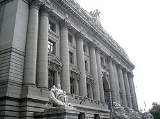
Alexander Hamilton U.S. Custom House

Encyclopedia

New York City
New York is the most populous city in the United States and the center of the New York Metropolitan Area, one of the most populous metropolitan areas in the world. New York exerts a significant impact upon global commerce, finance, media, art, fashion, research, technology, education, and...
, built 1902–1907 by the federal government to house the duty collection operations for the port of New York. It is located near the southern tip of Manhattan
Manhattan
Manhattan is the oldest and the most densely populated of the five boroughs of New York City. Located primarily on the island of Manhattan at the mouth of the Hudson River, the boundaries of the borough are identical to those of New York County, an original county of the state of New York...
, next to Battery Park, at 1 Bowling Green
Bowling Green (New York City)
Bowling Green is a small public park in Lower Manhattan at the foot of Broadway next to the site of the original Dutch fort of New Amsterdam. Built in 1733, originally including a bowling green, it is the oldest public park in New York City and is surrounded by its original 18th century fence. At...
. The building is now the home of the New York branch of the National Museum of the American Indian
National Museum of the American Indian
The National Museum of the American Indian is a museum operated under the auspices of the Smithsonian Institution that is dedicated to the life, languages, literature, history, and arts of the native Americans of the Western Hemisphere...
as well as the Bankruptcy Court for the Southern District of New York.
Architecture
The building was designed by Minnesotan Cass GilbertCass Gilbert
- Historical impact :Gilbert is considered a skyscraper pioneer; when designing the Woolworth Building he moved into unproven ground — though he certainly was aware of the ground-breaking work done by Chicago architects on skyscrapers and once discussed merging firms with the legendary Daniel...
, who later designed the Woolworth Building
Woolworth Building
The Woolworth Building is one of the oldest skyscrapers in New York City. More than a century after the start of its construction, it remains, at 57 stories, one of the fifty tallest buildings in the United States as well as one of the twenty tallest buildings in New York City...
, which is visible from the building's front steps. The selection of Gilbert to design the building was marked with controversy. Until 1893 federal office buildings were designed by government architects under the Office of the Supervising Architect
Office of the Supervising Architect
The Office of the Supervising Architect was an agency of the United States Treasury Department that designed federal government buildings from 1852 to 1939....
of the United States Department of the Treasury
United States Department of the Treasury
The Department of the Treasury is an executive department and the treasury of the United States federal government. It was established by an Act of Congress in 1789 to manage government revenue...
. In 1893 the Tarsney Act permitted the Supervising Architect to hire private architects following a competition. The Supervising Architect James Knox Taylor
James Knox Taylor
James Knox Taylor was Supervising Architect of the United States Department of the Treasury from 1897 to 1912. His name is listed ex officio as supervising architect of hundreds of federal buildings built throughout the United States during the period.-Early career:The son of H...
picked Gilbert who earlier had been his partner at the Gilbert & Taylor architect firm in St. Paul, Minnesota. The scandal never quite blew over and in 1913 the Act was repealed.
It was constructed between 1902 and 1907. It is a masterpiece of the Beaux-Arts style, where public transactions were conducted under a noble Roman dome. It incorporates Beaux Arts and City Beautiful movement
City Beautiful movement
The City Beautiful Movement was a reform philosophy concerning North American architecture and urban planning that flourished during the 1890s and 1900s with the intent of using beautification and monumental grandeur in cities. The movement, which was originally associated mainly with Chicago,...
planning principles, combining architecture, engineering, and fine arts. Lavish sculptures, paintings, and decorations by well-known artists of the time, such as Daniel Chester French
Daniel Chester French
Daniel Chester French was an American sculptor. His best-known work is the sculpture of a seated Abraham Lincoln at the Lincoln Memorial in Washington, D.C.-Life and career:...
(the seated groups of the Four Continents on the front steps), Louis St. Gaudens
Louis St. Gaudens
Louis St. Gaudens , was a significant American sculptor of the Beaux-Arts generation....
and Albert Jaegers
Albert Jaegers
Albert Jaegers was an American sculptor, who moved to Cincinnati, Ohio as a boy...
, embellish the facade, the two-story entry portico, the main hall parallel to the facade, the Rotunda, and the Collector's Reception Room. Sculpture was so crucial to the scheme that the figure groups had independent contracts. Above the main cornice are standing sculptures representing the great seafaring nations, representing American seagoing commerce as the modern heir of the Phoenicians. In 1936, during the Great Depression
Great Depression
The Great Depression was a severe worldwide economic depression in the decade preceding World War II. The timing of the Great Depression varied across nations, but in most countries it started in about 1929 and lasted until the late 1930s or early 1940s...
, the Works Projects Administration commissioned murals for the main rotunda from Reginald Marsh
Reginald Marsh (artist)
Reginald Marsh was an American painter, born in Paris, most notable for his depictions of life in New York City in the 1920s and 1930s. Crowded Coney Island beach scenes, popular entertainments such as vaudeville and burlesque, women, and jobless men on the Bowery are subjects that reappear...
(illustration, right).
The building sits on the site of Fort Amsterdam
Fort Amsterdam
For the historic fort on the island of Saint Martin, see Fort Amsterdam Fort Amsterdam was a fort on the southern tip of Manhattan that was the administrative headquarters for the Dutch and then British rule of New York from...
, the fortification constructed by the Dutch West India Company
Dutch West India Company
Dutch West India Company was a chartered company of Dutch merchants. Among its founding fathers was Willem Usselincx...
to defend their operations in the Hudson Valley
Hudson Valley
The Hudson Valley comprises the valley of the Hudson River and its adjacent communities in New York State, United States, from northern Westchester County northward to the cities of Albany and Troy.-History:...
. The fort became the nucleus of the New Amsterdam
New Amsterdam
New Amsterdam was a 17th-century Dutch colonial settlement that served as the capital of New Netherland. It later became New York City....
settlement, and in turn, of New York City
New York City
New York is the most populous city in the United States and the center of the New York Metropolitan Area, one of the most populous metropolitan areas in the world. New York exerts a significant impact upon global commerce, finance, media, art, fashion, research, technology, education, and...
.
Historic Preservation
The building is on the National Register of Historic PlacesNational Register of Historic Places
The National Register of Historic Places is the United States government's official list of districts, sites, buildings, structures, and objects deemed worthy of preservation...
, and for both exterior and public interior spaces. The Customs House was one of the earliest designations of the New York City Landmarks Preservation Commission, so in 1987 the completion of its preservation, spurred by Senator Daniel Patrick Moynihan
Daniel Patrick Moynihan
Daniel Patrick "Pat" Moynihan was an American politician and sociologist. A member of the Democratic Party, he was first elected to the United States Senate for New York in 1976, and was re-elected three times . He declined to run for re-election in 2000...
who saved the building from demolition in 1979, attracted much public attention: exterior and ceremonial interior spaces were cleaned, restored, and conserved, while old office space was renovated for Federal courtrooms and ancillary offices, for rental offices and meeting rooms, and for a 350-seat auditorium with state-of-the-art projection facilities. Upgrades of fire-safety, security, telecommunications, and heating, air conditioning, and ventilating systems accompanied alterations.
The site was declared a National Historic Landmark
National Historic Landmark
A National Historic Landmark is a building, site, structure, object, or district, that is officially recognized by the United States government for its historical significance...
in 1976.