

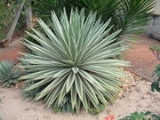
Agave angustifolia

Encyclopedia
Agave angustifolia is a plant
which is native to Mexico
and Central America
. It is used to make mezcal
and also as an ornamental plant
, particularly the cultivar 'Marginata'.
The World Checklist of Selected Plant Families regards Agave angustifolia as an illegitimate synonym for Agave vivipara L.
Other sources maintain them as distinct species with non-overlapping native distributions (García-Mendoza and Fernando Chiang 2003). A. angustifolia has narrow, stiffly erect leaves with moderately-spaced spines, producing capsules, not bulibiferous; whereas A. vivipara is described as having shorter, recurved leaves with short-spaced spines and bulbiferous. A. vivipara is likely similar to A. karatto. The A. vivipara of Miller (1768) and Smith et al. (2008) seem different, of a much smaller habit and narrower leaves, from the A. vivipara of Trelease (1913) and García-Mendoza and Fernando Chiang (2003), of a much larger habit.
Plant
Plants are living organisms belonging to the kingdom Plantae. Precise definitions of the kingdom vary, but as the term is used here, plants include familiar organisms such as trees, flowers, herbs, bushes, grasses, vines, ferns, mosses, and green algae. The group is also called green plants or...
which is native to Mexico
Mexico
The United Mexican States , commonly known as Mexico , is a federal constitutional republic in North America. It is bordered on the north by the United States; on the south and west by the Pacific Ocean; on the southeast by Guatemala, Belize, and the Caribbean Sea; and on the east by the Gulf of...
and Central America
Central America
Central America is the central geographic region of the Americas. It is the southernmost, isthmian portion of the North American continent, which connects with South America on the southeast. When considered part of the unified continental model, it is considered a subcontinent...
. It is used to make mezcal
Mezcal
Mezcal, or mescal, is a distilled alcoholic beverage made from the maguey plant native to Mexico. The word mezcal comes from Nahuatl metl and ixcalli which mean 'oven cooked agave.'...
and also as an ornamental plant
Ornamental plant
Ornamental plants are plants that are grown for decorative purposes in gardens and landscape design projects, as house plants, for cut flowers and specimen display...
, particularly the cultivar 'Marginata'.
The World Checklist of Selected Plant Families regards Agave angustifolia as an illegitimate synonym for Agave vivipara L.
Other sources maintain them as distinct species with non-overlapping native distributions (García-Mendoza and Fernando Chiang 2003). A. angustifolia has narrow, stiffly erect leaves with moderately-spaced spines, producing capsules, not bulibiferous; whereas A. vivipara is described as having shorter, recurved leaves with short-spaced spines and bulbiferous. A. vivipara is likely similar to A. karatto. The A. vivipara of Miller (1768) and Smith et al. (2008) seem different, of a much smaller habit and narrower leaves, from the A. vivipara of Trelease (1913) and García-Mendoza and Fernando Chiang (2003), of a much larger habit.