
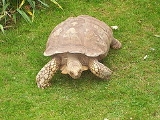
The
African Spurred Tortoise (
Geochelone sulcata), also called the African Spur Thigh Tortoise, is a
speciesIn biology, a species is:* a taxonomic rank or* a unit at that rank ....
of
tortoiseTortoises or land turtles are land-dwelling reptiles of the family of Testudinidae, order Testudines. Like their marine cousins, the sea turtles, tortoises are shielded from predators by a shell. The top part of the shell is the carapace, the underside is the plastron, and the two are connected by...
which inhabits the southern edge of the
SaharaThe Sahara is the world's largest hot desert. At over , it covers most of Northern Africa, making it almost as large as Europe or the United States. The desert stretches from the Red Sea, including parts of the Mediterranean coasts, to the outskirts of the Atlantic Ocean...
desert, in northern
AfricaAfrica is the world's second-largest and second most-populous continent, after Asia. At about 30.2 million km² including adjacent islands, it covers 6% of the Earth's total surface area and 20.4% of the total land area...
. It is the third largest species of tortoise in the world and the largest species of mainland tortoise (not found on an island).
Its
genericGenera is a commercial operating system and development environment for Lisp machines developed by Symbolics. It is essentially a fork of an earlier operating system originating on the MIT AI Lab's Lisp machines which Symbolics had used in common with LMI and Texas Instruments...
name is a combination of two
GreekAncient Greek is the historical stage in the development of the Greek language spanning the Archaic , Classical , and Hellenistic periods of ancient Greece and the ancient world. It is predated in the 2nd millennium BC by Mycenaean Greek...
words:
Geo(γαια) meaning "earth" or "land" and
Chelone(Χελωνη) meaning "
tortoiseTortoises or land turtles are land-dwelling reptiles of the family of Testudinidae, order Testudines. Like their marine cousins, the sea turtles, tortoises are shielded from predators by a shell. The top part of the shell is the carapace, the underside is the plastron, and the two are connected by...
".
The
African Spurred Tortoise (
Geochelone sulcata), also called the African Spur Thigh Tortoise, is a
speciesIn biology, a species is:* a taxonomic rank or* a unit at that rank ....
of
tortoiseTortoises or land turtles are land-dwelling reptiles of the family of Testudinidae, order Testudines. Like their marine cousins, the sea turtles, tortoises are shielded from predators by a shell. The top part of the shell is the carapace, the underside is the plastron, and the two are connected by...
which inhabits the southern edge of the
SaharaThe Sahara is the world's largest hot desert. At over , it covers most of Northern Africa, making it almost as large as Europe or the United States. The desert stretches from the Red Sea, including parts of the Mediterranean coasts, to the outskirts of the Atlantic Ocean...
desert, in northern
AfricaAfrica is the world's second-largest and second most-populous continent, after Asia. At about 30.2 million km² including adjacent islands, it covers 6% of the Earth's total surface area and 20.4% of the total land area...
. It is the third largest species of tortoise in the world and the largest species of mainland tortoise (not found on an island).
Taxonomy and etymology
Its
genericGenera is a commercial operating system and development environment for Lisp machines developed by Symbolics. It is essentially a fork of an earlier operating system originating on the MIT AI Lab's Lisp machines which Symbolics had used in common with LMI and Texas Instruments...
name is a combination of two
GreekAncient Greek is the historical stage in the development of the Greek language spanning the Archaic , Classical , and Hellenistic periods of ancient Greece and the ancient world. It is predated in the 2nd millennium BC by Mycenaean Greek...
words:
Geo(γαια) meaning "earth" or "land" and
Chelone(Χελωνη) meaning "
tortoiseTortoises or land turtles are land-dwelling reptiles of the family of Testudinidae, order Testudines. Like their marine cousins, the sea turtles, tortoises are shielded from predators by a shell. The top part of the shell is the carapace, the underside is the plastron, and the two are connected by...
". Its
specificIn biology, a species is:* a taxonomic rank or* a unit at that rank ....
name
sulcata is from the
LatinLatin is an Italic language originally spoken in Latium and Ancient Rome. Although often considered a dead language, in view of the fact that it has no native, fluent speakers, Latin continues to be taught in schools and has been, and currently is, used in the process of new word production in...
word
sulcus meaning "furrow" and refers to the furrows on the tortoise's scales.
Range and habitat
The African Spurred Tortoise is native to the Sahara Desert and the
SahelThe Sahel is the ecoclimatic and biogeographic zone of transition between the Sahara desert in the North and the Sudanian savannas in the south. It stretches across the north of the African continent between the Atlantic Ocean and the Red Sea...
, a transitional ecoregion of semi-arid grasslands, savannas, and thorn shrublands found in the countries of
Burkina FasoBurkina Faso – also known by its short-form name Burkina – is a landlocked country in West Africa. It is surrounded by six countries: Mali to the north, Niger to the east, Benin to the southeast, Togo and Ghana to the south, and Côte d'Ivoire to the southwest.Its size is 274,000 km² with an...
,
ChadChad , officially known as the Republic of Chad, is a landlocked country in central Africa. It is bordered by Libya to the north, Sudan to the east, the Central African Republic to the south, Cameroon and Nigeria to the southwest, and Niger to the west...
,
EritreaEritrea , officially the State of Eritrea, is a country in the Horn of Africa. It is bordered by Sudan in the west, Ethiopia in the south, and Djibouti in the southeast. The east and northeast of the country have an extensive coastline on the Red Sea, directly across from Saudi Arabia and Yemen...
,
EthiopiaEthiopia is a landlocked country located in the Horn of Africa. Officially known as the Federal Democratic Republic of Ethiopia, it is the second-most populous nation in Africa with over 79.2 million people and the tenth-largest by area with its 1,100,000 km
2. The capital is Addis...
,
MaliMali, officially the Republic of Mali , is a landlocked country in Western Africa. Mali borders Algeria on the north, Niger on the east, Burkina Faso and the Côte d'Ivoire on the south, Guinea on the south-west, and Senegal and Mauritania on the west. Its size is just over 1,240,000 km² with a...
,
MauritaniaMauritania , officially the Islamic Republic of Mauritania, is a country in North Africa. It is bordered by the Atlantic Ocean in the west, by Western Sahara in the north, by Algeria in the northeast, by Mali in the east and southeast, and by Senegal in the southwest...
,
NigeriaNigeria , officially the Federal Republic of Nigeria, is a federal constitutional republic comprising thirty-six states and its Federal Capital Territory, Abuja. The country is located in West Africa and shares land borders with the Republic of Benin in the west, Chad and Cameroon in the east, and...
,
SenegalSenegal , officially the Republic of Senegal , is a country south of the Sénégal River in western Africa.It owes its name to the river that borders it to the East and North and that originates from the Fouta Djallon in Guinea...
and
SudanSudan is a country in northeastern Africa. It is the largest country in Africa, and the Arab World, and tenth largest in the world by area...
In these arid regions the tortoise excavates burrows in the ground to get to areas with higher moisture levels spending the hottest part of the day in these burrows. Burrows may average 30 inches in depth; some dig tunnel systems extending 10 feet or more underground.
Size and lifespan
The Sulcata is the third largest species of tortoise in the world after the
Galapagos tortoiseThe Galápagos tortoise or Galápagos giant tortoise is the largest living tortoise, native to seven islands of the Galápagos archipelago. Fully grown adults can weigh over and measure long. They are long-lived, with a life expectancy in the wild estimated to be 100–150 years...
, and
Aldabra Giant TortoiseThe Aldabra Giant Tortoise , from the islands of the Aldabra Atoll in the Seychelles, is one of the largest tortoises in the world....
; and the largest of the mainland tortoises. Adults are usually 18 inches (45 cm) in shell length, and weigh 70 to 100 pounds. Specimens with 24 to 36 inch long (60-90 cm) shells weighing 150 pounds (70 kg) are not unknown. They grow from hatchling size (2-3 inches) very quickly, reaching 6-10 inches (15-25 cm) within the first few years of their lives. The oldest known of this species was 56 years old although it is believed they can live up to about 80 years.
Breeding
Copulation takes place right after the rainy season, during the months from September through November. Males combat each other for breeding rights with the females and are vocal during copulation.
Sixty days after mating,the female begins to roam looking for suitable nesting sites. For five to fifteen days, four or five nests may be excavated before she selects the perfect location in which the eggs will be laid.
Loose dirt is kicked out of the depression, and the female may frequently urinate into the depression. Once it reaches approximately 2 feet (60 cm) in diameter and approximately 3-6 inches (7-14 cm) deep, a further depression, measuring some eight inches (20 cm) across and in depth, will be dug out towards the back of the original depression. The work of digging the nest may take up to five hours; the speed with which it is dug seems to be dependent upon the relative hardness of the ground. It usually takes place when the ambient air temperature is around 78 F (27 C). Once the nest is dug, the female begins to lay an egg every three minutes. Clutches may contain 15-30 or more eggs. After the eggs are laid, the female fills in the nest, taking an hour or more to fully cover them all.
External links