
|
|
|
|
Advanced Encryption Standard
|
| |
|
| |
In cryptography, the Advanced Encryption Standard (AES) is an encryption standard adopted by the U.S. government. The standard comprises three block ciphers, AES-128, AES-192 and AES-256, adopted from a larger collection originally published as Rijndael. Each AES cipher has a 128 bit block size, with key sizes of 128, 192 and 256 bits, respectively. The AES ciphers have been analyzed extensively and are now used worldwide, as was the case with its predecessor, the Data Encryption Standard (DES).
AES was announced by National Institute of Standards and Technology (NIST) as U.S.

Discussion
Ask a question about 'Advanced Encryption Standard'
Start a new discussion about 'Advanced Encryption Standard'
Answer questions from other users
|
Encyclopedia
In cryptography, the Advanced Encryption Standard (AES) is an encryption standard adopted by the U.S. government. The standard comprises three block ciphers, AES-128, AES-192 and AES-256, adopted from a larger collection originally published as Rijndael. Each AES cipher has a 128 bit block size, with key sizes of 128, 192 and 256 bits, respectively. The AES ciphers have been analyzed extensively and are now used worldwide, as was the case with its predecessor, the Data Encryption Standard (DES).
AES was announced by National Institute of Standards and Technology (NIST) as U.S. FIPS PUB 197 (FIPS 197) on November 26, 2001 after a 5-year standardization process in which fifteen competing designs were presented and evaluated before Rijndael was selected as the most suitable (see Advanced Encryption Standard process for more details). It became effective as a standard May 26, 2002. , AES is one of the most popular algorithms used in symmetric key cryptography. It is available in many different encryption packages. AES is the first publicly accessible and open cipher approved by the NSA for top secret information (see Security of AES, below).
The Rijndael cipher was developed by two Belgian cryptographers, Joan Daemen and Vincent Rijmen, and submitted by them to the AES selection process. Rijndael is a portmanteau of the names of the two inventors and is .
Description of the cipher
AES is fast in both software and hardware, is relatively easy to implement, and requires little memory. Unlike its predecessor DES, which used a Feistel network, the AES cipher is a substitution-permutation network.
AES has a fixed block size of 128 bits and a key size of 128, 192, or 256 bits, whereas Rijndael can be specified with block and key sizes in any multiple of 32 bits, with a minimum of 128 bits and a maximum of 256 bits.
Assuming one byte equals 8 bits, the fixed block size of 128 bits is 128 ÷ 8 = 16 bytes. AES operates on a 4×4 array of bytes, termed the state (versions of Rijndael with a larger block size have additional columns in the state). Most AES calculations are done in a special finite field.
The AES cipher is specified as a number of repetitions of transformations rounds that convert the input plain-text into the final output of cipher-text. Each round consists of several processing steps, including one that depends on the encryption key. A set of reverse rounds are applied to transform cipher-text back into the original plain-text using the same encryption key.
High-level description of the algorithm
- AddRoundKey
- SubBytes—a non-linear substitution step where each byte is replaced with another according to a lookup table.
- ShiftRows—a transposition step where each row of the state is shifted cyclically a certain number of steps.
- MixColumns—a mixing operation which operates on the columns of the state, combining the four bytes in each column
- AddRoundKey—each byte of the state is combined with the round key; each round key is derived from the cipher key using a key schedule.
- Final Round (no MixColumns)
- SubBytes
- ShiftRows
- AddRoundKey
The SubBytes step
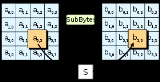
In the SubBytes step, each byte in the array is updated using an 8-bit substitution box, the Rijndael S-box. This operation provides the non-linearity in the cipher. The S-box used is derived from the multiplicative inverse over GF(28), known to have good non-linearity properties. To avoid attacks based on simple algebraic properties, the S-box is constructed by combining the inverse function with an invertible affine transformation. The S-box is also chosen to avoid any fixed points (and so is a derangement), and also any opposite fixed points.
The ShiftRows step
The ShiftRows step operates on the rows of the state; it cyclically shifts the bytes in each row by a certain offset. For AES, the first row is left unchanged. Each byte of the second row is shifted one to the left. Similarly, the third and fourth rows are shifted by offsets of two and three respectively. For the block of size 128 bits and 192 bits the shifting pattern is the same. In this way, each column of the output state of the ShiftRows step is composed of bytes from each column of the input state. (Rijndael variants with a larger block size have slightly different offsets). In the case of the 256-bit block, the first row is unchanged and the shifting for second, third and fourth row is 1 byte, 3 bytes and 4 bytes respectively - although this change only applies for the Rijndael cipher when used with a 256-bit block, which is not used for AES.
The MixColumns step
In the MixColumns step, the four bytes of each column of the state are combined using an invertible linear transformation. The MixColumns function takes four bytes as input and outputs four bytes, where each input byte affects all four output bytes. Together with ShiftRows, MixColumns provides diffusion in the cipher. Each column is treated as a polynomial over GF(28) and is then multiplied modulo with a fixed polynomial . The MixColumns step can also be viewed as a multiplication by a particular MDS matrix in Finite field. This process is described further in the article Rijndael mix columns.
The AddRoundKey step
In the AddRoundKey step, the subkey is combined with the state. For each round, a subkey is derived from the main key using Rijndael's key schedule; each subkey is the same size as the state. The subkey is added by combining each byte of the state with the corresponding byte of the subkey using bitwise XOR.
Optimization of the cipher
On systems with 32-bit or larger words, it is possible to speed up execution of this cipher by combining SubBytes and ShiftRows with MixColumns, and transforming them into a sequence of table lookups. This requires four 256-entry 32-bit tables, which utilizes a total of four kilobytes (4096 bytes) of memory—one kilobyte for each table. A round can now be done with 16 table lookups and 12 32-bit exclusive-or operations, followed by four 32-bit exclusive-or operations in the AddRoundKey step.
If the resulting four kilobyte table size is too large for a given target platform, the table lookup operation can be performed with a single 256-entry 32-bit table by the use of circular rotates.
Using a byte-oriented approach it is possible to combine the SubBytes, ShiftRows, and MixColumns steps into a single round operation.
Security
As of 2006, the only successful attacks against AES implementations have been side-channel attacks. The National Security Agency (NSA) reviewed all the AES finalists, including Rijndael, and stated that all of them were secure enough for US Government non-classified data. In June 2003, the US Government announced that AES may be used to protect classified information:
The design and strength of all key lengths of the AES algorithm (i.e., 128, 192 and 256) are sufficient to protect classified information up to the SECRET level. TOP SECRET information will require use of either the 192 or 256 key lengths. The implementation of AES in products intended to protect national security systems and/or information must be reviewed and certified by NSA prior to their acquisition and use."
Two of NSA's algorithms for protection of TOP SECRET information (BATON and JUNIPER) use 160-bit keys; NSA may simply have required the longer AES key lengths to provide a similar security margin against brute-force attacks.
The most common way to attack block ciphers is to try various attacks on versions of the cipher with a reduced number of rounds. AES has 10 rounds for 128-bit keys, 12 rounds for 192-bit keys, and 14 rounds for 256-bit keys. By 2006, the best known attacks were on 7 rounds for 128-bit keys, 8 rounds for 192-bit keys, and 9 rounds for 256-bit keys.
Cryptographers worry about the security of AES. They feel that the margin between the number of rounds specified in the cipher and the best known attacks is too small for comfort. There is a risk that some way to improve such attacks might be found and then the cipher could be broken. In this meaning, a cryptographic "break" is anything faster than an exhaustive search, thus an attack against a 128-bit-key AES requiring 'only' 2120 operations (compared to 2128 possible keys) would be considered a break even though it would be, at present, quite infeasible. In practical application, any break of AES which is only that "good" would be irrelevant. At present, such concerns can be ignored. The largest successful publicly-known brute force attack has been against a 64-bit RC5 key by distributed.net.
Other debates center around the mathematical structure of AES. Unlike most other block ciphers, AES has a very neat algebraic description. This has not yet led to any attacks. During the AES process, developers of competing algorithms wrote of Rijndael, "...we are concerned about [its] use...in security-critical applications." However, at the end of the AES process, Bruce Schneier, a developer of Twofish, wrote that while he thought academic attacks on Rijndael would be developed someday, "I do not believe that anyone will ever discover an attack that will allow someone to read Rijndael traffic."
In 2002, a theoretical attack, termed the "XSL attack", was announced by Nicolas Courtois and Josef Pieprzyk, showing a potential weakness in the AES algorithm. Several cryptography experts have found problems in the underlying mathematics of the proposed attack, suggesting that the authors may have made a mistake in their estimates. Whether this line of attack can be made to work against AES remains an open question. At present, the XSL attack against AES appears speculative; it is unlikely that the current attack could be carried out in practice.
Side-channel attacks
Side-channel attacks do not attack the underlying cipher and so have nothing to do with its security as described here, but attack implementations of the cipher on systems which inadvertently leak data. There are several such known attacks on certain implementations of AES.
In April 2005, D.J. Bernstein announced a cache-timing attack that he used to break a custom server that used OpenSSL's AES encryption. The custom server was designed to give out as much timing information as possible (the server reports back the number of machine cycles taken by the encryption operation), and the attack required over 200 million chosen plaintexts. Some say the attack is not practical over the internet with a distance of one or more hops; Bruce Schneier called the research a "nice timing attack."
In October 2005, Dag Arne Osvik, Adi Shamir and Eran Tromer presented a paper demonstrating several cache-timing attacks against AES. One attack was able to obtain an entire AES key after only 800 operations triggering encryptions, in a total of 65 milliseconds. This attack requires the attacker to be able to run programs on the same system that is performing AES.
Tadayoshi Kohno wrote a paper entitled "Attacking and Repairing the WinZip Encryption Scheme" showing possible attacks against the WinZip implementation (the zip archive's metadata isn't encrypted).
FIPS validation
The Cryptographic Module Validation Program (CMVP) is operated jointly by the United States Government's National Institute of Standards and Technology (NIST) Computer Security Division and the Communications Security Establishment (CSE) of the Government of Canada. The use of validated cryptographic modules is required by the United States Government for all unclassified uses of cryptography. The Government of Canada also recommends the use of FIPS 140 validated cryptographic modules in unclassified applications of its departments.
Although NIST publication 197 ("FIPS 197") is the unique document that covers the AES algorithm, vendors typically approach the CMVP under FIPS 140 and ask to have several algorithms (such as Triple DES or SHA1) validated at the same time. Therefore, it is rare to find cryptographic modules that are uniquely FIPS 197 validated and NIST itself does not generally take the time to list FIPS 197 validated modules separately on its public web site. Instead, FIPS 197 validation is typically just listed as an "FIPS approved: AES" notation (with a specific FIPS 197 certificate number) in the current list of FIPS 140 validated cryptographic modules.
FIPS validation is challenging to achieve both technically and fiscally. There is a standardized battery of tests as well as an element of source code review that must be passed over a period of several days. The cost to perform these tests through an approved laboratory can be significant (e.g., well over $10,000 US) and does not include the time it takes to write, test, document and prepare a module for validation. After validation, modules must be resubmitted and reevaluated if they are changed in any way.
Test vectors
Test vectors are a set of known ciphers for a given input and key. For example, for the 128-bit key "00010203050607080A0B0C0D0F101112" (16 bytes represented as two hexadecimal characters per byte), and an input "506812A45F08C889B97F5980038B8359" the AES-128 cipher output should be "D8F532538289EF7D06B506A4FD5BE9C9".
Implementations
Libraries Rijndael is free for any use public or private, commercial or non-commercial. The authors of Rijndael used to provide a homepage for the algorithm. Care should be taken when implementing AES in software. Like most encryption algorithms, Rijndael was designed on big-endian systems. For this reason, little-endian systems return correct test vector results only through considerable byte-swapping, with efficiency reduced as a result.
The algorithm operates on plaintext blocks of 16 bytes. Encryption of shorter blocks is possible only by padding the source bytes, usually with null bytes. This can be accomplished via several methods, the simplest of which assumes that the final byte of the cipher identifies the number of Null bytes of padding added.
Careful choice must be made in selecting the mode of operation of the cipher. The simplest mode encrypts and decrypts each 128-bit block separately. In this mode, called "electronic code book (ECB)", blocks that are identical will be encrypted identically. This will make some of the plaintext structure visible in the ciphertext. Selecting other modes, such as empressing a sequential counter over the block prior to encryption (CTR mode) and removing it after decryption avoids this problem.
-
- - Most of these involve a commercial implementation of AES algorithms. Look for "FIPS-approved algorithms" entry in the "Level / Description" column followed by "AES" and then a specific certificate number.
C/ASM library
C++ library
- Botan has implemented Rijndael since its very first release in 2001
- A comprehensive C++ semi-public-domain implementation of encryption and hash algorithms. FIPS validated
-
C# /.NET
Java
JavaScript
- , includes an efficient implementation.
- transparently coded, with counter mode of operation
-
-
- , OpenSSL compatible with CBC operation, and very efficient. MIT Licensed
- , JavaScript and Python implementation. Apache 2.0 Licensed
- , both CTR and CBC mode of operation. ISC Licensed
Delphi
-
-
- David Barton's implementation in Delphi, as part of a suite of hashes and ciphers called : OIS-Certified open source
LISP
- , Common Lisp cryptography library.
- using 8 and 32 bits arithmetic.
-
Other languages
- (Registration required)
- LGPL implementation in PHP supporting 128, 192, and 256-bit keys.
- Program made in Flash to encrypt/decrypt using AES-128.
- A VB5/6 Source-Code (cls) implementation of the AES-Rijndael Block Cipher.
- for Perl
- for Erlang implements AES (binding for Openssl)
- for PHP
- for the D (programming language) implements AES
Applications
Archive and compression tools
Disk encryption
Misc
- OpenSSL includes AES cipher support as of version 0.9.7 (released in 2002) and is dual-licensed under the terms of the OpenSSL License and the original SSLeay license. FIPS validated via IBM
-
- GPG, GPL-licensed, includes AES, AES-192, and AES-256 as options.
-
-
- IronKey Uses AES Encryption
- Pidgin (software) Has a plugin that allows for AES Encryption:
See also
External links
|
| |
|
|